Week 1 HW: Principles and Practices

I propose the development of AI-powered smart clothing and e-textiles that continuously monitor vital signs (heart rate, ECG, glucose levels, sleep patterns) in real time. This technology integrates textile-based sensors with artificial intelligence to enable continuous, non-invasive health monitoring.
Specifically, these sensors are embedded into fabrics, enabling real-time glucose monitoring without invasive procedures like pricking a finger with a lancet for glucose meter readings. They also allow pulse rate monitoring in a more comfortable way, eliminating the need to attach electrodes directly to the skin when wearing a Holter monitor for 24 hours.
AI algorithms improve the accuracy and reliability of collected data, offering valuable insights for managing diabetes and heart disease.
GOVERNANCE GOALS
To create an ethical future for wearable digital health technology (such as AI-driven vital sign monitors), governance policies should address these three key goals:
Goal 1. Protecting User Privacy & Data Security: Wearables collect sensitive biometric personal health data, therefore making strong privacy safeguards is essential and necessary.
Sub-goal 1.1: Enforce Strong Data Encryption
- Implement end-to-end encryption for all health data stored and transmitted by wearables.
- Require data anonymization before any third-party sharing to protect user identity.
Sub-goal 1.2: Establish Transparent Data Ownership & Consent Policies
- Users should ****own their health data and have the ability to opt-in or opt-out of data sharing.
- Companies must provide clear, accessible consent agreements before collecting or using biometric data.
Goal 2. Ensuring Fairness & Accuracy in Health Monitoring: AI algorithms must be reliable, unbiased, and clinically validated.
Sub-goal 2.1: Ensure Clinical Validation & Diverse Testing
- AI-driven health monitoring must undergo rigorous testing across different demographics (age, gender, race, pre-existing conditions).
- Regulatory bodies (e.g., FDA, WHO) must approve AI algorithms before deployment.
Sub-goal 2.2: Maintain Continuous Monitoring & Performance Reviews
- AI models require regular audits to prevent algorithmic drift and performance degradation.
- Independent review boards must evaluate fairness, accuracy, and potential bias in AI-generated health insights.
Goal 3.Promoting Accessibility & Health Equity: Wearable technology should not widen health disparities but instead promote equitable access to digital healthcare.
Sub-goal 3.1: Ensure Affordability & Insurance Coverage
- Governments should incentivize subsidized pricing or insurance coverage for medically necessary AI wearables.
- Encourage public-private partnerships to distribute affordable health monitoring devices in underserved communities.
Sub-goal 3.2: Prevent Corporate Monopolization & Enable Open Standards
- Develop interoperability standards so wearables can work across different healthcare platforms and providers.
- Prevent tech giants from monopolizing AI-driven health monitoring by encouraging open-source development and competition.
By addressing these governance areas—privacy, fairness, accessibility—AI wearable health technology can be ethically deployed to enhance healthcare while preventing harm.
GOVERNANCE ACTIONS
To ensure that wearable digital health technology benefits everyone fairly, safely, and ethically, I propose these three governance actions:
- Mandatory AI Fairness & Clinical Validation
Purpose: Ensure AI algorithms in wearable technologies undergo rigorous clinical validation and standard trials before public use to prevent bias.
Design: Companies must transparently publish their AI accuracy rates and bias mitigation strategies.
Assumption: AI bias can be measured and mitigated through testing across diverse populations.
Success: Achievement of consistent AI accuracy and safety.
Failure:` Companies exploit regulatory loopholes to avoid compliance.
- User Empowerment Action
Purpose: Ensure users can control and delete their personal health data collected by AI wearable technology. Companies must obtain user consent before selling health data to third parties.
Design: Implement a Personal User Dashboard where users can view, download, and delete their health data. All data will automatically expire after 6 years of cloud storage.
Assumption: Users will actively manage their collected data.
Success: Aligns with ethical principles to prevent data breaches and builds trust in AI wearable technology.
Failure: Companies might create an overly complex Personal User Dashboard interface. Users may not grasp the importance of privacy controls, particularly when the technology is first introduced.
- Economic Policy Action
Purpose: Ensure AI-driven health monitoring wearables remain accessible and affordable for all members of the public, particularly low-income and elderly populations, rather than becoming luxury products.
**Design:** Establish partnerships with public health programs and nonprofit organizations to distribute products at reduced costs. Implement tax incentives for companies producing affordable, FDA-approved AI-driven health monitoring wearables.
Assumption: Companies will utilize tax incentives responsibly, and public health programs and NGOs will participate in partnership opportunities.
Success: Reduced urgent care and hospital expenditures.
Failure: Program sustainability may be compromised if companies cannot maintain quality standards.
SCORING CHART & KEY
Below is a detailed scoring chart that evaluates each governance action against the policy goals using specific criteria:
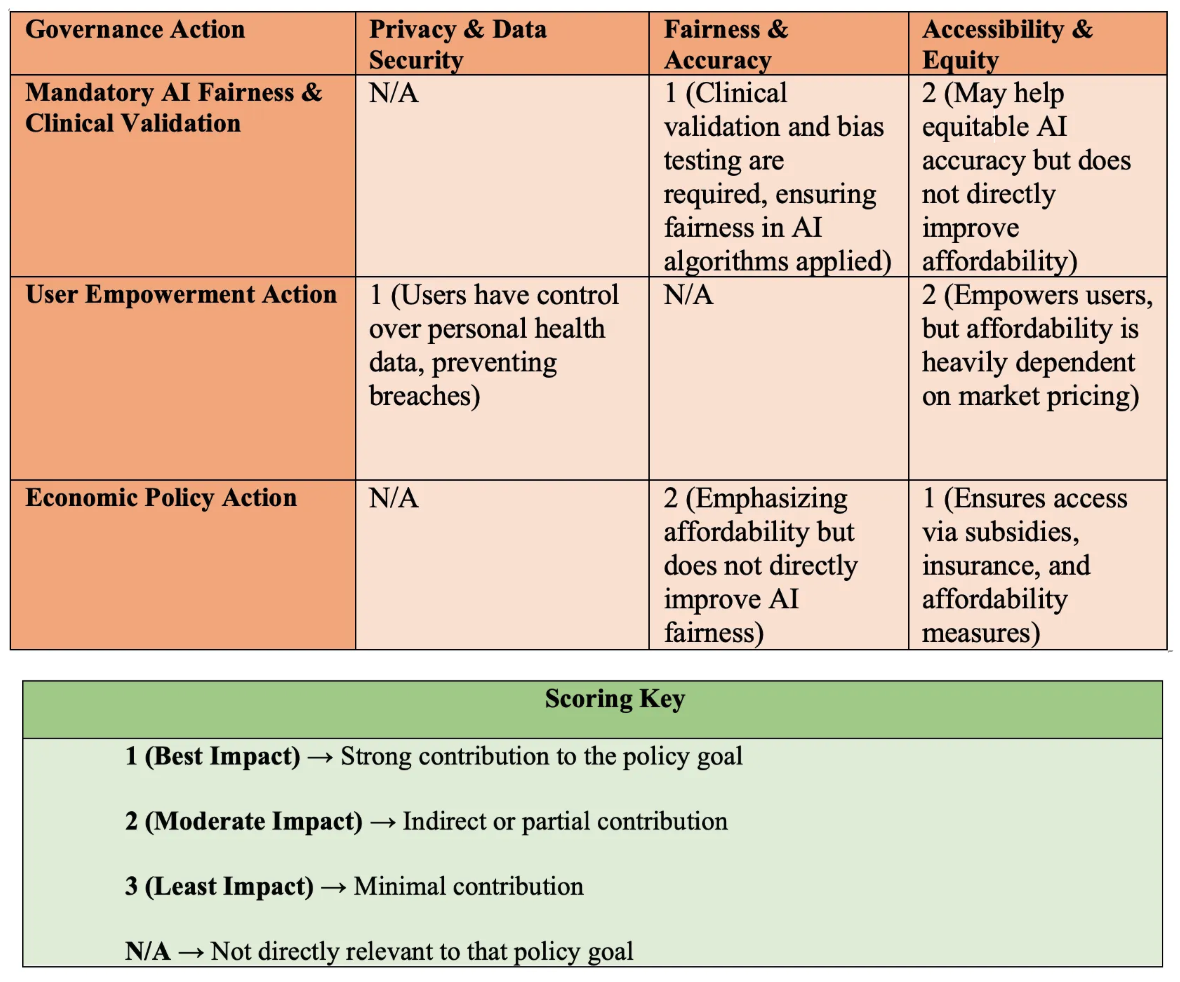
GOVERNANCE PRIORITIES FOR AI-POWERED SMART CLOTHING & E-TEXTILES
To ensure ethical and accessible AI-driven wearables, I recommend a combined approach focusing on User Empowerment and Economic Policy, with AI Fairness & Clinical Validation as a secondary priority.
1. User Empowerment (High Priority – Privacy & Control)
Ensures users control their biometric data, building trust in AI wearables.
Trade-off: Users may struggle to understand privacy settings, requiring education efforts.
2. Economic Policy (High Priority – Accessibility & Affordability)
Promotes affordability through subsidies, insurance, and tax incentives to prevent exclusivity.
Trade-off: Risk of companies exploiting tax incentives without ensuring affordability.
3. AI Fairness & Clinical Validation (Moderate Priority – Accuracy & Bias Reduction)
Ensures AI reliability and fairness through clinical validation and transparency.
Trade-off: Regulatory delays may slow innovation, and companies may resist compliance.
Key Assumptions & Challenges
Users will engage with privacy controls but may need guidance.
Regulatory bodies can audit AI fairness without excessive costs.
Governments and non-profits will support affordability programs.
Industry leaders may resist open standards to maintain market control.
Target Audience
Multinational Industry Leaders & U.S. Federal Agencies (FDA, FTC, NIH)
FTC (Federal Trade Commission): Enforce privacy standards.
FDA (The Food and Drug Administration): Require AI clinical validation.
NIH (National Institutes of Health): Funding and research support
Industry Consortia: Develop open standards and affordability initiatives.
By combining privacy safeguards, affordability policies, and fairness regulations, this approach ensures ethical, accessible, and reliable AI-powered smart clothing & e-textiles while balancing innovation with consumer protection.