Throughout the term each student defines and executes an Individual Final Project and then presents their work
before the class as a culmination of their semester. This applies to all students including local for-credit MIT/Harvard
students as well as the Global “Committed Listeners” who present their projects on Zoom to the Course Instructors, Lecturers and
Teaching Staff (note that this presentation is one of the requirements for Committed Listeners to earn a Certificate of
Completion for the course).
Info
May 12, 2026: MIT / Harvard Individual Final Project Presentations (~3 Hours)
May 13, 2026: Global Committed Listener Individual Final Project Presentations (~9-12 Hours)
In addition, all students have the opportunity to contribute to the Group Final Project, a collaborative effort
towards a significant research result which runs through the term and sometimes beyond.
Project brief & stages — 2025 continues from 2024’s effort
Subsections of Final Projects
Individual Final Project
For your Individual Final Project, write up your project and results on your HTGAA webpage following the guidelines below.
You will present your project from that online writeup; presentations should be 6 minutes for MIT/Harvard students and 3 minutes
for Global Committed Listeners, with 1-2 minutes of questions and discussion following.
Important Dates
Feb 25, 2026: Share 3 Individual Final Project ideas (1 slide each, in Google slide deck to be provided) Mar 18, 2026: Finalize Individual Final Project topic; send TAs Twist designs Apr 30 & May 1, 2026: Final project open Lab sessionn #1 (MIT/Harvard) May 7 & 8, 2026: Final project open Lab sessionn #2 (MIT/Harvard) May 12, 2026: MIT / Harvard Individual Final Project presentations (~3 Hours) May 13, 2026: Global Committed Listener Individual Final Project presentations (~9-12 Hours)
Links:
Links will be available later in the semester:
(Signup sheets for a presentation slot)
(A schedule of MIT/Harvard TA availability for lab work)
(Signup sheet for MIT/Harvard Lab slots)
SECTION 1: ABSTRACT
1. Provide an abstract/summary for your project. (minimum 150 words)
Self-contained description of the project
Should contain a brief outline of:
Significance
Broad objectives
Hypotheses
Specific aims
Methods to be employed
Use lay language (i.e., understandable by the general public) as much as possible
SECTION 2: BACKGROUND
Provide background information and research for your final project. This should describe the current state of knowledge related to your project and should include a critical evaluation of the literature that identifies the gap in knowledge that this project will fill. Explain the larger context of your project area. What are the challenges and obstacles related to your project? What problem(s) are you seeking to address?
Cite at least 2 peer-reviewed research papers. Include any figures or visuals to help assist in explaining the background of your project area.
(min. 2 paragraphs)
SECTION 3: VISION and IMPACT
3a. Introduce the vision and impact of your final project. (min. 1-2 paragraphs) What is the overall vision and goal of your project? How will the world be different if your project is successful? Include figures and visuals as appropriate.
Examples of topics to discuss
How your project solves a pressing problem in the world
Importance of the problem it solves or the critical barrier(s) to progress in the field that the proposed project addresses
The ways in which it contributes to the larger society
How the proposed project will improve scientific knowledge, technical capability, and/or clinical practice in one or more broad fields
How the concepts, methods, technologies, treatments, services, or preventative interventions that drive this field will be changed if the proposed aims are achieved
3b. Describe how your project is innovative (min. 3 sentences)
Examples of topics to discuss
Novel applications, usage, or development of theoretical concepts, approaches, methodologies, instrumentation, and/or interventions
How it challenges current theories, paradigms, or ways in which technology/biological tools are used
How your project pushes the boundaries of synthetic biology
3c. Describe the bioethical considerations involved in your project. (min. 2 paragraphs)
First paragraph: Include what ethical implications are involved in your project. Try to suggest ethical the principle(s) you may apply (e.g. non-maleficence, justice)?
Second paragraph: Describe the measures that should be taken to ensure that your project is ethical (both in how the research is conducted and in its broader implications for society). You may wish to answer the following questions:
What action(s) do you propose?
What are potential unintended consequences of your proposed actions?
What could you have wrong (e.g., incorrect assumptions and uncertainties)?
What are alternatives to your proposed actions?
SECTION 4: PROJECT AIMS
Outline three aims of your final project (min. 3 sentences, at least one for each aim)
The first aim should be structured “The first aim of my final project is to [insert an achievable experimental goal that encompasses your project] by utilizing [insert protocols/tools/strategies you will use to achieve your goal]”
State or link any methods/experimental protocols/OpenTrons protocols/DNA or protein designs/protein design tools or models/Twist orders you will use
You will provide a detailed, step-by-step outline of how you will achieve your goal for the first aim in the experimental design portion of this assignment (i.e., in question 7)
Feel free to run your goal by a TA
The second aim should be a medium-term aim that is a follow-up to your first aim and focused on goals beyond this class, building toward your third, visionary aim
For example, your second aim may be to successfully execute a set of experimental protocols, solve a specific problem, or develop a specific technology building upon the goals of your first aim.
The third aim should be a visionary, long-term aim
Reveal how the larger goal of the project can be impactful
Examples: challenging an existing paradigm or clinical practice, addressing a critical barrier to progress in the field, describing how you envision a new technology to change how a certain type of research is conducted
SECTION 5: EXPERIMENTAL DESIGN
Share a detailed experimental plan for your final project. Include a timeline for each part of your experimental plan (i.e., how long you would expect each step in your final project to take). (min. 15 lines/sentences—a numbered list is acceptable)
Include specific methods/tools/technologies/biological concepts for each part of the final project and analysis
Include any details related to any DNA designs and explain your design choices
This section will be used to determine whether the experiments are well designed, feasible, and likely to succeed in testing your hypothesis
Often this section is broken into discrete tasks/sub-aims
For each experiment and/or analysis, include a description of your expected results
If possible, include figure(s) that visually shows a broad workflow of your project or a specific aspect of your experimental plan
SECTION 6: RESULTS
Share the experimental results of your project. Include figures, tables, graphs, etc. to represent your experimental work. What did you measure and what were the results of those measurements? These results can be from lab work, computational methods, etc.
Here is a non-exhaustive list of areas where you can provide results:
Performing a PCR reaction using primers relevant to your final project
Performing a Gibson assembly relevant to your final project
Designing DNA relevant to your final project
Creating and performing a cell-free assay related to your final project
Creating and running a code to validate an aspect of your final project
Developing a model or completing a computational analysis relevant to your project
Designing DNA construct(s) that can express at least one gene of interest, ordering it (via Twist), and testing of the expression of the construct(s) (potentially using an OpenTrons robot)
In the event you were unable to run certain experiments, please share your expected results. What kind of data were you hoping to get and why? Show an example data set or plot for reference (this could be from the literature or something you draw or plot).
SECTION 7: DISCUSSION AND FUTURE WORK
7a. Discussion (2 paragraphs minimum). Interpret your results. What worked? What didn’t? What data met your expectations? What did not go as planned and why do you think it didn’t work?
Discuss any other aspects of your project here as well. What were foreseen and/or unforeseen challenges? What strategies did you employ, or will you employ, to overcome these challenges?
7b. Future Work (1 paragraph minimum).
What are the next immediate steps you would like to take? What is your short term future work? What is your medium and long term future work? How do these plans relate to your aims?
SECTION 8: TECHNIQUES, TOOLS, AND TECHNOLOGY
8. We discussed and practiced various techniques related to synthetic biology throughout the semester. Place a check next to the techniques relevant to your project.
Chassis Selection (e.g., DH5α, Bl21-DE3 for expression)
Registry of Standard Biological Parts
FreeGenes
Plasmid Preparation
Bacterial Culturing
Quality Control / Analysis
Bacterial Processing (e.g., Centrifugation, Lysis, DNA Purification)
Cell-Free System
Cell-Free Reactions
Freeze-Dried Cell-Free Systems
NEB Express Kits
miniPCR Tools
Gibson Assembly
Primer Design or Selection
PCR Reactions
Gibson Assembly
Other Cloning Methods (e.g., Restriction Enzyme Digestion or Gateway Cloning)
Creating Twist Order
9. Expand upon two techniques you checked in the previous question by describing how you would utilize those techniques in your final project. (min. 4 sentences
SECTION 9: ADDITIONAL INFORMATION
10a. List all references cited in this assignment (bullet-point list)
10b. Create a supply list and budget for your project (bullet-point list)
What supplies, equipment, and budget is needed for your project to work?
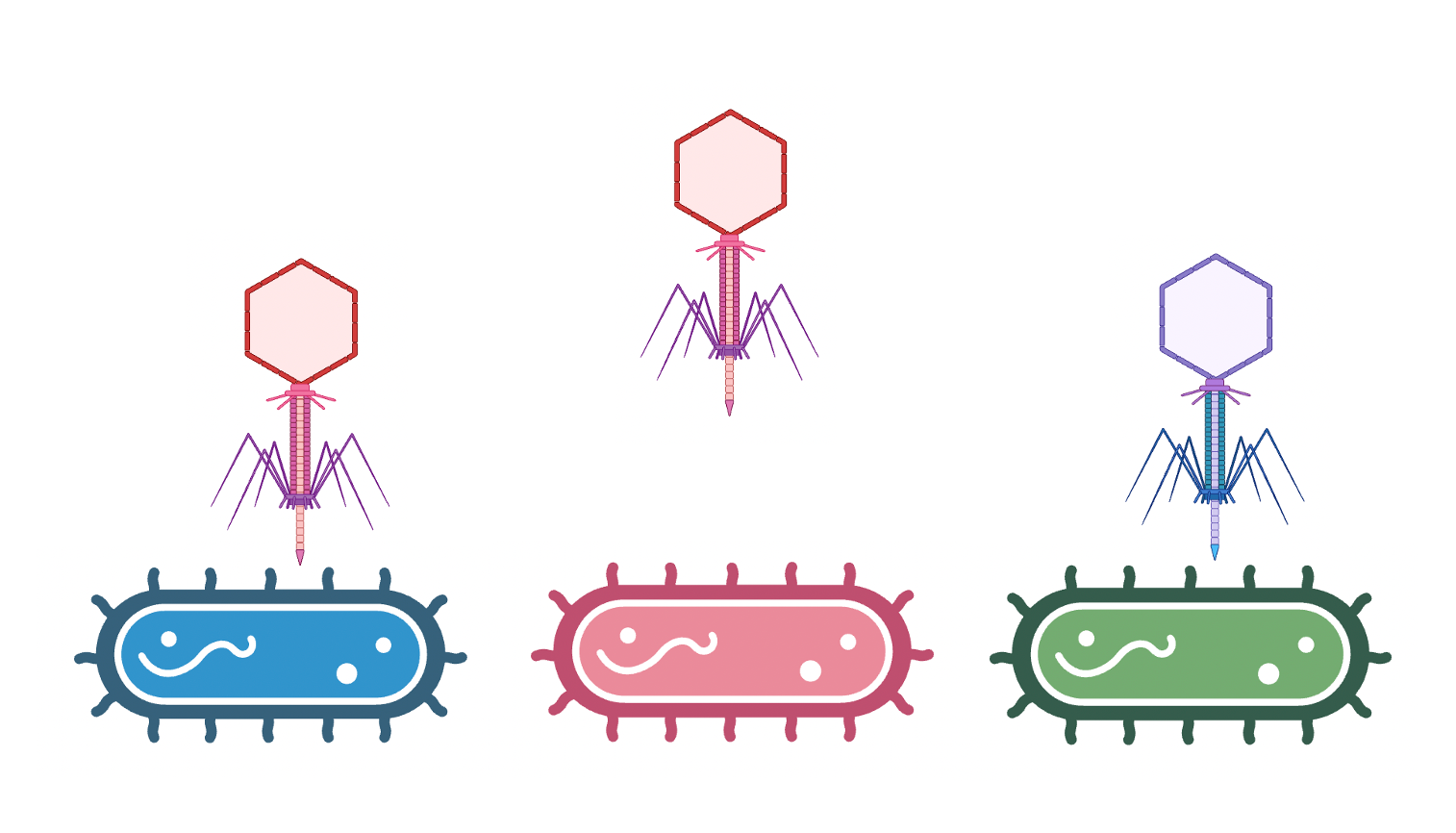
Phage therapy is the therapeutic use of bacteriophages to treat bacterial infections. Bacteriophages, or phages, are viruses that infect bacteria. They are highly specific, often infecting only a single strain of bacteria. Because of this specificity, phage therapy has potential advantages over traditional antibiotic treatment, which can kill beneficial bacteria along with the harmful ones. Phage therapy is seen as a solution to the problem of antibiotic resistance, which is becoming prevalent worldwide. At the current trend, in 26 years, the number of deaths attributed to antibiotic resistance are projected to become comparable with the number of deaths caused by cancer.
This project represents our HTGAA large-scale group research effort, where every participant has the opportunity to contribute to state-of-the-art research using advanced techniques. The potential impact of this work is significant, with the potential to make a real difference in people’s lives. For instance, consider the Patterson story, which highlights the transformative power of phage therapy. This Group Final Project is not just about academic advancement, but about making a tangible difference in the global fight against antibiotic resistance.
As evidenced in the Patterson story, a significant challenge in phage therapy is the ability of bacteria to rapidly develop resistance to the phages. In Patterson’s case, the initial phage cocktail became ineffective after a few days. Consequently, another cocktail was developed and administered. Once again, it became ineffective after a short period. It was not until the third cocktail was introduced that the patient was finally cured. This highlights the need for continual monitoring and adaptation in phage therapy, reflecting the dynamic nature of bacterial resistance.
You can find a detailed introduction into bacteria, phages and phage therapy in our HTGAA Bootcamp Part 1
The Group Final Project
Despite the great advantages of phage therapy over conventional antibiotics, bacteriophages have a major limitation: Bacteria can develop ways to defend themselves against the phages and become resistant. But, in contrast to the static nature of antibiotics, phages have the power to evolve too. For billions of years, there has been an arms race between phages and bacteria. But now, with the development of new tools in synthetic biology such as protein engineering and the synthesis of new genomes harboring advantageous mutations, we can try to give the phages a head start. We attempt this by engineering their DNA or RNA, so they are prepared in case they encounter bacteria developing a resistance. This is the overall goal of the group final project. Specifically, we want to engineer the bacteriophage MS2 to be more prepared and more efficient in killing its host bacteria Escherichia coli (E. coli).
MS2 bacteriophage
MS2 bacteriophages infect E. coli bacteria with a high specificity. It is a very small virus consisting of coat proteins, a maturation protein and genetic material. They infect bacteria by attaching to the F-pilin protein on the host cell membrane and entering the cell. Once inside, the viral RNA acts as a messenger for phage protein production. All proteins for virion assembly are translated and the virus RNA is replicated. Next, new viruses form by assembling the coat and maturation proteins and encapsulating the virus RNA. Finally, a lysis protein expressed from the viral RNA triggers bacterial lysis by causing cell wall breakdown, whereby the new phages are released into the environment to infect new bacteria.
Empowering MS2 in their fight against E. coli
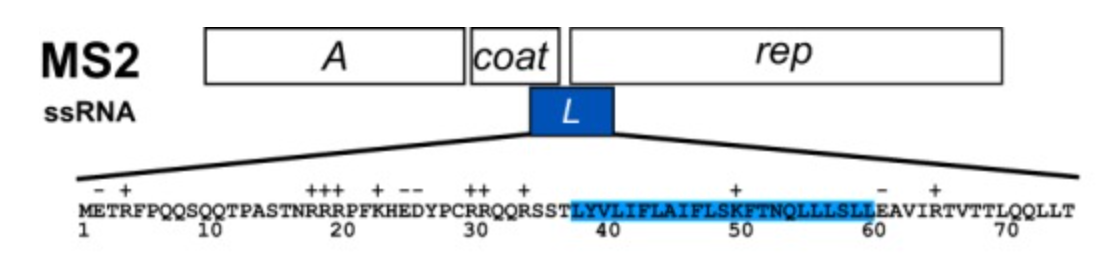
To make phages stronger against their host and to prepare them against host resistance, we can introduce mutations into their genes to slightly change the structure and/or function of the encoded proteins. Four genes are present on the MS2 RNA: 1. the maturation protein (A), 2. the coat protein (coat), 3. the lysis protein (L) and 4. the replicase (rep). For this course, we focus on the L gene encoding the lysis protein.
The exact function of the L protein is unknown, however, it is thought to form oligomers that can then integrate into the cell membrane to form pores, which ultimately lyse and kill the bacterial cell. This lysis protein is crucial for the phage to complete its life cycle and release new phages to infect more bacteria. Because of its importance, E. coli can try to intervene in the lysis protein production to stop the spread of the phages. For the translation and processing of the viral proteins, the phage heavily relies on the bacterial protein machinery. One example for such a protein is DnaJ, a chaperone responsible for proper protein folding, which has been shown to be important for MS2 lysis protein processing. E. coli can mutate this chaperone, preventing the lysis protein from interacting with DnaJ. This in turn causes the lysis protein to lose its function and stops MS2 from infecting more bacteria.
In this project, we want to engineer the lysis protein to increase the ability of MS2 to overcome potential E. coli resistance. We can attempt this by mutating the lysis protein to change its properties. Together, we aim for finding mutations that change the lysis protein one of the following ways: (1) an independence of lysis protein processing from DnaJ or other bacterial chaperones and (2) a faster or more efficient killing of E. coli to reduce the window in which the host can acquire resistance. In the course of this class, we will proceed through the following stages to create and test new MS2 phage mutants:
Stage 2: Synthesize the L protein mutant gene via Twist
Stage 3: Clone the L protein mutant gene into a plasmid using Gibson Assembly
Stage 4: Test the L protein mutant’s structural integrity using the Nuclera system
Stage 5: Test the L protein in E. coli (details will follow)
With this group project, each student will have the opportunity to actively contribute to authentic scientific research that will advance scientific knowledge and could potentially have an impact on people’s lives.