This week lays the foundation for ethics, safety, and governance in biotechnology — and we get hands-on with lab basics.
Lecture (Tues, Feb 3) The Lecture recording will be posted here when Zoom releases it.
Recitation (Wed, Feb 4) The Recitation recording and recitation slides will be posted here when Zoom releases it.
if I have [words in brackets] does it freak out?
I need words around it to see
I need words around it to see no inline
some text
words in caption words1
words in caption words2
Subsections of Weeks
Week 1 — Principles & Practices
This week lays the foundation for ethics, safety, and governance in biotechnology — and we get hands-on with lab basics.
Lecture (Tues, Feb 3)
The Lecture recording will be posted here when Zoom releases it.
Recitation (Wed, Feb 4)
The Recitation recording and recitation slides will be posted here when Zoom releases it.
Make sure to document every step of the in-silico and lab experiments. Make sketches, screenshots, notes, drawings - anything that helps you - and others understand the experiment.
Your Documentation should help you - and others - to understand the topic. Don’t be afraid to add things that don’t work. Show your failures - and how you did overcome them. Your Documentation should be a description of the amazing journey you are on!
Class Assignment
First, describe a biological engineering application or tool you want to develop and why. This could be inspired by an idea for your HTGAA class project and/or something for which you are already doing in your research, or something you are just curious about.
Next, describe one or more governance/policy goals related to ensuring that this application or tool contributes to an “ethical” future, like ensuring non-malfeasance (preventing harm). Break big goals down into two or more specific sub-goals. Below is one example framework (developed in the context of synthetic genomics) you can choose to use or adapt, or you can develop your own. The example was developed to consider policy goals of ensuring safety and security, alongside other goals, like promoting constructive uses, but you could propose other goals for example, those relating to equity or autonomy.
Next, describe at least three different potential governance “actions” by considering the four aspects below (Purpose, Design, Assumptions, Risks of Failure & “Success”). Try to outline a mix of actions (e.g. a new requirement/rule, incentive, or technical strategy) pursued by different “actors” (e.g. academic researchers, companies, federal regulators, law enforcement, etc). Draw upon your existing knowledge and a little additional digging, and feel free to use analogies to other domains (e.g. 3D printing, drones, financial systems, etc.).
Purpose: What is done now and what changes are you proposing?
Design: What is needed to make it “work”? (including the actor(s) involved - who must opt-in, fund, approve, or implement, etc)
Assumptions: What could you have wrong (incorrect assumptions, uncertainties)?
Risks of Failure & “Success”: How might this fail, including any unintended consequences of the “success” of your proposed actions?
Next, score (from 1-3 with, 1 as the best, or n/a) each of your governance actions against your rubric of policy goals. The following is one framework but feel free to make your own:
Your context:
Does the option:
Option 1
Option 2
Option 3
Enhance Biosecurity
• By preventing incidents
• By helping respond
Foster Lab Safety
• By preventing incident
• By helping respond
Protect the environment
• By preventing incidents
• By helping respond
Other considerations
• Minimizing costs and burdens to stakeholders
• Feasibility?
• Not impede research
• Promote constructive applications
Last, drawing upon this scoring, describe which governance option, or combination of options, you would prioritize, and why. Outline any trade-offs you considered as well as assumptions and uncertainties. For this, you can choose one or more relevant audiences for your recommendation, which could range from the very local (e.g. to MIT leadership or Cambridge Mayoral Office) to the national (e.g. to President Biden or the head of a Federal Agency) to the international (e.g. to the United Nations Office of the Secretary-General, or the leadership of a multinational firm or industry consortia). These could also be one of the “actor” groups in your matrix.
Weekly Assignment
Reflecting on what you learned and did in class this week, outline any ethical concerns that arose, especially any that were new to you. Then propose any governance actions you think might be appropriate to address those issues. This should be included on your class page for this week.
Final Project Assignment
As part of your final project, design one or more strategies to ensure that your project, and what it enables, contributes to growing an ethical biological future.
Synthetic Genomics: Options for Governance This is an older but useful report for thinking about a variety of options for the governance of biotechnology that inspired this week’s homework
National Security Commission on Emerging Biotechnology: This U.S. Congressional Commission will produce its first “comprehensive” report at the end of 2024 but has an “interim” 2023 report posted now, and they are currently soliciting input to guide national policy regulating biotech
iGEM 2020 Safety Hub: This page includes links to many useful resources including the WHO biosafety manual, the NIH guidelines and the CDC Biosafety in Microbial and Biomedical Laboratories Guide; additional information is available on the iGEM 2023 Responsibility page
Handbook for Community Biology Spaces: A handbook co-developed by community biolobabs, designed as a living document that can be updated and expanded by the community over time
DIYBio Ask a biosafety expert This page includes a portal where you can get your biosafety questions answered by professionals
Rooftop Solar and the Four Levers of Social Change: A blog post from Ethan Zuckerman considering different types of ways of regulating behavior, adopted in part from Lawrence Lessig’s book: Code 2.0, and explored in the context of energy consumption and production
Subsections of Week 1 (Feb 3)
Lab — Introduction to Pipetting and Dilutions
Overview
Objective
Welcome to HTGAA! This is our very first lab, and in this lab we will introduce students to the foundational techniques of pipetting and serial dilutions, critical for precise liquid handling and solution preparation in biological and chemical experiments.
This is a one-day lab with two protocols covered on mixing colors and dilution. By the end of the lab, students will confidently use pipettes, prepare solutions with desired concentrations, and troubleshoot common errors in pipetting.
Concepts Learned & Skills Gained
Students will:
Understand Units and Conversions: moles (mol), molarity (M), and conversions between µL, mL, and L.
Perform Serial Dilutions: Learn the stepwise dilution process to achieve specific solution concentrations.
Gain Pipetting Proficiency: Operate P20, P200, and P1000 pipettes accurately for volume transfers.
Visualize Mixing Outcomes: Use colors and absorbance measurements to observe concentration gradients.
Pre-Lab
Reading
Key Definitions
Here are some key definitions we’d like you to know before you get started.
Moles (mol): A unit representing $6.022 \times 10^{23}$ particles (atoms, molecules, etc.).
Molarity (M): Concentration defined as moles of solute per liter of solution (mol/L).
Conversions:
1 L = 1000 mL = 1,000,000 μL
1 M = 1000 mM = 1,000,000 μM
Planning Your Experiments
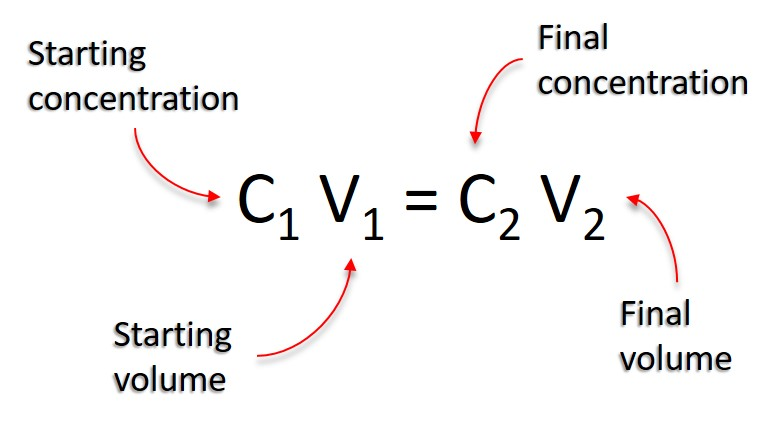
To calculate the volume of water needed for a dilution, use the formula: $$C_1 V_1 = C_2 V_2$$
$C_2$ : Final concentration (desired concentration).
$V_2$ : Final volume (total volume of the diluted solution).
Steps:
Rearrange the formula to calculate $V_1$: $$ V_1 = \frac{C_2 V_2}{C_1} $$
Calculate the volume of water (let’s call it $V_Water$) to add: $$ V_Water = V_2 - V_1 $$
Practice
Dilution Practice 1
Scenario: The stock concentration of a mystery substance (MS) is 5 M. Calculate how to dilute to 100 µM (0.1 mM):
Use sequential 1:499 and 1:99 dilution steps for accurate preparation.
Step 1: Dilute 5 M (5,000,000 µM) to 10,000 µM (500x dilution).
Step 2: Dilute 10,000 µM to 100 µM (100x dilution).
Dilution Practice 2
The stock concentration of a mystery substance (MS) is 5 M.
If the molar mass of MS is 532 g/mol, what’s the concentration of the stock concentration in g/mL? To make your life easier, you can use one of many online calculators.
You will perform a serial dilution to get 100 uM of MS. Devise a plan to dilute a 5 M MS solution to 100 uM. How many dilution steps will we need? Which tubes should we use? Which pipettes?
Fill out the following chart to prepare a final reaction with 60 uL reaction volume. Why did we make 100 uM MS if we actually need 40 uM MS? Why not prepare 40 uM in serial dilutions?
Reagent
Stock concentration
Desired concentration
Volume
Loading dye
6X
1X
MS
100 uM
40 uM
dH2O
n/a
n/a
Note
Please fill this out before coming to lab.
Additional resources
You must watch or be able to understand the following videos:
Mysterious substance (food coloring with water), henceforth: MS
Red, Blue and Yellow food coloring solutions
Gel loading dye (commonly used reagents for loading gels, strong purple color)
Part 1: Mixing Color
Prepare tubes with red, yellow, and blue food coloring solutions OR watercolor
Take ten tubes and mark them with numbers 1 to 6
Tube 1, 2 and 3: add 500 uL each red, yellow, and blue solution to the tube.
Tube 4: add 220 uL red solution to the tube, and add 220 uL yellow solution.
Try adding this in 2 steps: add 200 uL first, and then 20 uL. Discard your tips after you add one color!
Tube 5: add 525 uL yellow solution to the tube, and add 525 uL blue solution.
Tube 6: add 155 uL red solution to the tube, and add 155 uL blue solution.
Now you have a rainbow! You can try mixing other colors with the solutions.
Try plating different volumes (e.g. 1uL, 2uL, 5uL, 10uL) on a petri plate to make some designs and build your intuitive understanding of these volumes.
Part 2: Performing Serial Dilution
Perform serial dilutions to get 100 uM (0.1 mM) of MS.
Every time you mix in liquid, pipette up and down three or four times to ensure the two liquids are mixed thoroughly.
Mark each tube with its respective concentration using a pen.
Prepare a final reaction of 60 uL based on your table in the pre-lab.
Bonus: Take 20 uL from the final reaction and pipette it to a pre-prepared gel well. Wells are a bit trickier because they are thin and your pipette tip will puncture the gel if you’re not careful. Be gentle!
Lysis protein DNA sequence
```
atggaaacccgattccctcagcaatcgcagcaaactccggcatctactaatagacgccggccattcaaacatgaggattacccatgtcgaagacaacaaagaagttcaactctttatgtattgatcttcctcgcgatctttctctcgaaatttaccaatcaattgcttctgtcgctactggaagcggtgatccgcacagtgacgactttacagcaattgcttacttaa
```
stop
Lysis protein DNA sequence `atggaaacccgattccctcagcaatcgcagcaaactccggcatctactaatagacgccggccattcaaacatgaggattacccatgtcgaagacaacaaagaagttcaactctttatgtattgatcttcctcgcgatctttctctcgaaatttaccaatcaattgcttctgtcgctactggaagcggtgatccgcacagtgacgactttacagcaattgcttacttaa`
stop
Lysis protein DNA sequence atggaaacccgattccctcagcaatcgcagcaaactccggcatctactaatagacgccggccattcaaacatgaggattacccatgtcgaagacaacaaagaagttcaactctttatgtattgatcttcctcgcgatctttctctcgaaatttaccaatcaattgcttctgtcgctactggaagcggtgatccgcacagtgacgactttacagcaattgcttacttaa
stop
Lysis protein DNA sequence with Codon-Optimization

`ATGGAAACCCGCTTTCCGCAGCAGAGCCAGCAGACCCCGGCGAGCACCAACCGCCGCCGCCCGTTCAAACATGAAGATTATCCGTGCCGTCGTCAGCAGCGCAGCAGCACCCTGTATGTGCTGATTTTTCTGGCGATTTTTCTGAGCAAATTCACCAACCAGCTGCTGCTGAGCCTGCTGGAAGCGGTGATTCGCACAGTGACGACCCTGCAGCAGCTGCTGACCTAA`
Lysis protein DNA sequence with Codon-Optimization ATGGAAACCCGCTTTCCGCAGCAGAGCCAGCAGACCCCGGCGAGCACCAACCGCCGCCGCCCGTTCAAACATGAAGATTATCCGTGCCGTCGTCAGCAGCGCAGCAGCACCCTGTATGTGCTGATTTTTCTGGCGATTTTTCTGAGCAAATTCACCAACCAGCTGCTGCTGAGCCTGCTGGAAGCGGTGATTCGCACAGTGACGACCCTGCAGCAGCTGCTGACCTAA
stop
Lysis protein DNA sequence with Codon-Optimization