2026a-mine-arbay
title: Mine Ozoguz Arbay
HTGAA Spring 2026' type: home
Original visual identity
title: Mine Ozoguz Arbay
Original visual identity
I am Mine Özoğuz Arbay, PhD, an Assistant Professor in Interior Architecture and Environmental Design.
My research and teaching explore biodesign, bio-based material systems, and color–light interactions as tools for experimental and sustainable design thinking.
My work focuses on understanding design as a research-driven and process-oriented practice, where materials—especially living and time-based systems—are not merely shaped, but cultivated, observed, and interpreted.
This website documents my academic and experimental work during HTGAA Spring 2026, with a particular emphasis on:
During this term, my work is structured around research-based design exploration, addressing the following themes:
Rather than presenting finalized outcomes, the emphasis is placed on process transparency, experimental rigor, and reflective analysis.
This section includes weekly reflections, reading responses, and short analytical texts that support the theoretical grounding of the studio and laboratory work.
Homework entries are used to:
Week 1 HW: Principles and Practices
Governance as a Design Decision Tree This project treats governance not as an external constraint added after design, but as an integral part of the design process itself. Key technical uncertainties and scaling decisions are understood as ethical and governance decision points. Decision Point 1: Living vs. Non-Living Pigment Systems At the current stage of the project, it is not yet determined whether pigments will be used through living bacterial systems (e.g., embedded or encapsulated) or extracted from non-living biomass after bacterial deactivation. This unresolved decision is treated as a critical ethical limitation.
Week 2 HW — DNA Read, Write & Edit
Week 2 — DNA Read, Write & Edit This week focused on the fundamental processes of reading, writing, and editing DNA. Using Benchling, restriction digest simulations, and sequence design tools, I explored how DNA can be interpreted not only as biological information but also as a visual and computational medium. Part 1 — Benchling & In-silico Gel Art This exercise explores how restriction enzyme digestion can be simulated digitally and how gel electrophoresis patterns emerge from these cuts.
Co-Light Molecular Automation Study Concept Original visual identity Code OT-2 Python protocol Output Simulated agar deposition Post-Lab Questions 1. Example of laboratory automation in biology One example of laboratory automation using the Opentrons platform is the paper:
Week 4 HW — Protein Design Part1
Week 4 — Protein Design I Selected Protein For this assignment, I selected Calmodulin (CaM), a calcium-binding signaling protein found in many organisms, including humans. Calmodulin plays an essential role in cellular signaling by detecting calcium ion (Ca²⁺) concentration changes and transmitting this information to other proteins.
Week 5 HW — Protein Design Part2
Part 1: Generate Binders with PepMLM For this part, I retrieved the reviewed human SOD1 sequence from UniProt (P00441) and introduced the ALS-associated A4V mutation. The mutant SOD1 sequence used for peptide generation was: MATKAVCVLKGDGPVQGIINFEQKESNGPVKVWGSIKGLTEGLHGFHVHEFGDNTAGCTSAGPHFNPLSRKHGGPKDEERHVGDLGNVTADKDGVADVSIEDSVISLSGDHCIIGRTLVVHEKADDLGKGGNEESTKTGNAGSRLACGVIGIAQ Using the PepMLM Colab linked from the Hugging Face PepMLM-650M model card, I generated four peptides of length 12 amino acids conditioned on the mutant SOD1 sequence. PepMLM-generated peptides RTEDETPTEEPL — pseudo perplexity: 11.656761 RDGEGELLENRR — pseudo perplexity: 10.782790 DRTGETTVGEPE — pseudo perplexity: 16.547998 RTGGELELLGGR — pseudo perplexity: 12.788915 Known comparison peptide FLYRWLPSRRGG — known SOD1-binding peptide used for comparison Among the generated candidates, RDGEGELLENRR showed the lowest pseudo perplexity, suggesting the highest model confidence among the four PepMLM-generated peptides in this run. Overall, the generated peptides are enriched in charged and polar residues, which may be relevant for interactions with the exposed surface of mutant SOD1. Part 2: Evaluate Binders with AlphaFold3 To evaluate the binding potential of the generated peptides, I used the AlphaFold Server to model protein–peptide complexes.
Week 6 HW — Genetic Circuits Part 1
Week 6 — DNA Assembly 1. Phusion High-Fidelity PCR Master Mix components The Phusion High-Fidelity PCR Master Mix contains several key components: Phusion DNA Polymerase A high-fidelity enzyme that synthesizes DNA with very low error rates. dNTPs (deoxynucleotide triphosphates) The building blocks used to construct new DNA strands.
Week 7 HW — Genetic Circuits Part 2
Intracellular Artificial Neural Networks (IANNs) 1. Advantages of IANNs over Boolean Genetic Circuits Traditional genetic circuits operate based on Boolean logic, where outputs are typically binary (ON/OFF). While this approach is useful for simple decision-making, it is limited in representing complex and graded biological behaviors.
Week 9 — Biological Design Cycle Cell-Free Systems Material Integration Space Application Synthetic Cells Design Logic A circular framework connecting cell-free systems, synthetic cells, material integration, and space applications into a continuous design cycle.
Week 10 HW — Imaging and Measurement
Week — Waters & Measurement (Conceptual Submission) Measurement Strategy for Final Project For my final project, which explores bio-responsive materials and spatial feedback systems, I approach measurement as a multi-layered process. Rather than focusing on a single metric, I aim to evaluate:
Part A: The 1,536 Pixel Artwork Canvas | Collective Artwork Reflection on Collective Contribution Interestingly, the pixels I initially contributed are no longer individually identifiable in the final composition. Rather than seeing this as a loss, I interpret it as a key feature of the system. The artwork demonstrates how individual inputs dissolve into a collective output, similar to biological systems where single components rarely remain distinguishable but still contribute to the overall structure.
Pulse Space — Research Evolution & System Formation Final Project Development This week focused on transforming Pulse Space from a speculative responsive environment concept into a more structured biological-material system. Rather than designing a conventional smart interior, the project began investigating how biological systems might operate as slow temporal infrastructures capable of accumulating physiological traces over time.
Week 13 HW — Biodesign & Biofabrication
Pulse Space — Biological Direction & System Integration ## Biodesign & Biofabrication This week focused on strengthening the biological and fabrication framework of Pulse Space. Earlier stages of the project primarily investigated conceptual questions around temporal interiors and spatial memory. This week, the research shifted toward developing a more grounded biological system architecture capable of supporting controlled material transformation.
Week 14 HW — Final Reflection & Future Directions
Pulse Space — Final Reflection & Research Position Biodesign & Biofabrication This final stage of the project focused on consolidating Pulse Space as an experimental research framework situated between interior architecture, synthetic biology, responsive environments, and biofabrication. Rather than presenting a finalized architectural product, the project evolved into an investigation of how biological systems may operate as temporal material infrastructures capable of gradual transformation over time.
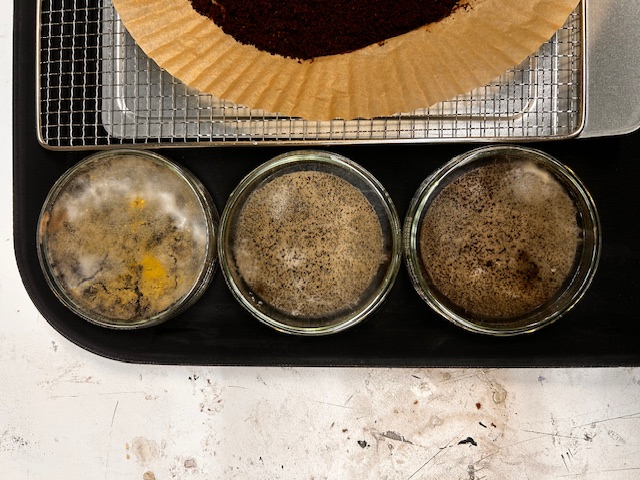
The Labs section documents material and laboratory-based experiments, including protocols, observations, visual records, and preliminary evaluations.
Rather than controlled results alone, this section values:
Projects are developed as open-ended research inquiries rather than conventional design assignments.
Each project is structured as a research log, documenting:
https://benchling.com/s/seq-HvPSJOGRRsfce8poHTfp?m=slm-fZ9SJ9R1fzPv5Au5TOpu Final Project Title: Pulse Space: Biological Memory Interfaces for Interior Architecture by Mine Arbay May 12, 2026