Week 11 — Bioproduction & Cloud Labs
Part A: The 1,536 Pixel Artwork Canvas
- My Contribution: I was trying to make a buddha/baby at the bottom center.
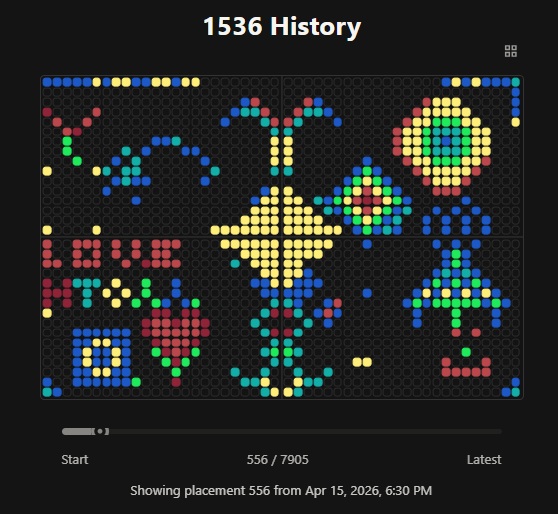
- What I liked about the project: It was amazing to see it develop as soon as the email went out and during the class. It was a very surreal experience and the spirit of collaboration is really visible when you roll back the history and how it became its final version. So grateful to be a part of this amazing cohort of humans in the loop. Suggestions for improvement: Lets keep this spirit going and make this dream happen; of cloud labs around the world that conduct synthetic biology in the spirit of collaboration and ethics to advance synthetic biology in the least harmful most useful direction. We did it during covid, lets not wait for another pandemic to come together. Thanks Ronan and the team for giving us the taste of this global spirit.
Part B: Cell-Free Protein Synthesis
1. Component Descriptions
| Component | Role in Cell-Free Reaction |
|---|---|
| E. coli Lysate | The guts of the living cell that still work without the shell of a cell. Reminds me of a bug cut into two but still functional since the component parts don’t necessarily know they are “dead”—fascinating for microscopic life. It provides the machinery: Polymerase, Ribosomes, and Enzymes. |
| Potassium Glutamate | The primary salt for the “biological soup.” It maintains osmotic balance and ensures the ionic strength is just right for protein-DNA interactions. |
| HEPES-KOH pH 7.5 | The buffer system. It keeps the pH steady so the reaction doesn’t crash or get too acidic as metabolic byproducts start to accumulate. |
| Magnesium Glutamate | A vital cofactor. It’s basically the glue that stabilizes the ribosomes and RNA polymerase; without it, the translation engine stalls. |
| Potassium phosphate | Provides a phosphate source for energy regeneration and doubles as extra buffering capacity for the system. |
| Energy/Nucleotide System | The fuel tank. Provides the ATP, GTP, UTP, and CTP required to power transcription and “charge” the tRNAs with amino acids. |
| Translation Mix | The raw building blocks; the 20 standard amino acids that the ribosomes string together to build your target protein. |
| Nicotinamide | Precursor to NAD+/NADH. It drives the metabolic recycling pathways that turn your energy source back into usable ATP. |
| Nuclease Free Water | Pure solvent. Ensures no stray RNases or DNases get in there to shred your DNA template or mRNA before the reaction even starts. |
2. Master Mix Comparison
- Difference: Usually, the “High-Yield” vs “Standard” versions come down to the specific energy regeneration system (like using 3-PGA instead of Creatine Phosphate) and a finely tuned Magnesium concentration optimized for high-speed output. Basically the use of MonoPhasphates allows for the reuptake of the Phosphates that are discarded after being used as the backbone for the mRNA synthesis.
3. Bonus: Transcription without GMP
- Mechanism: In Transcription RNA Polymerase primarily utilizes the triphosphate form (GTP) to build the RNA chain. But if you just add guanine it is used as a raw material precursor to GMP and GTP which occurs with a series of enzymatic steps using the endogenous cellular machinery in the lysate. And this upccyling of phasphates provides the NMP Robose Mic the extra time of cell free reaction.
Part C: Planning the Global Experiment
1. Fluorescent Protein Analysis
- sfGFP: Superfolder GFP. The reliable workhorse of the lab; it folds fast and stays bright even when the conditions get a bit messy.
- mRFP1: The monomeric red standard. Great for multi-color tagging without the proteins clumping together.
- mKO2: Monomeric Kusabira Orange. A super bright orange that gives a great third channel for logic gate visualization.
- mTurquoise2: A cyan protein that’s incredibly stable—the “gold standard” when you need a high-end FRET donor.
- mScarlet_I: One of the brightest synthetic reds available today; it really pops against the background.
- Electra2: A specialized, highly engineered fluorescent tool designed for specific high-performance assays in cloud lab environments.
2. Experimental Hypothesis
Target Protein: mTurquoise2 with mKO2 for salt-stress analysis
Adjusted Reagent(s): Magnesium Glutamate, Glucose, and Amino Acid saturation.
Expected Effect: I hypothesize that maximizing the Magnesium concentration to 15–18 mM will stabilize the ribosome-mRNA complexes against the high ionic strength of the locked 312.5 mM Potassium Glutamate baseline. Furthermore, I expect that supplementing the reaction with 3.0 g/L Glucose and a surplus of Amino Acids (5–6 mM) will prevent metabolic exhaustion over the 36-hour incubation period, resulting in a sustained fluorescence signal and higher total protein yield compared to the standard NMP-Ribose-Glucose master mix.
3: Final Reagent Supplement JSON
For the global experiment, I designed a 6-well optimization cluster to test the limits of molecular crowding and metabolic longevity in a high-salt environment (locked at ~312mM Potassium Glutamate).
| Well | Strategy | Hypothesis |
|---|---|---|
| J2 | Baseline Optimized | Balanced increase of Mg, AA, and Glucose for maximum total yield. |
| J3 | Mg-Max | Testing the upper inhibitory threshold of Magnesium (18.225 mM). |
| J4 | AA Saturation | Testing if surplus building blocks (Tyrosine/AA Mix) can overcome salt-stress. |
| K2 | Fuel Injection | Maximizing Glucose (3.0 g/L) to prevent late-stage ATP exhaustion. |
| K3 | Redox Support | Pushing Nicotinamide (6.0 mM) to maintain NAD+ recycling over 36 hours. |
| K4 | The “Final Boss” | A hyper-concentrated mix testing the limits of molecular crowding. |
Part D: Build-A-Cloud-Lab (Optional)
- Since I’m working on the DermLogic skin patch for HPV detection, I’m interested in how the Nebula RAC could prototype dual-channel fluorescence sensors. Seeing this level of remote automation makes the “sandbox lab” dream feel much more attainable for an entrepreneur.