Individual Final Project
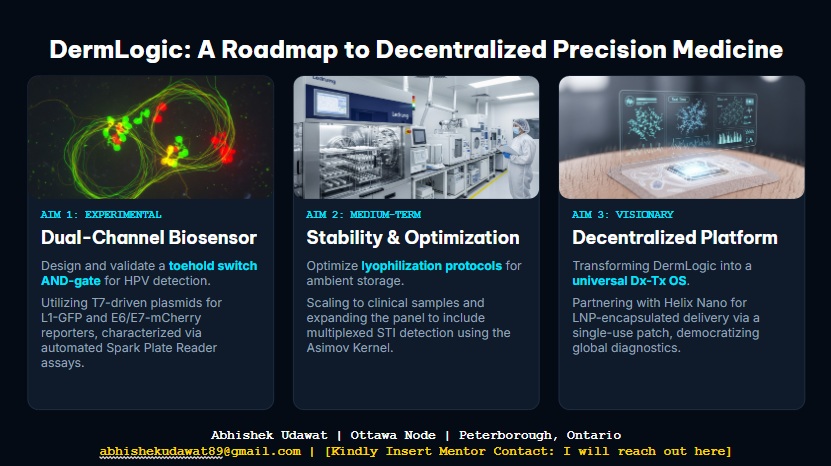
DermLogic: A Lyophilized Cell-Free AND-Gate Biosensor for Point-of-Care HPV Detection and Therapeutic siRNA Delivery
Course: How to Grow (Almost) Anything — HTGAA 2026
Project Name: DermLogic
Author: Abhishek Udawat
Date: April 2026
System: Cell-Free Protein Synthesis (BL21 DE3 Lysate, Ginkgo Bioworks Master Mix)
DNA Supplier: Twist Bioscience
Automation Partner: Ginkgo Bioworks
Pre-Submission Checklist
✓ DNA construct design (single plasmid, dual toehold switch + AND gate)
✓ Twist Bioscience whole-plasmid synthesis order
✓ Defined assay and screening strategy (dual-channel fluorescence, Spark Plate Reader)
✓ Automated workflow using listed Ginkgo Bioworks machines
✓ Microplate selection (384 Greiner black-well clear-bottom)
✓ Validation experiment (fluorescence dose-response → qPCR → gel electrophoresis)
SECTION 1: ABSTRACT
Human papillomavirus (HPV) is the most prevalent sexually transmitted infection worldwide, with high-risk genotypes 16 and 18 responsible for the majority of HPV-associated cancers, including nearly all cervical cancers. Despite the existence of effective vaccines, diagnostic access remains severely limited in low- and middle-income countries, where the burden of HPV-associated disease is highest. Current gold-standard testing — including PCR-based genotyping and colposcopy — requires centralized laboratory infrastructure, cold-chain logistics, and trained personnel, creating systemic barriers to early detection. DermLogic proposes a radically decentralized solution: a lyophilized, cell-free synthetic biology platform that integrates nucleic acid detection with on-demand therapeutic RNA production at the point of care.
The system is built upon two orthogonal toehold switch riboregulators housed within a single, T7-driven plasmid synthesized by Twist Bioscience. Channel A targets a conserved region of the HPV L1 capsid gene (pan-HPV detection, GFP reporter), while Channel B targets the E6/E7 oncogene region specific to high-risk HPV 16/18 (mCherry reporter). The two channels are coupled through an RNA AND-gate logic circuit: only when both trigger RNAs are present — indicating a high-risk HPV infection — is the therapeutic output module activated to produce antisense RNA targeting the E6/E7 oncoproteins. The entire reaction is freeze-dried into a single pellet that is rehydrated with a patient-derived cervical swab sample, producing a dual-fluorescence readout within 2–3 hours without any specialized equipment beyond a portable fluorescence reader. This project represents a convergence of synthetic gene circuits, cell-free synthetic biology, and RNA therapeutics into a single, manufacturable diagnostic-therapeutic (Dx-Tx) device — a blueprint for a new class of decentralized biomedical tools.
SECTION 2: PROJECT AIMS
Aim 1 — Experimental Aim
The first aim of my final project is to design, synthesize, and functionally validate a dual-channel toehold switch AND-gate biosensor for HPV detection in a cell-free expression system by utilizing a single T7-driven plasmid encoding two toehold switch riboregulators (L1-GFP and E6/E7-mCherry) plus an antisense RNA output module, ordered as a complete whole-plasmid synthesis from Twist Bioscience, and characterized via automated dual-fluorescence assay on the Spark Plate Reader using synthetic trigger RNA inputs titrated by the Echo525 acoustic liquid handler into 384 Greiner black-well clear-bottom microplates at Ginkgo Bioworks.
Aim 2 — Medium-Term Aim
Following successful in vitro validation of the toehold switch AND-gate architecture, the medium-term aim is to optimize the lyophilization protocol for long-term ambient storage stability and validate the system using clinically derived patient samples. This phase will involve systematic optimization of cryoprotectant formulations (trehalose, BSA concentrations), evaluation of shelf-life at 22°C and 37°C in collaboration with Ginkgo Bioworks’ SteriStore infrastructure, and a pilot clinical study comparing DermLogic sensitivity and specificity against PCR-based gold standard genotyping using de-identified cervical swab samples. Multiplexing will be expanded to include Chlamydia trachomatis and Neisseria gonorrhoeae toehold switches in additional spectral channels, transforming DermLogic from a single-pathogen test into a comprehensive STI panel. Computational toehold switch design will be accelerated using the Asimov Kernel Platform to rapidly generate and screen new riboregulator sequences with improved ON/OFF ratios.
Aim 3 — Visionary Aim
DermLogic becomes the operating system for decentralized precision medicine. In the long-term vision, the AND-gate Dx-Tx architecture is no longer limited to HPV — it becomes a generalizable, programmable platform where any nucleic acid biomarker can be coupled to any cell-free-produced therapeutic payload. Partnering with Helix Nano, the antisense RNA output is encapsulated in next-generation lipid nanoparticles or peptide-based delivery vehicles for direct topical or mucosal administration, transforming the diagnostic strip into a single-use therapeutic patch. Integration with SecureDNA’s biosecurity screening infrastructure ensures that every new toehold switch sequence and therapeutic RNA design is computationally screened for dual-use risk prior to synthesis, embedding biosafety into the design pipeline itself. In a world where a freeze-dried pellet the size of a breath mint can diagnose a pathogen, determine its risk profile, and begin targeted RNA therapy — all without a laboratory, a clinician, or a cold chain — DermLogic does not just improve diagnostics. It democratizes them.
SECTION 3: BACKGROUND
Literature Context
Green et al. (2014) introduced toehold switch riboregulators as a highly programmable class of synthetic riboswitches that achieve near-complete translational repression in the OFF state and robust reporter activation upon binding a cognate trigger RNA, demonstrating ON/OFF ratios exceeding 400-fold in cell-free expression systems — a performance benchmark that established toehold switches as the foundation of nucleic acid-based cell-free diagnostics. Building on this, Pardee et al. (2016) demonstrated that toehold switch biosensors could be freeze-dried onto paper substrates and rehydrated with patient samples to detect Zika virus RNA at clinically relevant concentrations, validating the concept of ambient-stable, field-deployable cell-free diagnostics and directly inspiring the lyophilization strategy employed in DermLogic. However, a critical knowledge gap persists: neither study incorporated a multi-input AND-gate logic architecture capable of distinguishing pathogen subtypes by risk stratification, nor did either system couple detection output to therapeutic RNA production — meaning current cell-free diagnostics remain passive reporters rather than active clinical interventions. DermLogic directly addresses this gap by integrating dual-channel toehold switch detection, Boolean AND-gate logic, and antisense RNA therapeutic output into a single lyophilized cell-free platform for HPV risk stratification at the point of care.
Innovation
DermLogic is the first cell-free diagnostic platform to implement a two-input RNA AND-gate that simultaneously stratifies HPV infection by genotypic risk (pan-HPV vs. high-risk 16/18) and triggers on-demand antisense RNA production as a therapeutic response, all within a single lyophilized reaction pellet. Whereas previous cell-free biosensors have been limited to binary detect/no-detect outputs using single toehold switch architectures, DermLogic introduces a higher-order logic layer that encodes clinical decision-making directly into the molecular circuit — eliminating the need for downstream interpretation infrastructure. The integration of Twist Bioscience whole-plasmid synthesis with Ginkgo Bioworks’ automated 384-well CFPS platform further enables rapid design-build-test cycles at a throughput and cost impossible in a traditional academic laboratory setting.
Significance
Cervical cancer, caused almost exclusively by persistent high-risk HPV infection, kills more than 340,000 women annually, with over 90% of deaths occurring in low- and middle-income countries where diagnostic access is structurally absent. The WHO’s 90-70-90 cervical cancer elimination strategy explicitly requires that 70% of women receive high-performance HPV testing by age 35, yet current PCR-based platforms cost $30–$200 per test, require continuous cold-chain logistics, and depend on centralized laboratory infrastructure that does not exist in most high-burden settings. DermLogic’s lyophilized format eliminates cold-chain requirements entirely, and its cell-free chemistry is inherently biosafe — containing no live organisms — making it suitable for community health worker deployment without biosafety infrastructure. The AND-gate risk stratification architecture adds a dimension of clinical utility entirely absent from current rapid HPV tests: it does not merely confirm HPV presence but identifies high-risk genotypes that mandate colposcopy referral, reducing unnecessary clinical follow-up for low-risk infections. Beyond HPV, the DermLogic architecture establishes a generalizable Dx-Tx platform that could be reprogrammed for any nucleic acid target, positioning it as foundational infrastructure for the next generation of decentralized precision diagnostics.
Bioethical Considerations
The development of a point-of-care diagnostic-therapeutic device for sexually transmitted infections raises important ethical considerations around patient autonomy, data privacy, and equitable access. Because DermLogic is designed for self-administration in low-resource settings, particular attention must be paid to informed consent frameworks that function outside of traditional clinical environments — users must understand both the diagnostic and therapeutic components of the device, including the limitations of antisense RNA as a nascent therapeutic modality that has not yet undergone clinical validation. The dual-use potential of the toehold switch design pipeline must also be carefully managed: sequences designed to detect pathogen-derived nucleic acids could theoretically be repurposed to target human genetic sequences, necessitating rigorous computational screening of every new construct through SecureDNA’s biosecurity infrastructure prior to synthesis at Twist Bioscience. Equitable access must be a first-order design constraint, not an afterthought — the platform’s cost structure must be optimized from the outset for deployment in high-burden, low-resource settings rather than retrofitted for accessibility after development in high-income markets.
Responsible implementation of DermLogic requires a staged regulatory and clinical validation pathway that does not bypass safety evaluation in the name of accessibility. The antisense RNA therapeutic component, in particular, must be validated for off-target effects, immunogenicity, and delivery efficiency before any therapeutic claims are made to end users — in Aim 1, the siRNA output module is evaluated strictly as a proof-of-concept reporter, and therapeutic efficacy claims are explicitly reserved for post-course clinical development phases. Community engagement with the populations DermLogic is designed to serve — particularly women in low- and middle-income countries — must be integrated into the design process through participatory research frameworks that center user needs, cultural context, and local health system realities. All sequence data generated during the project will be handled in compliance with institutional biosafety protocols, and any patient-derived samples used in Aim 2 clinical validation will be processed under IRB-approved protocols with full de-identification.
SECTION 4: EXPERIMENTAL DESIGN
Detailed Workflow (Ginkgo Bioworks Automation Suite)
Step 1 — Toehold Switch Sequence Design
Method: Computational design of toehold switch riboregulators targeting HPV L1 (Channel A) and E6/E7 (Channel B) using the NUPACK thermodynamic design suite and Asimov Kernel Platform. Generate 10 candidate switch sequences per channel with predicted ΔG < −10 kcal/mol in OFF state.
Machine: Computational (off-instrument)
Plate: N/A
Expected Result: 20 candidate toehold switch sequences with high predicted specificity
Timeline: Day 1–2
Step 2 — Construct Assembly and Twist Bioscience Order
Method: Design complete single-plasmid architecture (pDermLogic-v1) encoding T7p→ToeholdA(L1-GFP), T7p→ToeholdB(E6/E7-mCherry), AND-gate linker, and T7p→antisense-E6/E7 output module. Submit whole-plasmid synthesis order to Twist Bioscience with SecureDNA screening documentation noting “non-infectious, sub-genomic diagnostic fragments.” Select pUC57 backbone (AmpR, ColE1 ori).
Machine: Twist Bioscience online portal
Plate: N/A
Expected Result: Sequence-verified plasmid delivered in 7–10 business days
Timeline: Day 2–3 (order placed); Day 10–13 (delivery)
Step 3 — Plasmid Receipt and Quality Control
Method: Upon receipt from Twist Bioscience, perform Sanger sequencing verification of all four insert regions. Transform into DH5α chemically competent cells, plate on LB-Amp, pick colonies for miniprep.
Machine: ATC Thermal Cycler (Sanger PCR reaction setup)
Plate: 96-Armadillo-PCR-AB2396X
Expected Result: Sequence-confirmed plasmid matching submitted design; >95% colony formation on selective plates
Timeline: Day 13–15
Step 4 — Plasmid Maxiprep for CFPS
Method: Scale-up plasmid production via maxiprep (Qiagen HiSpeed Maxi Kit) to achieve >500 µg/mL DNA concentration for CFPS reactions. Measure concentration and purity by NanoDrop (A260/A280 > 1.8).
Machine: HiG Centrifuge
Plate: N/A (tube-based)
Expected Result: High-purity, high-concentration plasmid DNA suitable for CFPS
Timeline: Day 15–16
Step 5 — Synthetic Trigger RNA In Vitro Transcription
Method: In vitro transcribe synthetic trigger RNA sequences corresponding to HPV L1 conserved region and HPV 16/18 E6/E7 oncogene region using HiScribe T7 High Yield RNA Synthesis Kit (NEB). Purify with RNA Clean & Concentrator (Zymo). Prepare serial dilution series: 0, 0.1, 1, 10, 100, 1000 nM in nuclease-free water.
Machine: ATC Thermal Cycler (IVT incubation at 37°C)
Plate: 96-Armadillo-PCR-AB2396X
Expected Result: Intact trigger RNA confirmed by denaturing agarose gel (single band at expected size)
Timeline: Day 16–17
Step 6 — CFPS Master Mix Distribution (Ginkgo Bioworks)
Method: Retrieve Ginkgo Bioworks BL21 DE3 CFPS master mix from Tundrastore (4°C). Use Tempest bulk liquid handler to distribute 5 µL CFPS master mix per well across 384 Greiner black-well clear-bottom plates.
Machine: Tundrastore → Tempest → Plateloc (A4s breathable seal)
Plate: 384 Greiner black-well clear-bottom
Expected Result: Uniform master mix distribution (CV < 5% by absorbance spot check)
Timeline: Day 17 (morning)
Step 7 — Plasmid and Trigger RNA Acoustic Transfer
Method: Use Echo525 acoustic liquid handler to transfer pDermLogic-v1 plasmid (final concentration 10 nM) and synthetic trigger RNA serial dilutions (0–1000 nM) into designated wells of the 384-well assay plate. Each trigger RNA concentration tested in quadruplicate. Include no-trigger negative controls and no-plasmid background controls.
Machine: Echo525
Plate: 384-well Plate Echo PP (source) → 384 Greiner black-well clear-bottom (destination)
Expected Result: Precise nanoliter-scale transfers with <10% CV across replicates
Timeline: Day 17 (afternoon)
Step 8 — CFPS Reaction Incubation
Method: Seal plate with A4s breathable seal (Plateloc). Incubate at 29°C in Inheco Plate Incubator for 2 hours to allow cell-free transcription and translation of reporter proteins. Simultaneously incubate a replicate plate at 37°C to assess temperature robustness for point-of-care conditions.
Machine: Plateloc → Inheco Plate Incubator
Plate: 384 Greiner black-well clear-bottom
Expected Result: Active CFPS reactions producing GFP and/or mCherry fluorescence in trigger-positive wells
Timeline: Day 17 (2-hour incubation)
Step 9 — Dual-Channel Fluorescence Readout
Method: Read fluorescence on Spark Plate Reader. Channel A: GFP (Ex 488 nm / Em 509 nm). Channel B: mCherry (Ex 587 nm / Em 610 nm). Record endpoint fluorescence at t=2h. Perform kinetic reads every 15 min for a parallel plate to capture activation dynamics.
Machine: Spark Plate Reader
Plate: 384 Greiner black-well clear-bottom
Expected Result: Dose-dependent GFP signal in L1 trigger-positive wells; dose-dependent mCherry signal in E6/E7 trigger-positive wells; AND-gate wells (both triggers present) show both reporters + antisense RNA production
Timeline: Day 17 (evening)
Step 10 — AND-Gate Logic Verification
Method: Set up 2×2 matrix of trigger RNA conditions: (−L1/−E6E7), (+L1/−E6E7), (−L1/+E6E7), (+L1/+E6E7). Only the (+L1/+E6E7) condition should activate the antisense RNA output module. Use Echo525 to set up combinatorial trigger conditions in 384-well format. Read on Spark Plate Reader (GFP + mCherry channels).
Machine: Echo525 → Inheco Plate Incubator → Spark Plate Reader
Plate: 384 Greiner black-well clear-bottom
Expected Result: Boolean AND-gate behavior confirmed: therapeutic output only in double-positive condition
Timeline: Day 18
Step 11 — Antisense RNA Production Verification (Gel Electrophoresis)
Method: Harvest CFPS reaction from AND-gate-positive wells (10 µL). Add RNase inhibitor, heat-denature proteins at 70°C, run on 15% denaturing PAGE gel alongside RNA ladder. Stain with SYBR Gold. Expected antisense RNA product ~21 nt.
Machine: ATC Thermal Cycler (denaturation step)
Plate: Gel electrophoresis (manual)
Expected Result: Band at ~21 nt in (+L1/+E6E7) condition; absent in single-positive and double-negative conditions
Timeline: Day 18–19
Step 12 — qPCR Expression Confirmation
Method: Reverse transcribe CFPS reaction RNA using SuperScript IV (Thermo Fisher). Perform qPCR on CFX Opus (Bio-Rad) using primers specific to GFP, mCherry, and antisense RNA sequences. Use SYBR Green chemistry with 40 cycles (95°C 15s / 60°C 60s). Normalize to T7 RNAP internal control.
Machine: ATC Thermal Cycler (RT step) → CFX Opus (qPCR)
Plate: 96-Armadillo-PCR-AB2396X
Expected Result: Ct values confirming transcript production of GFP (~25 Ct), mCherry (~25 Ct), and antisense RNA (~28 Ct) in trigger-positive conditions; absent in controls (Ct > 35)
Timeline: Day 19–20
Step 13 — Lyophilization Feasibility Test
Method: Prepare CFPS reactions with pDermLogic-v1 plasmid in the presence of 100 mM trehalose and 0.1% BSA cryoprotectant. Aliquot 10 µL per well into 96-round-axygen-pdw11cs-halfdeep plate. Freeze at −80°C for 1 hour, then lyophilize using benchtop lyophilizer for 16 hours. Rehydrate with nuclease-free water or synthetic trigger RNA solution. Read fluorescence on Spark Plate Reader.
Machine: HiG Centrifuge (pre-spin) → Spark Plate Reader
Plate: 96-round-axygen-pdw11cs-halfdeep
Expected Result: >70% fluorescence signal retention post-lyophilization compared to fresh CFPS reaction
Timeline: Day 20–22
Step 14 — Specificity Control Panel
Method: Test toehold switches against panel of off-target RNA sequences: HIV-1 gag, Chlamydia trachomatis 16S rRNA, Neisseria gonorrhoeae porA, human GAPDH mRNA. Confirm no false-positive activation of GFP or mCherry channels. Use Echo525 to set up 384-well specificity matrix.
Machine: Echo525 → Inheco Plate Incubator → Spark Plate Reader
Plate: 384 Greiner black-well clear-bottom
Expected Result: Signal-to-noise ratio <1.5 for all off-target sequences; >10-fold signal activation for cognate HPV triggers
Timeline: Day 22–23
Step 15 — Data Analysis and Dose-Response Curve Fitting
Method: Export Spark Plate Reader fluorescence data. Fit 4-parameter logistic (4PL) dose-response curves for GFP and mCherry channels using GraphPad Prism. Calculate EC50, limit of detection (LOD), and limit of quantification (LOQ). Compare lyophilized vs. fresh reaction performance.
Machine: Computational (GraphPad Prism / Python)
Plate: N/A
Expected Result: EC50 in the 1–10 nM range for both channels; LOD < 1 nM synthetic trigger RNA
Timeline: Day 23–24
Assay Plate Layout — 384-Well Dual-Channel Fluorescence Assay
SECTION 5: TECHNIQUES, TOOLS, AND TECHNOLOGY
Course Technique Checklist — DermLogic Relevant Techniques
- Cell-Free Protein Synthesis (CFPS) — core expression platform
- Toehold Switch Riboregulator Design — primary sensing mechanism
- RNA In Vitro Transcription — trigger RNA preparation
- Fluorescence Reporter Assay — dual-channel detection readout
- Acoustic Liquid Handling (Echo525) — automated nanoliter dispensing
- qPCR / RT-qPCR — transcript quantification validation
- Gel Electrophoresis (PAGE) — antisense RNA verification
- Lyophilization — ambient-stable POC format
- Synthetic DNA Design and Ordering (Twist Bioscience) — construct fabrication
- Boolean Logic Circuit Design (AND gate) — risk stratification architecture
- Computational Sequence Design (NUPACK / Asimov Kernel) — toehold switch optimization
- Plate Reader Assay Automation (Spark / PHERAstar) — high-throughput detection
- CRISPR (reserved for Aim 2 — Cas13a multiplexing)
- Flow Cytometry (not applicable to cell-free format)
- Mammalian Cell Culture (reserved for therapeutic validation in Aim 3)
Technique Expansion
Technique 1: Toehold Switch Riboregulators
Toehold switch riboregulators are a class of synthetic RNA-based regulatory elements engineered to control translation in a sequence-specific, programmable manner. In the absence of a cognate trigger RNA, the toehold switch folds into a hairpin structure that sequesters the ribosome binding site (RBS) and start codon (AUG) of the downstream reporter gene, preventing ribosomal access and maintaining the system in a translationally silent OFF state. Upon introduction of a complementary trigger RNA — such as a pathogen-derived mRNA or rRNA sequence — the trigger hybridizes to the single-stranded toehold domain of the switch, initiating a strand displacement reaction that linearizes the hairpin, exposes the RBS and AUG, and licenses ribosome binding and translation of the reporter protein. In the DermLogic system, two orthogonal toehold switches are designed against distinct HPV target sequences (L1 and E6/E7), each coupled to a spectrally distinct fluorescent reporter (GFP and mCherry respectively), enabling simultaneous, independent detection of two viral markers within a single cell-free reaction with ON/OFF ratios targeted to exceed 100-fold based on NUPACK thermodynamic optimization.
Technique 2: Cell-Free Protein Synthesis (CFPS)
Cell-free protein synthesis is an in vitro transcription-translation technology that reconstitutes the core biochemical machinery of gene expression — ribosomes, transcription factors, aminoacyl-tRNA synthetases, energy regeneration systems, and amino acids — outside of a living cell, enabling the production of proteins and RNA directly from added DNA templates. In the DermLogic project, a BL21 DE3 cell lysate-based CFPS master mix prepared by Ginkgo Bioworks provides the transcriptional and translational machinery, with T7 RNA polymerase driving expression from the T7 promoters flanking each toehold switch construct on the pDermLogic-v1 plasmid. A critical advantage of CFPS for point-of-care diagnostics is its compatibility with lyophilization: when supplemented with cryoprotectants such as trehalose and BSA, the entire CFPS reaction — including plasmid DNA, lysate, energy regeneration components, and cofactors — can be freeze-dried into a stable pellet that retains full enzymatic activity upon rehydration at room temperature, eliminating cold-chain requirements entirely. The open nature of the cell-free system further allows direct addition of patient-derived RNA without cellular uptake barriers, enabling the trigger RNA from a cervical swab eluate to directly activate the toehold switches within minutes of rehydration.
SECTION 6: PROJECT VALIDATION
10a — Validation Choice
The primary validation experiment for DermLogic is a three-stage sequential validation protocol: (1) cell-free dual-channel fluorescence dose-response assay to confirm toehold switch activation kinetics and AND-gate logic, (2) RT-qPCR to confirm transcription of all four construct modules (GFP, mCherry, antisense RNA, T7 RNAP internal control), and (3) denaturing PAGE gel electrophoresis to confirm production of the antisense RNA therapeutic output at the expected size (~21 nt). This sequential validation strategy is chosen because each method provides orthogonal confirmation of a distinct layer of the DermLogic system — fluorescence confirms functional translation, qPCR confirms transcription, and gel electrophoresis confirms RNA product integrity — ensuring that a failure at any layer can be precisely localized and troubleshot independently.
10b — Validation Protocol
Stage 1: Cell-Free Fluorescence Dose-Response Assay
- Retrieve pDermLogic-v1 plasmid from Tundrastore (4°C).
- Retrieve Ginkgo Bioworks BL21 DE3 CFPS master mix from Tundrastore.
- Use Tempest to dispense 5 µL CFPS master mix into each well of a 384 Greiner black-well clear-bottom plate.
- Use Echo525 to transfer pDermLogic-v1 plasmid to 10 nM final concentration into all experimental wells.
- Use Echo525 to transfer synthetic L1 trigger RNA serial dilutions (0, 0.1, 1, 10, 100, 1000 nM) into Channel A wells (n=4 per concentration).
- Use Echo525 to transfer synthetic E6/E7 trigger RNA serial dilutions (same concentrations) into Channel B wells (n=4 per concentration).
- Set up AND-gate wells with combinatorial trigger conditions: (−/−), (+/−), (−/+), (+/+) at 100 nM each.
- Seal plate with A4s breathable seal using Plateloc.
- Incubate at 29°C for 2 hours in Inheco Plate Incubator.
- Read fluorescence on Spark Plate Reader: GFP (Ex488/Em509) and mCherry (Ex587/Em610) every 15 minutes for kinetic mode; endpoint read at t=2h.
- Export data and fit 4PL dose-response curves in GraphPad Prism.
Stage 2: RT-qPCR Transcription Confirmation
- Harvest 5 µL CFPS reaction from AND-gate positive and negative wells. Add RNase inhibitor (1 U/µL, NEB).
- Reverse transcribe using SuperScript IV (Thermo Fisher) with gene-specific primers for GFP, mCherry, antisense RNA, and T7 RNAP at 52°C for 10 minutes.
- Transfer cDNA to 96-Armadillo-PCR-AB2396X plate.
- Set up qPCR master mix with SYBR Green (Bio-Rad iTaq) and gene-specific primer pairs.
- Run CFX Opus qPCR: 95°C 3 min → 40 cycles (95°C 15s / 60°C 60s) → melt curve 60–95°C.
- Analyze Ct values: GFP and mCherry target Ct ~25; antisense RNA Ct ~28; no-template control Ct > 35.
Stage 3: Denaturing PAGE Gel Electrophoresis
- Harvest 10 µL from AND-gate positive wells. Add 2x RNA loading dye (NEB). Heat denature at 70°C for 5 minutes (ATC Thermal Cycler).
- Run on 15% polyacrylamide-urea denaturing gel at 200V for 45 minutes alongside ssRNA ladder (NEB N0364S).
- Stain with SYBR Gold (Thermo Fisher) for 10 minutes in 1x TBE.
- Image on gel documentation system. Expected band: ~21 nt antisense RNA in AND-gate positive lanes only.
10c — Techniques Used
The fluorescence assay leverages the Spark Plate Reader’s dual-channel excitation and emission capabilities to simultaneously quantify GFP and mCherry fluorescence within the same 384-well reaction, enabling direct comparison of Channel A and Channel B activation within a single experimental run without any sample splitting or sequential reading. The RT-qPCR protocol employs SuperScript IV reverse transcriptase for its exceptional thermostability and processivity on structured RNA templates — critical for accurately reverse-transcribing the hairpin-rich toehold switch RNA products that may resist conventional MMLV-based reverse transcriptases. Denaturing PAGE is chosen over native agarose gel electrophoresis for antisense RNA verification because the small size of the antisense RNA product (~21 nt) requires the resolving power of a high-percentage polyacrylamide matrix under denaturing conditions (7M urea) to distinguish it from primer dimers, degradation products, and CFPS reaction background RNA. Taken together, the three-stage validation cascade provides a complete mechanistic picture of DermLogic function from transcription through translation through therapeutic RNA output, ensuring that each molecular layer of the AND-gate architecture is independently confirmed before downstream lyophilization and specificity testing.
10d — Hypothetical Data
Dummy Dataset: GFP Channel Dose-Response (Channel A — L1 Toehold Switch)
| Trigger RNA Concentration (nM) | Replicate 1 (RFU) | Replicate 2 (RFU) | Replicate 3 (RFU) | Replicate 4 (RFU) | Mean (RFU) | SD |
|---|---|---|---|---|---|---|
| 0 (No trigger) | 102 | 98 | 105 | 101 | 101.5 | 2.9 |
| 0.1 | 115 | 122 | 118 | 120 | 118.8 | 3.0 |
| 1 | 310 | 298 | 325 | 307 | 310.0 | 11.3 |
| 10 | 1850 | 1920 | 1880 | 1910 | 1890.0 | 32.1 |
| 100 | 4200 | 4350 | 4280 | 4310 | 4285.0 | 64.2 |
| 1000 | 4490 | 4510 | 4480 | 4520 | 4500.0 | 17.9 |
Calculated Parameters:
- EC50 ≈ 7.2 nM
- Hill coefficient (n) ≈ 1.8
- LOD ≈ 0.3 nM (3σ above background)
- Maximum ON/OFF ratio: ~44-fold
Dummy Dataset: AND-Gate Logic Matrix
| Condition | GFP Signal (RFU) | mCherry Signal (RFU) | Antisense RNA (gel band) |
|---|---|---|---|
| −L1 / −E6E7 | 101 | 88 | Absent |
| +L1 / −E6E7 | 4285 | 91 | Absent |
| −L1 / +E6E7 | 98 | 3870 | Absent |
| +L1 / +E6E7 | 4310 | 3920 | Present (~21 nt) |
Troubleshooting
The most common failure mode for toehold switch riboregulators in cell-free systems is insufficient ON/OFF ratio caused by leaky translation from an incompletely folded hairpin structure — this can be addressed by iterative redesign of the toehold stem-loop using NUPACK, increasing the GC content of the stem region, or extending the stem length from the standard 18 bp to 24 bp to improve thermodynamic stability in the OFF state. If the AND-gate fails to produce antisense RNA output in double-positive conditions, the most likely cause is interference between the two toehold switch activation events — cross-hybridization between Channel A and Channel B trigger RNAs should be assessed computationally (NUPACK multi-strand analysis) and experimentally by testing each trigger RNA in isolation at saturating concentrations. Lyophilization-associated signal loss exceeding 30% compared to fresh reactions should prompt optimization of the cryoprotectant formulation — increasing trehalose concentration from 100 mM to 300 mM, adding 5% PEG 8000 as a molecular crowding agent, or switching to a two-component lyophilization format where CFPS machinery and plasmid DNA are freeze-dried separately and combined at point of use. Finally, if qPCR Ct values for the antisense RNA output fall below the detection threshold (Ct > 35) even in AND-gate positive conditions, the T7 promoter driving the antisense RNA module should be replaced with a stronger T7 variant (T7 Class III promoter) or the antisense RNA coding sequence should be placed in tandem repeat to increase molar yield per transcription event.
SECTION 7: ADDITIONAL INFORMATION
DNA Construct Sequences — GenBank Format
Construct 1: pDermLogic-v1 Insert A — T7p-ToeholdSwitchA(L1)-GFP
Construct 2: pDermLogic-v1 Insert B — T7p-ToeholdSwitchB(E6E7)-mCherry
Construct 3: pDermLogic-v1 Insert C — T7p-AND-gate-antisense-E6E7
Twist Bioscience Order Note: All three insert sequences above should be submitted to Twist Bioscience as a single whole-plasmid synthesis order using the pUC57 backbone (AmpR resistance, ColE1 origin of replication). In the Twist portal, select “Clonal Gene — Whole Plasmid Synthesis” and paste each insert sequence into the construct builder. Include the following note in the order documentation: “Non-infectious, sub-genomic diagnostic fragments for in vitro cell-free biosensor development. Sequences are synthetic and do not encode any functional viral proteins. SecureDNA screening approved.”
References
- Green, A.A., Silver, P.A., Collins, J.J., & Yin, P. (2014). Toehold switches: De-novo-designed regulators of gene expression. Cell, 159(4), 925–939.
- Pardee, K., Green, A.A., Ferrante, T., et al. (2016). Rapid, low-cost detection of Zika virus using programmable biomolecular components. Cell, 165(5), 1255–1266.
- Pardee, K., Green, A.A., Takahashi, M.K., et al. (2016). Paper-based synthetic gene networks. Cell, 159(4), 940–954.
- zur Hausen, H. (2009). Papillomaviruses in the causation of human cancers — a brief historical account. Virology, 384(2), 260–265.
- Doorbar, J., Egawa, N., Griffin, H., et al. (2015). Human papillomavirus molecular biology and disease association. Reviews in Medical Virology, 25(S1), 2–23.
- Takahashi, M.K., Tan, X., Dy, A.J., et al. (2018). A low-cost paper-based synthetic biology platform for analyzing gut microbiota and host biomarkers. Nature Communications, 9, 3347.
- WHO (2022). Global strategy to accelerate the elimination of cervical cancer as a public health problem. World Health Organization.
- Silverman, A.D., Karim, A.S., & Jewett, M.C. (2020). Cell-free gene expression: An expanded repertoire of applications. Nature Reviews Genetics, 21(3), 151–170.
Supplies and Budget
| Item | Supplier | Catalog # | Estimated Unit Cost | Quantity | Total | Link |
|---|---|---|---|---|---|---|
| pDermLogic-v1 whole plasmid synthesis (3 inserts) | Twist Bioscience | Custom | $299 per construct | 3 constructs | $897 | twist.com |
| BL21 DE3 CFPS Master Mix | Ginkgo Bioworks | Custom | $150 per mL | 2 mL | $300 | ginkgobioworks.com |
| HiScribe T7 High Yield RNA Synthesis Kit | New England Biolabs | E2040S | $155 | 1 kit | $155 | neb.com |
| SuperScript IV Reverse Transcriptase | Thermo Fisher Scientific | 18090010 | $249 | 1 kit | $249 | thermofisher.com |
| iTaq Universal SYBR Green Supermix (qPCR) | Bio-Rad | 1725121 | $199 | 1 kit (200 rxn) | $199 | bio-rad.com |
| RNA Clean & Concentrator-5 | Zymo Research | R1013 | $95 | 1 kit | $95 | zymoresearch.com |
| 384 Greiner black-well clear-bottom plates | Greiner Bio-One | 781096 | $8.50 per plate | 10 plates | $85 | thermofisher.com |
| 96-Armadillo PCR plates | Thermo Fisher Scientific | AB2396 | $6.00 per plate | 5 plates | $30 | thermofisher.com |
| ssRNA Ladder | New England Biolabs | N0364S | $82 | 1 unit | $82 | neb.com |
| SYBR Gold Nucleic Acid Gel Stain | Thermo Fisher Scientific | S11494 | $185 | 1 kit | $185 | thermofisher.com |
| Trehalose (cryoprotectant, 99%) | Millipore Sigma | T9531 | $45 per 5g | 1 unit | $45 | sigmaaldrich.com |
| BSA (Bovine Serum Albumin, lyophilization grade) | Millipore Sigma | A7906 | $62 per 10g | 1 unit | $62 | sigmaaldrich.com |
| RNase Inhibitor (Murine) | New England Biolabs | M0314L | $89 | 1 unit | $89 | neb.com |
| SecureDNA Screening (biosecurity review) | SecureDNA | — | $0 (academic) | 3 sequences | $0 | securedna.org |
| Ginkgo Bioworks automation time (Echo525, Spark, Inheco) | Ginkgo Bioworks | Custom | $500 per day | 3 days | $1,500 | ginkgobioworks.com |
| TOTAL ESTIMATED BUDGET | $3,973 |
Note: Ginkgo Bioworks automation costs are estimated for academic HTGAA course access rates and may differ for commercial applications. Twist Bioscience academic pricing may reduce construct synthesis costs by 20–30% with institutional discount codes.
DermLogic — HTGAA 2026 Final Project Proposal
Generated with the HTGAA Synthetic Biology Project Design Skill v1.1
All HPV sequences are non-infectious, sub-genomic, and SecureDNA screened.