Week 7 Homework: Genetic Circuits Part II
Assignment Part 1: Intracellular Artificial Neural Networks (IANNs)
What advantages do IANNs have over traditional genetic circuits, whose input/output behaviors are Boolean functions?
- Analog Processing: IANNs process continuous, multi-level inputs to produce graded, proportional responses, rather than being restricted to rigid binary (ON/OFF) states.
- Complex Integration: A single IANN layer can compute complex, non-linear functions by tuning biological “weights” (like promoter strength), whereas Boolean logic requires fragile, metabolically expensive cascades of multiple gates to achieve the same complexity.
- Robustness: Because they use graded signals and distributed pathways, IANNs are more resistant to biological noise and mutation, showing gradual performance decline (graceful degradation) instead of catastrophic failure.
Describe a useful application for an IANN; include a detailed description of input/output behavior, as well as any limitations an IANN might face to achieve your goal.
A potential application could be an environmental risk biosensor that measures the combined threat of multiple water pollutants (e.g., arsenic and pesticides) and outputs a color-coded, continuous risk scale.
Input/Output Behavior:
- Inputs (X1, X2): Varying concentrations of two different toxins activate specific DNA promoters.
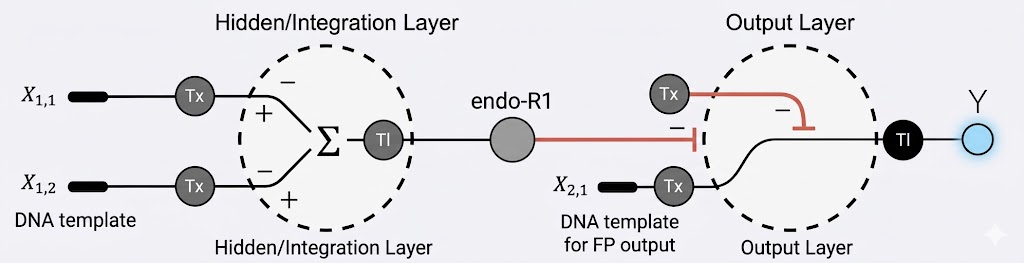
- Hidden Layer: The circuit integrates these inputs to produce an intermediate endoribonuclease. Its concentration is a weighted, non-linear reflection of the combined toxin levels.
- Final Output (Y): The endoribonuclease proportionally inhibits the production of a fluorescent protein. Low toxins yield high fluorescence (Safe), while high toxins completely inhibit fluorescence (Danger).
What limitations might an IANN face to achieve your goal? Running multi-layer circuits with numerous unique DNA parts and proteins drains cellular energy, which can cause the host bacteria to grow slowly or mutate the circuit to survive. Additionally, intermediate regulators (like the endoribonuclease) must be perfectly specific. If they accidentally interfere with the host cell’s natural mRNA, the system will fail or the cell will die. Finally, precisely calibrating the “weights” of the network requires finding the exact combination of promoter strengths, ribosome binding sites, and degradation rates, which takes immense trial and error.
IANN Diagrams
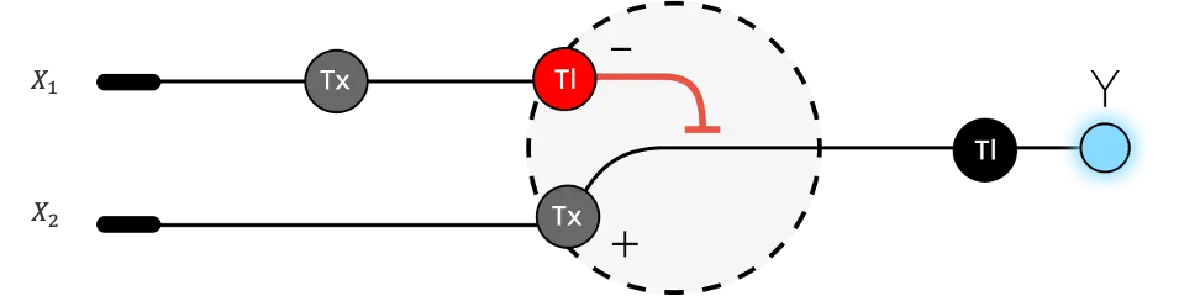
Below is a diagram depicting an intracellular single-layer perceptron where the X1 input is DNA encoding for the Csy4 endoribonuclease and the X2 input is DNA encoding for a fluorescent protein output whose mRNA is regulated by Csy4. Tx: transcription; Tl: translation.
Below is a diagram for an intracellular multilayer perceptron where layer 1 outputs an endoribonuclease that regulates a fluorescent protein output in layer 2.
Assignment Part 2: Fungal Materials
What are some examples of existing fungal materials and what are they used for? What are their advantages and disadvantages over traditional counterparts?
The mycelium network can be bound to things like agricultural waste to create materials and items. For example, mycelium leather can be used for vegan clothing, mycelium can be used as a packaging alternative to foam, and composite structures like bricks can be used as well. They are biodegradable and clean, making them very environmentally friendly considering they also help repurpose waste. Some disadvantages stem in structural capacity and integrity, since its highly water soluble, and the compressive strength is not practical for load bearing weight.
What might you want to genetically engineer fungi to do and why? What are the advantages of doing synthetic biology in fungi as opposed to bacteria?
You could create custom biomaterials, like for example, a water resistant polymer to enhance the strength of mycelium materials. Fungi are also powerful producers and could be used for efficient synthesis of complex biologics, and can also be used to break down environmental crises like oil spills. From a synthetic biology standpoint, fungi utilize eukaryotic machinery allowing for more complex protein folding and molecular synthesis.
Gemini AI was consulted for formatting and content organization