Final Project Document Link to Presentation
Final Project Gallery
Project Description My goal is to develop a system capable of converting carbon dioxide into more chemically inert compounds as a means of combating carbon pollution via carbon capture. The system at a baseline should function in two parts: efficient conversion of carbon dioxide into bicarbonate, and conversion of bicarbonate into chemically locked compounds for storage or other practical usage. By utilizing enzymes like carbonic anhydrase to speed up the process, this system could contend with other methods of carbon capture technology or see application as a sustainable, carbon dioxide scrubbing system. Continued iteration would hopefully result in a completely self-replenishing, stable system capable of fixing CO2 with minimal intervention.
My goal is to develop a system capable of converting carbon dioxide into more chemically inert compounds as a means of combating carbon pollution via carbon capture. The system at a baseline should function in two parts: efficient conversion of carbon dioxide into bicarbonate, and conversion of bicarbonate into chemically locked compounds for storage or other practical usage. By utilizing enzymes like carbonic anhydrase to speed up the process, this system could contend with other methods of carbon capture technology or see application as a sustainable, carbon dioxide scrubbing system. Continued iteration would hopefully result in a completely self-replenishing, stable system capable of fixing CO2 with minimal intervention.
Aim 1: Experimental Aim
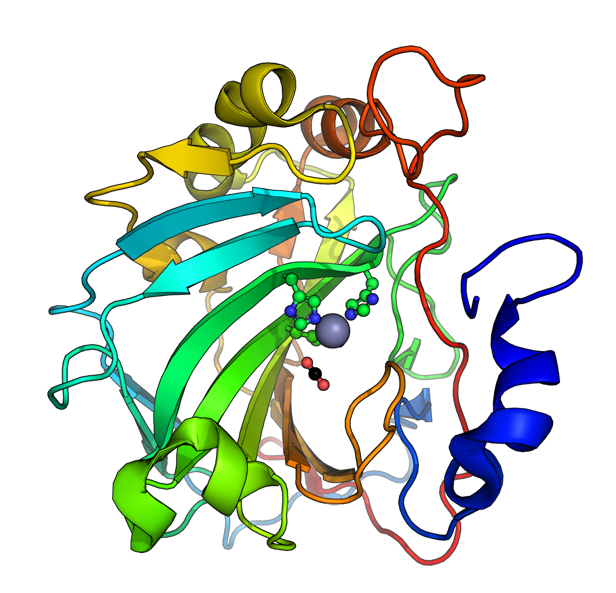
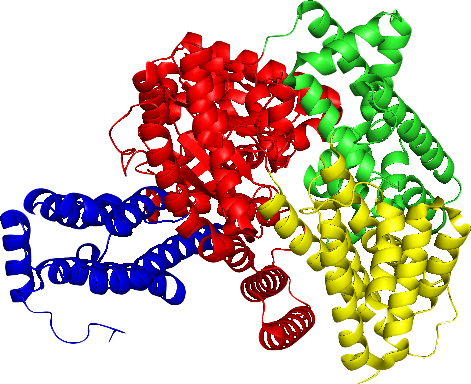
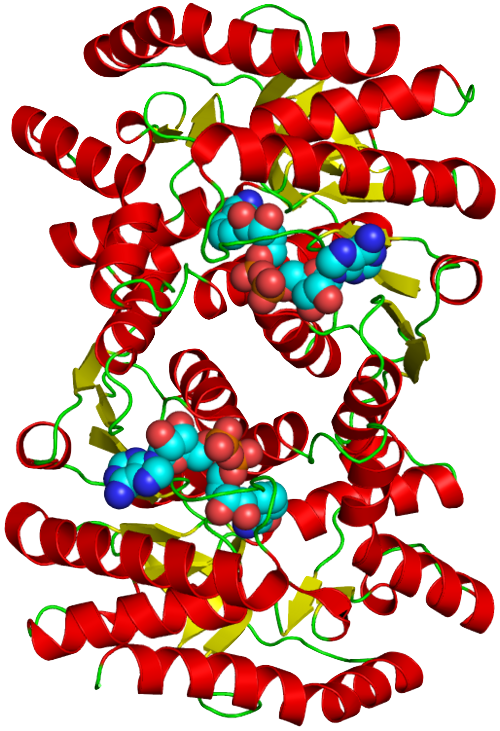
My goal for this project is to be able to successfully link the two systems together as a proof of concept. I will use cell-free protein expression to produce the enzymes carbonic anhydrase, phosphoenolpyruvate carboxylase, and malate dehydrogenase. I will combine carbonic anhydrase in a solution containing calcium ions and inorganic dissolved carbon dioxide from a sodium derivative, and then measure calcium bicarbonate precipitate output as a proxy for carbonic anhydrase mineralization capabilities. A secondary experiment will be performed using my “Sodastream” to directly dissolve CO2 into the liquid (gaseous carbon dioxide source) as functional evidence for CO2 emission elimination. Secondly, carbonic anhydrase, phosphoenolpyruvate carboxylase, and malate dehydrogenase will be combined in solution without calcium ions, allowing for bicarbonate incorporation into catalyzed reactions to produce malate. Readout will be determined by NADH utilization, which can be measured with a spectrophotometer (NADH is consumed by malate dehydrogenase). Should time permit, I hope to use LLM tools to try to increase the efficiency and stability of these enzymes.
Aim 2: Development Aim
The key technical limitations of this project arise in achieving a stable system capable of functioning with minimal human intervention. Currently, my proposed mechanism requires serial addition of reagents, and the sequestered output has limited viability and utility. A developmental aim for this project would be to optimize the system mechanics to be functional on a commercially viable scale. For example, the enzymes are not capable of sustained function for more than a few hours, so a secondary aim would be designing more kinetically stable enzymes or a system to cheaply manufacture enzymes at a large scale with long chemical viability so that resupply isn’t a prohibitive barrier. Additionally, optimizing the mechanism to utilize the minimum amount of reagents or to utilize exclusively self-regenerating reagents would push the concept to a practical, commercial scale as well.
Aim 3: Visionary Aim
Once viable, the global application of this system would help combat carbon emissions to aid in the battle against climate change. Ideally, this system would be able to capture the majority of CO2 output from an emission source, preventing the accumulation of more carbon in our atmosphere. From car-exhaust pipes, power plant smoke stacks, and home heating systems, a liquid sequestration system could take on many different carbon emission sources with applications across a variety of industries and products. Finally, creating a cell-free system capable of attacking the source problem could then be applied to attacking the atmospheric cleanup problem by deploying biological machinery across new mediums and scales.
Spectrophotometer (340nm for NADH, 600nm for mineralization)
96-Well Plate Reader
-20ºC Freezer
4ºC Frdige
30ºC/37ºC Warm Room
Centrifuge
Mineralization Assay
Buffer: 20 mM HEPES or Tris (pH 8.2–8.4)
Substrates: 10–25 mM NaHCO3, 5–15 mM CaCl2
Enzyme: Carbonic Anhydrase (variable for testing)
Note: pH near 8.3 supports carbonate availability. A non-phosphate buffer avoids false precipitation, and calcium carbonate forms cleanly under these conditions compared to phosphate systems (avoids Ca3PO4 contamination).
NaHCO3 is used first for a simple proof of concept. Further testing with dissolved CO2/carbonated water/gas-equilibrated solution as the carbon source will follow. CA will accelerate hydration and mineralization, providing evidence for capture.
Reaction Conditions
Full reaction w/ CA
No Carbonic Anhydrase
No CaCl2
Readout
Analyze the change in turbidity at 600nm (expected increase)
Pellet sample and analyze behavior (CaCO3-like?)
Relative to controls, Full Reaction with CA should show faster turbidity and/or more precipitate and/or reproducible solid formation
Fixation Assay
CA supplies bicarbonate efficiently from dissolved CO2/bicarbonate pool.
Reaction Step 1 (PPC): PEP + HCO3− → oxaloacetate + Pi
Ran the SDS-PAGE gel at 150→50→70 volts for ~1.5hrs until the dye reached the bottom
Pried the gel out of the box and rinsed 3 times with dH2O
Added enough SimpleBlue SafeStain to coat the entire gel
1 hour staining on tilt-table
O/N destaining in ddH2O
Liquid Culture Preparation
Retrieved LB+Agar plates from incubation
Prepared 3 flasks of LB+Amp at 25ml volumes
Inoculated liquid culture with colony from LB+Agar plates for each sample
Placed liquid cultures in 37ºC warm room for incubation
Lab Day 3:
SDS–Page Gel Imaging
Removed stained gel from the tilt table
Imaged both with iPhone camera and gel box
Plasmid Mini-Prep
Grabbed liquid cultures from the 37ºC warm room
Spun down duplicate 1.5mL samples from each culture
Followed Monarch Spin Plasmid Mini-Prep Protocol
Eluted with heated elution buffer to make 50ul plasmid mixtures
Left in -20C
Ronan then created CFPS reactions for each of my mini-preps while I was away
Lab Day 4:
Ginkgo Preperation
Brought all my reagents to Ginkgo to run my assays
Prepared fresh dissolved CO2 and measured pH to determine concentration (~10mM)
Prepared fresh PEP, HEPES, and NADH for the reaction series
Setup two scripts to run the Fixation Assay and the Mineralization Assay
Mineralization Assay
Setup script for 96-Well Plate Reader
Initial shake
OD600 reading every two minutes for 1 hour
Repeated protocol 3 times
Data export
Fixation Assay
Setup Script for 96-Well Plate Reader
Initial Shake
380nm and 340nm absorbance readings every 30 seconds for 3 hours
Data export
(Wells E and F were actually ran in A and B on a separate plate)
Results
SDS-Page Gel
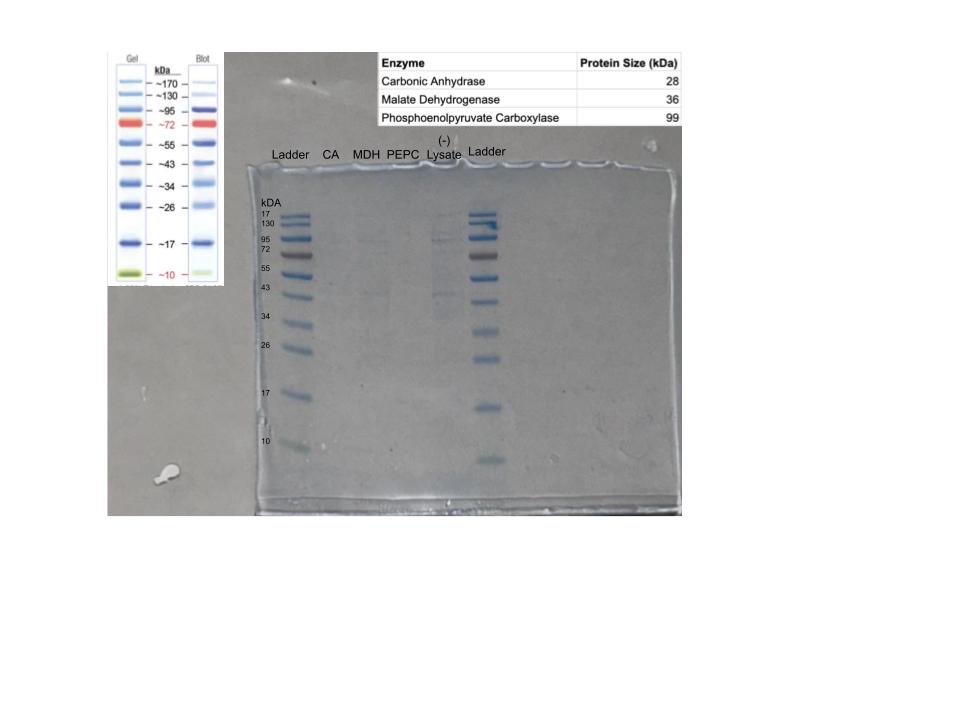
The gel results were interesting. The bands that appeared were very faint and some were nearly impossible to capture on camera. Based on visual interpretation (I promise I saw these bands): There were bands present at the expected MW for Carbonic Anhydrase and Malate Dehydrogenase. There were no bands present in the Phosphoenolypyruvate Carboxylase lane and there were control bands present in the Lysate lane. Because there were no bands at all present in the PEPC lane, its very likely that the loaded sample was too dilute so this did not invalidate that PEPC was expressed cell-free. Additionally, given the very faint bands across the entire gel, its likely that they were also quite dilute, which actually supports the data from the Mineralization and Fixation Assays.
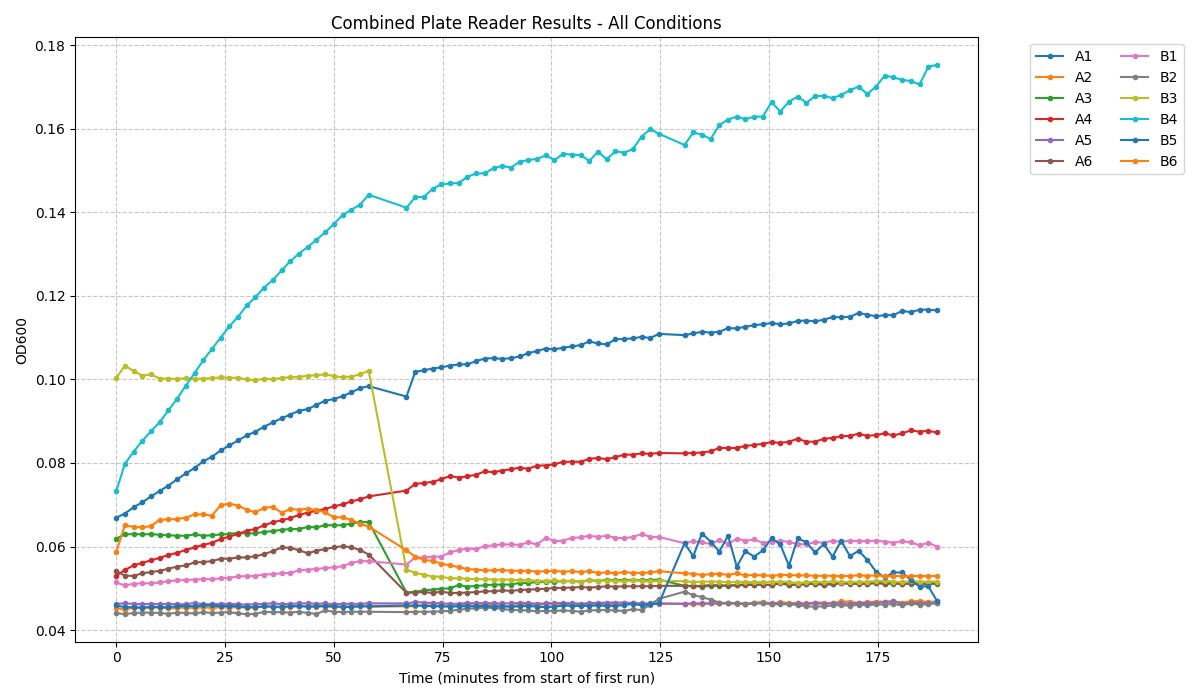
I was very excited with the results of this assay! Its important to note that conditions A(n) and B(n) differ only in the enzyme added. A’s all had the initial CFPS reaction I ran (the one with finnicky SDS-Page results) and B’s all had the secondary CFPS reaction that was prepared from the plasmids that I minipreped. Conditions n= 1-3 and n= 4-6 differ only in the carbon source, A’s using NaHCO3 and B’s using dissolved CO2 from my Sodastream. B4 was the full reaction with dissolved CO2 and showed exactly what I had hoped: faster formation of calcium precipitate, indicating effective conversion of dissolved CO2 into bicarbonate! A4 yeilded a similar result, though at a diminished level which I hypothesize is due to low protein yeild in the initial CFPS reaction. A1 and B1, again, behaved as expected, and were the same reaction except dissolved CO2 was from NaHCO3 which in solution forms CO2. The 6’s and 3’s both behaved as expected: these were reactions without calcium chloride, so they maintained a constant turbidity as no precipitate was forming (there are some weird step-function looking shapes that are almost definetely experimental artificat. Each incidence happens when the script finished and then resumed again, so the OD calibration might have been effected, but within a 1 hour interval, the value stayed constant). Overall very happy with these results!
Fixation Assay
,
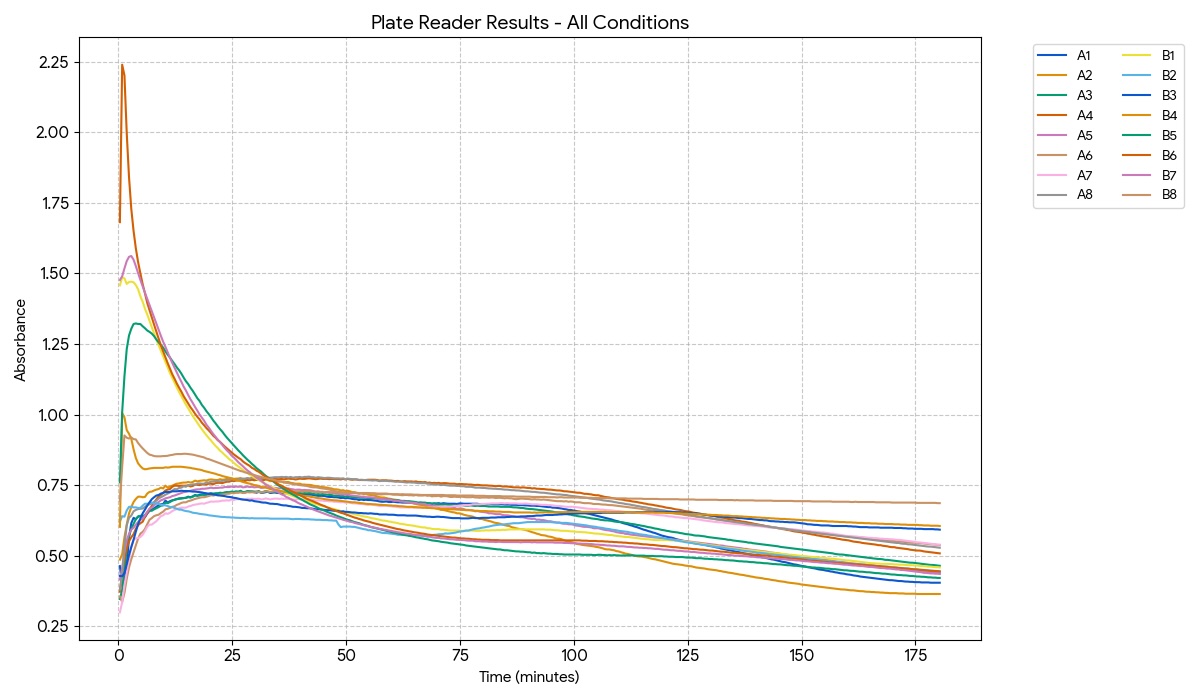
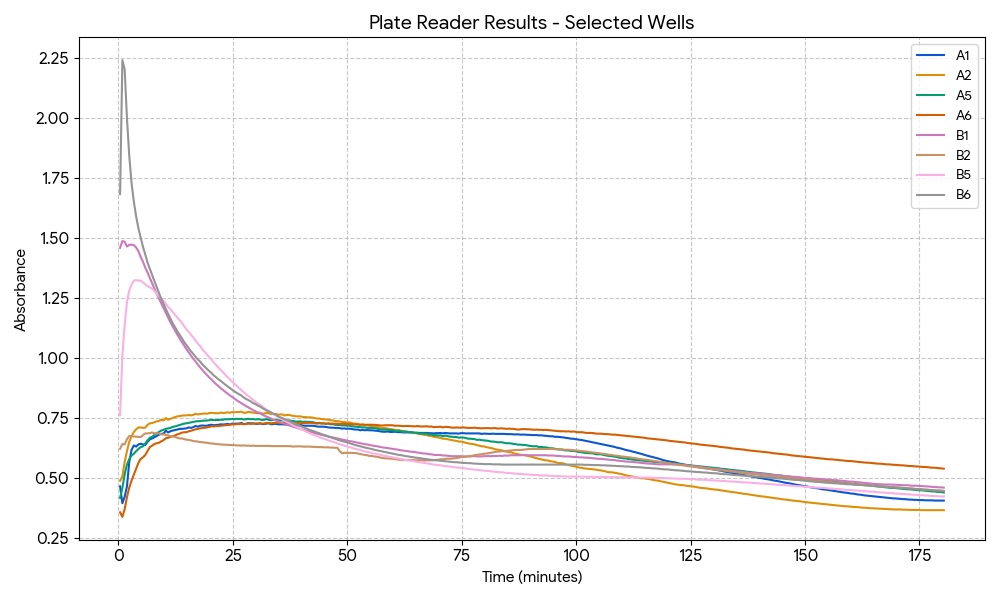
This assay was a little more interesting, but again I was definitely very happy with the overall results! Its important to note that conditions A(n) and B(n) differ only in the enzyme added. A’s all had the initial CFPS reaction I ran (the one with finnicky SDS-Page results) and B’s all had the secondary CFPS reaction that was prepared from the plasmids that I minipreped. Conditions n= 1-4 and n= 5-8 differ only in the carbon source, A’s using NaHCO3 and B’s using dissolved CO2 from my Sodastream. Consumption of NADH should result in a decrease in absorbance at 340nm. This should be the case in wells n=1,2,5, and 6. 1 and 5 are full reaction conditions, and 2 and 6 are missing only Carbonic Anhydrase which is a catalyst that increases HCO3 availability in the reaciton, but is not necessary for the reaction cascade to proceed. Other conditions removed PEPC or MDH, and both are necessary for NADH consuption to occur. The way the results played out are as follows: The conditions yeilded expected results for the functional, experimental groups but in weird ways. The B’s had the biggest initial absorbance then decline, where as the A’s had a smaller initial absorbance followed by their decline. However, the other groups also featured a decline in abosorbance over time, but strangely. NADH is unstable so there was likely oxidation and reduction of other substances within the reaction that caused the decline in NADH as it became NAD+. However, looking at the data with all wells, the 1,2,5,6 samples are the cluster that are the lowest on the graph! And after running some statistics across the conditions (comparing experimental to constants (A1 vs A3, A1 vs A4, etc.)) the rate and total absorbance were statistically significant (p < 10^-40) and the normalized rates and absorbances were also significant to the same degree. So despite the weird curves, there was a significant, measurable difference in NADH consumption, indicating that the reactions were successful, and CO2 was being fixed into malate!
Summary
Overall I had a really incredible experience working on my final project and through this class in general. I want to give special thanks to Ronan who supported me through long lab hours and even while I was away to make this final project come together. I am excited and proud to say that my final project was a success!
I designed 3 distinct plasmids with custom t7 promoters and 7x Histidines tags that were successfully created
The proteins I selected are very complex and large, and yet were expressed cell-free which is remarkable!
My assays provided effective proof of concept: measurable CO2 conversion into HCO3 and measurable fixation into 4-C Malate
With these results I would be eager to further explore making this system a reality. I assayed across one set of buffer conditions and can experiment with adjusting the buffer conditions to find an optimal rate for the system! I assayed across one temperature and can add that variable into testing. I used the enzymes in their wildtype form and can now try and optimize them to increase stablity, efficiency, and availability with language models! This project has opened the door for what is possible with biology and cell-free reactions and I am excited to continue doing work in this field.