Week 11 — Bioproduction & Cloud Labs
Homework
Part A: The 1,536 Pixel Artwork Canvas | Collective Artwork
Assignees for this section MIT/Harvard students Required Committed Listeners Required
Contribute at least one pixel to this global artwork experiment before the editing ends on Sunday 4/19 at 11:59 PM EST.
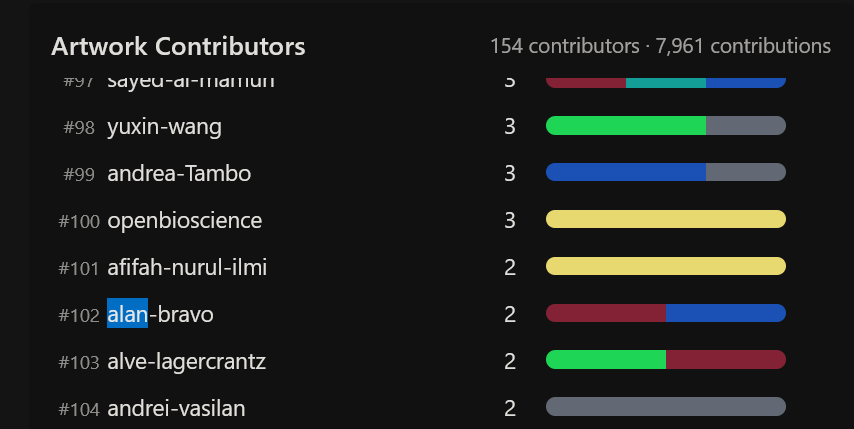
Make a note on your HTGAA webpages including:
what you contributed to the community bioart project (e.g., “I made part of the DNA on the bottom right plate”)
If I recall correctly, I was helping on the HTGAA spelling in the bottom left corner!
what you liked about the project, and
what about this collaborative art experiment could be made better for next year.
I love the inspiration from r/place, I actually have participated in r/place twice! I think we could work with more space (if, physically possible). That’d be neat.
Part B: Cell-Free Protein Synthesis | Cell-Free Reagents
E. coli Lysate
BL21 (DE3) Star Lysate (includes T7 RNA Polymerase)
It is for the conversion of RNA to DNA via retrotranscription
Salts/Buffer
Potassium Glutamate
A co-factor that provides a source of potassium ions for the enzyme HEPES-KOH pH 7.5 This is the buffer, and it sets the pH to an optimal one for the enzyme Magnesium Glutamate A co-factor that provides a source of magnesium ions for the enzyme
Potassium phosphate monobasic
Potassium phosphate dibasic
So these two tend to go together as buffering salts (they too help with the pH), and as phosphate sources (as this helps with ATP regeneration systems)
Energy / Nucleotide System
Ribose
Ribose is essential because of Deoxyribose, from Deoxyribose Nucleic Acid (aka DNA), so, it’s the backbone of nucleotides.
Glucose
Glucose is the energy source, some CFPS platforms use glucose-6-phosphate too
AMP
While this is an indicator of low ATP, this too when coupled with inorganic polyphosphate, polyphosphate and AMP phosphotransferase, it can be regenerated from AMP to ADP (Itoh et al., 2006).
CMP
This is a precursor to cytidine triphosphate (CTD), which is a nucleotide
GMP
This is a precursor to guanosine triphosphate (GTP), which is required by the ribosome
UMP
This is a precursor to uridine triphosphate (UTP), one of 4 ribonucleotides required for transcription
Guanine
This is a precurstor to both GMP and GTP!
Translation Mix (Amino Acids)
17 Amino Acid Mix
Aminoacids are very much needed by the ribosome in order to synthesize proteins
Tyrosine
It is another aminoacid, however, at pH 12 it is more concentrated
Cysteine
This is yet another aminoacid, however, this one’s very reactive and oxidizes very quickly
Additives
Nicotinamide
Precursor for NAD+ and NADP+
Backfill
Nuclease Free Water
Well the water needs to be free of nucleases in order for the nucleotides bonds to remain intact
Describe the main differences between the 1-hour optimized PEP-NTP master mix and the 20-hour NMP-Ribose-Glucose master mix shown in the Google Slide above. (2-3 sentences)
They can be be differentiated from the energy components, because these will dictate also how long these reactions will keep going. The 1-hour one uses PEP and nucleoside triphosphates, so they’re going for fast yields, while the 20-hour one uses simple precursors and glucose for ATP regeneration
Bonus question: How can transcription occur if GMP is not included but Guanine is?
I would assume that guanine would be able to then later become GMP with an added enzyme (or enzymes) that do(es) this
Part C: Planning the Global Experiment | Cell-Free Master Mix Design
Given the 6 fluorescent proteins we used for our collaborative painting, identify and explain at least one biophysical or functional property of each protein that affects expression or readout in cell-free systems. (Hint: options include maturation time, acid sensitivity, folding, oxygen dependence, etc) (1-2 sentences each)
The amino acid sequences are shown in the HTGAA Cell-Free Benchling folder.
sfGFP: it is reported to mature in just 13.6 minutes, so fluorescence appears quite quickly.
mRFP1: in here we can see quite the opposite, fluorescence appears pretty slowly given that the maturation time is 60 minutes
mKO2: we can see the same here in mKO2, except that the maturation time is doubled, with 108 minutes until maturation. These last 2 proteins are already expressed but it'll take a while until fluorescence (and consequently, readouts) happens.
mTurquoise2: mTurquoise2 has a pretty decent readout time thanks to its maturation time which is 33.5 minutes.
mScarlet_I: comparted to mRFP1, its maturation time is almost tripled with a 174 minute maturation time.
Electra2: a very bright protein! since it has a reported brightness of 61.48, maturation time however is unknown.
Create a hypothesis for how adjusting one or more reagents in the cell-free mastermix could improve a specific biophysical or functional property you identified above, in order to maximize fluorescence over a 36-hour incubation. Clearly state the protein, the reagent(s), and the expected effect.
We’re gonna go with mScarlet_I
In an article by Liu et al., (2021), it is mentioned that mSCarlet_I is pretty sensitive to pH changes. So that’s what we’re going to tackle here
So if we’re going to go for a 36-hour incubation, we have to keep in mind the pH changes that could happen, and to avoid them, I’d focus on buffering strength with HEPES-KOH and keeping the potassium phosphate & glutamate balance near neutral pH. I’d expect this sensitive protein to hopefully last around the incubation period of 36 hours.
The second phase of this lab will be to define the precise reagent concentrations for your cell-free experiment. You will be assigned artwork wells with specific fluorescent proteins and receive an email with instructions this week (by April 24). You can begin composing master mix compositions here.
- Potassium Glutamate 312.56 mM
- HEPES-KOH pH 7.5 61.25 mM
- Magnesium Glutamate 15.72 mM
- Potassium phosphate dibasic 5.63 mM
- Potassium phosphate monobasic 5.63 mM
- 17 Amino Acid Mix 4.06 mM
- Tyrosine pH 12 4.06 mM
- Cysteine 4.00 mM
- Nicotinamide 3.13 mM
- AMP 625.00 uM
- CMP 375.00 uM
- UMP 375.00 uM
- Guanine 156.25 uM
- Ribose 11.625 g/L
- Glucose 1.250 g/L
- Nuclease-Free Water 1.325 uL
This is what I’ve come up with! As I previously mentioned, HEPES-KOH is great to keep for a protein like the mScarlet_I, and I also noticed there’s not a whole lot MgGlutamate compared to KGlutamate, so I tweaked that as well.
Part D: Build-A-Cloud-Lab | (optional) Bonus Assignment
If given the chance, I’ll do it, because it looks really cool! If this page doesn’t change by the deadline though, you may assume I wasn’t able to do it in time.
Anyways, as this is the end, please, feel free to go to my final project. Cheers!
https://pages.htgaa.org/2026a/alan-bravo/projects/individual-final-project/index.html
References:
Bak, D. W., Bechtel, T. J., Falco, J. A., & Weerapana, E. (2019). Cysteine reactivity across the subcellular universe. Current opinion in chemical biology, 48, 96–105. https://doi.org/10.1016/j.cbpa.2018.11.002
Calhoun, K. A., & Swartz, J. R. (2005). Energizing cell-free protein synthesis with glucose metabolism. Biotechnology and bioengineering, 90(5), 606–613. https://doi.org/10.1002/bit.20449
Harman, J. (2021). Development of a cell-free strategy for the directed evolution of enzymes for high-value natural products (Master’s thesis, University of Kent (United Kingdom)). https://kar.kent.ac.uk/99209/1/88Thesis_-_Joshua_Harman_complete.pdf
Itoh, H., Kawazoe, Y., & Shiba, T. (2006). Enhancement of protein synthesis by an inorganic polyphosphate in an E. coli cell-free system. Journal of microbiological methods, 64(2), 241–249. https://doi.org/10.1016/j.mimet.2005.05.003
Liu, A., Huang, X., He, W., Xue, F., Yang, Y., Liu, J., Chen, L., Yuan, L., & Xu, P. (2021). pHmScarlet is a pH-sensitive red fluorescent protein to monitor exocytosis docking and fusion steps. Nature Communications 2021 12:1, 12(1), 1413-. https://doi.org/10.1038/s41467-021-21666-7