Individual Final Project
Autologous engraftment of immunoengineered hematopoietic stem cells for Env-targetting broad neutralizing antibodies
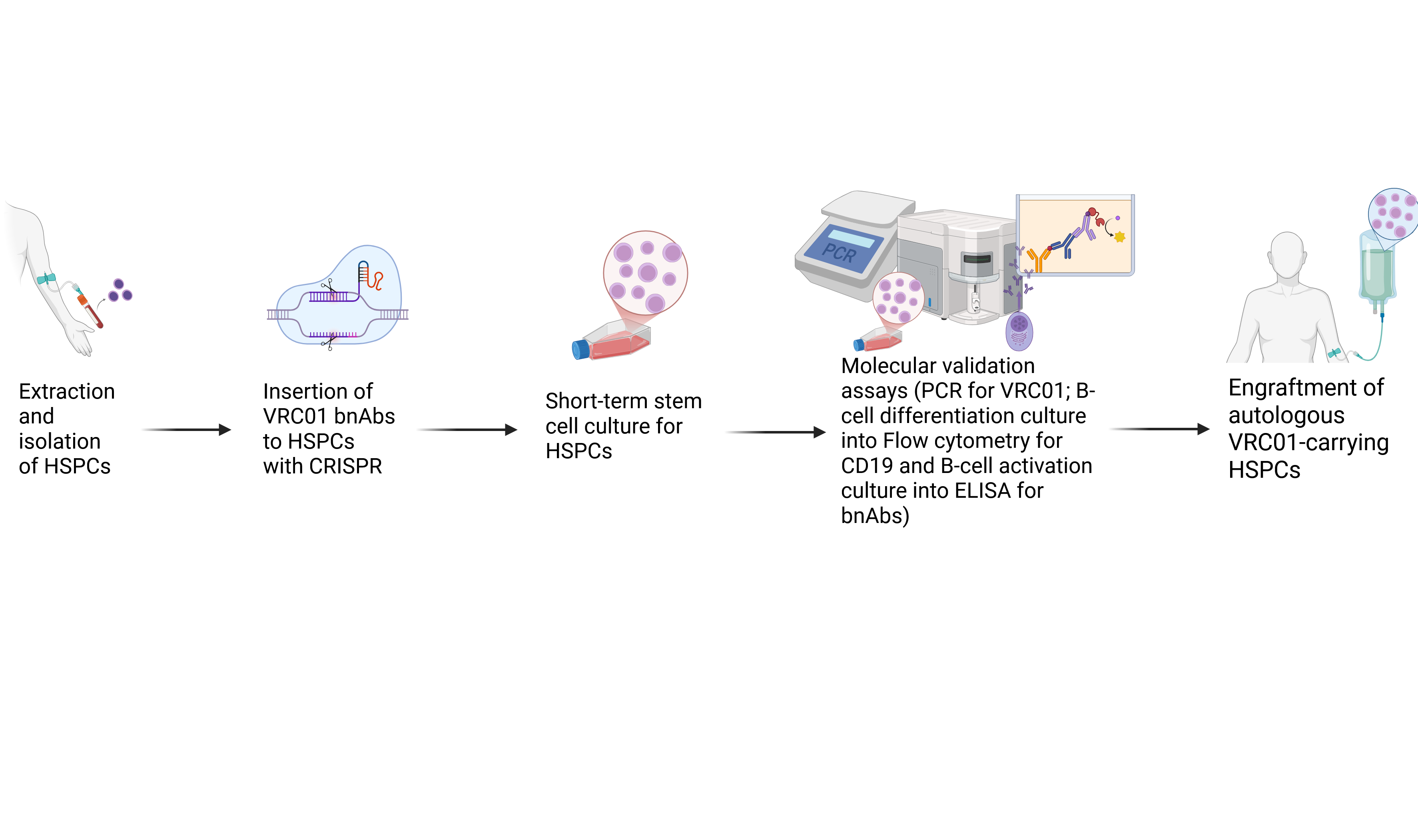
Thank you for allowing me to present this idea (https://docs.google.com/presentation/d/1vxVu8kgoHVHmmDpRqoX6xxGv62YjuYbUX5MRlUITn7I/edit?slide=id.SLIDES_API1013492449_4099#slide=id.SLIDES_API1013492449_4099)
At the very end, bibliographic references, among relevant information such as sequences and their origin will be found there.
Addendum: Some things were explained during the presentation, such as:
- CCR5 being the target because people who have a malfunctioning CCR5 are just fine! So it is considerably a ‘healthy’ target.
SECTION 1: Abstract
Generating humoral immunity against HIV, particularly the difficulty of eliciting broadly neutralizing antibodies (bnAbs) through conventional vaccination remains a challenge. Current approaches rely on complex immune maturation pathways that are inefficient and often impaired in immunocompromised individuals, highlighting the need for alternative strategies. The objective here is to develop a stem cell–based immunoengineering platform capable of producing long-term, self-renewing humoral immunity by genetically programming antibody specificity. The hypothesis here is that autologous hematopoietic stem cells engineered to carry predefined anti-HIV Env bnAb heavy and light chain genes will differentiate into B-cell lineages that express functional bnAb receptors, then produce the antibodies that are predefined. The first milestone will consist of the design of a construct encoding bnAb heavy and light-chain sequences, which can be gathered from scientific literature, secondly, perform CRISPR-mediated genome editing in human CD34+ hematopoietic stem and progenitor cells, and third, evaluate differentiation into B-cell progeny and expression of the engineered receptor.
Methods will include ex vivo isolation of CD34+ HSPCs from peripheral blood, CRISPR-Cas9–based genome editing, short-term stem cell culture for HSPCs, and validation through molecular assays, sequencing, and flow cytometry to confirm integration and antigen-specific receptor expression.
SECTION 2: Project Aims
Aim 1: Experimental Aim
The first aim of my final project is to genetically engineer autologous hematopoietic stem cells to carry predefined anti-HIV Env broadly neutralizing antibody heavy and light-chain genes, so that their B-cell progeny express an HIV-specific broadly neutralizing B-cell receptor, by utilizing CRISPR-based gene editing, a DNA design for bnAb heavy and light chain insertion, ex vivo HSC culture, and differentiation and molecular validation assays.
Aim 2: Development Aim
This could shift prevention and treatment from repeated drug administration to a one-time or very infrequent treatment.
Aim 3: Visionary Aim
If fully realized, this approach would challenge the current paradigm of lifelong antiretroviral therapy by overcoming the challenge that viruses like HIV, denguevirus, and influenza has: mutations and serotypes. Essentially, this could be a universal treatment if done for each virus that has these kind of challenges.
SECTION 3: Background
Briefly summarize two peer-reviewed research citations relevant to your research (minimum four sentences).
A very relevant study by Jardine et al., (2016) shows that immunogens like eOD-GT8 can activate rare VRC01-class precursor B cells and recover their paired heavy and light chain sequences, but these cells are extremely rare and require complex maturation.
And another one, by Porteus et al., (2026), which demonstrates that CRISPR-edited HSPCs can be genetically engineered to produce B cells that secrete functional antibodies.
Explain how your project is novel or innovative. (Minimum 3 sentences.)
This is innovative because it applies CRISPR-based genome engineering of hematopoietic stem cells to directly program the production of HIV broadly neutralizing antibodies, rather than relying on immunogems to elicit them. It introduces a new approach that assures the generation of B-cells with predefined production of bnAbs that are known to neutralize HIV virions. This challenges the existing belief that protective immunity must be induced through immunogens.
SECTION 4: Experimental design, techniques, tools and technology
(I believe this comes from the homework from one of the weeks)
Please identify at least one (ideally many) aspect(s) of your project that you will measure. It could be the mass or sequence of a protein, the presence, absence, or quantity of a biomarker, etc.
- The integration of the VRC01 sequence in the hematopoietic cells.
Please describe all of the elements you would like to measure, and furthermore describe how you will perform these measurements.
- VRC01 sequence (bnAbs that target Env) in the hematopoietic cells
- A GFP reporter gene
What are the technologies you will use (e.g., gel electrophoresis, DNA sequencing, mass spectrometry, etc.)? Describe in detail.
- Flow cytometry we can get to know how many cells have been genetically modified.
- PCR can be done too, targetting the construct we’ve inserted with primers designed just for that.
VRC01 Sequencing:
4S1R_2|Chain B[auth H]|Fab of VRC01-lineage antibody,45-VRC01.H08.F-117225 heavy chain|Homo sapiens (9606) QVRLVQSGPQIKTPGASVTISCGTSGYDFMESLINWVRQDIGKGPEWMGWINPRGGGVNYGRRFQGKVTMTRDVSSGTAYLTLRGLTSDDTAKYYCVRGKSCCGGRRYCNGADCFNWDFEHWGQGTLVIVSSASTKGPSVFPLAPSSKSTSGGTAALGCLVKDYFPEPVTVSWNSGALTSGVHTFPAVLQSSGLYSLSSVVTVPSSSLGTQTYICNVNHKPSNTKVDKKVEPKSC 4S1R_3|Chain C[auth L]|Fab of VRC01 light chain|Homo sapiens (9606) EIVLTQSPGTLSLSPGETAIISCRTSQYGSLAWYQQRPGQAPRLVIYSGSTRAAGIPDRFSGSRWGPDYTLTISNLESGDFGVYYCQQYEFFGQGTKVQVDIKRTVAAPSVFIFPPSDEQLKSGTASVVCLLNNFYPREAKVQWKVDNALQSGNSQESVTEQDSKDSTYSLSSTLTLSKADYEKHKVYACEVTHQGLSSPVTKSFNRGEC
And as for the workflow, it’s the first image in this page! Here it is once more:
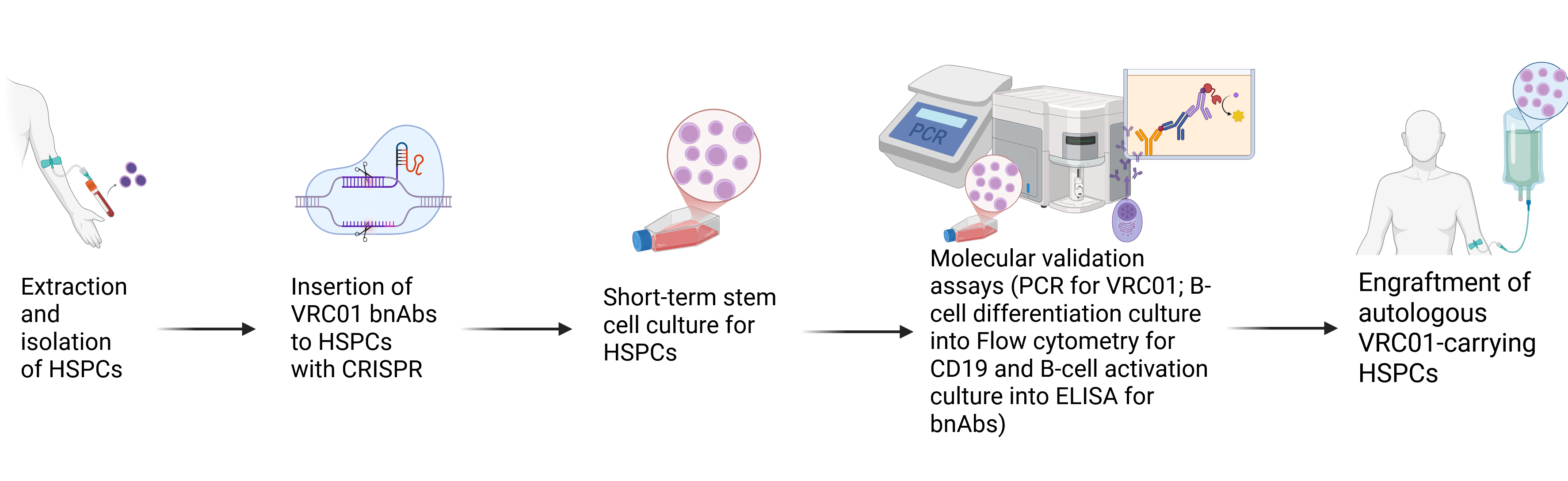
A detailed experimental plan for your final project. Include a timeline for each part of your experimental plan (i.e., how long you would expect each step in your final project to take).
- Design a CCR5-targeting sgRNA and assemble the AAV6 donor cassette containing VRC01 heavy/light chain sequences, immunoglobulin promoter/enhancer elements, P2A peptide, homology arms, etc (This genuinely took me 2 weeks, I’ve never done CRISPR designs before).
- First administrate G-CFS and plerixafor to mobilize CD34+ HSPCs, then from peripheral blood through perform mononuclear cell isolation, red blood cell lysis, and magnetic enrichment of lineage-negative/CD34+ cells, followed by short-term cytokine-supported ex vivo culture (Rodríguez et al., 2021). (1 week).
- Perform CRISPR-Cas9 genome editing through electroporation and AAV6-mediated donor delivery for insertion into the CCR5 locus (1 week).
- Validate successful integration through sequencing of the edited CCR5 locus (1 week).
- Differentiate edited HSPCs toward the B-cell lineage using StemSpan™ B Cell Differentiation Supplement 3, followed by flow cytometry analysis of CD19/CD20 expression (2 weeks).
- Activate differentiated B cells to stimulate antibody secretion with Miltenyi Biotec B Cell Expansion Kit and evaluate VRC01 bnAb production through ELISA (1 week).
Place a check next to the techniques relevant to your project. (I’m gonna list them off because I often have trouble with syntaxing)
Pipetting Pipetting✅ Bioethical Considerations✅
Bioproduction Plasmid Preparation✅
DNA Gel Art DNA Sequencing✅ DNA Editing✅ DNA Construct Design✅ Databases (e.g., GenBank, NCBI, Ensembl, and UCSC Genome Browser)✅ Gel Electrophoresis✅
Lab Automation Designing a Twist Order✅
Gibson Assembly Primer Design or Selection✅
CRISPR CRISPR/Cas9✅ Designing Prime Editing gRNA✅
Talking about CRISPR, here’s some relevant images:
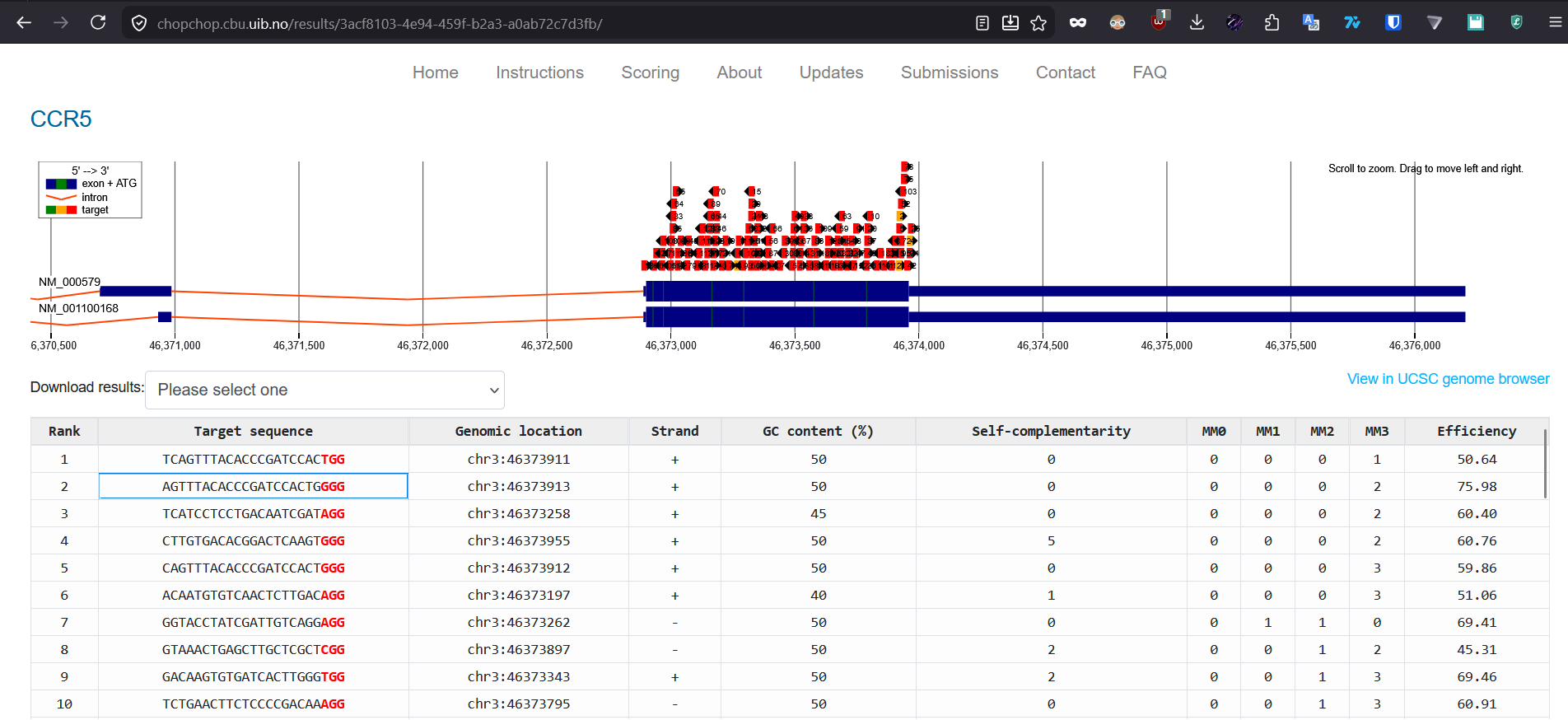
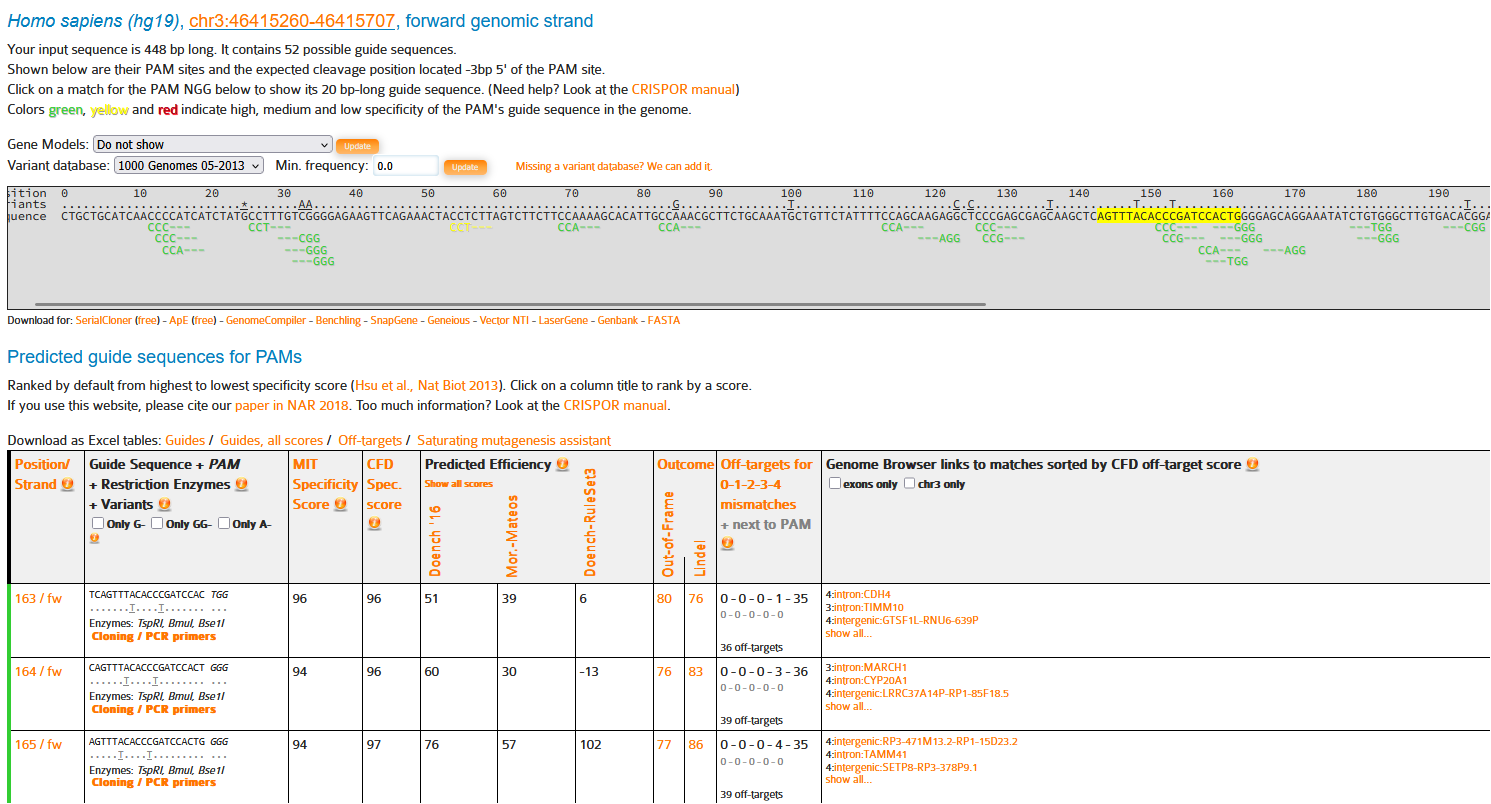
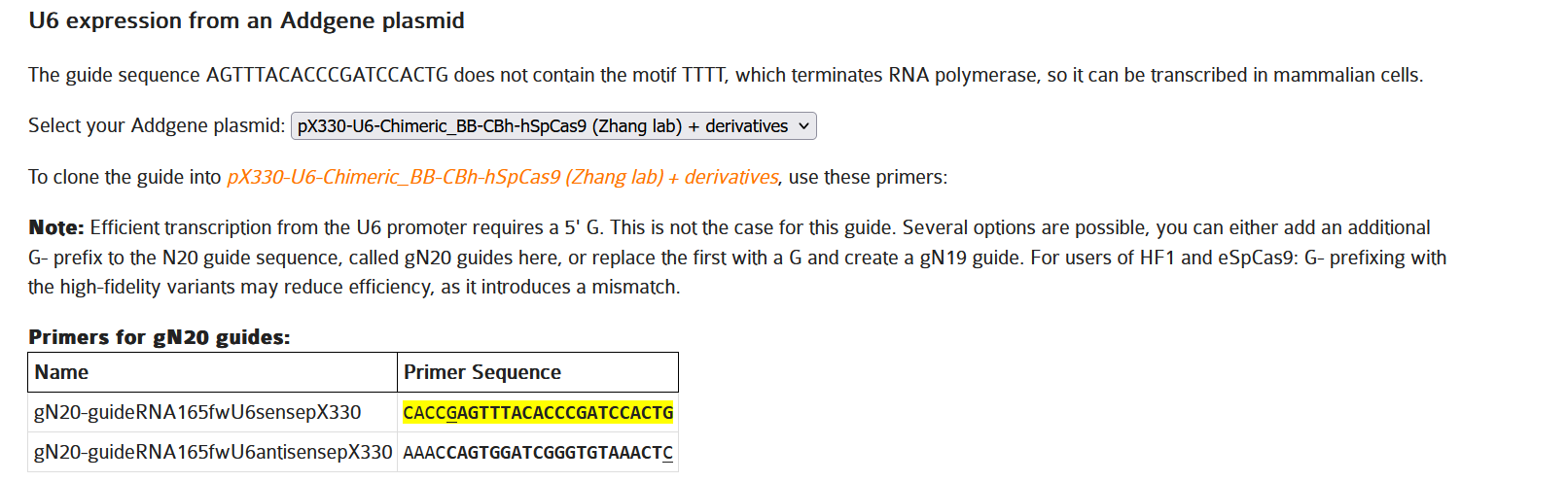
This took a week for me to learn. Pretty fun admittedly!
1. Expand upon two techniques you checked in the previous question by describing how you would utilize those techniques in your final project. (min. 4 sentences)
I’d use CRISPR because I consider that is the safest way to genetically modified cells. The point after all is to make have the HSPCs already know what antibody to produce, and because adjuvants are rarely enough, desining a prime editing gRNA is one of the first steps to take into consideration for a project like this.
SECTION 5: Results & Quantitative Expectations
You are required to validate at least one aspect of your final project aims
I have chosen to validate: Performing a PCR reaction using primers relevant to my final project
Write down a detailed protocol of how you validated this aspect of your final project. (Numbered list or paragraph is fine)
- Design primers to amplify the beginning and the end of the CCR5 locus in order to verify the integration of the VRC01 bnAb casette
- Using agenomic DNA template, the designed forward and rever primers, a DNA polymerase master mix, nuclease-free water and dNTPs, PCR would be performed in a thermocycler.
- The product would then be analyzed through agarose gel electrophoresis to confirm the presence of the inserted DNA (given that wek now the size of it) using a molecular ladder.
What synthetic biology techniques did you utilize in validating this aspect of your final project? You can refer to the list of techniques in question 8. (min. 4 sentences)
CRISPR/Cas9 genome editing (for the insertion of a foreign gene), primer design (for electrophoresis), PCR reactions (also for electrophoresis), gel electrophoresis (to see if the gene has been indeed inserted), DNA sequencing (can also be used to verify gene integration), and DNA construct design (the design of the gene that’s going to be inserted).
Adding now Gel Electrophoresis to the checkmark list above
You must present data as part of your final project and include some analysis of that data. The data may be collected experimentally in the lab or generated as simulated data (e.g., using the Asimov Kernel or another simulation method). (min. 2 sentences)
I will refer to my ChopChop results for this.
So there were multiple options as to what gRNA to use in order to target CCR5, the likely most important thing to look at is the efficiency, which is predicted with GC content, self-complementarity, and potential off-targets for each gRNA generated. This is arguably the most important step because without this step, no other step is to be had, so knowing this data, as in, the efficiency, and analyzing every other result, it is essential to pick which option’s the best in order to make this experiment work.
Did you encounter any unexpected challenge(s) when performing your validation? If so, describe the challenge(s) and strategies to overcome it. If not, discuss potential problems, difficulties, limitations, and/or alternative strategies to overcome challenges in your final project. (min. 4 sentences).
I will answer that they were more a challenge of my own understanding rather than technical ones, given that I have a weak background on bioinformatics! But if I have to propose strategies, then, it is simply to read into the FAQ, about, and all documentation of a software or platform I may be using. Secondly, recur to YouTube tutorials if that doesn’t suffice. Third, if none of those options work, then recur to an LLM.
SECTION 6: ADDITIONAL INFORMATION
Bibliographic references
Jardine, J. G., Kulp, D. W., Havenar-Daughton, C., Sarkar, A., Briney, B., Sok, D., Sesterhenn, F., Ereño-Orbea, J., Kalyuzhniy, O., Deresa, I., Hu, X., Spencer, S., Jones, M., Georgeson, E., Adachi, Y., Kubitz, M., deCamp, A. C., Julien, J. P., Wilson, I. A., Burton, D. R., … Schief, W. R. (2016). HIV-1 broadly neutralizing antibody precursor B cells revealed by germline-targeting immunogen. Science (New York, N.Y.), 351(6280), 1458–1463.
Porteus, M., Luna, S., Feist, W., Utz, A., Afaghani, J., Miyauchi, M., … & Schmiderer, L. (2026). Engineered hematopoietic stem cells give rise to therapeutic antibody secreting B cells. https://www.researchsquare.com/article/rs-9269825/v1
Rodríguez, A., Filiatrault, J., Flores-Guzmán, P., Mayani, H., Parmar, K., & D’Andrea, A. D. (2021). Isolation of human and murine hematopoietic stem cells for DNA damage and DNA repair assays. STAR protocols, 2(4).
Wu, X., Yang, Z. Y., Li, Y., Hogerkorp, C. M., Schief, W. R., Seaman, M. S., Zhou, T., Schmidt, S. D., Wu, L., Xu, L., Longo, N. S., McKee, K., O’Dell, S., Louder, M. K., Wycuff, D. L., Feng, Y., Nason, M., Doria-Rose, N., Connors, M., Kwong, P. D., … Mascola, J. R. (2010). Rational design of envelope identifies broadly neutralizing human monoclonal antibodies to HIV-1. Science (New York, N.Y.), 329(5993), 856–861. https://doi.org/10.1126/science.1187659
- Create a supply list and budget for your project (bullet-point list) What supplies, equipment, and budget is needed for your project to work?
CD34+ HSPC isolation and enrichment materials: $1,256.00 (https://www.stemcell.com/products/stemspan-cd34-expansion-supplement-10x.html)
HSPC culture media and cytokines: Unknown (must request price https://www.stemcell.com/products/stemspan-sfem-ii.html)
CRISPR-Cas9 editing kit: $273.00 (https://www.takarabio.com/products/gene-function/gene-editing/crispr-cas9/mutation-detection-kits?srsltid=AfmBOoqOPcztPxrYpUjsZBhEP1ALiDK5ddSfOtnIadSUhsIWW1S1xuxF)
AAV6 donor vector production containing the VRC01 cassette: $860.00 (https://www.cellbiolabs.com/aav-6-packaging-system)
PCR and sequencing reagents: $68 (https://www.genscript.com/kit/L00342-High_Stability_PCR_Kit.html)
Flow cytometry antibodies and analysis reagents: $825.00 (https://www.miltenyibiotec.com/US-en/products/macs-flow-cytometry/kits-and-support-reagents.html)
B-cell differentiation and activation media/cytokine kits: $5,525.00 + $309.00 (https://www.miltenyibiotec.com/US-en/products/b-cell-expansion-kit-human.html) (https://www.stemcell.com/products/stemspan-b-cell-differentiation-supplement-3-20x.html)
ELISA reagents for bnAb detection: $3,365.00 (https://www.antibodies.com/products/elisa-kits)
Electrophoresis agarose gel: $201.40 (https://www.thermofisher.com/order/catalog/product/G401001)
Required equipment:
Biosafety cabinet
CO₂ incubator
PCR thermocycler
Gel electrophoresis system
Flow cytometer
Electroporator
CRISPR CONSTRUCTS / Twist Order
Construct 1: https://benchling.com/s/seq-JUNnre8HZRwtYLbAV7ER?m=slm-NLI7GfaPtF5eARNkdXdJ
Construct 2: https://benchling.com/s/seq-Ngzb3W2nNNFJV5ATbkWG?m=slm-RBkCoX91Qww1fGfqicPh
Sequences and their origin
ssgRNA (From CRISPOR and ChopChop, targetting knock-in for CCR5) GTTTTAGAGCTAGAAATAGCAAGTTAAAATAAGGCTAGTCCGTTATCAACTTGAAAAAGTGGCACCGAGTCGGTGC
CAS9_STRP1 (https://www.uniprot.org/uniprotkb/Q99ZW2/entry#sequences): atggataaaaaatatagcattggcctggatattggcaccaacagcgtgggctgggcggtg attaccgatgaatataaagtgccgagcaaaaaatttaaagtgctgggcaacaccgatcgc catagcattaaaaaaaacctgattggcgcgctgctgtttgatagcggcgaaaccgcggaa gcgacccgcctgaaacgcaccgcgcgccgccgctatacccgccgcaaaaaccgcatttgc tatctgcaggaaatttttagcaacgaaatggcgaaagtggatgatagcttttttcatcgc ctggaagaaagctttctggtggaagaagataaaaaacatgaacgccatccgatttttggc aacattgtggatgaagtggcgtatcatgaaaaatatccgaccatttatcatctgcgcaaa aaactggtggatagcaccgataaagcggatctgcgcctgatttatctggcgctggcgcat atgattaaatttcgcggccattttctgattgaaggcgatctgaacccggataacagcgat gtggataaactgtttattcagctggtgcagacctataaccagctgtttgaagaaaacccg attaacgcgagcggcgtggatgcgaaagcgattctgagcgcgcgcctgagcaaaagccgc cgcctggaaaacctgattgcgcagctgccgggcgaaaaaaaaaacggcctgtttggcaac ctgattgcgctgagcctgggcctgaccccgaactttaaaagcaactttgatctggcggaa gatgcgaaactgcagctgagcaaagatacctatgatgatgatctggataacctgctggcg cagattggcgatcagtatgcggatctgtttctggcggcgaaaaacctgagcgatgcgatt ctgctgagcgatattctgcgcgtgaacaccgaaattaccaaagcgccgctgagcgcgagc atgattaaacgctatgatgaacatcatcaggatctgaccctgctgaaagcgctggtgcgc cagcagctgccggaaaaatataaagaaattttttttgatcagagcaaaaacggctatgcg ggctatattgatggcggcgcgagccaggaagaattttataaatttattaaaccgattctg gaaaaaatggatggcaccgaagaactgctggtgaaactgaaccgcgaagatctgctgcgc aaacagcgcacctttgataacggcagcattccgcatcagattcatctgggcgaactgcat gcgattctgcgccgccaggaagatttttatccgtttctgaaagataaccgcgaaaaaatt gaaaaaattctgacctttcgcattccgtattatgtgggcccgctggcgcgcggcaacagc cgctttgcgtggatgacccgcaaaagcgaagaaaccattaccccgtggaactttgaagaa gtggtggataaaggcgcgagcgcgcagagctttattgaacgcatgaccaactttgataaa aacctgccgaacgaaaaagtgctgccgaaacatagcctgctgtatgaatattttaccgtg tataacgaactgaccaaagtgaaatatgtgaccgaaggcatgcgcaaaccggcgtttctg agcggcgaacagaaaaaagcgattgtggatctgctgtttaaaaccaaccgcaaagtgacc gtgaaacagctgaaagaagattattttaaaaaaattgaatgctttgatagcgtggaaatt agcggcgtggaagatcgctttaacgcgagcctgggcacctatcatgatctgctgaaaatt attaaagataaagattttctggataacgaagaaaacgaagatattctggaagatattgtg ctgaccctgaccctgtttgaagatcgcgaaatgattgaagaacgcctgaaaacctatgcg catctgtttgatgataaagtgatgaaacagctgaaacgccgccgctataccggctggggc cgcctgagccgcaaactgattaacggcattcgcgataaacagagcggcaaaaccattctg gattttctgaaaagcgatggctttgcgaaccgcaactttatgcagctgattcatgatgat agcctgacctttaaagaagatattcagaaagcgcaggtgagcggccagggcgatagcctg catgaacatattgcgaacctggcgggcagcccggcgattaaaaaaggcattctgcagacc gtgaaagtggtggatgaactggtgaaagtgatgggccgccataaaccggaaaacattgtg attgaaatggcgcgcgaaaaccagaccacccagaaaggccagaaaaacagccgcgaacgc atgaaacgcattgaagaaggcattaaagaactgggcagccagattctgaaagaacatccg gtggaaaacacccagctgcagaacgaaaaactgtatctgtattatctgcagaacggccgc gatatgtatgtggatcaggaactggatattaaccgcctgagcgattatgatgtggatcat attgtgccgcagagctttctgaaagatgatagcattgataacaaagtgctgacccgcagc gataaaaaccgcggcaaaagcgataacgtgccgagcgaagaagtggtgaaaaaaatgaaa aactattggcgccagctgctgaacgcgaaactgattacccagcgcaaatttgataacctg accaaagcggaacgcggcggcctgagcgaactggataaagcgggctttattaaacgccag ctggtggaaacccgccagattaccaaacatgtggcgcagattctggatagccgcatgaac accaaatatgatgaaaacgataaactgattcgcgaagtgaaagtgattaccctgaaaagc aaactggtgagcgattttcgcaaagattttcagttttataaagtgcgcgaaattaacaac tatcatcatgcgcatgatgcgtatctgaacgcggtggtgggcaccgcgctgattaaaaaa tatccgaaactggaaagcgaatttgtgtatggcgattataaagtgtatgatgtgcgcaaa atgattgcgaaaagcgaacaggaaattggcaaagcgaccgcgaaatattttttttatagc aacattatgaacttttttaaaaccgaaattaccctggcgaacggcgaaattcgcaaacgc ccgctgattgaaaccaacggcgaaaccggcgaaattgtgtgggataaaggccgcgatttt gcgaccgtgcgcaaagtgctgagcatgccgcaggtgaacattgtgaaaaaaaccgaagtg cagaccggcggctttagcaaagaaagcattctgccgaaacgcaacagcgataaactgatt gcgcgcaaaaaagattgggatccgaaaaaatatggcggctttgatagcccgaccgtggcg tatagcgtgctggtggtggcgaaagtggaaaaaggcaaaagcaaaaaactgaaaagcgtg aaagaactgctgggcattaccattatggaacgcagcagctttgaaaaaaacccgattgat tttctggaagcgaaaggctataaagaagtgaaaaaagatctgattattaaactgccgaaa tatagcctgtttgaactggaaaacggccgcaaacgcatgctggcgagcgcgggcgaactg cagaaaggcaacgaactggcgctgccgagcaaatatgtgaactttctgtatctggcgagc cattatgaaaaactgaaaggcagcccggaagataacgaacagaaacagctgtttgtggaa cagcataaacattatctggatgaaattattgaacagattagcgaatttagcaaacgcgtg attctggcggatgcgaacctggataaagtgctgagcgcgtataacaaacatcgcgataaa ccgattcgcgaacaggcggaaaacattattcatctgtttaccctgaccaacctgggcgcg ccggcggcgtttaaatattttgataccaccattgatcgcaaacgctataccagcaccaaa gaagtgctggatgcgaccctgattcatcagagcattaccggcctgtatgaaacccgcatt gatctgagccagctgggcggcgat
CMV Enhancer (https://benchling.com/benchling/f/lib_iuOubVW42Y-promoter-sequences/seq_pY99leaE-cmv-promoter/edit): CGTTACATAACTTACGGTAAATGGCCCGCCTGGCTGACCGCCCAACGACCCCCGCCCATTGACGTCAATAATGACGTATGTTCCCATAGTAACGCCAATAGGGACTTTCCATTGACGTCAATGGGTGGAGTATTTACGGTAAACTGCCCACTTGGCAGTACATCAAGTGTATCATATGCCAAGTACGCCCCCTATTGACGTCAATGACGGTAAATGGCCCGCCTGGCATTATGCCCAGTACATGACCTTATGGGACTTTCCTACTTGGCAGTACATCTACGTATTAGTCATCGCTATTACCATG
CMV Promoter (https://benchling.com/benchling/f/lib_iuOubVW42Y-promoter-sequences/seq_pY99leaE-cmv-promoter/edit): GTGATGCGGTTTTGGCAGTACATCAATGGGCGTGGATAGCGGTTTGACTCACGGGGATTTCCAAGTCTCCACCCCATTGACGTCAATGGGAGTTTGTTTTGGCACCAAAATCAACGGGACTTTCCAAAATGTCGTAACAACTCCGCCCCATTGACGCAAATGGGCGGTAGGCGTGTACGGTGGGAGGTCTATATAAGCAGAGCT
U6 Promoter (https://www.addgene.org/browse/sequence/135959/) gagggcctatttcccatgattccttcatatttgcatatacgatacaaggctgttagagagataattggaattaatttgactgtaaacacaaagatattagtacaaaatacgtgacgtagaaagtaataatttcttgggtagtttgcagttttaaaattatgttttaaaatggactatcatatgcttaccgtaacttgaaagtatttcgatttcttggctttatatatcttgtggaaaggacgaaacacc
B-cell promoter + enhancer (gathered elements such as the Heptamer + Octamer from https://www.pnas.org/doi/epdf/10.1073/pnas.84.21.7634 , E6 enhancer from https://pubmed.ncbi.nlm.nih.gov/1986254/) CCGAAACTGAAAAGGCCGAAACTGAAAAGGCCGAAACTGAAAAGGCCGAAACTGAAAAGGCTCACCAATGCAAATTATAAAA
Left AAV2 ITR (https://parts.igem.org/Part:BBa_K5471021) cgcgctcgctcgctcactgaggccgcccgggcaaagcccgggcgtcgggcgacctttggtcgcccggcctcagtgagcgagcgagcgcgcagagagggagtggccaactccatcactaggggttcct
Right AAV2 ITR (https://parts.igem.org/Part:BBa_K5471022) aggaacccctagtgatggagttggccactccctctctgcgcgctcgctcgctcactgaggccgggcgaccaaaggtcgcccgacgcccgggctttgcccgggcggcctcagtgagcgagcgagcgcg
Kozak sequence (https://pmc.ncbi.nlm.nih.gov/articles/PMC10819008/) GCCGCCACCATGG
VRC01 broadly neutralizing antibody for HIV Env protein (Extracted the heavy chain, added a linker, plus extracted teh light chain) (https://www.rcsb.org/structure/3NGB). First, starting off with the heavy chain, reverse translated caggtgcgcctggtgcagagcggcccgcagattaaaaccccgggcgcgagcgtgaccatt agctgcggcaccagcggctatgattttatggaaagcctgattaactgggtgcgccaggat attggcaaaggcccggaatggatgggctggattaacccgcgcggcggcggcgtgaactat ggccgccgctttcagggcaaagtgaccatgacccgcgatgtgagcagcggcaccgcgtat ctgaccctgcgcggcctgaccagcgatgataccgcgaaatattattgcgtgcgcggcaaa agctgctgcggcggccgccgctattgcaacggcgcggattgctttaactgggattttgaa cattggggccagggcaccctggtgattgtgagcagcgcgagcaccaaaggcccgagcgtg tttccgctggcgccgagcagcaaaagcaccagcggcggcaccgcggcgctgggctgcctg gtgaaagattattttccggaaccggtgaccgtgagctggaacagcggcgcgctgaccagc ggcgtgcatacctttccggcggtgctgcagagcagcggcctgtatagcctgagcagcgtg gtgaccgtgccgagcagcagcctgggcacccagacctatatttgcaacgtgaaccataaa ccgagcaacaccaaagtggataaaaaagtggaaccgaaaagctgc
G4S₃ Linker (https://www.ptglab.com/pdf/gmpantibodydatasheet?catNo=CT-1002) GGGGSGGGGSGGGGS
reverse translation of G4S₃ Linker ggcggcggcggcagcggcggcggcggcagcggcggcggcggcagc
reverse translation of light chain gaaattgtgctgacccagagcccgggcaccctgagcctgagcccgggcgaaaccgcgatt attagctgccgcaccagccagtatggcagcctggcgtggtatcagcagcgcccgggccag gcgccgcgcctggtgatttatagcggcagcacccgcgcggcgggcattccggatcgcttt agcggcagccgctggggcccggattataccctgaccattagcaacctggaaagcggcgat tttggcgtgtattattgccagcagtatgaattttttggccagggcaccaaagtgcaggtg gatattaaacgcaccgtggcggcgccgagcgtgtttatttttccgccgagcgatgaacag ctgaaaagcggcaccgcgagcgtggtgtgcctgctgaacaacttttatccgcgcgaagcg aaagtgcagtggaaagtggataacgcgctgcagagcggcaacagccaggaaagcgtgacc gaacaggatagcaaagatagcacctatagcctgagcagcaccctgaccctgagcaaagcg gattatgaaaaacataaagtgtatgcgtgcgaagtgacccatcagggcctgagcagcccg gtgaccaaaagctttaaccgcggcgaatgc
SV40 polyA (https://parts.igem.org/wiki/index.php?title=Part:BBa_K4235020&diff=591364&oldid=591058) aacttgtttattgcagcttataatggttacaaataaagcaatagcatcacaaatttcacaaataaagcatttttttcactgcattctagttgtggtttgtccaaactcatcaatgtatcttatcatgtctggatc
Left Homology Arm (https://genome.ucsc.edu/cgi-bin/hgc?hgsid=3963386416_Q1Nl8NlvkAdxJ4zt3LsdfkHg0FbK&g=htcDnaNearGene&i=ENST00000292303.5&c=chr3&l=46370945&r=46376206&o=knownGene&boolshad.hgSeq.promoter=0&hgSeq.promoterSize=1000&hgSeq.utrExon5=on&boolshad.hgSeq.utrExon5=0&hgSeq.cdsExon=on&boolshad.hgSeq.cdsExon=0&hgSeq.utrExon3=on&boolshad.hgSeq.utrExon3=0&hgSeq.intron=on&boolshad.hgSeq.intron=0&boolshad.hgSeq.downstream=0&hgSeq.downstreamSize=1000&hgSeq.granularity=gene&hgSeq.padding5=0&hgSeq.padding3=0&boolshad.hgSeq.splitCDSUTR=0&hgSeq.casing=upper&boolshad.hgSeq.maskRepeats=0&hgSeq.repMasking=lower&submit=submit) CTGCAGCTCTCAT TTTCCATACAGTCAGTATCAATTCTGGAAGAATTTCCAGACATTAAAGAT AGTCATCTTGGGGCTGGTCCTGCCGCTGCTTGTCATGGTCATCTGCTACT CGGGAATCCTAAAAACTCTGCTTCGGTGTCGAAATGAGAAGAAGAGGCAC AGGGCTGTGAGGCTTATCTTCACCATCATGATTGTTTATTTTCTCTTCTG GGCTCCCTACAACATTGTCCTTCTCCTGAACACCTTCCAGGAATTCTTTG GCCTGAATAATTGCAGTAGCTCTAACAGGTTGGACCAAGCTATGCAGGTG ACAGAGACTCTTGGGATGACGCACTGCTGCATCAACCCCATCATCTATGC CTTTGTCGGGGAGAAGTTCAGAAACTACCTCTTAGTCTTCTTCCAAAAGC ACATTGCCAAACGCTTCTGCAAATGCTGTTCTATTTTCCAGCAAGAGGCT CCCGAGCGAGCAAGCTCAGTTTACACCCGATCCACTG
Right Homology Arm (https://genome.ucsc.edu/cgi-bin/hgc?hgsid=3963386416_Q1Nl8NlvkAdxJ4zt3LsdfkHg0FbK&g=htcDnaNearGene&i=ENST00000292303.5&c=chr3&l=46370945&r=46376206&o=knownGene&boolshad.hgSeq.promoter=0&hgSeq.promoterSize=1000&hgSeq.utrExon5=on&boolshad.hgSeq.utrExon5=0&hgSeq.cdsExon=on&boolshad.hgSeq.cdsExon=0&hgSeq.utrExon3=on&boolshad.hgSeq.utrExon3=0&hgSeq.intron=on&boolshad.hgSeq.intron=0&boolshad.hgSeq.downstream=0&hgSeq.downstreamSize=1000&hgSeq.granularity=gene&hgSeq.padding5=0&hgSeq.padding3=0&boolshad.hgSeq.splitCDSUTR=0&hgSeq.casing=upper&boolshad.hgSeq.maskRepeats=0&hgSeq.repMasking=lower&submit=submit) GGGAGCAGGAAAT ATCTGTGGGCTTGTGACACGGACTCAAGTGGGCTGGTGACCCAGTCAGAG TTGTGCACATGGCTTAGTTTTCATACACAGCCTGGGCTGGGGGTGGGGTG GGAGAGGTCTTTTTTAAAAGGAAGTTACTGTTATAGAGGGTCTAAGATTC ATCCATTTATTTGGCATCTGTTTAAAGTAGATTAGATCTTTTAAGCCCAT CAATTATAGAAAGCCAAATCAAAATATGTTGATGAAAAATAGCAACCTTT TTATCTCCCCTTCACATGCATCAAGTTATTGACAAACTCTCCCTTCACTC CGAAAGTTCCTTATGTATATTTAAAAGAAAGCCTCAGAGAATTGCTGATT CTTGAGTTTAGTGATCTGAACAGAAATACCAAAATTATTTCAGAAATGTA CAACTTTTTACCTAGTACAAGGCAACATATAGGTTGTAAATGTGTTTAAA ACAGGTCTTTGTCTTGCTATGGGGAGAAAAGACATGA