Week 3 HW: Lab Automation
HW3
Lab Preparation: Opentrons Artwork
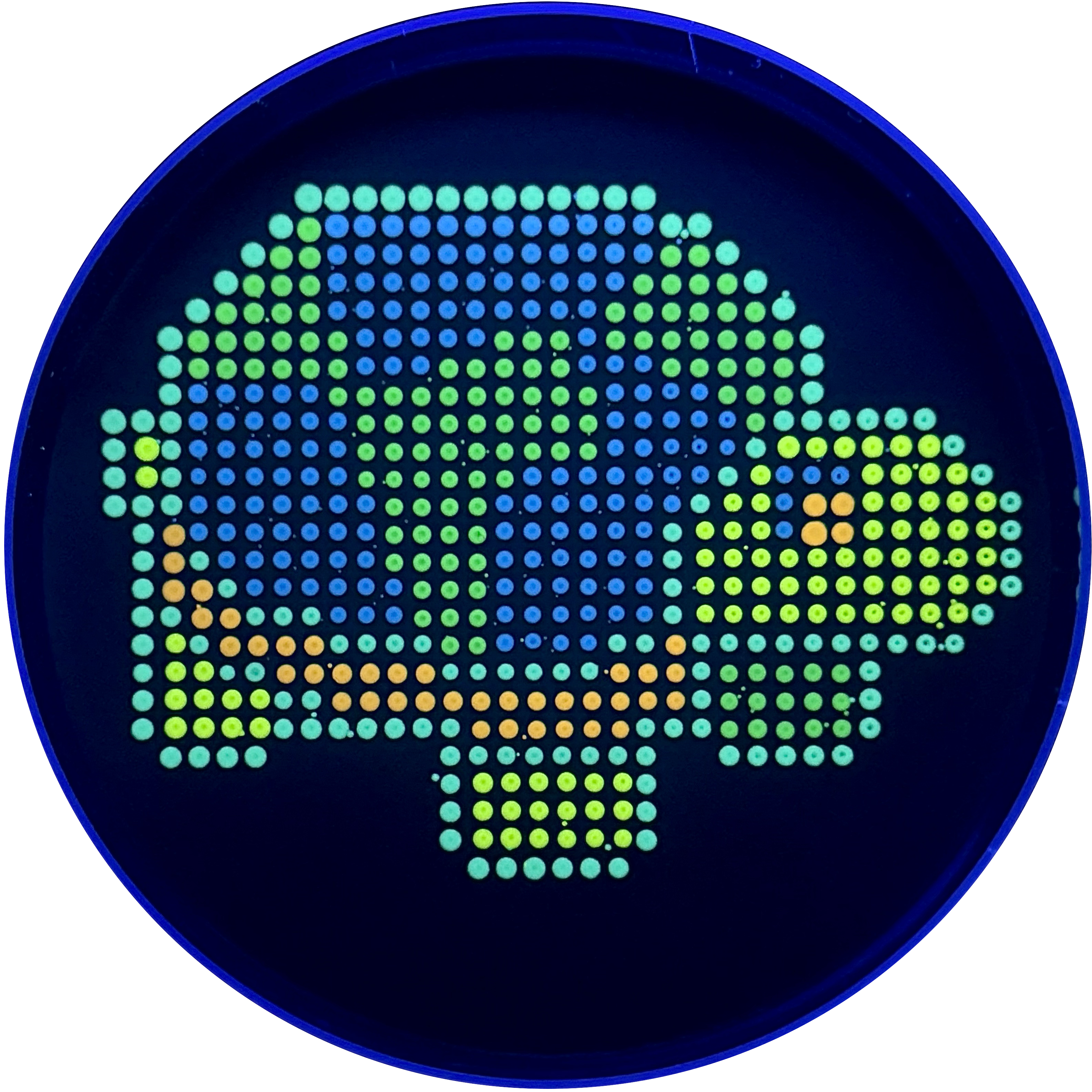
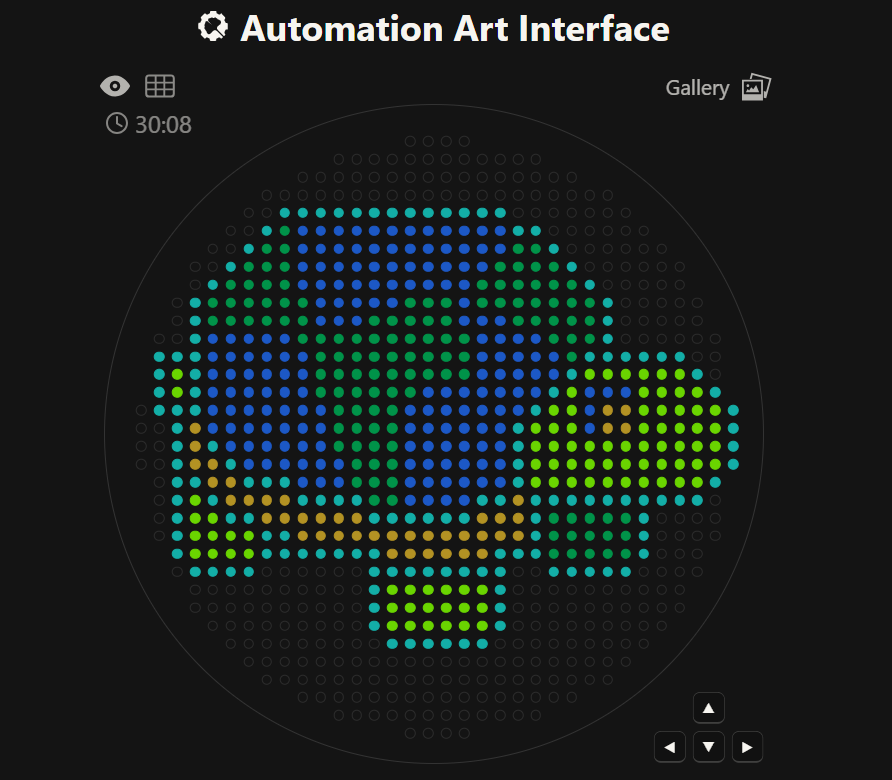
This week, we programmed the Opentrons liquid handling robot to create fluorescent protein masterpieces. I was really looking forward to this lab and even did last week homework about expressing GFP in E.Coli. Rather than using the GFP, I found we used a variety of different colors of superfluorescent proteins. Ronan’s webtool [1] made it really easy to visualize a design, and we could even upload images to serve as a template for our designs. I decided to go all in on turtles and make a turtles all the way down image featuring a turtle with a globe for its shell. This was the original image, from my collection of Turtle CADS:
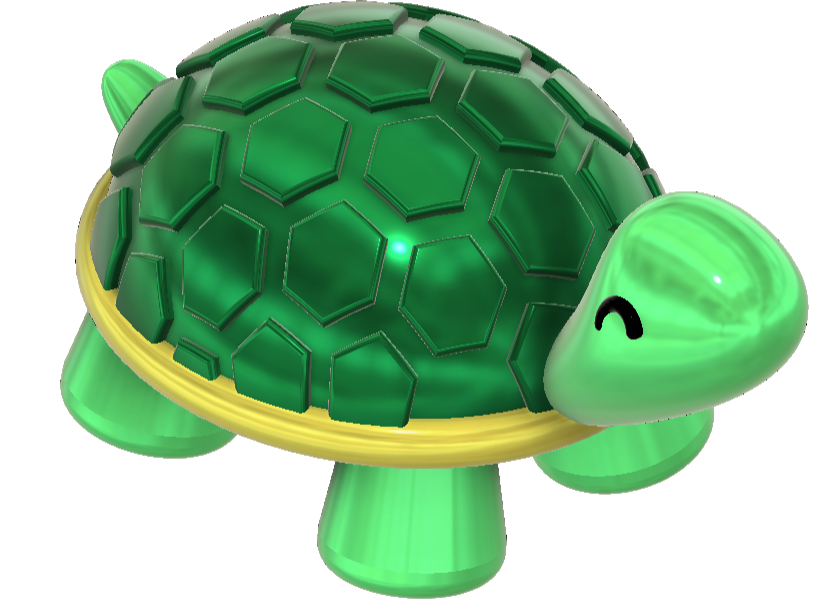
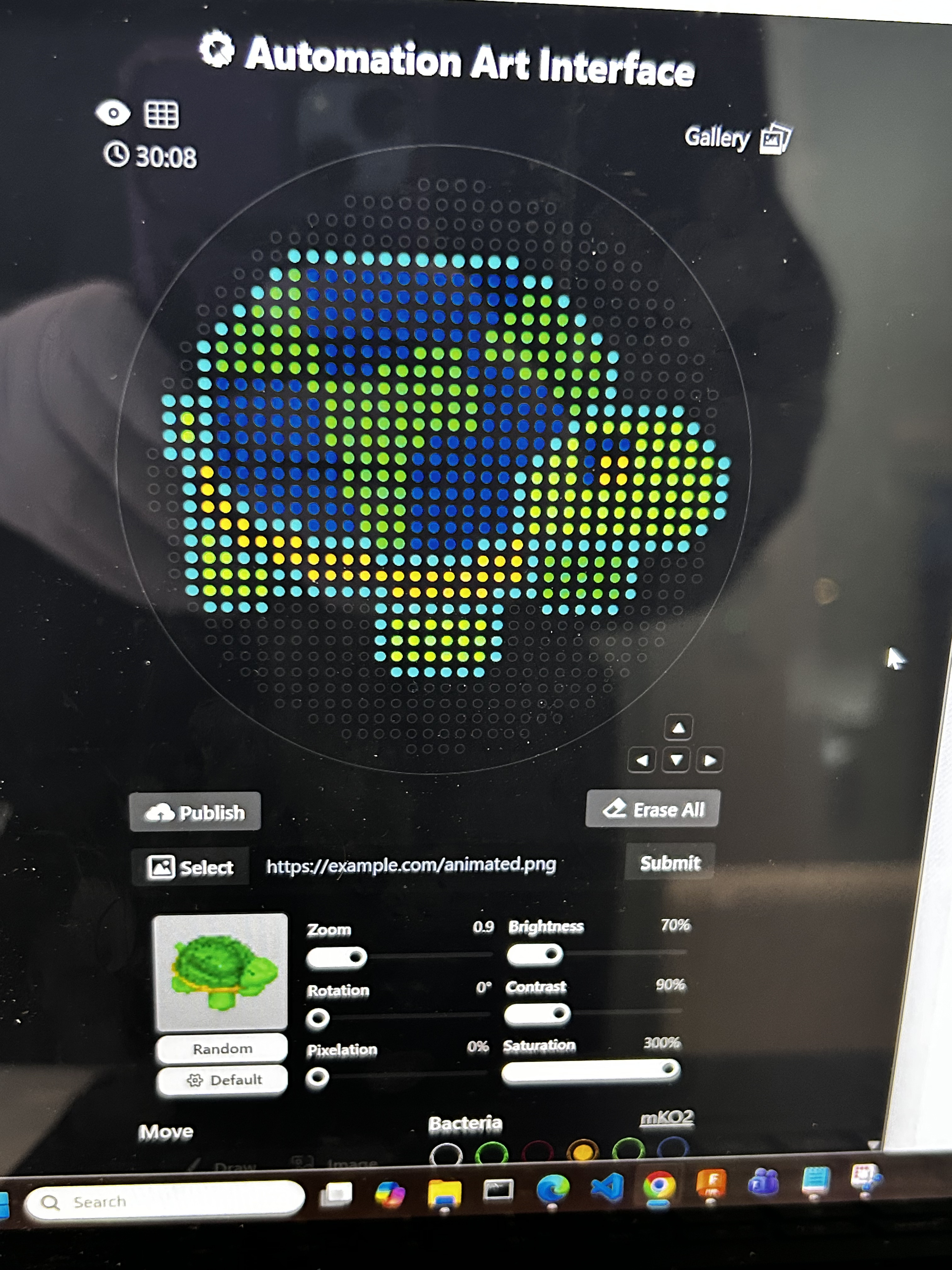
I took the coordinates from this image for each different color and put them into the Colab Python Script. I had to add and change colors to match the ones I used. I originally ran into a problem where I’d tell the robot to fill up the pipette, empty it, then continue attempting to dispense I was able to see this error in the simulation and correct it by adding a loop where, after the pipette was empty (20 dots in my case using a p20 and 1ul droplets) I’d pick up more before continuing. I used the built-in Gemini chatbot to help with this assignment, after explaining the functions I had access to I asked it to use these functions to deposit blue droplets at every coordinate in a list. From there, I used the same functions and procedures to do the rest of my colors. After some troubleshooting, the simulation finally showed me the result I wanted, and the verification also went through.
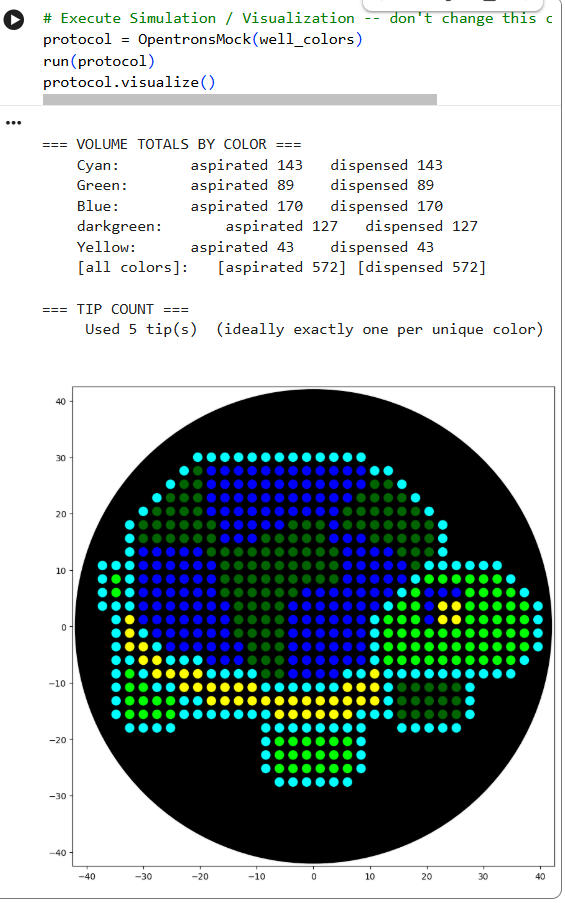
It was really straightforward to go from my design to the Opentron, at least from my point of view as a student (not sure what magic the TAs and staff work behind the scenes). The machine itself was incredibly precise, not only in movement but also in dispensing. Here’s how my final design ended up: I’ll explain more about the process in my lab3 webpage:
Post-Lab Questions
Bioautomation in the wild [2]
The paper I chose was entitled: “TidyTron: Reducing lab waste using validated wash-and-reuse protocols for common plasticware in Opentrons OT-2 lab robots” authored by Bryant et al. (2023). I chose this paper because it touches on two things I care about, one being minimizing lab waste, and two being washing processes.
In this study, the authors developed an automated system, called TidyTron, that runs on the Opentrons liquid-handling robot and reduces laboratory plastic waste by automating wash-and-reuse protocols for common lab consumables like pipette tips and microplates. Traditionally, many of these are discarded after a single use because of uncertainty about cross-contamination, the authors even state that biotechnology labs generate ~5.5 million tons of plastic waste per year. TidyTron addresses this problem by using the OT-2 to perform consistent and reliable cleaning processes that are tested and validated for effectiveness.
The paper describes how the automated protocols were implemented on the Opentrons to rinse, clean, and sterilize plastics used with DNA solutions or microbial cultures. They evaluated the cleaned materials by measuring residual contamination using colony-forming unit (CFU) counts, quantitative PCR to detect residual DNA, and other metrics to confirm that the robot-washed consumables were equivalent in performance to new plastics. Their results showed that the wash-and-reuse procedures could effectively remove contamination, demonstrating that automation makes reusable workflows both practical and safe. I thought this approach was interesting because it applies automation not to increasing throughput or accuracy, but to sustainability in biological labs. I hope to use a similar system, not for plastic but for metal/more permanent lab equipment, which I’ll build into my DNA dispensing machine.
Bioautomation in my final project
As a mechanical engineer, I am very interested in the bioautomation part of synthetic biology. Two of my three final project ideas either seek to improve or apply bioautomation as a main part of the project. One idea I had was to do what we did in lab this week but in 3D. Two approaches I imagine are either to embed a 3D model in a brick of clear gel, similar to the lasers that can engrave a model into glass, or to build a 3D model out of gel and “paint” different fluorescent proteins around it all completely automated. I can imagine different challenges based on which version I pursue, but this would be nearly impossible without an automated system.
Sources
- [1] https://opentrons-art.rcdonovan.com/
- [2] Bryant JA Jr, Longmire C, Sridhar S, Janousek S, Kellinger M, Wright RC. TidyTron: Reducing lab waste using validated wash-and-reuse protocols for common plasticware in Opentrons OT-2 lab robots. SLAS Technol. 2024 Apr;29(2):100107. doi: 10.1016/j.slast.2023.08.007. Epub 2023 Sep 9. PMID: 37696493; PMCID: PMC12212179.
AI Prompts
- “Using the functions described in this document, write a loop that deposits blue droplets at every coordinate in a given list”
- “Use the function to refill the pipette after it’s empty, then continue depositing droplets if there are more droplets than the pipette can hold at once”