Week 7 HW: Genetic Circuits Part II
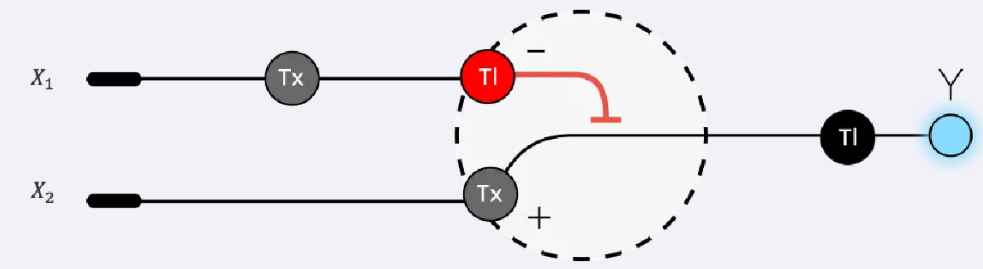
HW7
Intracellular Artificial Neural Networks
- What advantages do IANNs have over traditional genetic circuits, whose input/output behaviors are Boolean functions?
Intracellular Artificial Neural Networks use continuous analog signals instead of binary ones, which allows them to understand complex inputs like concentrations as opposed to just noting presence. They can use this to perform thresholding, enabling more complex reactions with fewer components. Overall, they are more scalable and better at multi-input sensing than regular genetic circuits.
- Describe a useful application for an IANN; include a detailed description of input/output behavior, as well as any limitations an IANN might face to achieve your goal.
Diseases like cancer consist of lots of unique biomarkers in various concentrations, an IANN can be used to engineer smart therapeutic cells that detect these tumors by integrating multiple biomarkers. The inputs would be markers like hypoxia, lactate, and cytokine levels. These would all be observed over a continuous scale and processed by taking a weighted combination of these inputs with a threshold response. So only responding when levels are high enough to indicate a tumor. Then the output could be something like the expression of a therapeutic protein or reporter. Some limitations of this system would be biological noise, difficulty tuning weights, and having a slow response times.
- Draw a diagram for an intracellular multilayer perceptron where layer 1 outputs an endoribonuclease that regulates a fluorescent protein output in layer 2.
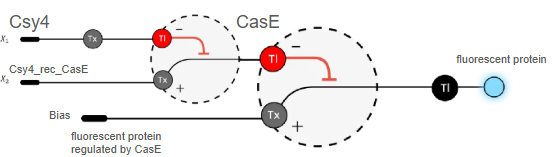
Fungal Materials
- What are some examples of existing fungal materials and what are they used for? What are their advantages and disadvantages over traditional counterparts?
Fungal materials made from mycelium are used for packaging, insulation, leather alternatives. The pros are that these materials are biodegradable, sustainable, and can be grown with low energy input, utilizing waste. They are also often lighter weight than their counterparts. However, they are generally less strong and durable than plastics or metals and can be quite sensitive to moisture and mass production of these materials is a challenge.
- What might you want to genetically engineer fungi to do and why? What are the advantages of doing synthetic biology in fungi as opposed to bacteria?
You could engineer fungi to produce building materials that capture and store CO₂ by storing it from their growth substrates. Fungi naturally form filamentous, multicellular networks ideal for shaping walls, panels, or insulation, and can sequester carbon directly in their biomass. The main challenges are fungi have slower growth and more complex genetic engineering compared to bacteria.
First DNA Twist Order
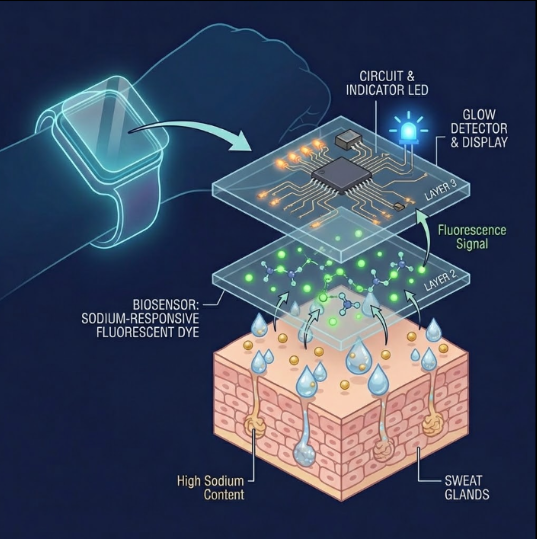
For my final project, I want to make a “hydration” checking wearable device. Originally, I wanted to sense increased sodium levels insweat but that proved to be difficult so instead I’m approximating increased hydration risk by just detecting lactate. I want this to be a cell free system to make it more compatible with a safe wearable device.
I’m still working on my first DNA order. I want it to be cell free and got some help designing a genetic circuit but want to verify with the cell free lesson before placing order. I want it to follow this genetic circuit:
Lactate (input signal from sweat) -> Lactate Oxidase (breaks lactate down into) -> Pyruvate (byproduct not used) + H2O2 (which then activates OxyR by oxidizing it) -> OxyR (has two states starts reduced then is oxidized to become active and bind to DNA to activate transcription of PoxyS) -> PoxyS Promoter (controlled by OxyR, switches on reporter gene) -> RNA Aptamer (produced when PoxyS promoter is enabled binds to dye) -> DFHBI Dye (non-fluorescent when bound to RNA Aptamer)
All together it follows this chain: Lactate provides the biological input (increased sweat means increased need for hydration) Lactate Oxidase and H2O2 convert it into a detectable chemical signal OxyR and PoxyS act as switch RNA aptamer and dye generate a fast fluorescent output (that way the glow happens quicker than with protein translation and safer for a wearable because there are no cells)