Week 11 HW: Bioproduction and Cloud Labs
HW11
Part A
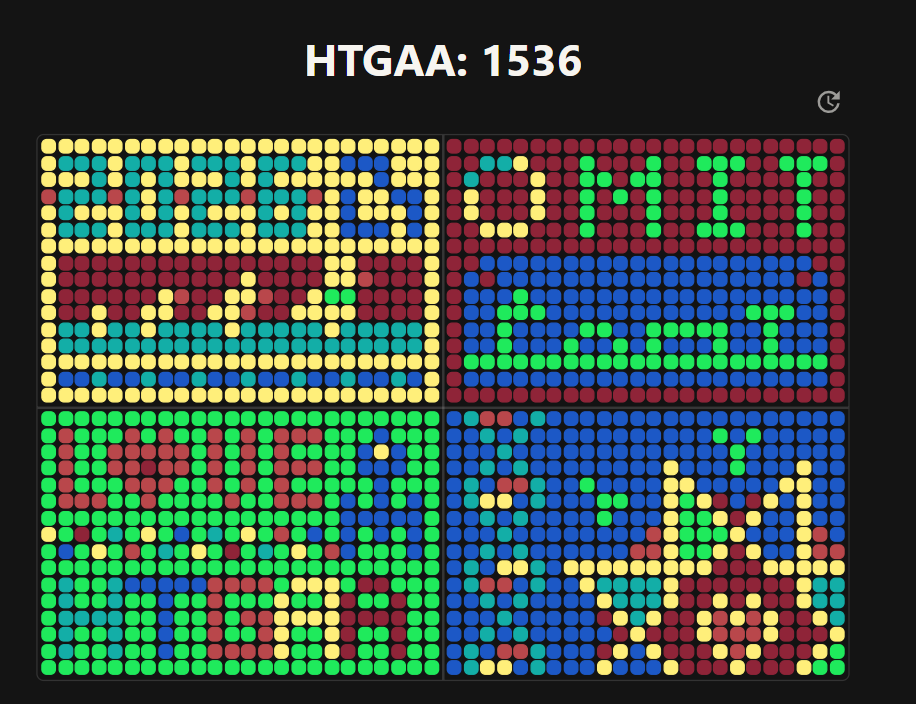
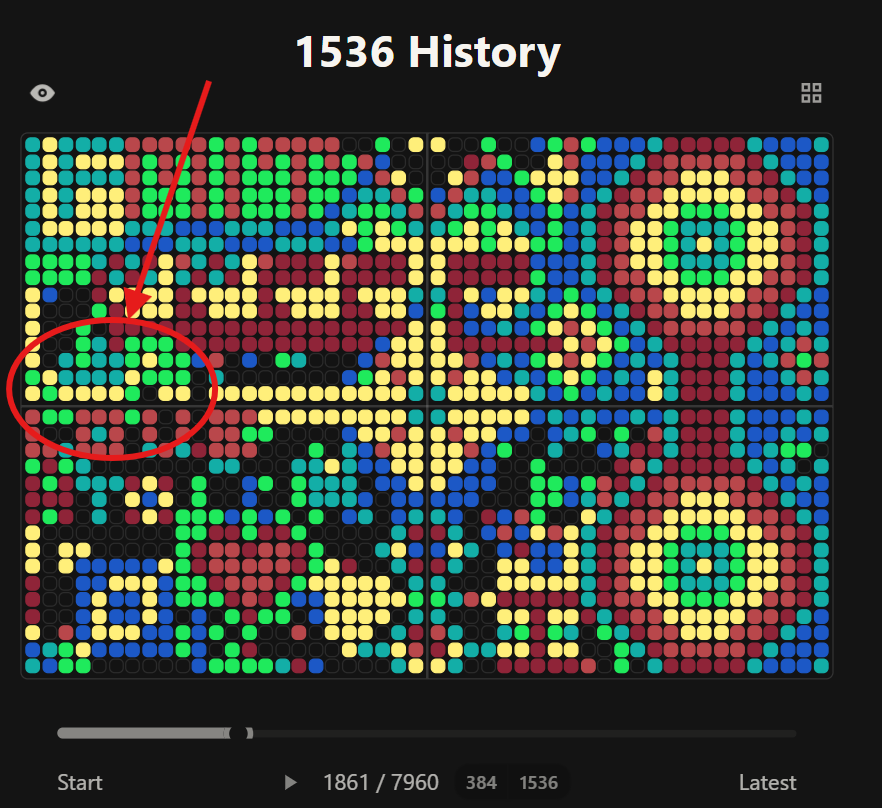
At some point during the global artwork process, I drew a little turtle in the bottom left of the top left plate. It later evolved into the border for the 2026 media lab side of the design but some of the pixels still exist. I loved seeing the artwork evolve over time and seeing what each person created and how, sometimes, people would join together asynchronously to complete designs. I wished the cooldown time was a little less; the 20-second period was more fun for individual creations but the longer time was better for collaboration and competition.
Part B
- Referencing the cell-free protein synthesis reaction composition (the middle box outlined in yellow on the image above, also listed below), provide a 1-2 sentence description of what each component’s role is in the cell-free reaction.
E. coli Lysate
- BL21 (DE3) Star Lysate (includes T7 RNA Polymerase) Provides the transcription and translation machinery (ribosomes, enzymes, tRNAs), with T7 RNA polymerase enabling strong expression from T7 promoters.
Salt/Buffer
Potassium Glutamate Maintains intracellular-like ionic conditions that stabilize enzymes and ribosomes for efficient protein synthesis.
HEPES-KOH pH 7.5 Buffers the reaction to maintain a stable pH optimal for enzymatic activity.
Magnesium Glutamate Supplies Mg²⁺ ions, which are essential cofactors for ribosomes, RNA polymerase, and ATP-dependent reactions.
Potassium phosphate monobasic Contributes to buffering capacity and provides phosphate for metabolic processes.
Potassium phosphate dibasic Works with the monobasic form to stabilize pH and maintain phosphate balance.
Energy / Nucleotide System
Ribose Serves as a substrate for nucleotide regeneration through metabolic pathways.
Glucose Provides a sustained energy source via glycolysis to extend reaction lifetime.
AMP Acts as a precursor that can be phosphorylated to generate ATP for energy and transcription.
CMP Precursor to CTP, required for RNA synthesis.
GMP Precursor to GTP, necessary for transcription and translation.
UMP Precursor to UTP, another essential RNA building block.
Guanine A nucleobase that can be converted into GMP/GTP via salvage pathways in the lysate.
Translation Mix (Amino Acids)
17 Amino Acid Mix Provides most amino acids needed for protein synthesis.
Tyrosine Added separately due to solubility limitations in mixed amino acid stocks.
Cysteine Added separately because it is chemically unstable and prone to oxidation.
Additives
- Nicotinamide Supports redox balance by maintaining NAD⁺/NADH-dependent metabolic activity for energy regeneration.
Backfill
- Nuclease Free Water Adjusts reaction volume without introducing nucleases that could degrade DNA or RNA.
- Describe the main differences between the 1-hour optimized PEP-NTP master mix and the 20-hour NMP-Ribose-Glucose master mix shown in the Google Slide above.
The 1-hour PEP-NTP system uses phosphoenolpyruvate (PEP) and pre-supplied NTPs to drive rapid, high-level protein expression, but it depletes energy quickly and accumulates inhibitory byproducts. The 20-hour NMP–ribose–glucose system relies on nucleotide monophosphates and metabolic substrates to regenerate energy and NTPs over time, enabling slower but more sustained protein production. This results in a tradeoff between fast, short-lived expression and longer-lasting, more stable reactions
Part C
- Given the 6 fluorescent proteins we used for our collaborative painting, identify and explain at least one biophysical or functional property of each protein that affects expression or readout in cell-free systems.
Fluorescent protein properties:
sfGFP
- sfGFP has enhanced folding efficiency, allowing it to maintain high fluorescence even under suboptimal cell-free conditions.
mRFP1
- mRFP1 has a slow chromophore maturation time, which delays fluorescence development despite successful protein expression.
mKO2
- mKO2 matures relatively quickly but can be sensitive to environmental factors like pH, affecting its fluorescence intensity.
mTurquoise2
- mTurquoise2 is highly bright but depends strongly on proper folding and oxygen availability for chromophore formation.
mScarlet-I
- mScarlet-I has high brightness and improved maturation speed, but still requires efficient folding for optimal fluorescence.
Electra2
- Electra2 is engineered for high brightness and stability but may place higher demands on cellular resources, making it sensitive to energy availability.
- Create a hypothesis for how adjusting one or more reagents in the cell-free mastermix could improve a specific biophysical or functional property you identified above, in order to maximize fluorescence over a 36-hour incubation. Clearly state the protein, the reagent(s), and the expected effect.
Increasing glucose concentration in reactions expressing mRFP1 will extend energy availability and reaction lifetime, allowing more protein to fully mature and increasing total fluorescence over 36 hours.
- The second phase of this lab will be to define the precise reagent concentrations for your cell-free experiment. You will be assigned artwork wells with specific fluorescent proteins and receive an email with instructions this week (by April 24).