Week 3 HW: Lab Automation
Assignment: Python Script for Opentrons Artwork
Being a CL at Designer Cells Node, I had an opportunity for my image being printed!
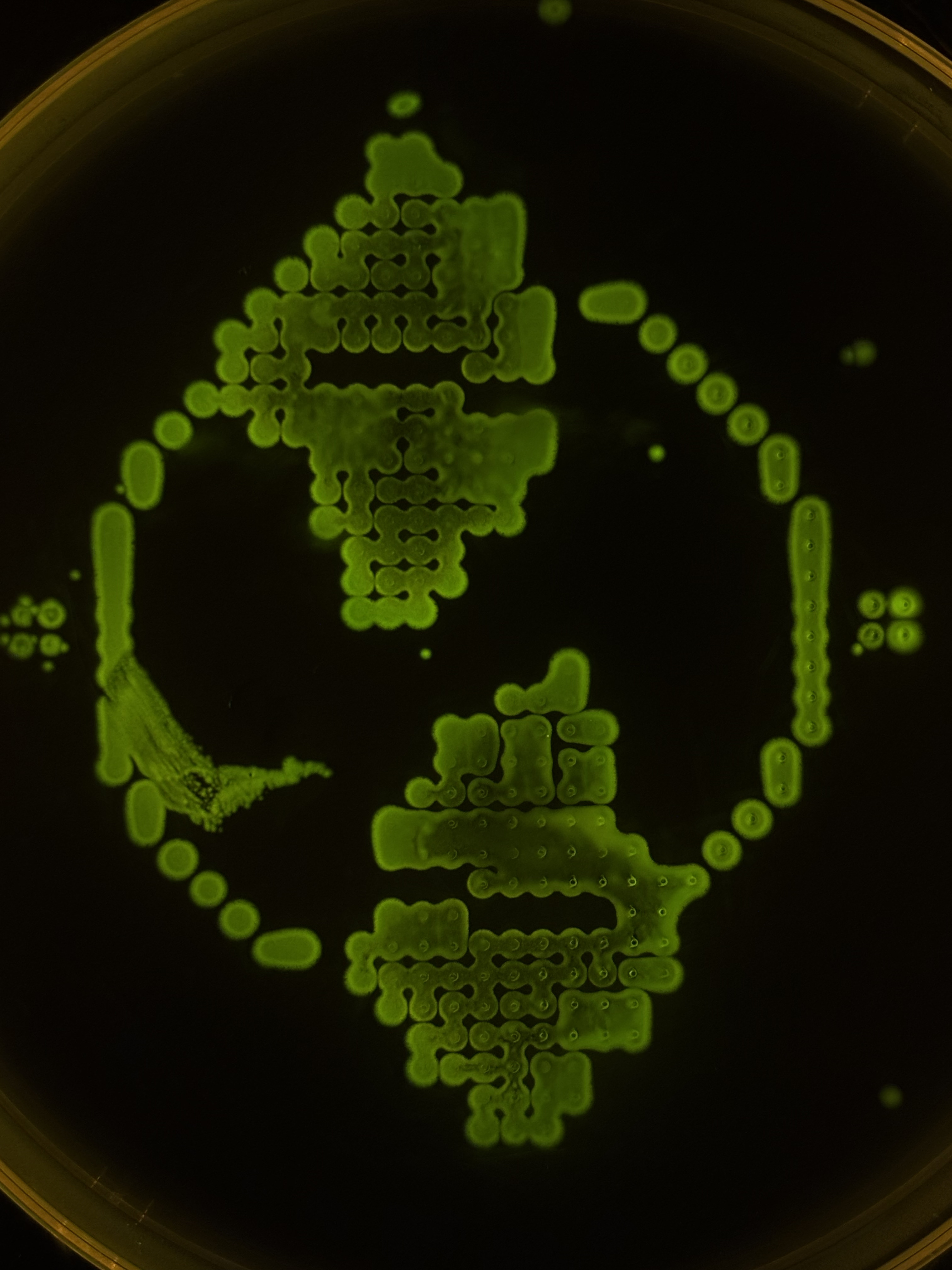
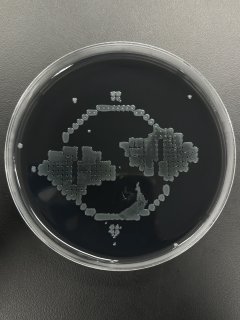
Here’s my code which was written with assistance of multiple AI agents, Gemini was not sufficient to correct all my mistakes.
I used this Art Nouveau-ish ornament with Ginkgo leaves as a reference, manually assigning printing dots via Ronan’s website.

Only red and green fluorescent E. coli strains wera available at my Node at the moment, and that matched perfectly with the picture. I like the resulting bio-print, although I should’ve selected lesser drop volume to avoid dots merging.
Opentrons in Published Research
I found a paper entitled “Slowpoke: An Automated Golden Gate Cloning Workflow for Opentrons OT-2 and Flex” surprizingly starting with “slowpoke” and ending with “flex”… (cough) The paper introduces Slowpoke, an easy-to-use automated system for DNA assembly that streamlines the cloning process using popular liquid-handling robots. It includes a free graphical interface for users and has been tested successfully with various DNA toolkits, making it a flexible solution for synthetic biology labs.
The study found that the Slowpoke automated workflow successfully created DNA constructs, achieving high assembly efficiencies with different genetic toolkits across two liquid-handling platforms, the OT-2 and Flex. Specifically, all 17 attempts resulted in successful colonies with one toolkit on the OT-2, 11 out of 12 were successful on Flex, and 8 out of 13 were successful using another toolkit on the OT-2. Additionally, when testing combinations of parts, 55 out of 57 resulted in correct DNA constructs, demonstrating that the workflow is effective and adaptable for various applications in synthetic biology. To make the Slowpoke tool easier to use, the developers created an online version with a simple interface, allowing users to generate experimental protocols with just one click. Users need to provide specific input files in CSV format, which outline the genetic components and their arrangements for tasks like Golden Gate cloning. This setup includes a standard toolkit map and a custom parts map, making it flexible for users to combine different genetic parts for their experiments, while being guided through the process both online and offline. Slowpoke allows researchers to prepare up to 96 Golden Gate assemblies and perform colony PCR reactions at the same time, streamlining laboratory work. In a typical setup using the Opentrons OT-2 robot, one thermocycler is used for both assembly and transforming E. coli cells, but it takes up a lot of space. To make better use of the available slots on the robot, researchers can switch to standard benchtop thermocyclers, allowing more flexibility and increasing the number of experiments that can be conducted simultaneously.
Slowpoke stands out from other DNA-assembly automation tools by being affordable and user-friendly. While tools like AssemblyTron and DNA-BOT require coding skills or focus on less commonly used methods, Slowpoke offers a complete solution that covers various processes like assembly, transformation, plating, and colony PCR without needing any programming knowledge. This makes Slowpoke accessible for more users in synthetic biology, particularly due to OT-2 and Flex relatively low price. Although Slowpoke has many advantages for automating DNA assembly, it still has some limitations that require human involvement, such as sealing PCR plates and transferring tubes between machines. Colony picking remains the most labor-intensive task because current Opentrons systems don’t fully support this step. However, new open-source solutions, like the one developed by Marburg iGEM 2019 team, are working to automate this process using 3D-printed technology and neural networks, which could help make Slowpoke even more efficient by reducing the need for human intervention.
Final Project Ideas + Lab Automation Tools
At the current stage, I elaborate some ideas related with Mgnetic or Protein-Based Nanoparicles (MNP and PBNP respectively) as DNA cargo for transfection. An Opentrons OT-2 liquid handling robot could be programmed to automate preparation of nanoparticle–DNA complexes by dispensing plasmid DNA, peptide solutions, and buffer components at controlled ratios (e.g., optimized N/P charge ratios for PBNP). This would reduce pipetting variability and allow rapid screening of different nanoparticle compositions and concentrations.
Python-based workflow scripting in Google Colab could be used to generate automated experimental layouts, calculate reagent volumes, and export OT-2-compatible protocols. For example, scripts could automatically produce dilution matrices for testing different peptide:DNA ratios or different nanoparticle formulations. Pseudocode example:
Regarding cargo DNA, computational tools such as Ginkgo Nebula could also be used for construct design and sequence organization, including codon optimization, annotation of plasmid features.