Week 3 HW: Lab Automation
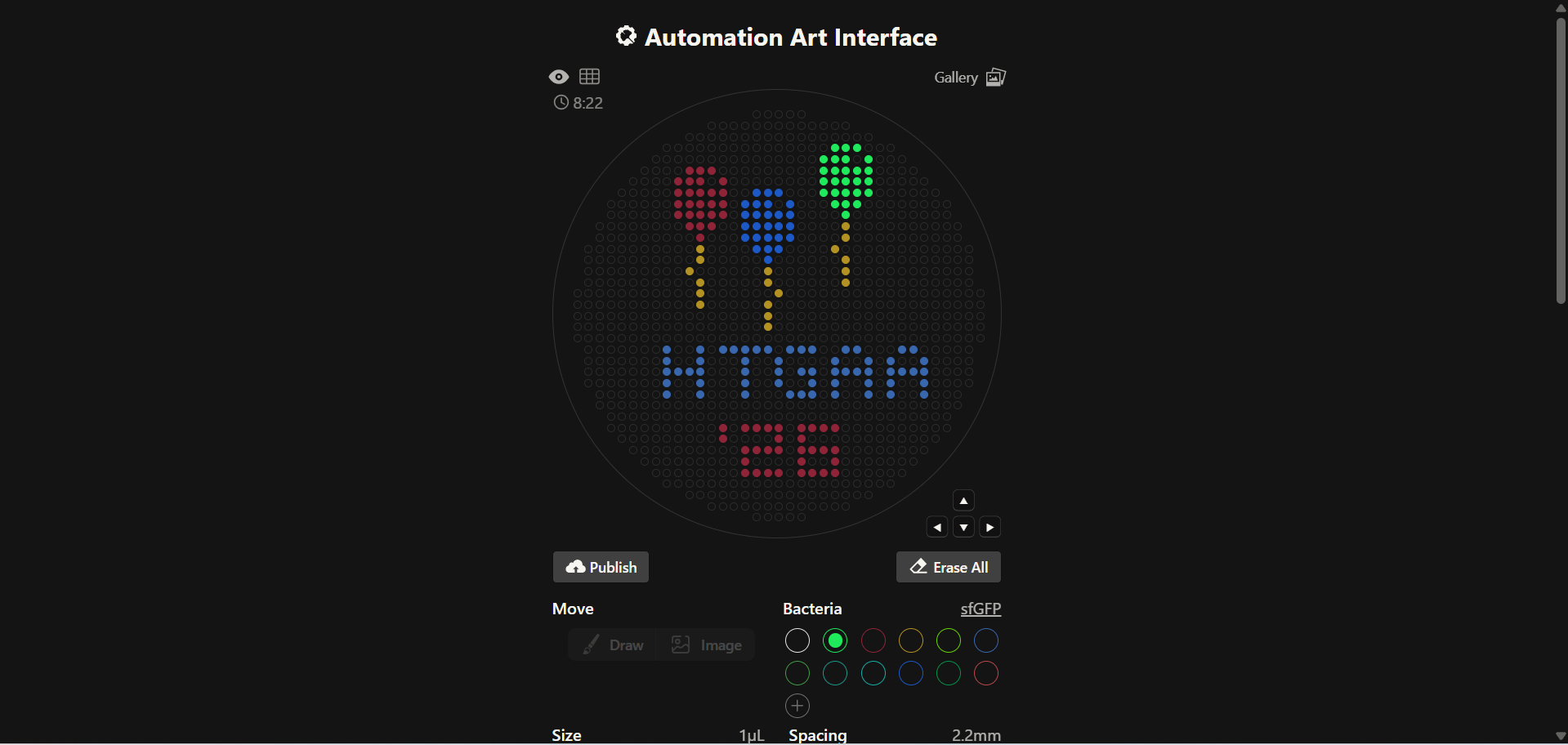
Opentrons Artwork
Post-Lab Questions
- I found a published paper which describes how researchers leveraged the Opentrons OT-2 automated liquid handler to develop an automated, high-throughput proxy viscometer. The robot was programmed to dispense liquids of various viscosities and collect data for machine-learning models to predict viscosity, demonstrating a practical application of the OT-2 in fluid characterization workflows — requiring minimal human intervention while significantly increasing throughput.
- If I would go for my first project idea, which is the Bacterial Microplastic Sensor, there would be the following automation tools that I could apply:
| Automated Fluorescence Detection System | The goal is to automatically quantify GFP output in response to PET degradation products. I can automate the timed fluorescence measurement (every 10 min), background subtraction, data logging (CSV), real-time plotting and threshold alert. |
|---|---|
| Automated Incubation + Sampling | There can be a shaking plattform automation, with 3D tube rack and/or temperature control with heat pad, temperature sensor and automated regulation. A pseudocode example can be: if temperature < 37: heater_on() else: heater_off() |
| AI-Based Fluorescence Quantification | Instead of raw intensity, there can be the use of computer vision or a train model to classify fluorescence levels. |
| Ginkgo Nebula Integration Plan | The usage of Gingko Nebula could be very helpful with DNA design automation (Promoter optimization, RBS strength prediction, codon optimization, circuit simulation) or experimental tracking (automated protocol versioning, construct iteration tracking, strain documentation). |