Week 2 HW: Read, write and edit DNA
Preparation for Week 2 lecture:
About next generation gene synthesis
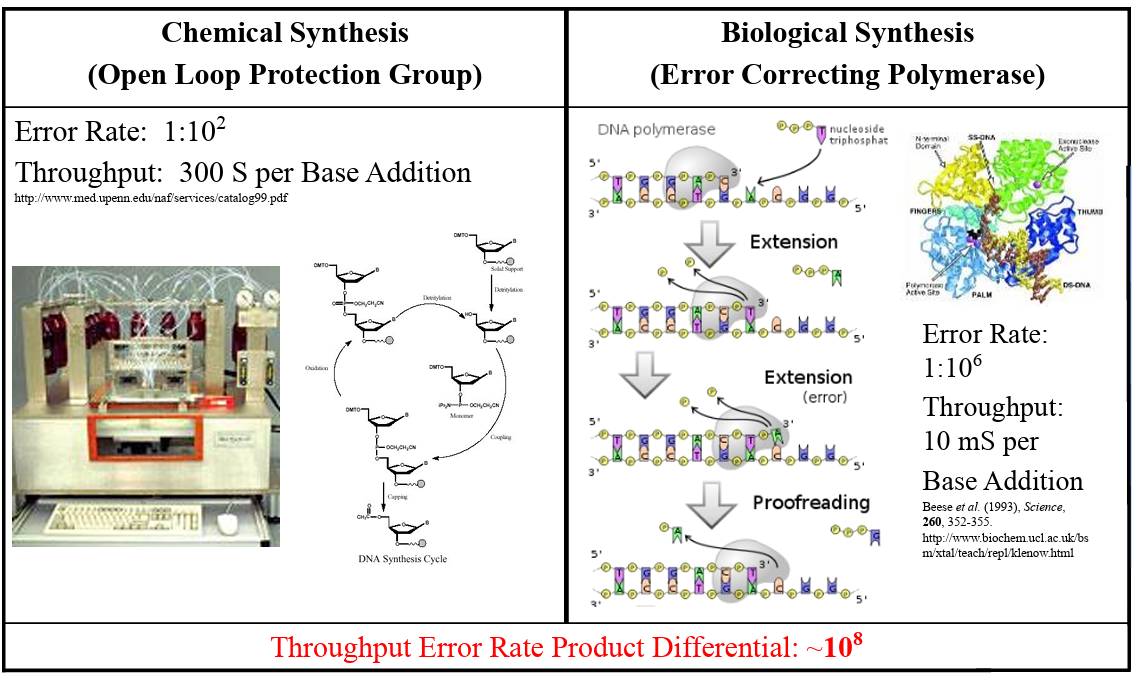
What is the error rate of polymerase? 1:10^6
How does this compare to the length of the human genome? Human genome consist on 3.2 Giga base pairs, so at least more than 3 000 errors could be made in the synthesis of an entire human genome by one polymerase. But, since human methabolic pathways are at most 10kbp long, its negligible in the majority of context.
How does biology deal with that discrepancy? There are a lot of polymerase and DNA genome is separated in chromosomes, so chances of committing errors in replication are low, also thera are DNA mismatch reparation systems (MutS Repair System).
How many different ways are there to code for an average human protein? Considering that the average human protein has 1036 bp, and the genetic code is degenerate, you can make the same protein with different codons that in the end encode the same aminoacid, so there should be a lot of different ways.
In practice what are some of the reasons that all of these different codes don’t work to code for the protein of interest? This is primarily because, when using different base conjugations, some bases will be compatible with others, and in the case of biological synthesis, we could risk the formation of hairpin-like structures between them (as in the case of RNA proteins), which would force the termination of the translation when we want to obtain the proteins. There is also the error rate.
From DNA Synthesis Development and Application:
- What’s the most commonly used method for oligo synthesis currently? Phosphoramidite method
- Why is it difficult to make oligos longer than 200nt via direct synthesis? An accumulation of errors due to the error rate of chemical synthesis
- Why can’t you make a 2000bp gene via direct oligo synthesis? Because the error rate makes it, probabilistically speaking, almost impossible to achieve. So instead gene assembly is used.
From reading and writing life:
What are the 10 essential amino acids in all animals and how does this affect your view of the “Lysine Contingency”?
- 10 essentials: Histidine, Isoleucine, Leucine, Lysine, Methionine, Phenylalanine, Threonine, Tryptophan, Valine, Arginine The lysine contingency It would work well if dinosaurs were as easy to isolate from external resources as bacteria in a petri dish. After all, essential amino acids are those we can’t produce ourselves, but obtain by eating other organisms that do possess them. It would be very difficult to cut off any other available source of lysine from the enviroment, so I would recommend another aproach.
Google Search: “Lysine Contigency”
Week 2 assingments:
(Part 2 consisted of “Gel Art - Restriction of Digests and Gel Electrophoresis”, intended to be carried out in the laboratory, since I do not have access to one, I did not complete it)
Part 1: Benchling & In silico gel art
Using a ladder Life 1 kb Plus and different restriction enzymes (EcoRI, XhoI, SalI, EcoRV, NdeI, BamHI, HindIII and KpnI) on the Lambda fage genome, I tried to draw a Teletubbie.
All started choosing my favourite protein…
Part 4: DNA Synthesis order, building my first plasmid
Stitching together the components to form a plasmid
Why and how