Week 09 HW: cell free systems
- Advantages of cell-free systems Cell-free protein synthesis (CFPS) offers a highly flexible and controllable environment compared to in vivo expression systems. Because there are no living cells, experimental conditions such as pH, ionic strength, redox environment, DNA concentration, cofactors, and additives can be directly tuned without affecting cell viability. This enables rapid optimization and prototyping of genetic constructs.
Additionally, CFPS is significantly faster, allowing protein production within hours instead of requiring cell growth, transformation, and induction steps.
Cell-free systems are particularly advantageous in cases such as:
- Toxic proteins: proteins that would inhibit or kill host cells can be produced safely
- Membrane proteins: can be expressed with detergents, liposomes, or nanodiscs to improve folding and functionality
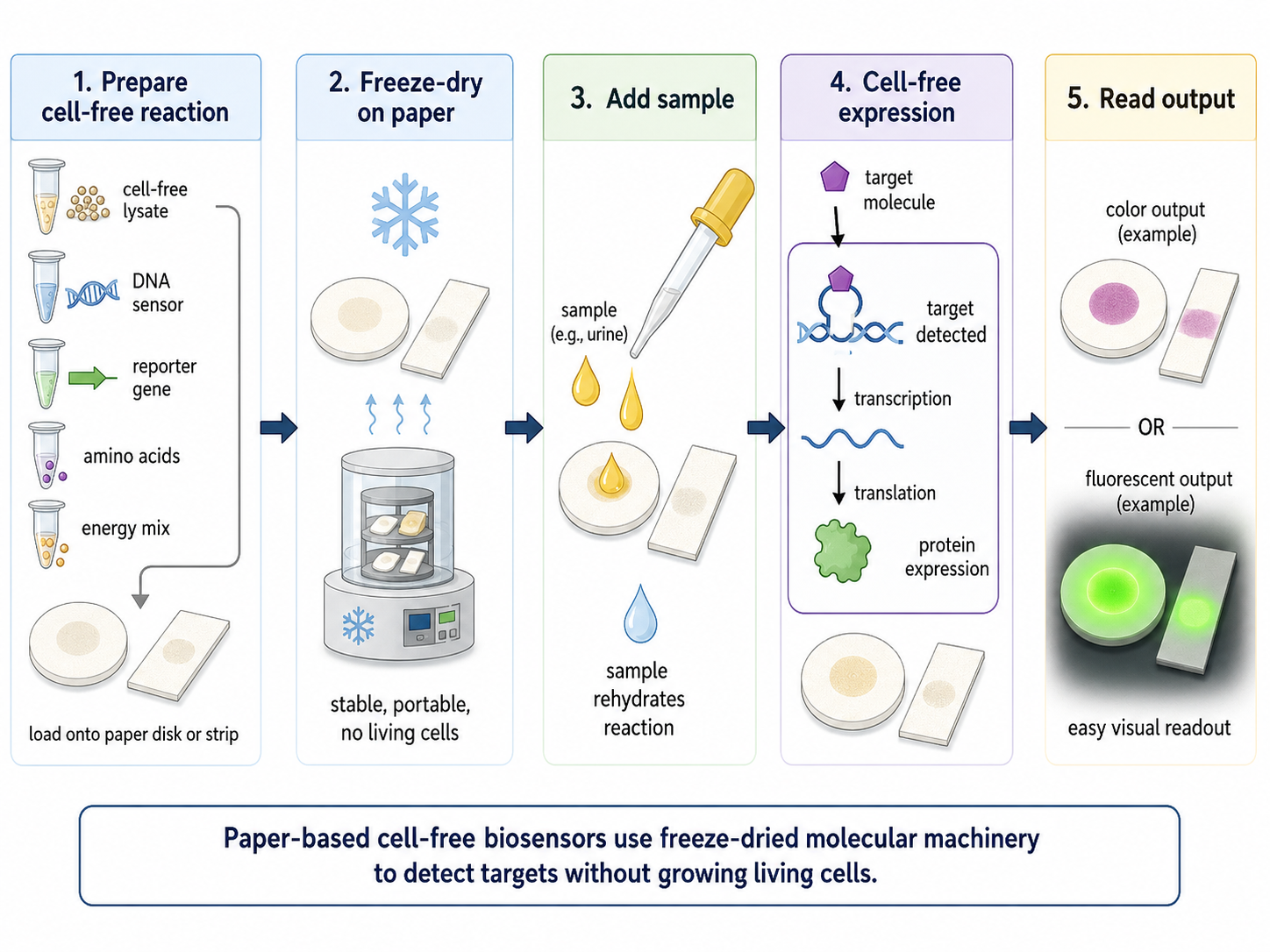 *Generated by ChatGBT)
A real-world example is freeze-dried paper-based diagnostics, where cell-free reactions are dried onto paper and then reactivated by adding a liquid sample. Instead of growing engineered bacteria, the paper contains the transcription–translation machinery needed to make a reporter protein when a target molecule is detected. This is useful for low-resource testing because it avoids maintaining living genetically modified cells and can be made portable.
- Components of a cell-free system
A typical cell-free expression system includes:
Cell extract / TX-TL machinery
- Provides ribosomes, tRNAs, enzymes, and factors required for transcription and translation
- DNA or mRNA template - Encodes the protein of interest
- Amino acids Building blocks for protein synthesis
- Nucleotides (ATP, GTP, CTP, UTP) - Required for transcription and energy transfer
- Energy regeneration system - Maintains ATP/GTP supply during the reaction
- Buffer + cofactors (Mg²⁺, K⁺, etc.) - Maintain optimal biochemical conditions
- Optional additives (chaperones, lipids, detergents)- Help folding or membrane protein insertion
- Why energy regeneration is critical
ATP and GTP are consumed during:
- transcription
- tRNA charging
- ribosomal translation
- Without regeneration, the reaction stops quickly.
Solution: Use an energy regeneration system such as: phosphoenolpyruvate (PEP) + pyruvate kinase or creatine phosphate + creatine kinase. These systems continuously regenerate ATP, allowing sustained protein production.
Prokaryotic vs eukaryotic systems
For a prokaryotic CFPS system, I would express GFP or sfGFP because it is a small, well-characterized reporter protein that folds efficiently in bacterial systems and gives an easy fluorescent readout.
For a eukaryotic CFPS system, I would express a human receptor fragment or a glycosylated protein, because eukaryotic systems are better suited for proteins that require complex folding, disulfide bonds, or post-translational modifications. For example, a mammalian lysate would be more appropriate for testing a human membrane receptor than an E. coli lysate.
| Feature | Prokaryotic CFPS | Eukaryotic CFPS |
|---|---|---|
| Speed | Fast | Slower |
| Yield | High | Lower |
| Complexity | Simple | Complex |
| PTMs | Limited | Full (glycosylation, etc.) |
- Designing a membrane protein experiment
Challenges:
- Poor solubility
- Misfolding
- Aggregation Approach:
- Add detergents or liposomes to mimic membranes
- Include chaperones
- Optimize Mg²⁺, temperature, and energy system
Membrane proteins are challenging because their hydrophobic regions normally need a lipid membrane to fold correctly. In a cell-free experiment, I would express the same DNA template under different membrane-like conditions, such as no additive, mild detergent, liposomes, nanodiscs, or membrane vesicles.
I would compare total protein yield using a tag such as GFP or His-tag, but also test function, because a membrane protein can be expressed but still misfolded. Key variables to optimize would include DNA concentration, magnesium/potassium concentration, temperature, incubation time, and lipid or detergent concentration.
Main challenges include aggregation, incorrect folding, and additives interfering with the cell-free reaction. I would address these by testing membrane mimics, using lower temperatures for slower folding, and including a soluble reporter control such as GFP to check that the cell-free system still works.
- Troubleshooting low protein yield Low yield could have several causes:
1. Poor DNA template design
The promoter, ribosome binding site, or coding sequence may not work well.
Troubleshooting: Check the sequence, use the correct promoter such as T7, test another RBS/UTR, and compare with a GFP control.
2. Reaction conditions are not optimized
Salt, magnesium, DNA concentration, temperature, or energy mix may be suboptimal.
Troubleshooting: Run a small optimization matrix testing DNA amount, Mg²⁺/K⁺ levels, temperature, and incubation time.
3. The protein is unstable or misfolded
The target protein may aggregate, degrade, or require cofactors/chaperones.
Troubleshooting: Lower the temperature, add folding helpers, cofactors, detergents, liposomes, or nanodiscs, and check the product by SDS-PAGE or fluorescence.