BioBoard want to develop a modular, plug and play platform for biological engineering inspired by how Arduino made electronics easy to access and build. Today, even though synthetic biology is advancing quickly, the ability to design and test biological systems is still limited to well funded labs with specialized equipment. The tool I imagine, which I conceptually call “BioBoard”, would act as a simple interface between users and biological systems. Instead of mastering complicated workflows, users could connect optimized biological modules such as growth sensors, environmental monitors, light control units, or cell free expression kits into a central platform. This would allow faster experimentation, easier data collection, and more room for creativity.
Part 0: Basics of Gel Electrophoresis I attended and reviewed the lecture and recitation materials on gel electrophoresis. From these sessions, I learned that gel electrophoresis is a technique used to separate DNA fragments based on size, where negatively charged DNA migrates toward the positive electrode through an agarose matrix. Smaller fragments travel faster than larger ones, allowing visualization of fragment patterns after staining. Understanding these principles was important for designing and interpreting restriction digest patterns in the subsequent gel art exercise.
Subsections of Homework
Week 1 HW: Principles and Practices
1. BioBoard
want to develop a modular, plug and play platform for biological engineering inspired by how Arduino made electronics easy to access and build. Today, even though synthetic biology is advancing quickly, the ability to design and test biological systems is still limited to well funded labs with specialized equipment. The tool I imagine, which I conceptually call “BioBoard”, would act as a simple interface between users and biological systems. Instead of mastering complicated workflows, users could connect optimized biological modules such as growth sensors, environmental monitors, light control units, or cell free expression kits into a central platform. This would allow faster experimentation, easier data collection, and more room for creativity.
This idea is also deeply personal to me. Since childhood, I have enjoyed building small projects using sensors and breadboards. My mother is an electronics and communication engineering professor, and growing up around that environment encouraged me to explore, create, and solve problems in frugal ways. I learned that with the right platform, even complex technology can become approachable. However, when I became involved in biotechnology through synthetic biology, I noticed a sharp difference. The ability to prototype ideas was far more difficult than in electronics. Experiments required expensive tools, controlled lab spaces, and long preparation times. While biology is naturally complex and often costly, electronics once faced similar challenges in the 1970s before accessible platforms transformed the field. That shift allowed more people to innovate and ultimately accelerated technological progress.
Making biological engineering more structured and accessible could open the door for students, educators, community labs, and interdisciplinary innovators to participate. This vision is not about making biology careless or uncontrolled. Rather, it is about designing tools that encourage responsible experimentation while lowering unnecessary barriers. By focusing on modularity, usability, and thoughtful design, we can move toward a future where interacting with biological systems becomes more approachable without losing the care and responsibility the field requires.
2. Governance and Policy Goals for an Ethical Future
Goal 1: Prevent misuse while encouraging responsible experimentation
Sub goal 1: Build safety into the platform itself
The platform should guide users toward safe practices. For example, modules could be limited to non harmful organisms, cell free systems, or educational kits unless users have verified training. Built in checks can reduce the chance of accidental misuse without stopping curiosity.
Sub goal 2: Encourage basic biosafety training
Access to advanced modules could require simple certification, similar to how many labs require safety training before allowing equipment use. This ensures that as more people enter biology, they also understand their responsibility.
Goal 2: Make access fair without removing oversight
Sub goal 1: Support education and community labs
Lower cost tools can help students and smaller institutions participate in biological engineering. This helps prevent innovation from being limited only to wealthy organizations.
Sub goal 2: Avoid unrestricted distribution of sensitive tools
Some biological capabilities should remain controlled. A tiered system, where beginner modules are widely available but higher risk tools require approval, can balance openness with caution.
Goal 3: Promote a culture of responsibility, not just rule following
Sub goal 1: Normalize ethical thinking early
When tools are designed for learners, they should also introduce ethical reflection. Short guidance built into the platform can remind users to consider environmental impact, safety, and long term effects.
Sub goal 2: Encourage transparency and shared learning
Open documentation of experiments, successes, and failures can help communities learn from each other and avoid repeating mistakes. Transparency also builds trust as the technology spreads.
3. Governance Actions
Action 1: Tiered Access Based on Training and Use
Purpose
Today, biological tools are either tightly restricted to formal labs or freely available as simple kits. As platforms become more powerful, this gap becomes risky. I propose a tiered access system where basic modules are open to everyone, while more advanced capabilities require proof of basic biosafety training.
Design
Tool developers, academic institutions, and community labs could jointly define simple training requirements. Completing a short biosafety course would unlock access to higher level modules. This is similar to how drone users can fly basic models freely, but must register or train for more advanced use.
Assumptions
This assumes that users will take training seriously and that certification improves responsible behavior. It also assumes that shared standards across institutions are possible.
Risks of Failure and “Success” If the system becomes too strict, it could discourage learners and reduce creativity. If it is too relaxed, certification may become a formality without real impact. Even if successful, unequal access to training could create new barriers.
Action 2: Built in Technical Safety Limits
Purpose
Current biosafety relies heavily on user behavior and lab rules. For a more accessible platform, safety should be built directly into the technology rather than enforced only through policy.
Design
Platform developers could limit compatibility to low risk organisms, cell free systems, or educational strains by default. Software interfaces could flag potentially unsafe experiments or require additional confirmation steps. This is similar to how financial systems automatically detect and flag unusual transactions.
Assumptions This assumes that common risks can be identified and translated into technical safeguards. It also assumes developers are willing to invest in safety features even if they increase cost or reduce flexibility.
Risks of Failure and “Success”
Overly strict limits may block legitimate experimentation or creative exploration. Users may also attempt to bypass safeguards. If successful, there is a risk that users rely too heavily on the system and stop thinking critically about safety.
Action 3: Platform Certification Model
Purpose As biological platforms become more modular, there is a risk that unsafe third party modules could enter the ecosystem. A certification model, similar to how app stores review software or how hardware devices receive safety marks before entering the market, could help prevent harmful tools from spreading while still encouraging innovation.
Design Platform providers could require third party biological modules to pass a safety review before being listed in an official marketplace. Reviews could check for biosafety risks, environmental concerns, and proper documentation. Certified modules would receive a visible trust label so users can easily identify safer options. This approach mirrors how smartphone app stores approve applications and how electronic devices often require regulatory certification before sale.
Assumptions This assumes developers are willing to submit their modules for review and that certification bodies can evaluate risks effectively. It also assumes users will prefer trusted modules over uncertified alternatives.
Risks of Failure and “Success" If certification becomes slow or expensive, it could discourage small innovators and reduce creativity. Developers might also distribute tools outside official marketplaces to avoid oversight. However, if successful, this model could create a safer ecosystem where users naturally gravitate toward trusted components without requiring constant regulatory intervention.
Does the option:
Option 1
Option 2
Option 3
Enhance Biosecurity
• By preventing incidents
1
1
1
• By helping respond
2
2
2
Promote Safe Use of Accessible Biology
• By guiding responsible user behavior
1
1
1
• By supporting safer experimentation
2
1
1
Protect the environment
• By preventing harmful releases
2
1
1
• By encouraging precautionary design
2
1
1
Platform Sustainability and Trust
• Maintaining user trust
2
1
1
• Supporting long term ecosystem safety
2
1
1
Other considerations
• Minimizing costs and burdens to stakeholders
2
2
2
• Feasibility
2
2
2
• Not impede research
2
2
2
• Promote constructive applications
2
1
1
No single action is sufficient on its own. A layered approach that combines user training, technical safeguards, and ecosystem level certification provides stronger protection while still supporting innovation and creativity.
5. Governance Priority and Recommendation
Based on the scoring, I would prioritize Option 2 (Built in Technical Safety Limits) and Option 3 (Platform Certification Model), with Option 1 (Tiered Access)playing a supporting role.
Built in safety are the most effective because they make safer behavior the default and do not rely entirely on user behaviour. Certification further protects the ecosystem by ensuring that third party modules meet basic safety and documentation standards before being widely shared. Together, these options reduce risk while still allowing broad access and creativity.
The main trade off considered is between accessibility and control. Strict access requirements can slow learning and exclude students or small labs, while overly open systems increase the chance of misuse. Embedding safety into the platform helps balance this tension without recreating high barriers.
This recommendation is most relevant for organizations that actively shape biotechnology standards, such as the Engineering Biology Research Consortium (EBRC), for its guidance on responsible innovation in engineering biology. International coordination from groups like the World Health Organization through its biosafety and biosecurity programs is also important to support shared safety expectations as biological platforms become more accessible. The United Nations Cartagena Protocol on Biosafety further helps address ecological risks as these technologies scale globally.
AI Prompts Used
Used ChatGPT and Gemini for brainstorming and reasoning. I used it mainly for discussing the Governance Measures needed for my idea and its effect on the success of the idea, and also policy measures needed for ethical synthetic biology concepts.
Prompts:
Analyze the risks and benefits of democratizing biological engineering tools, using analogies from electronics, software platforms, or open-source hardware. Focus on how accessibility can increase innovation while also introducing governance challenges.
Break down the concept of “ethical synthetic biology” into concrete policy goals that apply to accessible, modular biological platforms. Avoid medical use cases and focus on education, experimentation, and creativity.
Propose governance actions for an Arduino-like biological platform by drawing from existing models in other fields such as app stores, drone regulation, or open-source software communities.
HOMEWORK QUESTIONS-PRE LECTURE PREP
Homework Questions from Professor Jacobson
1. What is the error rate of polymerase? How does this compare to the length of the human genome? How does biology deal with that discrepancy?
DNA polymerase makes roughly 1 error per 100,000 bases. The human genome has around 3.2 billion base pairs, which would cause around 30,000 mutations per division. Biology corrects this via proofreading and mismatch repair.
2. How many different ways are there to code (DNA nucleotide code) for an average human protein? Why don’t all of these codes work in practice?
An average human protein requires about 1036 base pairs, and it is 375 amino acids long, and each amino acid requires 3 codons, tso here can be 3
DNA sequences for an average protein. But, not all sequences work well due to some sequences forming secondary structures that interfere with proper function and differences in GC content or repeated regions can make synthesis difficult.
Homework Questions from Dr. LeProust
1. What’s the most commonly used method for oligo synthesis currently?
The standard method is phosphoramidite solid-phase synthesis. In this process:
Nucleotides are added one at a time to a growing chain attached to a solid support.
Each addition involves deprotection, coupling, capping, and oxidation steps.
This chemistry enables precise base addition but introduces cumulative inefficiency with each cycle.
2. Why is it difficult to make oligos longer than ~200 nt via direct synthesis?
Several factors limit direct synthesis:
Each synthesis cycle is less than 100% efficient, with typical stepwise yields around 99.5% or lower.
Small inefficiencies compound exponentially: (0.995)²⁰⁰ ≈ 37% full-length product.
Errors such as deletions, insertions, and incomplete coupling accumulate.
Longer sequences can form secondary structures that interfere with synthesis chemistry.
As a result, the yield of correct full-length products becomes very low beyond ~200 nt, making longer direct synthesis impractical.
3. Why can’t you make a 2,000 bp gene via direct oligo synthesis?
Direct synthesis above ~200 nt is already inefficient, so synthesizing a 2,000 bp gene is not feasible because:
Too many synthesis steps lead to near-zero correct material.
Error accumulation becomes extremely high.
Current methods cannot reliably remove truncated or faulty sequences.
Instead, long genes are typically assembled from short overlapping oligos, using methods such as PCR assembly or Gibson Assembly.
Homework Question from George Church
What are the 10 essential amino acids in all animals and how does this affect your view of the “Lysine Contingency”?
Essential amino acids in humans and most animals:
Histidine
Isoleucine
Leucine
Lysine
Methionine
Phenylalanine
Threonine
Tryptophan
Valine
(Arginine is sometimes considered essential in children under certain conditions.)
Since these amino acids cannot be synthesized de novo, animals must obtain them through their diet.
The “Lysine Contingency” refers to engineering organisms so they require lysine (or another essential metabolite) for survival as a containment strategy. Because lysine is essential, this dependency leverages a real biological limitation.
However, organisms may evolve bypass mutations or obtain nutrients from their environment, which reduces the reliability of this strategy. Therefore, lysine dependency should be combined with additional safeguards, as essential-amino-acid requirements alone may not prevent survival in complex environments.
This highlights that synthetic containment strategies must be robust and multilayered, especially when based on fundamental metabolic needs.
Cited source for amino acid list: Lehninger Principles of Biochemistry.
What code would you suggest for AA:AA interactions?
Unlike nucleic acids, amino acids do not follow a single fixed pairing rule like A–T or G–C. Protein interactions depend on chemistry, shape, and structure, which makes them harder to control but also more flexible for design.
I would suggest an AA:AA interaction code built in layers.
At the base level, interactions should follow chemical properties:
Positively charged amino acids interact with negatively charged ones.
Hydrophobic amino acids tend to cluster together away from water.
Hydrogen bonding supports stable contacts between compatible residues.
These rules provide a predictable foundation, similar to how base pairing provides stability in DNA.
On top of this, I would use structure-based motifs as higher-level interaction units. Repeating structural patterns such as coiled-coils, helix-turn-helix motifs, or engineered binding domains could act as modular “connectors” between proteins. These motifs are already used in nature and protein engineering to achieve specific and reliable binding.
Developing such an AA:AA code would be valuable for synthetic biology because it moves protein design toward modular, predictable systems, similar to how defined pairing rules enabled advances in DNA and RNA engineering.
Week 2 HW: DNA READ, WRITE AND EDIT
Part 0: Basics of Gel Electrophoresis
I attended and reviewed the lecture and recitation materials on gel electrophoresis. From these sessions, I learned that gel electrophoresis is a technique used to separate DNA fragments based on size, where negatively charged DNA migrates toward the positive electrode through an agarose matrix. Smaller fragments travel faster than larger ones, allowing visualization of fragment patterns after staining. Understanding these principles was important for designing and interpreting restriction digest patterns in the subsequent gel art exercise.
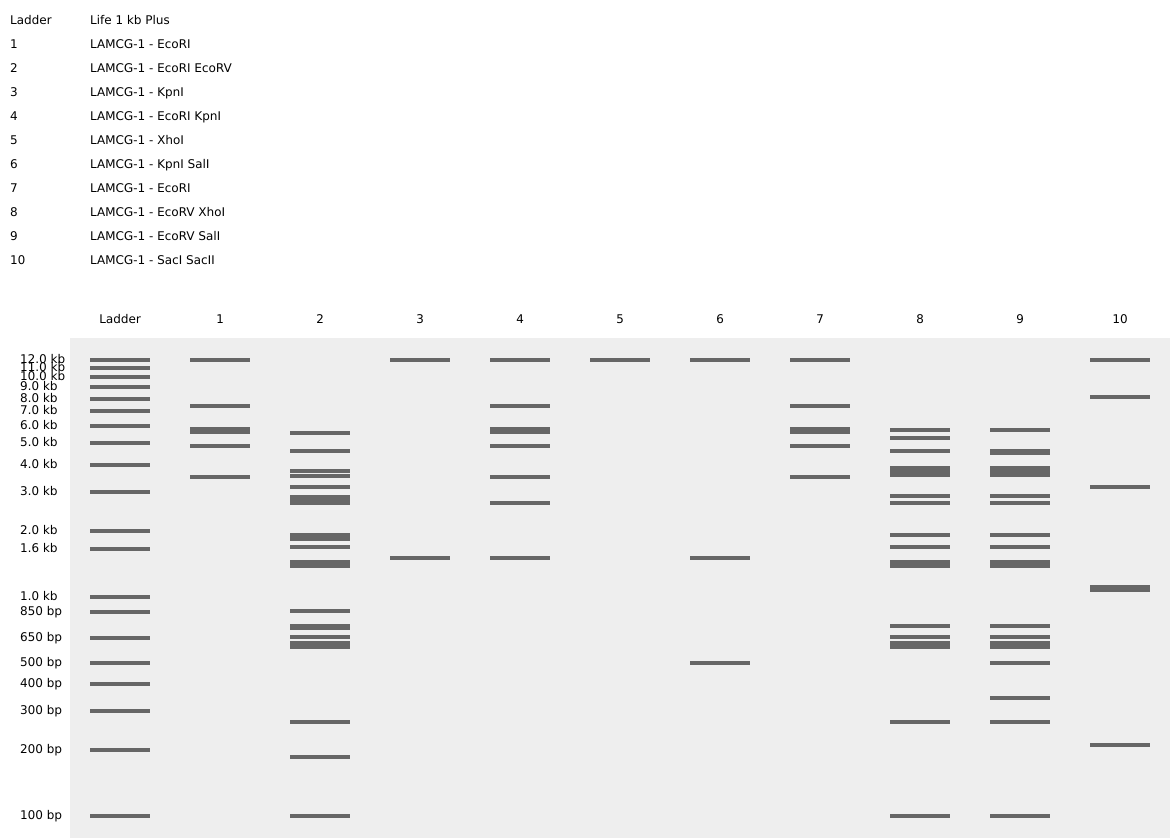
Part 1: Benchling & In-silico Gel Art
I created a Benchling account and imported the Lambda DNA sequence as described in the lab protocol. I simulated restriction enzyme digestion using multiple enzymes, including EcoRI, EcoRV, KpnI, SalI, SacI, XhoI, and combinations of these enzymes. I explored different digestion conditions to observe how fragment sizes and band patterns changed under various enzyme combinations.
To design the gel art, I iteratively tested different digests and compared band distributions to identify visually interesting patterns. I used Ronan’s gel design approach as inspiration to refine the arrangement and achieve a structured pattern consistent with the artistic style of Paul Vanouse’s Latent Figure Protocol works, where DNA fragment bands are treated as compositional elements.
The final design was constructed using the following ladder and digestion conditions:
Ladder
Life 1 kb Plus ladder
Lane setup
LAMCG-1 — EcoRI
LAMCG-1 — EcoRI + EcoRV
LAMCG-1 — KpnI
LAMCG-1 — EcoRI + KpnI
LAMCG-1 — XhoI
LAMCG-1 — KpnI + SalI
LAMCG-1 — EcoRI
LAMCG-1 — EcoRV + XhoI
LAMCG-1 — EcoRV + SalI
LAMCG-1 — SacI + SacII
Through this process, I evaluated multiple digestion scenarios and selected combinations that produced distinct band spacing and contrast, enabling a visually coherent pattern. The design reflects both the structural diversity of restriction fragments and the concept of DNA as a medium for encoding visual information.
Part 3: DNA Design Challenge
3.1 Choose your protein
I chose mCherry, a red fluorescent protein commonly used as a reporter in synthetic biology and molecular biology experiments. mCherry allows visualization of gene expression and protein localization due to its bright fluorescence and stable folding. Because it is widely expressed in E. coli and frequently used in engineered biological systems, it serves as a practical example for exploring DNA design, reverse translation, and protein expression workflows.
Using the reverse translation tool provided by Ghent University (GeneCorner), I converted the amino acid sequence into a corresponding nucleotide sequence. Reverse translation applies the principles of the central dogma, where multiple codons can encode each amino acid, allowing computational inference of a possible DNA sequence that produces the protein.
The reverse-translated sequence was codon optimized using VectorBuilder for expression in E. coli. Codon optimization improves protein expression by adjusting codon usage to match the host organism’s tRNA abundance, reducing ribosomal pausing and increasing translation efficiency.
I chose E. coli as the expression host because it is a well-characterized organism widely used for recombinant protein production, with fast growth and robust genetic tools.
During optimization, restriction enzyme recognition sites were removed to avoid cloning complications and enable compatibility with common assembly methods. These included:
The codon optimized DNA sequence can be inserted into an expression vector under a promoter and transformed into E. coli. The promoter recruits RNA polymerase to transcribe the DNA into mRNA, and the ribosome binds to the ribosome binding site to initiate translation. The mCherry protein is synthesized and folds into a fluorescent structure that emits red light.
Protein production can occur in:
Cell-dependent systems: recombinant expression in E. coli
Cell-free systems: transcription-translation reactions without living cells
These approaches allow controlled production and characterization of the protein.
Part 4: Prepare a Twist DNA Synthesis Order
4.1 Create accounts
I created accounts on Benchling and Twist Bioscience to design and simulate ordering a synthetic DNA construct. These platforms were used to build, annotate, and visualize the expression cassette and to simulate cloning into a plasmid backbone.
4.2 Build your DNA insert sequence
Using Benchling, I created a new DNA sequence with linear topology to represent the insert fragment. The goal was to design an expression cassette that constitutively expresses the mCherry fluorescent protein in E. coli.
I assembled the sequence by placing each genetic element sequentially:
Constitutive promoter (BBa_J23106)
Ribosome binding site (BBa_B0034)
mCherry coding sequence (codon optimized for E. coli)
C-terminal 7×His tag for purification
Stop codon
Transcription terminator (BBa_B0015)
Each component was annotated in Benchling to clearly indicate its function within the construct. The linear map view was used to verify that all features were correctly ordered and properly labeled.
This assembled sequence represents an expression cassette that can drive transcription and translation of mCherry in a bacterial host.
4.5 Import sequence
I uploaded the FASTA file of the annotated mCherry expression cassette to Twist using the nucleotide sequence upload option. This step represents submitting the design for synthesis.
4.6 Choose vector
I selected the pTwist Amp High Copy vector as the cloning backbone. This vector contains:
Ampicillin resistance for selection
High copy origin of replication for strong expression
Standard cloning features
Choosing a high copy vector supports robust production of the mCherry protein in E. coli.
After selecting the vector, I downloaded the full plasmid construct in GenBank format and imported it back into Benchling to visualize the complete plasmid map.
Final construct
The final plasmid contains the mCherry expression cassette inserted into the pTwist Amp High Copy backbone. The plasmid map confirms the presence of the insert, antibiotic resistance marker, and origin of replication, indicating a successful simulated cloning workflow.
This exercise demonstrates the process of designing a synthetic gene, assembling regulatory elements, and preparing a construct for DNA synthesis and expression.
Part 5: DNA Read / Write / Edit
5.1 DNA Read
(i) What DNA would you want to sequence and why?
I would want to sequence microbial DNA from wastewater samples. Wastewater contains DNA from bacteria, viruses, and other microorganisms, making it a powerful way to monitor public health and environmental changes. By sequencing wastewater DNA, we can track the spread of pathogens, detect antibiotic resistance genes, and monitor outbreaks such as viral infections. This approach can provide early warning signals for disease surveillance and help guide public health decisions.
(ii) What sequencing technology would you use and why?
I would use a combination of Illumina sequencing and Oxford Nanopore sequencing.
Illumina provides highly accurate short reads, which are useful for identifying specific genes and variants, while Nanopore sequencing provides long reads that help assemble genomes and detect structural variations.
Generation type
Illumina: Second-generation sequencing
Nanopore: Third-generation sequencing
Input and preparation
Input would be extracted DNA from wastewater samples.
Preparation steps include:
DNA extraction
Fragmentation
Adapter ligation
PCR amplification (for Illumina)
Library preparation
Essential sequencing steps
For Illumina:
DNA fragments bind to flow cell
Bridge amplification forms clusters
Sequencing by synthesis detects fluorescent signals as nucleotides are incorporated
For Nanopore:
DNA passes through a nanopore
Changes in electrical current are measured
Base calling software converts signals into sequence
Output
The output is a digital DNA sequence (FASTQ/FASTA files) that can be analyzed to identify organisms and genes present in the sample.
5.2 DNA Write
(i) What DNA would you want to synthesize and why?
I would like to synthesize a genetic circuit that expresses the mCherry fluorescent protein in response to environmental stress signals. This could serve as a biosensor to detect changes such as oxidative stress or toxic compounds. Such circuits could be used for environmental monitoring or research applications.
Example sequence component:
Promoter
Regulatory element
mCherry coding sequence
Terminator
(ii) What technology would you use and why?
I would use phosphoramidite chemical DNA synthesis followed by gene assembly methods such as Gibson Assembly or Twist Bioscience gene synthesis.
These methods allow precise construction of custom DNA sequences with high accuracy.
Essential steps
Chemical synthesis of oligonucleotides
Assembly into full-length gene
Sequence verification
Cloning into vector
Limitations
Error rates increase with longer sequences
Cost increases for large constructs
Synthesis length limits
Need for sequence verification
5.3 DNA Edit
(i) What DNA would you want to edit and why?
I would be interested in editing genes related to genetic diseases, such as correcting mutations that cause inherited disorders. For example, editing disease-associated genes could help develop gene therapies. Beyond medicine, editing microbial genomes to improve metabolic pathways could help in sustainable biomanufacturing.
(ii) What technology would you use and why?
I would use CRISPR-Cas9 because it is precise, programmable, and widely used for targeted genome editing.
How it edits DNA
CRISPR uses a guide RNA to direct the Cas9 enzyme to a specific DNA sequence, where it creates a double-strand break. The cell’s repair machinery then repairs the DNA, allowing insertion, deletion, or correction.
Preparation and input
Guide RNA design
Cas9 protein or plasmid
Donor template (if precise repair needed)
Target cells
Limitations
Off-target effects
Variable editing efficiency
Delivery challenges
Ethical considerations
Overall, DNA read, write, and edit technologies provide powerful tools for understanding and engineering biological systems, with applications ranging from medicine to environmental monitoring.