Week 11 – Building Genomes

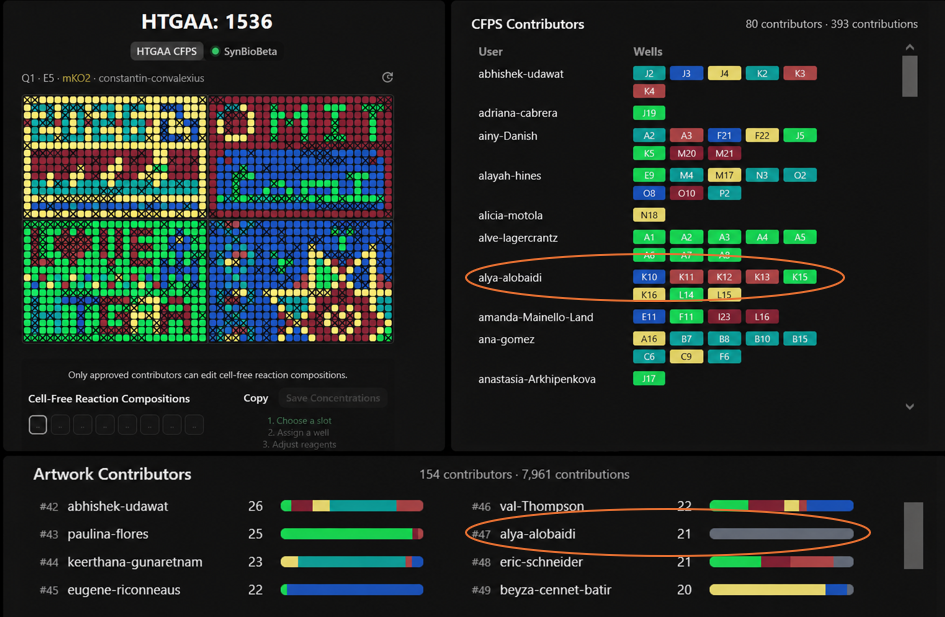
For the collaborative bioart project, I contributed to several wells including K10, K11, K12, K13, K15, K16, L14, and L15. Most of my contributions appeared in the right-side region of the artwork.
What I liked most about this project was seeing how many people from different backgrounds worked together to create one large scientific artwork. It honestly felt chaotic at first, but super cool once the final pattern started forming. I also liked how science and art were combined together in a very interactive way. One thing that could make the project even more fun next year is adding a little more guidance or visualization for first-time participants to better follow how the final image develops collectively over time. I really enjoyed the project overall, but at the beginning it took me some time to fully understand how everything was coming together. I wish I have participated more and on time!
E. coli Lysate
BL21 (DE3) Star Lysate (includes T7 RNA Polymerase) Provides the cellular machinery needed for protein synthesis, including ribosomes, enzymes, and T7 RNA polymerase for transcription. It essentially acts as the “engine” of the cell-free system.
Salts/Buffer
Potassium Glutamate Helps maintain ionic conditions similar to the inside of a cell and supports efficient protein synthesis.
HEPES-KOH pH 7.5 Acts as a buffer to maintain a stable pH during the reaction since cell-free systems are highly pH sensitive.
Magnesium Glutamate Provides magnesium ions required for ribosome activity, enzyme function, and transcription/translation.
Potassium phosphate monobasic Helps maintain phosphate balance and contributes to buffering capacity in the reaction.
Potassium phosphate dibasic Works together with monobasic phosphate to stabilize pH and maintain proper reaction conditions
Energy / Nucleotide System
Ribose Serves as a precursor for nucleotide synthesis in the NMP-ribose system.
Glucose Provides an energy source that helps sustain protein production for longer periods.
AMP Acts as a nucleotide precursor that can eventually be converted into ATP inside the lysate.
CMP Serves as a precursor for CTP synthesis during transcription.
GMP Acts as a precursor for GTP production used in RNA synthesis.
UMP Serves as a precursor for UTP production during transcription.
Guanine Can be enzymatically converted into GMP and later into GTP within the lysate system.
Translation Mix (Amino Acids)
17 Amino Acid Mix Provides most of the amino acids required for protein translation.
Tyrosine Added separately because it can become limiting during protein synthesis reactions.
Cysteine Added separately since it is relatively unstable and easily oxidized in solution.
Additives
- Nicotinamide Supports metabolic enzyme activity and helps improve reaction stability and protein production.
Backfill
- Nuclease Free Water Used to adjust the final reaction volume without introducing nucleases that could damage nucleic acids.
Based on the HTGAA recitation discussion, the 1-hour PEP-NTP system directly supplies nucleotide triphosphates (NTPs) and phosphoenolpyruvate (PEP), allowing rapid protein production but at a higher cost and for a shorter duration. In contrast, the 20-hour NMP-ribose-glucose system uses simpler precursor molecules such as NMPs, ribose, and glucose, which support longer and more sustainable protein production through enzymatic regeneration inside the lysate.
Bonus question: Transcription can still occur because guanine can be enzymatically converted into GMP inside the lysate. The GMP can then be further phosphorylated into GTP, which is required for RNA synthesis during transcription.
Part C: Planning the Global Experiment | Cell-Free Master Mix Design
sfGFP is known for very efficient folding, which makes it reliable in cell-free protein expression systems. Its fluorescence still depends on proper chromophore maturation, which requires oxygen and enough incubation time.
mRFP1 is an older red fluorescent protein and is generally less bright than newer red variants. Slower maturation and folding efficiency can affect the strength of its final fluorescence signal.
mKO2 produces a bright orange fluorescence, but its signal can be sensitive to pH changes. Because of this, maintaining stable reaction conditions may help preserve fluorescence during longer incubations.
mTurquoise2 is a cyan fluorescent protein with strong brightness and relatively good stability. Its lower acid sensitivity makes it useful for longer cell-free reactions where conditions may gradually change over time.
mScarlet-I is a newer red fluorescent protein with improved brightness and maturation compared with older red fluorescent proteins. Proper folding and chromophore maturation are still important for achieving strong fluorescence output.
Electra2 is a blue fluorescent protein, and blue fluorescent signals are sometimes harder to detect clearly compared with green or red proteins. Stable reaction conditions and efficient folding may help improve its fluorescence readout.
These descriptions were based on the HTGAA cell-free recitation discussions, the fluorescent protein information provided in the Benchling folder, and general fluorescent protein properties related to folding, maturation, pH sensitivity, and oxygen-dependent chromophore formation.
I would focus on sfGFP because its fluorescence depends on efficient folding and proper chromophore maturation over time. Based on the discussion about longer incubations and sustaining cell-free reactions, my hypothesis is that supplementing the reaction with additional amino acids and improving the glucose/ribose energy-support system could help maintain protein production during the 36-hour incubation, leading to stronger and more stable green fluorescence.
For the second phase, I would use the Cell-Free Optimization Interface to test small changes based on my sfGFP hypothesis. I would mainly focus on amino acid supplementation and improving the glucose/ribose energy-support system to see if it helps maintain stronger green fluorescence during the longer incubation.
For the final part, I am still waiting for the email and assigned instructions so it is TBD.