Week 1 HW: Principles and Practices

Week 1: Principles & Practices- Class Assignment
- First, describe a biological engineering application or tool you want to develop and why. This could be inspired by an idea for your HTGAA class project and/or something for which you are already doing in your research, or something you are just curious about.
Lactate Biosensor Tattoo for competition swimmers!
- I propose developing a semi-permanent, waterproof biosensor tattoo that detects lactate levels in athletes during pool training. The system would rely on engineered biological circuits that respond to lactate and trigger a visible fluorescent or colorimetric signal, functioning as a traffic-light-style, semi-quantitative indicator of physiological stress.
- The idea is connected to course topics such as genetic circuit design and fluorescent protein signaling. Lactate would act as the biological input, while the output would be a color change generated by chromoproteins or fluorescent reporters, similar to the chromophore and genetic circuit.
- This tool doesn’t pretend to replace clinical blood tests or provide precise measurements. Instead, it will support athletic training by providing real-time visual feedback, reducing invasive blood sampling, and minimizing medical waste, such as needles and collection tubes.
- This idea is inspired by my personal experience as a competitive swimmer, where lactate monitoring required repeated finger pricks during intense training sessions. I am particularly interested in exploring how biological sensing circuits and fluorescence-based outputs could be adapted to function under demanding conditions such as exercise, pool conditions, and temperature variation.
Biology pipeline of the application (circuit-inspired sensing)
Swimmer (physiological lactate production):
→ Input: Lactate diffusion into the tattoo microenvironment → Sensing module: Lactate-responsive biological circuit → Signal transduction: Activation of chromoprotein / fluorescent reporter → Output: Visual color scale (green/yellow/red)
Visual diagram
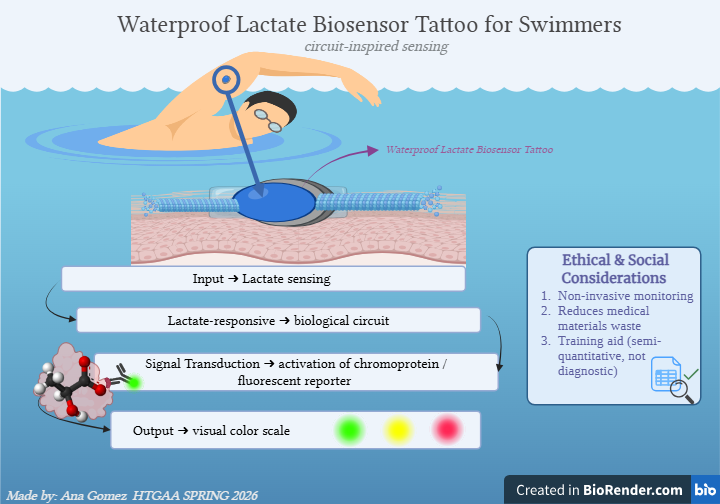 Created in https://BioRender.com
- Next, describe one or more governance/policy goals related to ensuring that this application or tool contributes to an “ethical” future, like ensuring non-malfeasance (preventing harm). Break big goals down into two or more specific sub-goals. Below is one example framework (developed in the context of synthetic genomics) you can choose to use or adapt, or you can develop your own. The example was developed to consider policy goals of ensuring safety and security, alongside other goals, like promoting constructive uses, but you could propose other goals for example, those relating to equity or autonomy.
Governance / Policy Goals:
For the present idea and to ensure that the lactate biosensor tattoo contributes to an ethical and responsible future, I propose the following governance goals:
- Goal 1: Protect Athlete Health and Prevent Harm (Non-maleficence)
- Sub-goals:
- Make sure that biosensor results are clearly communicated as semi-quantitative training indicators, not medical diagnoses (do not replace the traditional lab test).
- Prevent misinterpretation by athletes or coaches that could lead to overtraining or injury.
- Ensure that biosensor tattoos are biocompatible, with non-toxic materials, and safe.
- Required informed consent for younger athletes.
- Goal 2: Prevent Environmental and Biological Risks
- Sub-goals:
- Avoid environmental release of engineered biological components by using encapsulated or cell-free sensing systems.
- Ensure biodegradability or safe disposal of tattoo materials.
- Follow Ecuadorian biosafety regulations regarding GMOs and synthetic biology applications.
- Goal 3: Promote Equitable and Responsible Use
- Sub-goals:
- Acknowledge that early versions of the biosensor tattoo will likely be expensive and limited to pilot programs or elite training centers.
- Explore pathways for future cost reduction through industrial scaling and partnerships with public institutions.
- Encourage transparent communication about accessibility limitations during early deployment stages.
This goal particularly recognizes that initial implementations of the technology will likely be costly, requiring regulatory approval and industrial production to become broadly accessible.
- Next, describe at least three different potential governance “actions” by considering the four aspects below (Purpose, Design, Assumptions, Risks of Failure & “Success”). Try to outline a mix of actions (e.g. a new requirement/rule, incentive, or technical strategy) pursued by different “actors” (e.g. academic researchers, companies, federal regulators, law enforcement, etc). Draw upon your existing knowledge and a little additional digging, and feel free to use analogies to other domains (e.g. 3D printing, drones, financial systems, etc.)
- a. Purpose: What is done now and what changes are you proposing?
- b. Design: What is needed to make it “work”? (including the actor(s) involved - who must opt-in, fund, approve, or implement, etc)
- c. Assumptions: What could you have wrong (incorrect assumptions, uncertainties)?
- d. Risks of Failure & “Success”: How might this fail, including any unintended consequences of the “success” of your proposed actions?
Governance Actions:
- Before describing the governance actions, it is important to mention that the project is proposed as a pilot to be tested with competitive swimmers from Concentración Deportiva de Pichincha (Quito, Ecuador). The project is framed within local ethical, legal, and institutional constraints, particularly Ecuador’s restrictive regulations regarding genetically modified organisms (GMOs), and prioritizes athlete safety, non-malfeasance, and responsible innovation.
- To guarantee that, the lactate biosensor tattoo contributes to an ethical and socially responsible future. I propose the following governance actions, involving a mix of technical, institutional, and regulatory approaches, and different actors
Action 1: Technical Safety-by-Design for a Non-Invasive Biosensor Tattoo:
- (Actor: device developers + regulatory agencies + academic labs)
- Purpose: Currently, lactate monitoring in competitive swimming relies on repeated invasive blood sampling, which generates medical waste and causes discomfort to athletes. This action proposes a semi-quantitative, non-invasive biosensor tattoo as a complementary training tool that reduces harm while not replacing clinical diagnostics.
- Design:
- The biosensor is designed as a semi-permanent, waterproof tattoo that detects lactate accumulation and translates it into a visual color-scale output (green–yellow–red).
- The biological sensing circuit is conceptually inspired by synthetic biology, which signals pathways but does not to release or replicate living organisms in the environment.
- Design responsibilities would fall primarily on academic researchers, with oversight from institutional ethics committees and sports medicine professionals.
- The visual output (chromoprotein or fluorescent reporter) is intentionally semi-quantitative, reducing the risk of overinterpretation.
- Assumptions:
- That lactate can be detected reliably through accessible physiological fluids without requiring invasive blood access as sweat.
- That fluorescent or chromogenic reporters can remain stable under water exposure, physical stress, and temperature variation.
- That athletes and coaches will correctly understand the limitations of the signal.
- Risks of Failure & “Success”
- Failure could occur if lactate detection is inaccurate or unstable, leading to misleading feedback.
- A successful outcome could unintentionally encourage overreliance on the tool, even though it is not clinically precise; it would be a good suggestion on how swimmers manage the lactate during intense training.
- To mitigate this, clear labeling and training would be required to frame the tattoo strictly as a training aid, not a diagnostic device.
Action 2: Institutional Oversight and Ethical Use in Sports Contexts
- (Actors: Swimming National Federation (FENA), Ministerio del Deporte, etc)
- Purpose: Currently, limited governance frameworks are addressing the ethical use of biosensors in athletic training, particularly in developing countries. This action aims to prevent misuse or surveillance of athletes through physiological monitoring technologies, while ensuring the protection of biometric data generated by the biosensor tattoo.
- Design:
- Implementation would require approval from national sports institutions (Federación Ecuatoriana de Natación, Ministerio del Deporte) and review by local bioethics committees.
- Participation by athletes would be voluntary, with informed consent emphasizing data limits and privacy.
- Data generated by the biosensor would be locally interpreted and not digitally transmitted, minimizing privacy risks.
- Assumptions:
- That sports institutions will prioritize athlete wellbeing over performance pressure.
- Visual-only feedback reduces the risks of secondary data use or surveillance.
- Athletes feel empowered to decline participation without negative consequences.
- Risks of Failure & Success
- Failure could happen if coaches or institutions pressure athletes to adopt the technology for performance surveillance, or if biosensor results are treated as substitutes for clinical laboratory testing.
- Even in “success”, widespread adoption could normalize continuous biometric monitoring, raising concerns about autonomy and consent.
- This highlights the need for explicit governance rules limiting use to training and research contexts.
Action 3: Regulatory Alignment with Ecuadorian Bioethics and Biosafety Frameworks (Actors: Ministerio de Salud (MSP), Agencia Nacional de Regulación, Control y Vigilancia Sanitaria (ARCSA), Corte Constitucional del Ecuador (Constitutional Court of Ecuador)- Constitution of 2008)
- Purpose: Ecuador maintains strict constitutional and legal constraints on GMOs, and biotechnology advances medical devices. This action aims to ensure that the project remains compliant with national bioethical principles while enabling responsible research innovation.
- Design:
- The project is framed as a biosensing device, not a GMO deployment.
- Any biological components would be designed to be non-replicative, contained, and biodegradable, avoiding environmental release.
- Oversight would involve academic institutions, national ethics frameworks (MSP, ARCSA, and Constitution of Ecuador-2008), and alignment with international guidance (WHO biosafety principles).
- Assumptions:
- That conceptual designs inspired by synthetic biology can be ethically discussed and evaluated at a governance level without requiring immediate deployment of genetically modified organisms (GMOs), particularly when the proposed application relies on non-living or enzyme-based sensing components.
- Ecuadorian bioethics and regulatory frameworks can support the development of a highly controlled, small-scale pilot project for a biosensor intended for athletic training, after a long-term rigorous regulatory process, safety validation, and ethical review in coordination with national institutions such as MSP & ARSCA.
- Risks of Failure & Success
- Regulatory ambiguity could slow or prevent approval even at the pilot level.
- Conversely, “success” could provoke future pressure to commercialize without sufficient regulatory adaptation.
- This underscores the importance of early governance discussions, even for speculative designs.
- Next, score (from 1-3 with, 1 as the best, or n/a) each of your governance actions against your rubric of policy goals. The following is one framework but feel free to make your own:
Table 1: Scoring action table
| Evaluation Criteria: | Action 1 | Action 2 | Action 3 |
|---|---|---|---|
| Protect athlete health | |||
| • Prevent physical harm (biocompatibility, toxicity) | 1 | 2 | 2 |
| • Reduce invasive testing | 1 | 2 | 3 |
| Prevent misuse of data | |||
| • Avoid performance surveillance | 2 | 1 | 2 |
| • Provide informed consent | 3 | 1 | 2 |
| Environmental safety | |||
| • Containment of biological components | 1 | 2 | 1 |
| • Safe disposal | 1 | 2 | 1 |
| Feasibility in Ecuadorian context | |||
| • Institutional support availability | 2 | 1 | 3 |
| • Regulatory complexity | 1 | 1 | 3 |
| • Support responsible innovation | 1 | 2 | 3 |
| • Promote constructive applications | 1 | 1 | 2 |
(1 = best, 3 = weakest)
- Last, drawing upon this scoring, describe which governance option, or combination of options, you would prioritize, and why. Outline any trade-offs you considered as well as assumptions and uncertainties. For this, you can choose one or more relevant audiences for your recommendation, which could range from the very local (e.g. to MIT leadership or Cambridge Mayoral Office) to the national (e.g. to President Biden or the head of a Federal Agency) to the international (e.g. to the United Nations Office of the Secretary-General, or the leadership of a multinational firm or industry consortia). These could also be one of the “actor” groups in your matrix.
Prioritized Governance Approach:
Based on the scoring in Table 1, the most effective governance strategy for this project is a combination of Action 1 (Technical Safety-by-Design for a Non-Invasive Biosensor Tattoo) and Action 2 (Institutional Oversight and Ethical Use in Sports Contexts).
- Action 1: It’s prioritized because it directly protects athlete health and environmental safety by embedding biocompatibility, containment, and safe disposal into the technical design of the biosensor tattoo. This approach minimizes physical harm and reduces reliance on invasive lactate testing while remaining feasible within the Ecuadorian research context, where early-stage pilot projects must demonstrate safety before scaling.
- Action 2: This is prioritized too by addressing ethical risks related to data misuse. Institutional oversight through sports federations and bioethics committees ensures informed consent, limits performance surveillance, and protects athlete autonomy. This is particularly important in elite sports environments, where power imbalances between athletes and institutions may exist.
- For action 3 is not that prioritized in the early stage of the project, even though, in the long term, it remains relevant for future scaling once safety, ethical use, and institutional trust are established.
This combined approach is recommended primarily for local sports institutions and research actors in Ecuador, such as the Federación Ecuatoriana de Natación (FENA) and Ministerio del Deporte, balancing innovation with athlete protection under existing bioethical and regulatory frameworks. Also, by the supported international academic collaboration. Key uncertainties include institutional commitment and the long-term performance of the biosensor under real training conditions.
Reflection section.-

Reflecting on what you learned and did in class this week, outline any ethical concerns that arose, especially any that were new to you. Then propose any governance actions you think might be appropriate to address those issues. This should be included on your class page for this week.
This first week made me reflect on how biology is not only a technical field but also deeply connected to ethics, society, and human experience. Although I already had a background in bioethics and biosafety from my undergraduate studies (mostly focused on GMOs, plant biotechnology, and laboratory practices), this class helped me think about ethics in a broader context, especially for emerging technologies such as biosensors, where regulatory frameworks are not always clearly defined, particularly in developed countries like Ecuador.
One concern I realized is that for projects like this, it is sometimes unclear which national institutions should regulate them, especially when they fall between biomedical devices and sports technology. This highlighted the importance of having clear governance pathways and interdisciplinary oversight.
To address this concern, I believe governance actions such as institutional bioethics review, informed consent, and collaboration between sports organizations and academic researchers are essential, especially during early pilot stages. These steps can help ensure that innovation remains centered on wellbeing, responsibility, and trust.
What I also appreciated greatly about this week’s classes was the diversity of student backgrounds. There were not only scientists, but also economists, artists, psychologists, and others. It was inspiring to see how different perspectives came together around biology and innovation, reminding me that responsible science benefits from interdisciplinary thinking.
This assignment was challenging for me at first. I began with many ideas and felt overwhelmed thinking about everything that could go wrong. Eventually, I grounded my project in my personal experience as a competitive swimmer and realized that even conceptual ideas can have real-world relevance. One thing that helped me a lot was creating the SWOT analysis, which helped me visualize both the potential and the limitations of my proposal.
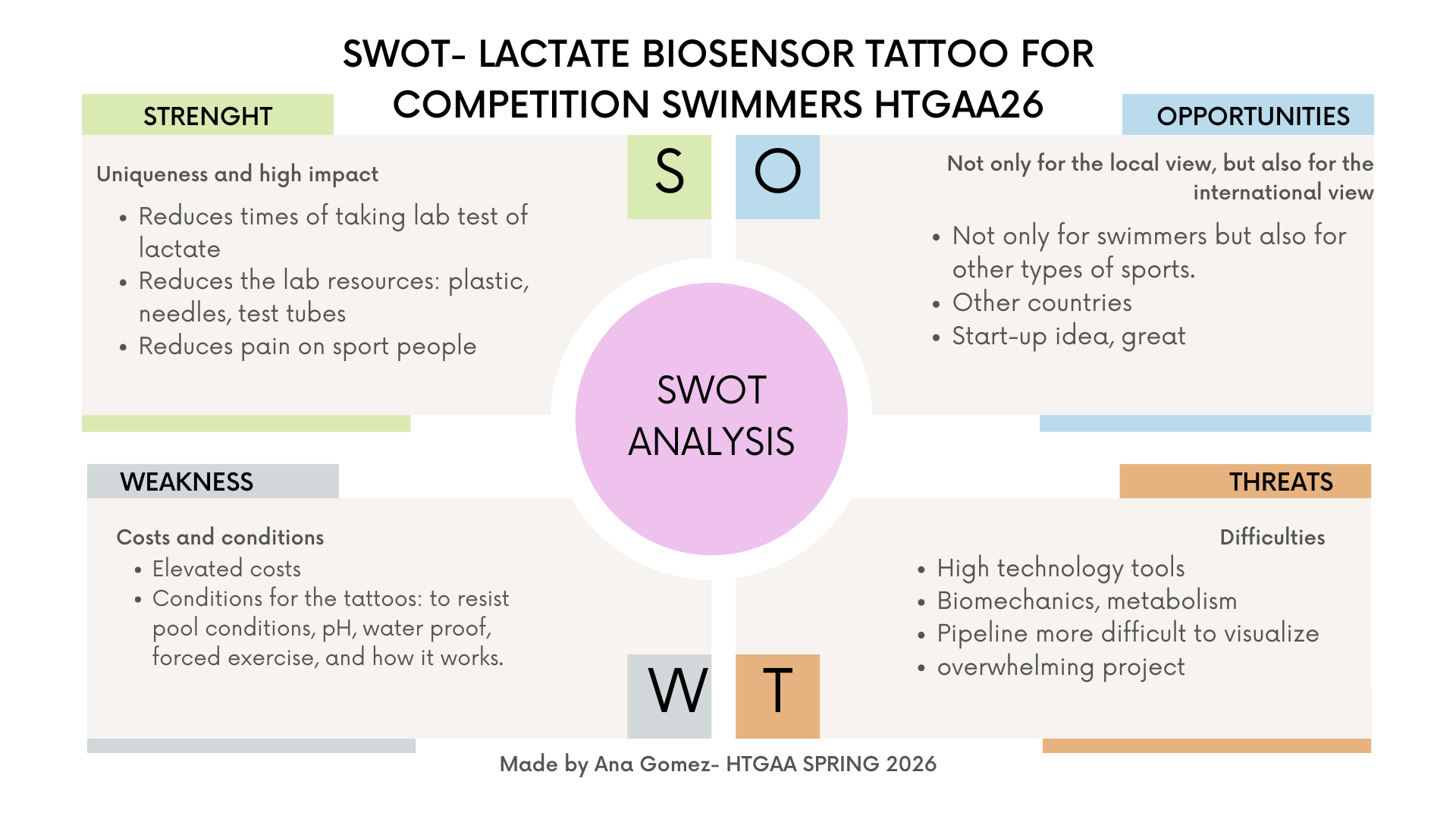
Thanks for reading, for pre-lecture part, please read week 2- homework section. For more information, you can access my notion in week 1 homework:
Resources/reviewed information
- General idea of Lactate biosensors: Electrochemical Tattoo Biosensors for Real-Time Noninvasive Lactate Monitoring in Human Perspiration
- Governance Actions
- Action 1:
- Action 2:
- Action 3: Spanish documents Biosecurity and normatives from Ecuadorian Institutions
- https://www.investigacionsalud.gob.ec/webs/intranet/wp-content/uploads/2022/09/M-BS-001-ed-02-Manual-de-Bioseguridad.pdf
- https://www.salud.gob.ec/wp-content/uploads/downloads/2013/09/reglamento_sobre_el_material_genético_septiembre_2013.pdf