Week 1 Lab: Pipetting

Introduction to Pipetting and Dilutions
1. Concentration of the 5 M stock solution in g/mL
Given:
- Stock concentration = 5 M
- Molecular weight = 532 g/mol
Calculation:
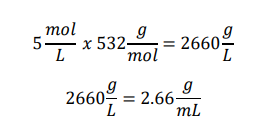
Answer
The concentration of the stock solution is 2.66 g/mL.
2. Serial dilution plan from 5 M to 100 µM
Because the dilution factor is extremely large, serial dilutions are more accurate than a single-step dilution.
Steps: Step 1: Dilute 5M to 10 mM (10,000 µM)
- Add 2 µL of 5M
- Add the rest to complete 1000 µL (998 µL of 𝑑𝐻2𝑂)
𝐷𝑖𝑙𝑢𝑡𝑖𝑜𝑛 1:500
Step 2: Dilute 10.000 µM to 100 µM
- Add 10 µL from the previous step
- Add 990 µL of 𝑑𝐻2𝑂
𝐷𝑖𝑙𝑢𝑡𝑖𝑜𝑛 1:1000
Tubes & Pipettes - Use 1,5 mL microcentrifuge tubes
- P20 pipette for 2-20 µL transfers
- P1000 pipette for 990-998 µL additions
3. Reaction setup 60 µL total
Using C1V1=C2V2 Dye: (6X)(V1) = (1X)(60) V1= 10 µL Mystery substance (MS) (100)(V1) = (40)(60) V1 = 24 µL Water: 60−(24+10) = 26μL
Summary:
| Reagent | Stock concentration | Desired concentration | Volume |
|---|---|---|---|
| Loading dye | 6X | 1X | 10 µL |
| MS | 100 µM | 40 µM | 24 µL |
| dH₂O | n/a | n/a | 26 µL |
Why prepare 100 µM first instead of directly preparing 40 µM?
Preparing 100 µM first improves dilution accuracy and reproducibility. Very large dilution factors increase pipetting error, especially when extremely small volumes are required. Using an intermediate concentration allows more reliable serial dilutions and reduces experimental variability.
Supplementary Calculation PDF DOC Click to download
Embed document: