Week 3 HW: Lab Automation
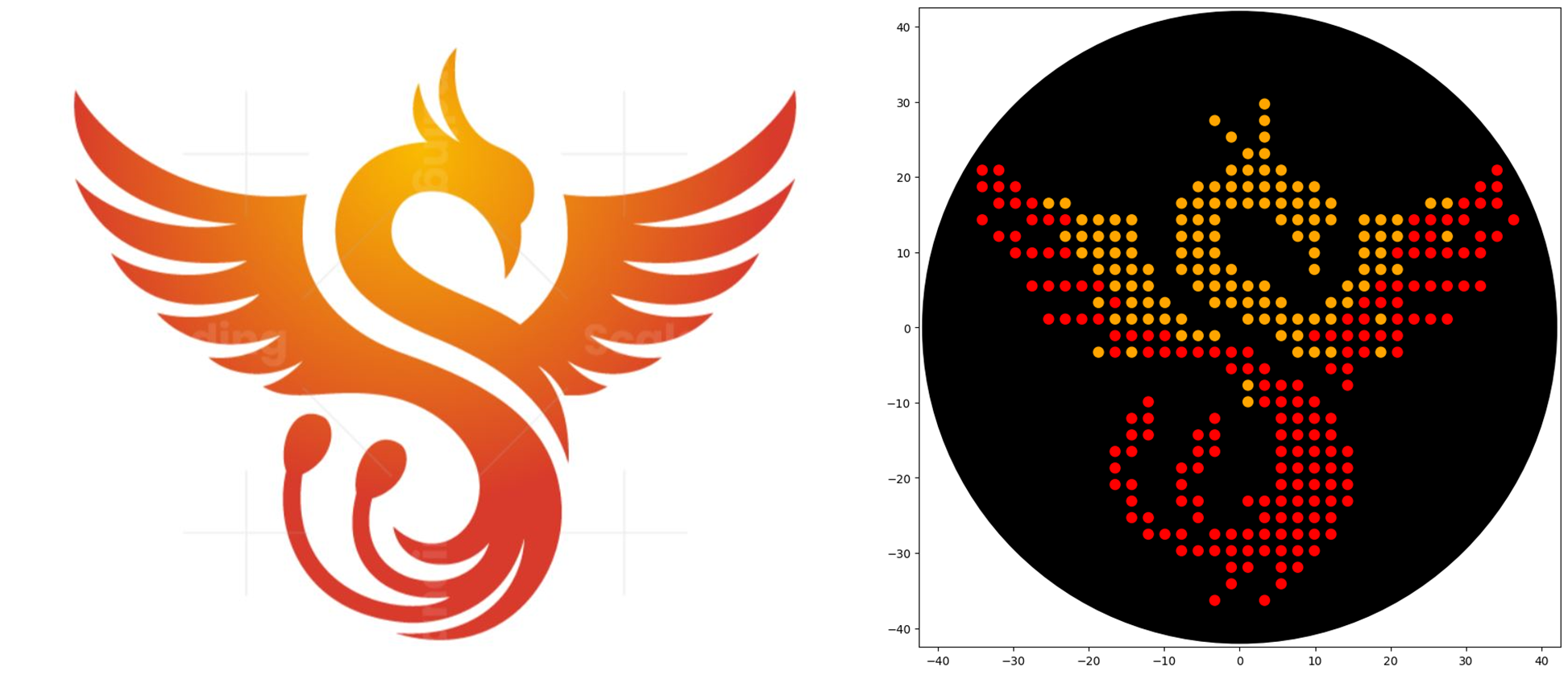
Assignment: Python Script for Opentrons Artwork
1. Generate an artistic design using the GUI at opentrons-art.rcdonovan.com.
I used the GUI for converting my rising phoenix image into the dot design, I loved the tool, very helpful, easy to use and to edit and perfectionate my design. The tool supplied the coordinates to add to my code, and the result looks perfect!
I selected the rising phoenix as it represents transformation, resilience, and renewal. It reminds me that growth often comes from challenges, and I have the capacity to transform and emerge stronger.
2. Using the coordinates from the GUI, follow the instructions in the HTGAA26 Opentrons Colab to write your own Python script which draws your design using the Opentrons.
Ready in Google Colab
I used ChatGPT to polish written explanations, to clarify concepts and clean and debug Opentrons Python code. All final decisions and interpretations were reviewed and confirmed by me.
Post-Lab Questions
One of the great parts about having an automated robot is being able to precisely mix, deposit, and run reactions without much intervention, and design and deploy experiments remotely.
For this week, we’d like for you to do the following:
- Find and describe a published paper that utilizes the Opentrons or an automation tool to achieve novel biological applications.
“Cell-free biosensor with automated acoustic liquid handling for rapid and scalable characterization of cellobiohydrolases on microcrystalline cellulose”
This study presents a cell-free biosensor designed to rapidly detect the activity of enzymes that break down crystalline cellulose. Instead of relying on traditional, slow assays or cell-based systems, the authors built a transcription factor-based biosensor that produces a fluorescent signal when cellobiose is generated. By integrating this system with the Echo 525 acoustic liquid handler, they demonstrated highly precise, optimized the reactions for small-volumes, and automated reactions that match manual performance while increasing a lot the throughput. Overall, the work shows how combining cell-free systems with automation can significantly accelerate enzyme screening and improve the efficiency of the complete experiment cycle in synthetic biology.
- Write a description about what you intend to do with automation tools for your final project. You may include example pseudocode, Python scripts, 3D printed holders, a plan for how to use Ginkgo Nebula, and more. You may reference this week’s recitation slide deck for lab automation details.
For my project on biosensors for anxiety, I plan to use automation tools like Opentrons to support the genetic engineering of bacteria. My goal is to modify Lactobacillus reuteri so that it can sense elevated cortisol levels and respond by producing GABA, a calming neurotransmitter. By automating key molecular cloning steps, I hope to make the strain engineering process more consistent, efficient, and scalable while reducing human error during repetitive lab work.
Molecular cloning is a central step in building this biosensor system. Automating these procedures will help ensure precision and reproducibility, allowing the design-build-test cycle to move faster and more reliably.
2.1.DNA Fragment Preparation
- Use Opentrons liquid handling to accurately pipette reagents for plasmid extraction and PCR amplification of gene fragments.
- Automate purification steps (e.g., magnetic bead-based purification or column-based cleanup) to standardize DNA yields.
2.2.Restriction Digestion & Ligation
- Automate enzymatic digestion using restriction enzymes to cut plasmids and insert fragments under precise conditions.
- Program ligase reactions for efficient DNA assembly, ensuring consistent reaction times and temperatures.
2.3.Transformation of Engineered Constructs
- Use Opentrons to pipette competent cells, mix them with recombinant DNA, and automate the heat shock or electroporation process.
- Plate transformed cells onto selective agar using a robotic liquid handler to ensure even distribution.
2.4.Screening and Colony Picking
- Automate pipetting of selection media for colony growth.
- Use robotic colony pickers (if available) or automate PCR setup for rapid screening of positive clones.
2.5.PCR & Validation
- Automate PCR setup for screening transformed colonies, ensuring each reaction is prepared with high accuracy.
- If sequencing is needed, automate DNA preparation for submission to sequencing facilities.
REFERENCES
- Taeok Kim, Eun Jung Jeon, Kil Koang Kwon, Minji Ko, Ha-Neul Kim, Seong Keun Kim, Eugene Rha, Jonghyeok Shin, Haseong Kim, Dae-Hee Lee, Bong Hyun Sung, Soo-Jung Kim, Hyewon Lee, Seung-Goo Lee, Cell-free biosensor with automated acoustic liquid handling for rapid and scalable characterization of cellobiohydrolases on microcrystalline cellulose, Synthetic Biology, Volume 10, Issue 1, 2025, ysaf005, https://doi.org/10.1093/synbio/ysaf005