Week 1 HW: Principles and Practices
 ChatGPT generated image
🧬 Project Interest
I am interested in developing a low-cost biological sensing toolkit that enables communities to detect environmental changes, such as air quality, water conditions, or microbial presence, using living or bioreactive materials. The project focuses on slow, visible, and multisensory responses for education, artistic research, and environmental awareness rather than precision measurement or industrial use. I am drawn to systems where organisms act as witnesses to their environments, translating environmental signals into changes in color, structure, sound, or smell.
🧬 Areas of Interest
- Bio-reactive or transcriptional biosensing systems
- Translation between senses (sound, smell, visual change)
- Slow and accessible biological tools for community use
- Artistic and educational approaches to environmental sensing
- Non-extractive and non-reproducible biological data traces
🧬 References
- Biosensor nanoengineering
https://www.sciencedirect.com/science/article/pii/S2666351120300401 - MIT image-to-fragrance prototype
https://www.yankodesign.com/2026/02/02/this-mit-prototype-translates-images-into-fragrances-that-your-mind-remembers-better/ - Holon: a cybernetic interface for bio-semiotics Jon McCormack & Elliott Wilson https://doi.org/10.48550/arXiv.2404.03894
- Doom E. coli
https://www.popsci.com/science/doom-e-coli-cells/ - Grow Your Own Cloud
https://growyourown.cloud/
 ChatGPT generated image
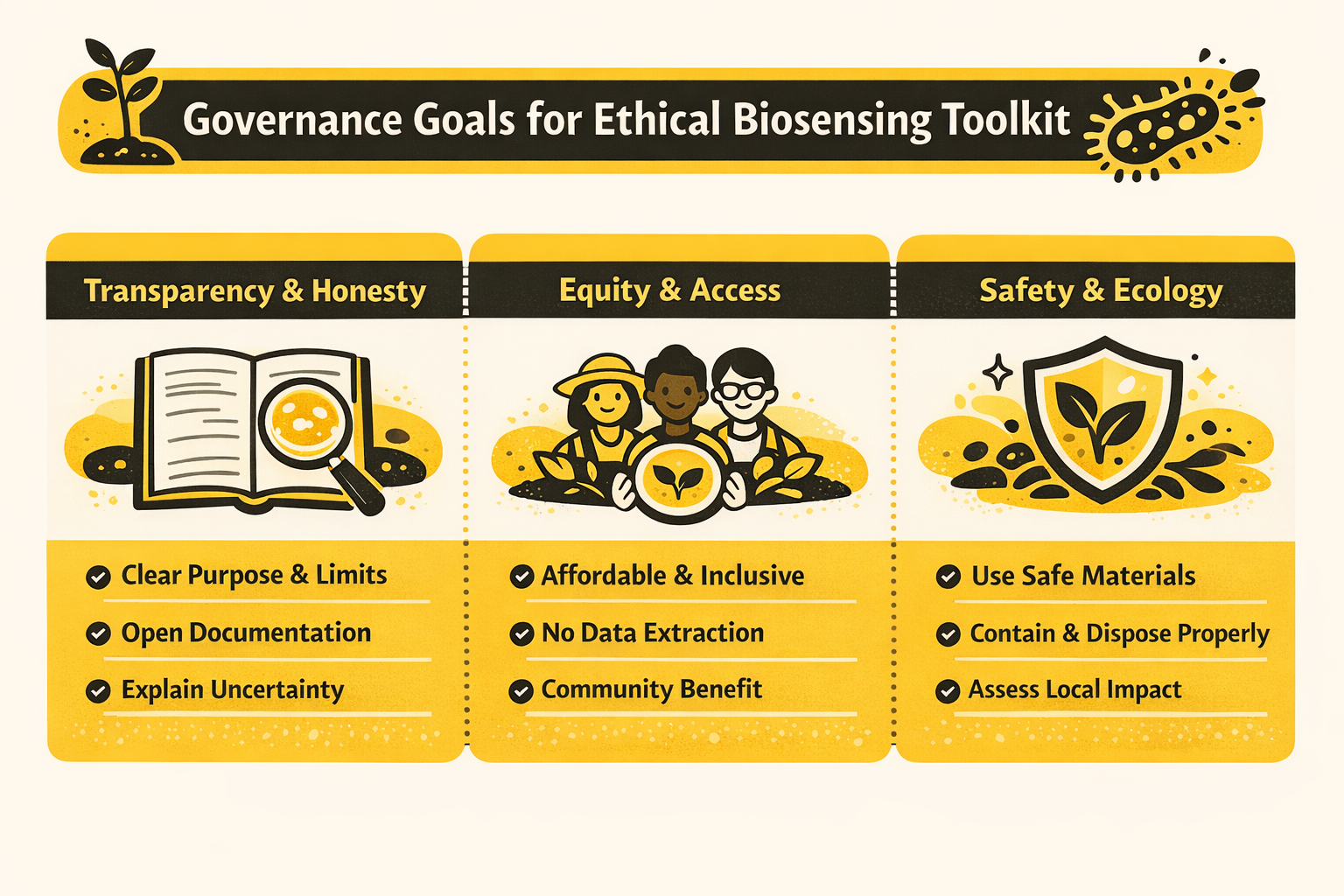
⭐ 1. Ensuring transparency and honesty in the design and use of the biosensing toolkit
Because this project involves living or bioreactive materials used in public, educational, or community contexts, transparency is essential for building trust and preventing misuse or misinterpretation.
- The project developers should be transparent about the purpose, limits, and non-diagnostic nature of the toolkit.
- The materials, organisms, and processes used in the toolkit should be clearly described and accessible to users.
- How are organisms chosen, and why are they considered low-risk?
- What kinds of environmental signals can and cannot be sensed?
- The toolkit should clearly communicate what the sensing responses mean and what they do not mean.
- Responses should not be framed as precise measurements or evidence.
- Uncertainty, slowness, and ambiguity should be explicitly acknowledged.
- Documentation should be open and easy to understand for non-experts.
- Instructions should include care, containment, and disposal guidelines.
- If possible, documentation should be reviewed by both biological and non-biological practitioners.
⭐ 2. Ensuring equity and preventing extractive or exclusionary use
This project aims to support community awareness and learning, not data extraction or institutional control.
- The toolkit should remain accessible and low-cost for educational and community use.
- It should not depend on proprietary platforms, expensive equipment, or specialized expertise.
- The project should avoid creating biological data that can be easily extracted, stored, or monetized.
- Biological responses should be local, ephemeral, and context-specific.
- Funding sources and institutional partnerships should be made visible.
- Are there stakeholders who may benefit from environmental data collection?
- Could those interests influence how the toolkit is used or interpreted?
- The toolkit should encourage collective observation and discussion rather than expert-only authority.
⭐ 3. Ensuring safety for environmental, ecological, and public health
Even low-risk biological systems require careful consideration when used outside traditional laboratories.
- All organisms and materials used should be non-pathogenic and appropriate for public-facing use.
- The project should clearly define potential risks, even if they are minimal.
- Could organisms survive or spread outside their intended context?
- Could materials cause unintended ecological effects if disposed of incorrectly?
- Clear guidelines should be provided for containment, maintenance, and disposal.
- Disposal methods should prevent environmental release.
- Biological components should be designed to degrade or become inactive over time.
- Users should be informed about who may be more vulnerable to potential exposure.
- Are there different risks for children, elderly users, or immunocompromised individuals?
- Safety should be approached as an ongoing responsibility, not a one-time checklist.
Next, describe at least three different potential governance “actions” by considering the four aspects below (Purpose, Design, Assumptions, Risks of Failure & “Success”). Try to outline a mix of actions (e.g. a new requirement/rule, incentive, or technical strategy) pursued by different “actors” (e.g. academic researchers, companies, federal regulators, law enforcement, etc). Draw upon your existing knowledge and a little additional digging, and feel free to use analogies to other domains (e.g. 3D printing, drones, financial systems, etc.).
- Purpose: What is done now and what changes are you proposing?
- Design: What is needed to make it “work”? (including the actor(s) involved - who must opt-in, fund, approve, or implement, etc)
- Assumptions: What could you have wrong (incorrect assumptions, uncertainties)?
- Risks of Failure & “Success”: How might this fail, including any unintended consequences of the “success” of your proposed actions?
🀄 Governance Action 1: Design-based biological containment and ephemerality
Purpose
Currently, many biosensing tools are designed to be stable, reproducible, and scalable. This project proposes the opposite: systems that are intentionally temporary, fragile, and difficult to scale. The goal is to reduce misuse and unintended persistence.
Design
- Use non-pathogenic, low-risk organisms with limited lifespans or dependencies
- Design sensing responses that fade over time rather than accumulate
- Avoid digital logging or long-term storage of biological signals
- Implemented by project developers, academic researchers, and educators
Assumptions
- Ephemeral systems are less likely to be repurposed for harmful or extractive uses
- Users value experiential and interpretive sensing over durable data
Risks of Failure and “Success”
- Failure: users attempt to stabilize, replicate, or hack the system anyway
- Success risk: the system becomes too fragile or short-lived to sustain engagement or learning
🀄 Governance Action 2: Clear usage framing and community-facing protocols
Purpose
At present, many biological tools are interpreted as authoritative or diagnostic, even when not intended that way. This action proposes explicit framing to prevent misinterpretation and overreach.
Design
- Provide clear written and visual guidance stating that the toolkit is not diagnostic or regulatory
- Include usage guidelines focused on education, reflection, and collective interpretation
- Use licensing or terms of use that discourage commercial, surveillance, or enforcement applications
- Implemented by developers, community organizations, and cultural institutions
Assumptions
- Clear framing and norms can shape how tools are understood and used
- Communities will engage critically rather than treat outputs as objective facts
Risks of Failure and “Success”
- Failure: guidelines are ignored or removed when the toolkit is shared
- Success risk: excessive disclaimers reduce curiosity, trust, or engagement
🀄 Governance Action 3: Light-touch institutional and interdisciplinary review
Purpose
Traditional biosafety or ethics review structures are often designed for laboratories, not public-facing or artistic biological work. This action proposes a lighter, more contextual form of oversight.
Design
- Review processes that include biosafety expertise alongside artists, educators, or community members
- Focus on communication, environmental impact, and public interpretation rather than formal compliance
- Applied through universities, community labs, or funding bodies
- Participation encouraged but not overly bureaucratic
Assumptions
- Interdisciplinary review improves ethical awareness without blocking experimentation
- Institutions are willing to support non-traditional biological practices
Risks of Failure and “Success”
- Failure: review becomes symbolic and ineffective
- Success risk: normalization of oversight that eventually restricts informal or grassroots work
🎯 Scoring governance actions against policy goals
Scoring: +++ = strong contribution, ++ = moderate contribution, + = limited contribution, n/a = not applicable
| Does the option: | Option 1: Design-based containment | Option 2: Usage protocols | Option 3: Institutional review |
|---|---|---|---|
| Enhance Biosecurity | |||
| • By preventing incidents | +++ | ++ | ++ |
| • By helping respond | ++ | ++ | +++ |
| Foster Lab Safety | |||
| • By preventing incident | +++ | ++ | +++ |
| • By helping respond | ++ | ++ | +++ |
| Protect the environment | |||
| • By preventing incidents | +++ | ++ | ++ |
| • By helping respond | ++ | ++ | +++ |
| Other considerations | |||
| • Minimizing costs and burdens to stakeholders | ++ | +++ | + |
| • Feasibility? | +++ | +++ | ++ |
| • Not impede research | +++ | +++ | + |
| • Promote constructive applications | +++ | +++ | ++ |
📔 Prioritization and recommendation
Based on the scoring above, I would prioritize a combination of Option 1 (design-based biological containment and ephemerality) and Option 2 (clear usage framing and community-facing protocols).
Option 1 is prioritized because it embeds ethical constraints directly into the material and biological design of the toolkit. By limiting lifespan, scalability, and data persistence, many potential risks are addressed before the toolkit is even used. This approach is especially important for a project intended to circulate outside formal laboratory environments.
Option 2 complements this by addressing how the toolkit is understood and used in practice. Clear framing, usage guidelines, and non-diagnostic positioning help prevent misinterpretation, overreach, or extractive use, while remaining low-cost and feasible for community and educational contexts.
Option 3 (light-touch institutional and interdisciplinary review) is considered supportive but secondary. While it plays an important role in accountability and response, it also introduces higher burdens and risks imposing institutional norms that may be misaligned with artistic, experimental, or community-led biological work.
📔 Trade-offs, assumptions, and uncertainties
This prioritization assumes that design choices and social norms can meaningfully shape behavior without heavy enforcement. There is uncertainty around whether ephemerality and framing alone are sufficient to prevent misuse, especially once the toolkit is shared beyond its original context.
Another trade-off is between openness and control. Making the toolkit accessible and easy to share increases its educational value but also reduces the ability to enforce intended use. These risks are accepted as part of the project’s commitment to openness and community engagement.
📔 Intended audience
This recommendation is primarily directed toward academic art–science programs, community laboratories, educators, and funding bodies that support public-facing biological work. These actors are well positioned to adopt design-based ethics and usage protocols without relying on strict regulatory enforcement, while still maintaining responsibility for safety and care.
One ethical concern that became clearer to me this week is how biological tools, even when designed to be low-resolution or interpretive, can still carry an aura of authority. The presence of living systems or biological responses often leads people to assume accuracy, objectivity, or scientific legitimacy, even when the signals are ambiguous or intentionally slow.
This raised concerns about misinterpretation and over-trust, especially in public or community contexts where users may not have biological training. A biosensing response meant to provoke awareness or reflection could unintentionally be read as evidence, diagnosis, or proof of environmental harm.
Another concern is how governance frameworks often assume goals of scale, efficiency, and control. These assumptions do not always align with artistic, educational, or community-based biological practices that value slowness, uncertainty, and situated knowledge. There is a risk that governance mechanisms designed for industrial or institutional biology may unintentionally suppress these alternative practices.
To address these concerns, I believe governance actions should not only focus on preventing harm, but also on shaping interpretation. This includes explicitly framing biological sensing as contextual and partial, pairing tools with educational or participatory activities, and designing systems that resist extraction and permanence. Governance, in this sense, becomes part of the design and communication process rather than an external layer imposed afterward.
These reflections reinforced the importance of treating biological tools not just as technologies, but as relational systems that shape how people understand environments, responsibility, and care.
- Nature’s machinery for copying DNA is called polymerase. What is the error rate of polymerase? How does this compare to the length of the human genome. How does biology deal with that discrepancy?
- How many different ways are there to code (DNA nucleotide code) for an average human protein? In practice what are some of the reasons that all of these different codes don’t work to code for the protein of interest?:
- What’s the most commonly used method for oligo synthesis currently?
- Why is it difficult to make oligos longer than 200nt via direct synthesis?
- Why can’t you make a 2000bp gene via direct oligo synthesis?:
Choose ONE of the following three questions to answer; and please cite AI prompts or paper citations used, if any.
- [Using Google & Prof. Church’s slide #4] What are the 10 essential amino acids in all animals and how does this affect your view of the “Lysine Contingency”?
- [Given slides #2 & 4 (
AA:NAandNA:NAcodes)] What code would you suggest forAA:AAinteractions? - [(Advanced students)] Given the one paragraph abstracts for these real 2026 grant programs sketch a response to one of them or devise one of your own: https://arpa-h.gov/explore-funding/programs/boss https://www.darpa.mil/research/programs/smart-rbc https://www.darpa.mil/research/programs/go:
Note: This content was developed with the assistance of ChatGPT as a writing and structuring aid. All ideas, positions, and final decisions reflect my own understanding and interests.