Week 3 HW: Opentrons
1.Designing opentrons artwork
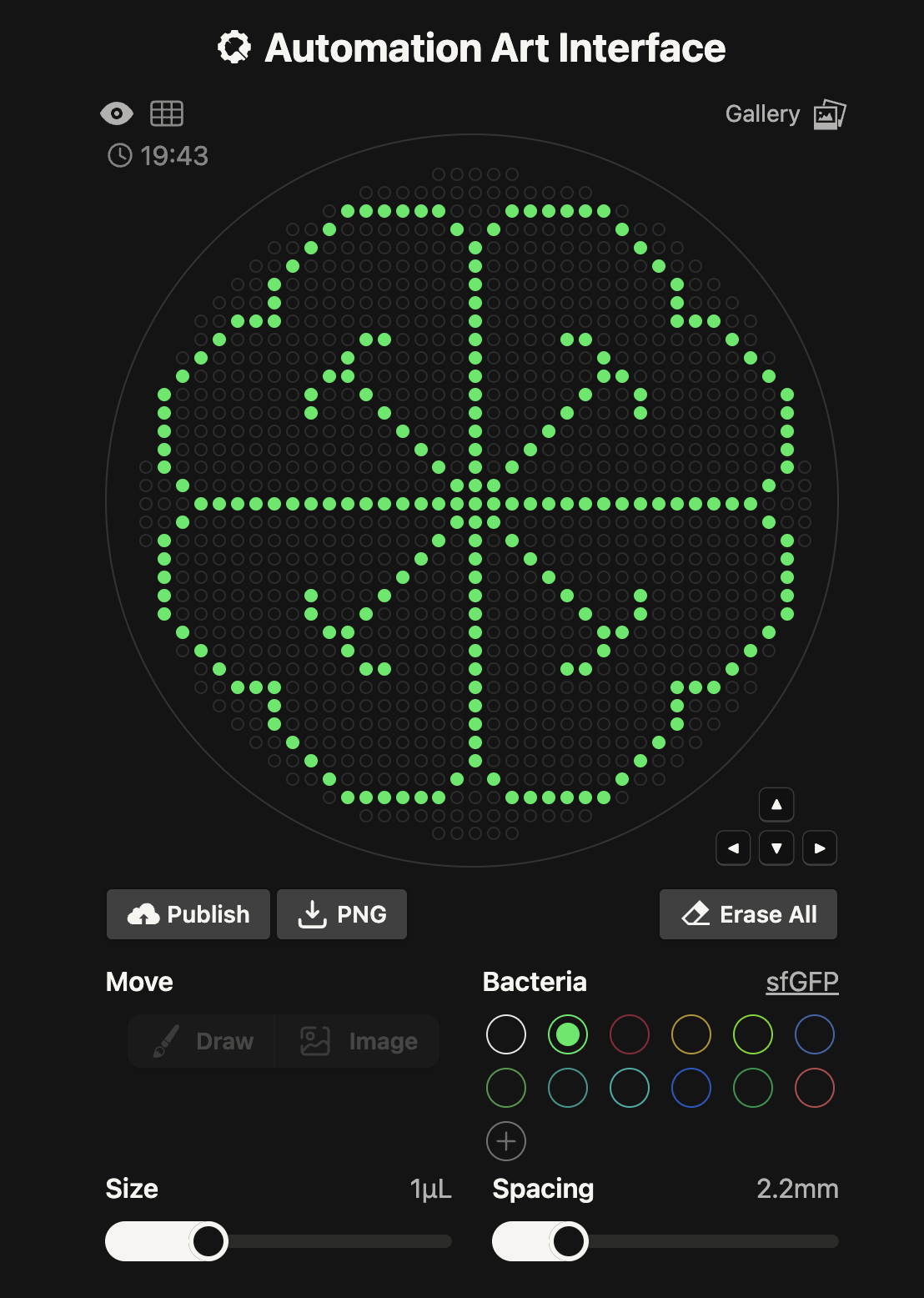 I used https://opentrons-art.rcdonovan.com/ to design a four leaf clover design. Using the coordinates from the GUI and with assistance of Gemini in-built within Google colab, I came up with an Opentron code in python for actually creating the design. Google Colab - https://colab.research.google.com/drive/1rBH37jyag6naTs3t0gUx6asZEOQE1XjN#scrollTo=pczDLwsq64mk&line=107&uniqifier=1
The code was visualized and this is the result:
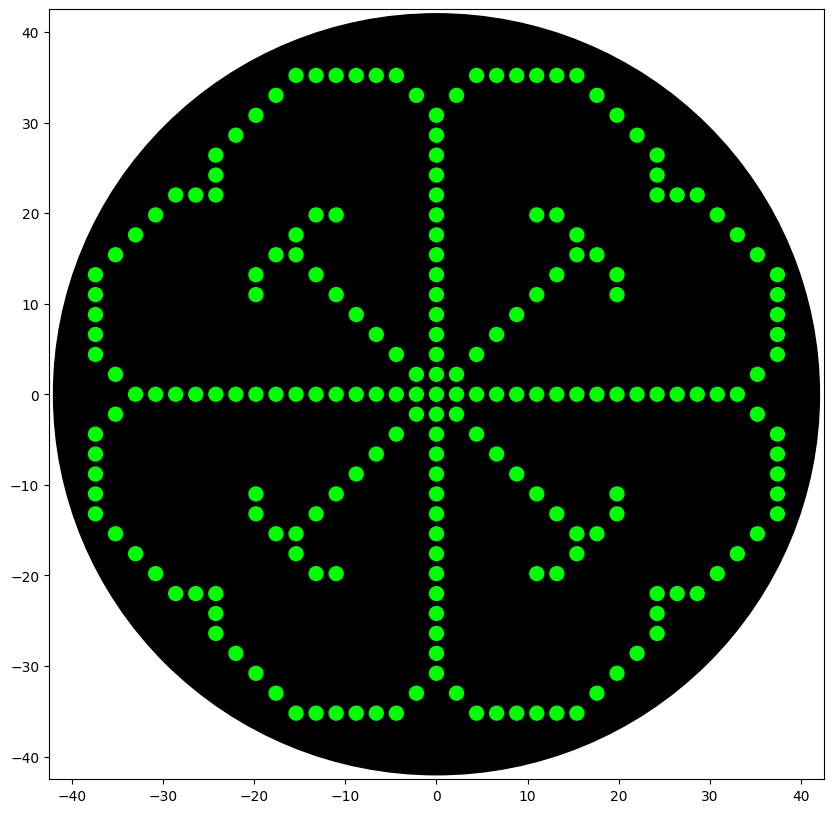
The metadata was then submitted to opentrons google form
Post-Lab Questions
1. Published Paper Using Lab Automation
Wierenga, R. P., et al. (2022). “Opentrons OT-2 as a low-cost liquid handling solution for automated cell culture and high-throughput biological experiments.” PLOS ONE. This paper demonstrated that the Opentrons OT-2 could be used to automate cell culture media exchanges, serial dilutions, and compound screening workflows that would otherwise require constant manual intervention. The authors showed that the robot could reliably perform these tasks with reproducibility comparable to manual pipetting, while significantly reducing hands-on time and human error — enabling experiments at a scale that would be impractical to run manually.
The key insight for my work is that automation is not just about speed — it is about spatial precision and reproducibility of deposition, which is directly relevant to creating consistent bio-dyed patterns across fabric surfaces.
2. Automation Plan for Final Project
My final project involves using Physarum polycephalum to create one-of-one dyed patterns on fabric surfaces by letting the organism grow and leave behind a pigment trail. While the organism’s path is inherently unpredictable (which is the artistic intent), the setup conditions need to be precisely controlled and reproducible for the biology to work consistently.
I would use the Opentrons OT-2 to automate the preparation stage of the experiment:
Automated workflow (pseudocode):
Load reservoir plate with:
Well A1: humectant/binder coating solution Well A2: phenolic precursor substrate solution Well A3: growth medium for Physarum inoculation
For each fabric sample (n=6, arranged in a 6-well plate):
aspirate(50 µL, reservoir[“A1”]) dispense evenly across well surface to coat fabric wait(120 seconds) # allow coating to partially dry
For each well:
aspirate(20 µL, reservoir[“A2”]) dispense(well) # add precursor substrate on top of binder
Manual step: inoculate each well with Physarum plasmodium at defined starting position Automated imaging at fixed intervals (external camera trigger) to document trail growth over 24-48 hours
This setup ensures the binder and substrate layers are applied at consistent volumes and uniformly across the fabric surface — two variables that strongly affect whether the pigment precipitates cleanly along the slime trail. Inconsistent coating thickness in manual application was identified as a likely source of variability in early experiments.
A 3D-printed fabric holder sized to sit inside a standard 6-well plate would allow the fabric swatches to be held flat during robotic dispensing.
Final Project Ideas
I submitted 1–3 slides to the Committed Listeners final project slide deck with the following ideas:
Physarum Polycephalum Bio-Dyeing — Engineering Physarum polycephalum to express a pigment-forming enzyme (tyrosinase/laccase) that reacts with a pre-coated fabric substrate to leave a permanent dyed trail as the organism forages across the surface. The goal is one-of-one textile art driven by biological growth behavior.
Slime Mould as a Living Sensor — Using the foraging behaviour of Physarum as a readout for environmental conditions (humidity gradients, chemical attractants/repellents) by encoding the gradient as a spatial pattern of growth, readable as a visual output on a surface.
Working with mycelium to make heat sensititve products — Designing a Ganordermma lucidum to express colour on heat stress and utilizing it to make a heat sensitive jacket. Exploring interaction with living materials through reactivity.