SECTION 1: ABSTRACT Significance: Mining is not merely an industry; for thousands of workers, it is a slaughterhouse. Despite modern advancements, the sector continues to be plagued by “silent killers”—methane (CH4) and carbon monoxide (CO)—which claim thousands of lives annually. In October 2023, the Kostenko mine disaster in Kazakhstan became a tomb for 46 miners following a catastrophic methane explosion, a tragedy that occurred despite the presence of standard electronic monitoring. Just months later, in January 2024, a coal mine gas outburst in Pingdingshan, China, killed 16 more workers. These events highlight a systemic failure: the industry’s fatal reliance on electronic sensors that are vulnerable to power outages and, most ironically, can act as ignition sources themselves. With the International Labour Organization (ILO) estimating over 15,000 mining-related fatalities per year, the need for an intrinsically safe, zero-power, and non-sparking detection system is a matter of life or death. Bio-Shield addresses this crisis by replacing fragile electronics with resilient biological watchdogs.
Significance: Mining is not merely an industry; for thousands of workers, it is a slaughterhouse. Despite modern advancements, the sector continues to be plagued by “silent killers”—methane (CH4) and carbon monoxide (CO)—which claim thousands of lives annually. In October 2023, the Kostenko mine disaster in Kazakhstan became a tomb for 46 miners following a catastrophic methane explosion, a tragedy that occurred despite the presence of standard electronic monitoring. Just months later, in January 2024, a coal mine gas outburst in Pingdingshan, China, killed 16 more workers. These events highlight a systemic failure: the industry’s fatal reliance on electronic sensors that are vulnerable to power outages and, most ironically, can act as ignition sources themselves. With the International Labour Organization (ILO) estimating over 15,000 mining-related fatalities per year, the need for an intrinsically safe, zero-power, and non-sparking detection system is a matter of life or death. Bio-Shield addresses this crisis by replacing fragile electronics with resilient biological watchdogs.
Broad Objective: The primary goal of this project is to develop Bio-Shield, a revolutionary wearable fungal biosensor patch (“Bio-sticker”). By repurposing the metabolism of Aspergillus nidulans, we aim to provide miners with an autonomous, real-time visual alert system for hazardous gases that operates without the need for circuitry or batteries in the most volatile subterranean environments.
Hypothesis: This project tests the principle of “Intrinsically Safe Biological Monitoring,” demonstrating that engineered fungal mycelium, structured as a Bulk Living Material (BLM), can detect chemical threats and trigger a high-intensity colorimetric shift as a fail-safe early warning system.
Aims & Methods:
Aim 1 (Engineering the Chassis): I used a direct-activation circuit design in Benchling, focusing on the codon optimization of the purple chromoprotein amilCP. Using Gibson Assembly, I construct a gas-responsive cassette PpmoA/PcooA) amplified in E. coli. The final construct is integrated into the A. nidulans genome through PEG-mediated protoplast transformation, ensuring genomic stability verified by PCR.
Aim 2 (Stress & Sensitivity Testing): To mirror the harsh reality of mining, I will subject the fungi to controlled atmosphere chambers and extreme environmental stressors (100% humidity, 40°C). I will determine the Limit of Detection (LoD) to ensure the colorimetric shift occurs before gas levels reach lethal thresholds.
Aim 3 (Bio-Sticker Functionalization): The engineered fungus is encapsulated in a Calcium Alginate hydrogel matrix for optimal gas diffusion. This bio-active core is integrated into a multi-layered wearable patch featuring a medical-grade adhesive and a hydrophobic membrane that blocks dust and moisture while allowing gas entry.
Expected Outcomes: Bio-Shield is expected to deliver a cost-effective, self-regenerating safety tool that provides a clear purple signal before disaster strikes. By converting biological responses into visual warnings, this project bridges the gap between synthetic biology and industrial survival, protecting the human lives at the heart of the global energy sector.
Reuters (2023): “Death toll in Kazakhstan mine blast rises to 46.” October 29, 2023.
CNN (2024): “China coal mine accident: 16 killed in Pingdingshan gas outburst.” January 13, 2024.
ILO (International Labour Organization): “Safety and Health in the Mining Sector.”.
Al Jazeera (2024): “Dozens missing after gold mine landslide in Turkey.” February 13, 2024.
SECTION 2: PROJECT AIMS
The first aim of my project is to engineer a methane-responsive Aspergillus nidulans chassis by utilizing targeted genomic integration, Gibson Assembly, and PEG-mediated protoplast transformation.
Engineering Strategy & Rationale:
Codon Optimization (amilCP): We will adjust the coral gene sequence to match the codon usage bias of Aspergillus.
Why? This maximizes translation efficiency and prevents gene silencing, ensuring a deep, visible purple signal.
Gibson Assembly: This method will be used to fuse the promoter, reporter, and terminator in a single reaction.
Why? Unlike traditional cloning, it is a “scarless” assembly technique that maintains high sequence fidelity and allows for the seamless joining of multiple large DNA fragments.
Utilization of the ∆70 Strain: We will use an A. nidulans strain deficient in the Non-Homologous End Joining (NHEJ) pathway.
Why? By knocking out ∆ku70, we force the cell to use Homologous Recombination exclusively. This significantly increases the probability of the DNA construct integrating precisely into the targeted argB locus rather than at random locations.
Protoplast Transformation: We will employ lytic enzymes to remove the chitinous cell wall.
Why? The fungal cell wall is an impenetrable physical barrier; by creating “naked” protoplasts, we enable DNA uptake via Polyetilenglicol (PEG) and Ca2+ cation treatment.
PCR Validation: Primers will be designed to hybridize one inside the construct and one in the native flanking genome.
Why? This is the only way to definitively confirm that the integration was site-specific and stable, distinguishing it from ectopic (random) insertions.
Aim 2: Development Aim:
Describe the next step that would follow a successful Aim 1, extending the work beyond the scope of this course. This aim should represent a realistic progression of the project, such as executing additional experiments, solving a technical limitation, or developing the system or technology further.
The next step is to characterize the biosensor’s functional limits and optimize its integration into a wearable hydrogel matrix.
Development Strategy & Rationale:
Controlled Atmosphere Chambers: Used to establish the Limit of Detection (LoD). Why? To ensure the colorimetric shift occurs at safe gas concentrations (well below the Lower Explosive Limit), providing enough lead time for a successful evacuation.
Alginate-Gelatin Interpenetrating Polymer Network (IPN): We will develop this hybrid matrix to encapsulate the fungus.
Why? Alginate provides excellent gas diffusion (critical for response speed), while gelatin enhances mechanical flexibility and cellular adhesion, ensuring the patch doesn’t tear during a miner’s physical activity.
Environmental Stress Testing (40°C, 100% Humidity): We will subject the patch to extreme mine simulations.
Why? To validate that the fungus, as a living material, is more resilient than electronic sensors or cell-free systems, which typically degrade rapidly in tropical or subterranean microclimates.
Aim 3: Visionary Aim:
Describe the long-term vision for the project. Explain how the broader concept could have an impact if fully realized.
Examples include:
Challenging an existing paradigm or clinical practice.
Addressing a major barrier in a field.
Enabling a new experimental capability or research approach.
The long-term vision for Bio-Shield is to disrupt the industrial safety paradigm by establishing ‘Zero-Power Biological Watchdogs’ as the global standard for protection in extreme environments.
Visionary Impact & Rationale:
Intrinsically Safe (IS) Design: The goal is to remove electronics from front-line sensing.
Why? In methane-rich environments, any spark from a failing electronic sensor can trigger a catastrophe. A biological system is physically incapable of generating an ignition spark.
Decentralization and Global Equity: We propose a system that can be “grown” locally.
Why? To reduce dependence on expensive imported equipment in developing nations—where the majority of the 15,000+ annual mining fatalities occur—democratizing access to high-tech safety.
Self-Regenerating Infrastructure: We leverage the biological capacity for growth and repair.
Why? To create sensors that, unlike chemical filters or batteries, can remain active and self-heal for weeks, drastically reducing maintenance costs and electronic waste.
SECTION 3: BACKGROUND
Briefly summarize two peer-reviewed research citations relevant to your research (minimum four sentences).
Huang et al. (2022) established the foundational framework for Bulk Living Materials (BLMs), demonstrating how microorganisms can be reprogrammed to act as macroscopic functional components within synthetic polymer matrices. This study illustrates that embedding microbes in hydrogels allows for the creation of materials that can sense, report, and even repair themselves, bridging the gap between molecular biology and material science.
Furthermore, Nguyen et al. (2021) pioneered the integration of synthetic biology into wearable textiles, successfully embedding engineered bacteria to detect environmental toxins and pathogens in real-time. Their work validated that living sensors can maintain functionality outside of controlled laboratory settings when protected by specialized membranes, providing a direct precedent for on-body environmental monitoring in high-stress industries.
Explain how your project is novel or innovative. (Minimum 3 sentences.)
Examples of topics to discuss:
New applications or uses of existing biological tools or concepts.
Development of new approaches, methodologies, or technologies.
Ways the project challenges existing paradigms or assumptions.
How the work expands the boundaries of synthetic biology.
The Bio-Shield project is innovative because it pivots fungal synthetic biology away from traditional industrial fermentation and toward the life-saving application of underground mining safety. It challenges the prevailing assumption that industrial monitoring must be energy-dependent by introducing a “zero-power” biological reporter system that remains intrinsically safe in explosive, methane-rich atmospheres. Additionally, the project expands the boundaries of synthetic biology by utilizing the structural resilience of Aspergillus nidulans to create a self-regenerating “Bio-sticker”—a tool that is not just a sensor, but a living, protective material.
Explain why your project matters and what impact it could have. (Minimum 5 sentences.)
Examples of topics to discuss:
The problem addressed: What pressing real-world problem does your project attempt to solve?
Importance of the problem: Why is this problem significant, or what critical barrier to progress in the field does it represent?
Broader societal contribution: How could the outcomes of your project benefit society beyond the immediate research context?
Advancement of knowledge or capability: How might the project improve scientific understanding, technical capability, or clinical practice within one or more fields?
Field-level change: If your aims are achieved, how could the concepts, methods, technologies, treatments, services, or preventative approaches used in this field of research change?
This project addresses the devastating real-world problem of gas outbursts and explosions in mines, which contribute to more than 15,000 fatalities annually. The problem is critical because traditional electronic sensors are prone to failure in the extreme humidity of mines and can ironically serve as ignition sources in volatile environments. By providing a non-electronic, colorimetric warning system via the amilCP protein, Bio-Shield offers a fail-safe redundant layer of protection that functions where current technology reaches its technical limit. On a broader societal level, the project promotes global safety equity by providing a low-cost, “grown” technology for developing nations that lack the infrastructure for expensive electronic safety networks. Ultimately, successful implementation will shift the field’s focus from fragile mechanical detection to resilient biological watchdogs, establishing a new standard for human protection in high-risk industrial settings.
Describe the ethical implications associated with your project and identify relevant ethical principles (e.g., non-maleficence, beneficence, justice, or responsibility). (Minimum 2 paragraphs.)
First paragraph: Include what ethical implications are involved in your project. Try to suggest ethical the principle(s) you may apply (e.g. non-maleficence, justice)?
Second paragraph: Describe the measures that should be taken to ensure that your project is ethical (both in how the research is conducted and in its broader implications for society). You may wish to answer the following questions:
What action(s) do you propose?
What are potential unintended consequences of your proposed actions?
What could you have been wrong (e.g., incorrect assumptions and uncertainties)?
What are alternatives to your proposed actions?
The ethical implications of Bio-Shield primarily involve the principles of beneficence and justice, as the project aims to mitigate lethal risks for a vulnerable labor population. However, the deployment of a Genetically Modified Organism (GMO) in a wearable format introduces significant concerns regarding non-maleficence. There is a potential risk of environmental contamination or accidental inhalation of fungal spores by the miner if the patch’s structural integrity is compromised. Therefore, the research must balance the immense benefit of early gas detection against the responsibility of ensuring that the engineered fungus does not pose a secondary health or ecological hazard.
Second paragraph: Describe the measures that should be taken to ensure that your project is ethical (both in how the research is conducted and in its broader implications for society). You may wish to answer the following questions:
What action(s) do you propose?
What are potential unintended consequences of your proposed actions?
What could you have been wrong (e.g., incorrect assumptions and uncertainties)?
What are alternatives to your proposed actions?
Note: in an NIH proposal, an ethics statement is used to describe the relevance of this research to public health
To ensure ethical conduct, I propose the implementation of a genetic kill-switch or an auxotrophic constraint that prevents the fungus from surviving outside the nutrient-rich hydrogel of the Bio-sticker. While a potential unintended consequence of this measure is a reduced operational shelf-life for the patch, it is an essential safeguard to prevent the persistence of engineered strains in the mine’s ecosystem. We must also account for the uncertainty regarding spontaneous mutations in Aspergillus nidulans under extreme subterranean stress, which could theoretically alter its pathogenicity or signal reliability. An alternative to this living system would be the use of cell-free protein synthesis (CFPS); however, while safer, CFPS currently lacks the self-regeneration and metabolic robustness required for long-term subterranean deployment, making the living BLM approach the most viable path forward for saving lives today.
SECTION 4: EXPERIMENTAL DESIGN, TECHNIQUES, TOOLS, AND TECHNOLOGY
Aim 1: Experimental Aim (Fungal Chassis Engineering)
“To design and construct a methane-responsive direct-activation genetic circuit in Aspergillus nidulans.”
Sub-Aim 1.1: In-silico Design and Codon Optimization: Perform the bioinformatic design of the expression cassette in Benchling, applying codon optimization to the amilCP reporter gene to match the specific translational bias of A. nidulans, thereby maximizing protein expression and preventing gene silencing.
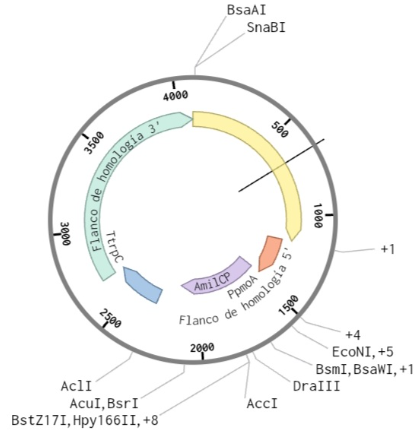
Sub-Aim 1.2: Molecular Assembly via Gibson Strategy: Execute the scarless assembly of the 1.5 kb cassette, integrating the gas-responsive promoter PpmoA, the optimized reporter gene, and the TtrpC terminator to ensure high transcriptional fidelity and circuit stability.
Sub-Aim 1.3: Genomic Transformation and Validation: Perform PEG-mediated protoplast transformation of the ku70\Delta strain to facilitate targeted homologous recombination at the argB locus, followed by verification of stable integration through Junction PCR and Sanger sequencing.
Aim 2: Development Aim (Characterization and Prototyping)
“To optimize biosensor performance and its functional integration into a wearable hydrogel matrix.”
Sub-Aim 2.1: Characterization of Response Kinetics: Determine the Limit of Detection (LoD) and quantify the rate of colorimetric shift (amilCP accumulation) upon exposure to controlled concentrations of CH_4 and CO within specialized atmosphere chambers.
Sub-Aim 2.2: Functional Biomaterial Engineering: Develop a semi-synthetic Calcium Alginate-Gelatin hydrogel matrix with tuned porosity to optimize the effective diffusion coefficient of hazardous gases while maintaining fungal viability and hydration in subterranean environments.
Sub-Aim 2.3: Robustness Validation under “Mine-Sim” Conditions: Evaluate the operational resilience of the Bio-sticker against critical environmental stressors, including 100% relative humidity, temperatures exceeding 40°C, and potential interference from coal and silica dust.
Aim 3: Visionary Aim (Scaling and Global Impact)
“To establish Zero-Power Biological Watchdogs as the global standard for intrinsically safe industrial protection.”
Sub-Aim 3.1: Decentralized Manufacturing and Scaling: Develop simplified cultivation and stabilization protocols that allow Bio-stickers to be “grown” locally, bypassing high-tech supply chains and reducing costs for developing mining economies.
Sub-Aim 3.2: Intrinsically Safe (IS) Certification: Partner with industrial safety regulatory bodies to establish a certification framework for biological sensors, validating that the non-electronic mechanism eliminates all primary ignition risks in explosive atmospheres.
Sub-Aim 3.3: Integration into Global Emergency Protocols: Advocate for the inclusion of autonomous living materials in international safety standards (such as ILO guidelines), transitioning mining safety from a power-dependent infrastructure to one of decentralized biological resilience.
Expand upon two techniques you checked in the previous question by describing how you would utilize those techniques in your final project. (min. 4 sentences)
Gibson Assembly: how overlapping fragments, NEB HiFi mix, and scarless joining are used in Aim 1
Calcium Alginate Encapsulation: how ionotropic gelation creates the bio-active core and why it suits the mining environment
What aspect of your final project did you choose to validate? (min. 2 sentences)
I chose to validate the genetic circuit design and in-silico assembly of the methane-responsive expression cassette for Aspergillus nidulans. This validation ensures that the codon-optimized amilCP reporter is correctly placed under the control of the PpmoA promoter and that the flanking homology arms are precisely designed for targeted integration at the argB locus.
Write down a detailed protocol of how you validated this aspect of your final project. (Numbered list or paragraph is fine)
Sequence Acquisition: Retrieved the native sequences for the PpmoA promoter and TtrpC terminator from the A. nidulans genomic database and the amilCP sequence from the registry of standard biological parts.
Codon Optimization: Utilized Benchling’s codon optimization tool to adapt the amilCP coding sequence (CDS) for the specific codon bias of Aspergillus, ensuring a CAI (Codon Adaptation Index) > 0.8 to maximize translation efficiency.
Homology Arm Design: Designed 1 kb flanking sequences upstream and downstream of the argB locus to facilitate high-efficiency homologous recombination.
Gibson Assembly Simulation: Designed 30-40 bp overlapping sequences between the promoter, CDS, and terminator. Validated the assembly in-silico using Benchling’s “Assembly Wizard” to ensure no frame-shifts or “scar” sequences were introduced.
Primer Design: Generated primers for Junction PCR validation, checking for melting temperatures (Tm) between 60–62 ° C and avoiding secondary structures or primer-dimers.
Virtual Digest: Performed a virtual restriction enzyme digest (e.g., using EcoRI and BamHI) to predict the fragment sizes, which would be used to verify the physical plasmid after extraction
What synthetic biology techniques did you utilize in validating this aspect of your final project? You can refer to the list of techniques in question 8. (min. 4 sentences)
I utilized computational DNA design and codon optimization to tailor the coral-derived amilCP gene for a fungal expression system. Furthermore, I applied Gibson Assembly strategy design, creating precise overlapping junctions for a scarless multi-fragment assembly. I also developed a Targeted Genomic Integration strategy by designing homology arms specific to the argB locus, taking advantage of the increased homologous recombination efficiency of the ku70Delta chassis. Finally, I used computational primer design to prepare for post-transformation validation via PCR.
You must present data as part of your final project and include some analysis of that data. The data may be collected experimentally in the lab or generated as simulated data (e.g., using the Asimov Kernel or another simulation method). (min. 2 sentences)
The validation dataset reflects the kinetic output of two highly engineered core inserts integrated into the fungal host chassis to enable specific methane sensing.
The Methane-Inducible Promoter (PpmoA): Positioned upstream of the reporter, this regulatory sequence utilizes a specialized promoter domain of bacterial origin that has been molecularly adapted to function seamlessly within the eukaryotic transcription machinery of Aspergillus nidulans. By engineering the sequence to bypass non-specific fungal activation pathways, the promoter remains transcriptionally silent under baseline atmospheric conditions and initiates downstream transcription only upon high-affinity binding triggered by the presence of target methane molecules (CH4).
The Codon-Optimized Reporter (amilCP): Positioned immediately downstream of the adapted bacterial switch, this open reading frame encodes the cnidarian chromoprotein responsible for the visual output. The sequence was fully synthesized using target codon optimization to match the specific transfer RNA (tRNA) pool bias of the Aspergillus chassis, preventing translational attenuation and ensuring that transcriptional activation translates into a rapid, dose-dependent purple colorimetric shift.
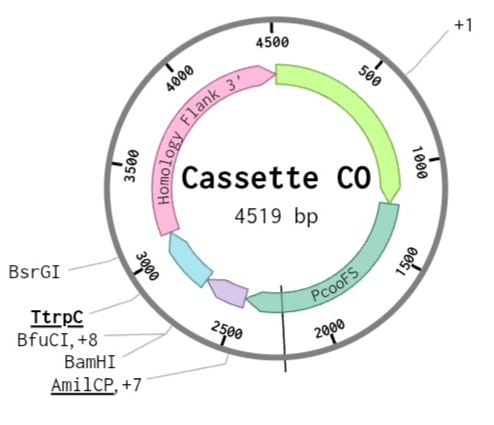
The direct-activation genetic circuit relies on two primary functional inserts strategically positioned between the genomic flanking regions to convert gas detection into an immediate visual output.
The Gas-Responsive Promoter PcooFS: This upstream regulatory sequence acts as the direct molecular switch, remaining transcriptionally silent until carbon monoxide interacts with the constitutively expressed CooA homodimeric transcription factor. Upon binding CO, CooA undergoes a conformational shift that allows it to recognize the target consensus operator sequence within PcooFS, rapidly recruiting the fungal RNA polymerase machinery to initiate high-level transcription without the need for secondary intracellular signaling cascades.
The Codon-Optimized Reporter (amilCP): Positioned immediately downstream of the promoter, this open reading frame encodes the 27 kDa Acropora millepora chromoprotein, which functions as an autonomous, zero-power reporter system. Because the native cnidarian sequence is prone to translational bottlenecking and gene silencing in filamentous fungi, the insert was subjected to full codon optimization to match the specific transfer RNA (tRNA) pool bias of Aspergillus nidulans, ensuring stable, high-yield protein accumulation that shifts the biosensor’s optical density at 588 nm to a visible purple hue.
The accurate positioning and stable inheritance of the direct-activation biosensor within the host genome are dictated by two flanking regions of homology targeted to a specific metabolic locus.
The 5’ (Upstream) and 3’ (Downstream) argB Flanks: These non-coding sequences, spanning approximately 1.0 to 1.4 kilobases, are identical to the chromosomal regions flanking the native ornithine carbamoyltransferase (argB) gene in Aspergillus nidulans. By utilizing these long stretches of sequence identity, the synthetic construct leverages the cell’s endogenous Homologous Recombination (HR) machinery. In the absence of the non-homologous end-joining pathway ∆ku70, these arms force a high-efficiency double-crossover event, replacing the defective native locus with the complete sensor cassette and permanently anchoring the gas-detection circuit into the fungal chromosome.
Did you encounter any unexpected challenge(s) when performing your validation? If so, describe the challenge(s) and strategies to overcome it. If not, discuss potential problems, difficulties, limitations, and/or alternative strategies to overcome challenges in your final project. (min. 4 sentences).
One potential challenge is the presence of high GC-content regions within the Aspergillus genome, which can lead to the formation of stable hairpins in the primers, reducing PCR efficiency. To overcome this, I would utilize DMSO (3-5%) in the PCR mix to lower the DNA melting temperature and optimize the annealing temperature through a gradient PCR. Another limitation is the possibility of low integration frequency despite the use of the ∆ku70 strain; an alternative strategy would be to utilize CRISPR/Cas9-mediated double-strand breaks at the argB locus to further drive the cell towards the desired homologous recombination event. Additionally, if the amilCP signal is too weak, I would investigate the use of a stronger constitutive promoter or an alternative synthetic transcriptional amplifier to boost the visual output
SECTION 6: ADDITIONAL INFORMATION
List all references cited in this assignment (bullet-point list)
Huang, L., et al. (2022). Engineering living materials via microbial reprogramming. Nature Reviews Materials, 7(12), 935-951. DOI: 10.1038/s41578-022-00517-4.
Nguyen, M. T., et al. (2021). Wearable materials with embedded synthetic biology sensors for biomolecule detection. Nature Biotechnology, 39(11), 1366-1374. DOI: 10.1038/s41587-021-00950-3.
He, L., et al. (2018). Aspergillus nidulans as a platform for synthetic biology. Current Opinion in Biotechnology, 53, 171-177.
Somerville, C., et al. (2024). Registry of Standard Biological Parts: BBa_K592009 (amilCP). iGEM Foundation.
Nayak, T., et al. (2006). A versatile set of rapid-transformation vectors for Aspergillus nidulans. Genetics, 174(3), 1553-1563. (Reference for the ku70Delta strain efficiency).
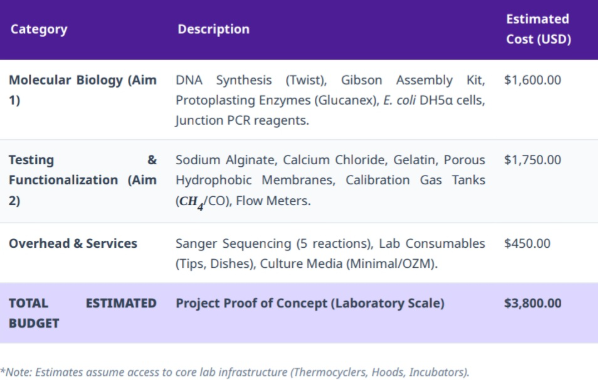
Create a supply list and budget for your project (bullet-point list)
What supplies, equipment, and budget is needed for your project to work?