Week 6: Genetic Circuits
Week 6 Homework: Genetic Circuits
1. What are some components in the Phusion High-Fidelity PCR Master Mix and what is their purpose?
Phusion High-Fidelity PCR Master Mix contains several key components required for accurate DNA amplification. One central component is the Phusion DNA polymerase, a high-fidelity enzyme with proofreading activity that synthesizes new DNA strands and reduces the error rate compared to standard Taq polymerase. The mix also contains dNTPs (deoxynucleotide triphosphates), which serve as the molecular building blocks used to construct the new DNA strand during amplification.
Another important component is the reaction buffer, which maintains the correct chemical environment for the polymerase to function efficiently. This buffer includes salts and magnesium ions (Mg²⁺), which are essential cofactors for polymerase activity and influence primer binding and enzyme performance. The mix may also include stabilizing agents that help preserve enzyme activity during thermal cycling. Because it is provided as a master mix, many of these ingredients are already pre-balanced, which reduces pipetting error and improves consistency across reactions.
2. What are some factors that determine primer annealing temperature during PCR?
Primer annealing temperature during PCR is determined primarily by the melting temperature (Tm) of the primers. The Tm depends on several sequence features, especially primer length, GC content, and base composition, since G–C pairs form three hydrogen bonds and are therefore more thermally stable than A–T pairs. Primers with higher GC content or longer length typically have a higher Tm and therefore require a higher annealing temperature.
A second factor is the degree of complementarity between the primer and the target sequence. If the primer sequence has mismatches with the target, annealing may be weaker and require optimization at a lower temperature, though this may reduce specificity. The salt concentration and reaction conditions in the PCR mix also affect hybridization behavior, because ionic conditions influence DNA duplex stability. In practice, the annealing temperature is usually chosen a few degrees below the primer Tm in order to balance efficient binding with high specificity.
3. There are two methods from this class that create linear fragments of DNA: PCR, and restriction enzyme digests. Compare and contrast these two methods, both in terms of protocol as well as when one may be preferable to use over the other.
PCR and restriction enzyme digestion can both generate linear DNA fragments, but they do so through very different mechanisms. PCR creates a linear fragment by enzymatically amplifying a specific region of DNA using primers, polymerase, dNTPs, and thermal cycling. The protocol involves repeated cycles of denaturation, primer annealing, and extension, which selectively amplify the region bounded by the primer pair. PCR is especially useful when a fragment must be isolated precisely, modified through primer design, or generated from a small starting amount of template DNA.
By contrast, a restriction enzyme digest generates linear DNA by cutting an existing DNA molecule at specific recognition sequences. The protocol is generally simpler: plasmid or DNA template is mixed with one or more restriction enzymes, appropriate buffer, and water, then incubated at the temperature optimal for enzyme activity. Restriction digestion is often preferable when the desired fragment is already flanked by known restriction sites and does not require amplification or sequence redesign. It is also useful for opening plasmids or excising inserts when convenient restriction sites are available.
PCR is more flexible because primer design allows the user to define fragment boundaries and add overlaps or other sequence features. However, it can introduce amplification errors or nonspecific bands if poorly optimized. Restriction digests are often cleaner and simpler when the sequence already contains the required cut sites, but they are limited by the availability and placement of those sites. In practice, PCR is often preferred when custom design flexibility is needed, whereas restriction digestion is preferred when a pre-existing construct already contains a convenient cloning architecture.
4. How can you ensure that the DNA sequences that you have digested and PCR-ed will be appropriate for Gibson cloning?
To ensure that digested and PCR-generated DNA fragments are appropriate for Gibson cloning, the most important requirement is that adjacent fragments contain overlapping homologous ends, typically around 20–40 base pairs long. These overlaps allow the Gibson Assembly enzymes to join fragments in the correct order. When PCR is used, these overlaps are usually added directly through primer design. When restriction digestion is involved, the resulting fragment must still be checked to make sure it contains the correct overlap regions relative to the other assembly partners.
It is also important to confirm that the fragments correspond to the intended sequence and orientation. This can be checked computationally by mapping the PCR primers and restriction enzyme cut sites in sequence software such as Benchling. In addition, the fragments should ideally be clean and specific, meaning the PCR gives a single product of the expected size and the digest yields the correct linearized or excised band. Gel electrophoresis and gel extraction are commonly used to confirm fragment size and purify the correct product before assembly.
A final precaution is to verify that the fragment ends do not include unwanted features that would interfere with assembly, such as incorrect overlaps, missing bases, or incompatible sequence order. In short, appropriate Gibson-ready fragments are confirmed by sequence design, overlap design, size verification, and purification before the actual assembly reaction is performed.
5. How does the plasmid DNA enter the E. coli cells during transformation?
During transformation, plasmid DNA enters E. coli cells after the cells have been made competent, meaning temporarily capable of taking up external DNA. In a standard chemical transformation protocol, the cells are treated with salts such as calcium chloride, which helps neutralize the negative charges on both the DNA and the bacterial cell membrane. This reduces electrostatic repulsion and allows the plasmid DNA to associate more closely with the cell surface.
A brief heat shock then creates a transient physical imbalance across the membrane, which helps drive the plasmid DNA into the cell. The exact molecular mechanism is still described somewhat operationally rather than as a single perfectly resolved pathway, but the key idea is that heat shock temporarily increases membrane permeability and promotes uptake of the plasmid. In electroporation, a different method, a short electrical pulse creates temporary pores in the membrane through which DNA can enter.
Once inside the cell, the plasmid is maintained and replicated if it contains an origin of replication compatible with the host. Cells that successfully took up the plasmid can then be selected on antibiotic plates if the plasmid also carries an antibiotic resistance marker.
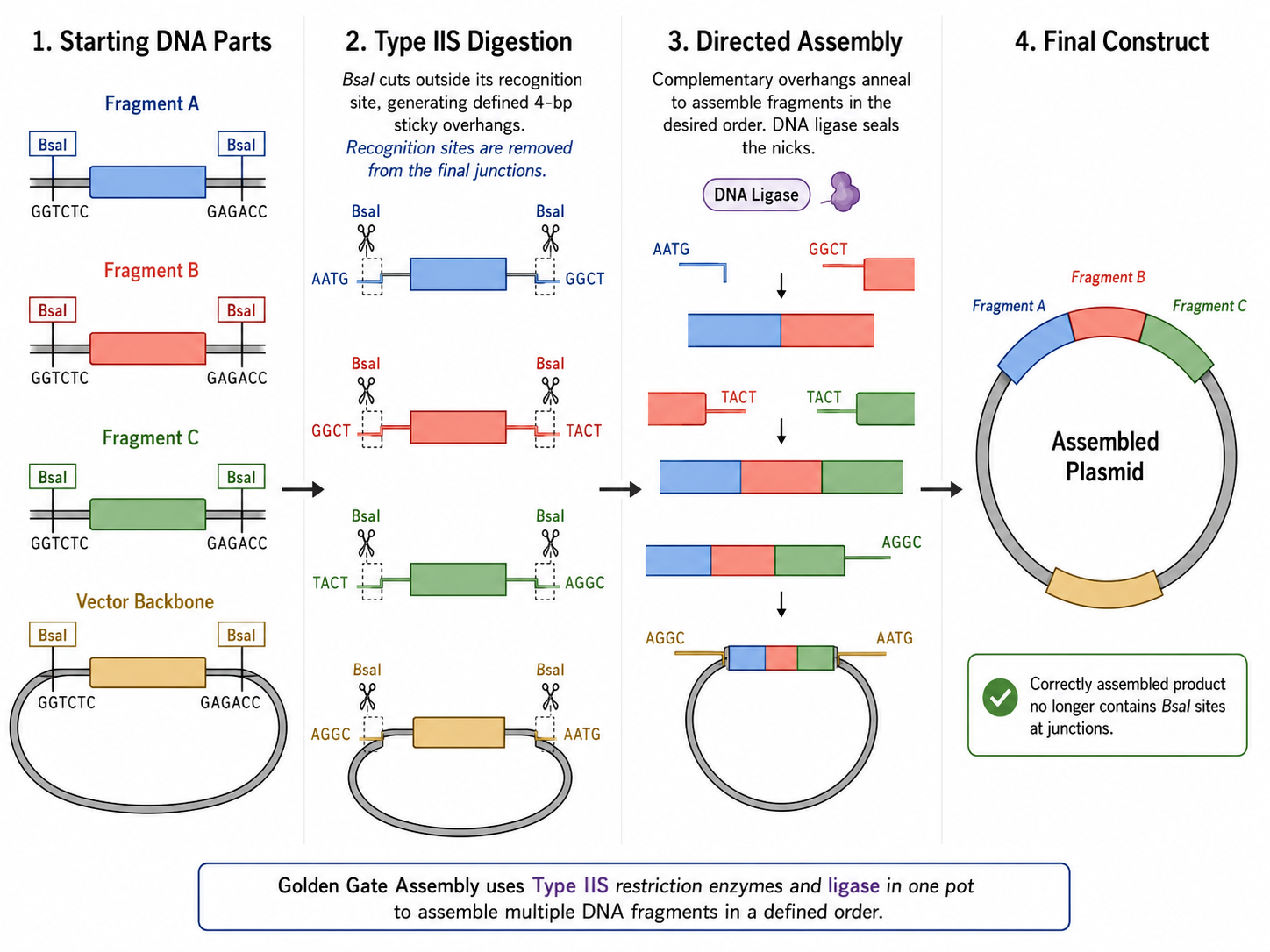
6. Describe another assembly method in detail (such as Golden Gate Assembly)
Golden Gate Assembly is a DNA assembly method that uses Type IIS restriction enzymes together with DNA ligase to join multiple DNA fragments in a defined order within a single reaction. Unlike standard restriction enzymes, Type IIS enzymes such as BsaI cut outside of their recognition sequence, which allows the user to design custom 4-base overhangs on each fragment. These overhangs determine exactly which fragments ligate to each other, enabling seamless and directional assembly without leaving unwanted restriction-site scars between parts. In practice, the DNA fragments and destination vector are designed so that digestion creates complementary overhangs, and the reaction is cycled between temperatures that favor digestion and ligation. Because correctly assembled products no longer contain the original Type IIS recognition sites, they are not re-cut, which enriches the desired final construct over time. Golden Gate Assembly is especially useful for modular cloning, multi-part assemblies, and workflows where many parts must be assembled rapidly and in a predefined order. It is often preferable when standardized part architecture is available, whereas Gibson Assembly may be more flexible when custom overlaps are easier to design than restriction-site-based overhangs.