Week 11: Bioproduction & Cloud Labs
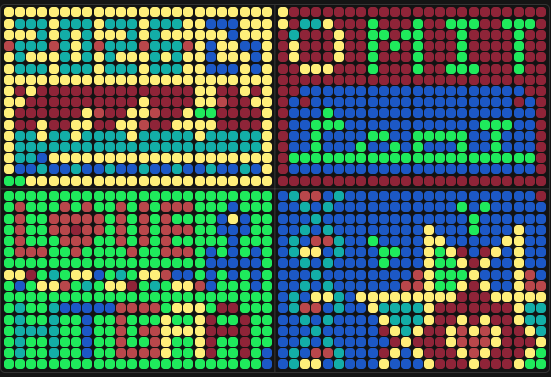
Part A: The 1,536 Pixel Artwork Canvas | Collective Artwork
What I contributed to the community bioart project
I looked up the final artwork, but I could only find the second version, which unfortunatley I could not contribute to in time. Even so, I found the project very compelling. Since I missed this round’s contributions, and respecting the week 11 homework description would be very happy to join HTGAA as a TA next semester!
What I liked about the project
What I liked most was its collaborative r/place-like quality and the nod to an original cultural phenomenon shaped by online communities. In the context of this course, that idea became even more meaningful, because it was extended through real distributed participation: people in different locations around the world were all taking part in the same collective experiment. I appreciated how the project made that network visible through a shared visual output.
What could be improved for next year
One possible improvement would be to expand the expressive range of the system by introducing more colors, more wells, or even a custom color-mixing interface. That could make the final artifact richer and allow participants to contribute with more nuance and variation.
Part B: Cell-Free Protein Synthesis | Cell-Free Reagents
Roles of each component in the cell-free reaction
E. coli Lysate
BL21 (DE3) Star Lysate (includes T7 RNA Polymerase)
The lysate provides the core molecular machinery needed for cell-free transcription and translation, including ribosomes, tRNAs, metabolic enzymes, and translation factors. Because this lysate comes from BL21 (DE3) Star, it also includes T7 RNA polymerase, which transcribes genes placed under a T7 promoter.
Salts / Buffer
Potassium Glutamate
Potassium glutamate helps recreate an intracellular-like ionic environment and supports ribosome and enzyme function during transcription and translation. It is often used as a major salt in bacterial cell-free systems because it better mimics cytoplasmic conditions than simple chloride salts.
HEPES-KOH pH 7.5
HEPES-KOH is the buffering system that keeps the reaction near a stable physiological pH. Maintaining pH is important because both transcription and translation enzymes are sensitive to acid/base changes over the course of the reaction.
Magnesium Glutamate
Magnesium is an essential cofactor for many enzymes in the reaction, especially RNA polymerase, ribosomes, and enzymes involved in nucleotide handling. If magnesium is too low or too high, the reaction can fail or become inefficient, so it is one of the most critical tuning parameters in CFPS.
Potassium phosphate monobasic
This phosphate salt helps contribute to the buffering and ionic balance of the reaction. Together with the dibasic form, it helps stabilize pH and phosphate availability in the system.
Potassium phosphate dibasic
This works with monobasic phosphate as part of a conjugate buffer pair. It helps maintain pH stability and contributes to the chemical environment needed for efficient enzyme activity.
Energy / Nucleotide System
Ribose
Ribose serves as a carbon source that can support nucleotide and energy metabolism in longer-running cell-free reactions. It is especially relevant in systems that regenerate resources over time rather than relying only on a single high-energy phosphate donor.
Glucose
Glucose provides an additional metabolic energy source that can feed endogenous enzymatic pathways in the lysate. In longer reactions, it helps sustain ATP regeneration indirectly and support continued protein production.
AMP
AMP is a nucleotide monophosphate precursor that can be recycled into higher-energy nucleotide forms in extended energy-regeneration systems. In this setup it supports rebuilding the nucleotide pool rather than supplying ATP directly.
CMP
CMP is a precursor for cytidine nucleotide regeneration and helps replenish the RNA-building pool needed for transcription. It is part of the lower-energy nucleotide set used in longer-duration reactions.
GMP
GMP supports regeneration of guanosine nucleotide pools used in RNA synthesis and other reaction processes. Like the other monophosphates, it is part of a resource-efficient long-duration system.
UMP
UMP is the uridine nucleotide precursor used to support RNA synthesis after regeneration into higher-energy forms. Its inclusion helps sustain transcription over longer reaction times.
Guanine
Guanine is a free nucleobase that can feed salvage pathways in the lysate to help replenish guanine nucleotide pools. It supports longer-term reaction economy by contributing to nucleotide regeneration.
Translation Mix (Amino Acids)
17 Amino Acid Mix
This mixture provides most of the amino acids needed as building blocks for protein synthesis. They are consumed directly by the ribosome as the target protein is translated.
Tyrosine
Tyrosine is often added separately because of solubility or stability issues in concentrated amino acid mixes. It serves the same role as the others: supplying a required amino acid for protein synthesis.
Cysteine
Cysteine is also commonly handled separately because it is chemically more reactive and less stable in stock solutions. It is required for translation of proteins containing cysteine residues and can also influence redox-sensitive folding contexts.
Additives
Nicotinamide
Nicotinamide supports metabolic cofactor balance because it is related to NAD-dependent biochemical pathways. In cell-free reactions, additives like this can help maintain metabolic activity and improve reaction longevity.
Backfill
Nuclease Free Water
Nuclease-free water is used to bring the reaction to its final volume without introducing DNases or RNases that could degrade templates or transcripts. It acts as the clean solvent base for the reaction mixture.
Main differences between the 1-hour optimized PEP-NTP master mix and the 20-hour NMP-Ribose-Glucose master mix
The main difference is that the 1-hour optimized PEP-NTP mix is built for fast, high-output expression using directly supplied high-energy nucleotide triphosphates and a strong phosphate-based energy donor such as PEP. By contrast, the 20-hour NMP-Ribose-Glucose mix is designed for longer-duration reactions and relies on a more gradual metabolic regeneration strategy, using nucleotide monophosphates plus carbon sources like ribose and glucose to sustain the reaction over time.
In other words, the PEP-NTP system prioritizes short-term speed and strong expression, while the NMP-Ribose-Glucose system prioritizes resource efficiency and longer reaction lifetime. The second mix is generally more metabolically distributed and slower, but better suited for extended incubation.
Part C: Planning the Global Experiment | Cell-Free Master Mix Design
sfGFP
sfGFP is useful in cell-free systems because it is engineered for robust folding and is also a fast-maturing GFP variant, which helps fluorescence appear quickly and reliably even when expression conditions are not ideal. Like other GFP-like proteins, however, chromophore maturation still depends on oxygen, so fluorescence can lag if oxygen availability is limited.
mRFP1
mRFP1 is a slowly maturing red fluorescent protein, so the protein may be present before the fluorescence is fully visible, which can make short cell-free reactions underestimate expression. It is reported to have relatively low acid sensitivity, which can help preserve signal if the reaction drifts slightly in pH over long incubations.
mKO2
mKO2 is generally valued because it is a relatively fast-maturing orange fluorescent protein, which is helpful when comparing fluorescence over limited reaction times. It also has moderate acid sensitivity, so pH drift in a long cell-free incubation could reduce its apparent brightness.
mTurquoise2
mTurquoise2 is known for its high brightness and photostability, which makes it a strong reporter when repeated imaging or long observation windows are needed. As a GFP-family fluorophore, it still requires oxygen-dependent chromophore maturation, so final fluorescence depends not only on translation but also on post-translational maturation conditions.
mScarlet-I
mScarlet-I is especially attractive in cell-free systems because it was engineered for accelerated maturation relative to mScarlet, which helps red signal appear more quickly in practical experiments. This is useful in long but finite reactions such as 20–36 hour incubations, where maturation speed strongly affects how much fluorescence is visible by the endpoint.
Electra2
Electra2 is a newer blue fluorescent protein, so one relevant consideration is that its performance may be more context-dependent and less broadly benchmarked than older standards like sfGFP or mTurquoise2. As with other fluorescent proteins, usable signal still depends on proper folding and chromophore maturation, so suboptimal reaction chemistry could reduce apparent output even if the protein is translated.
Hypothesis for improving fluorescence over a 36-hour incubation
Hypothesis: Increasing the buffering capacity of the cell-free mastermix and carefully re-optimizing magnesium concentration will improve the 36-hour fluorescence endpoint of mKO2, because stronger pH stability should reduce acid-related signal loss while optimized Mg²⁺ should support translation and folding efficiency.
I would therefore test a condition with slightly higher or more stable buffer capacity together with a small Mg²⁺ titration series. The expected effect is that mKO2 would retain more of its fluorescence over long incubation, rather than losing apparent brightness because of pH drift or suboptimal folding conditions.