AJ Grinnell - HTGAA Spring 2026
Week 1 HW: Principles and Practices
DNA Based Human Memory Storage and Governance I want to develop a DNA based memory storage system that encodes key aspects of a person’s memories or life history into synthetic DNA, with the intent that these memories could be stored long term and potentially be made inheritable across generations. DNA is already being explored as a long term medium for digital information, with approaches using synthetic DNA and enzymatic DNA synthesis for data archiving. In my concept, instead of just archiving arbitrary digital files, the system would encode structured “memory blocks” (e.g., life events, medical history, personal preferences, etc) into DNA segments that are linked, similar to a blockchain, where each new “block” references the previous one for integrity and auditability.
Week 2 HW: DNA Read, Write, & Edit
Working on catching up after being sick this past week. Apologies for the delay.
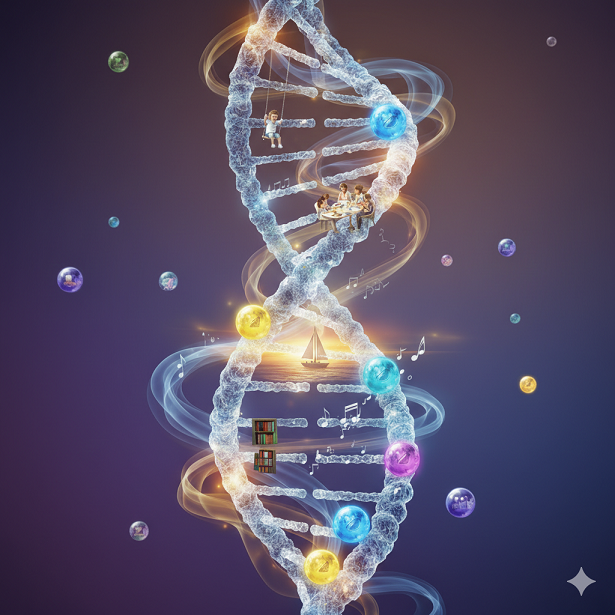
I want to develop a DNA based memory storage system that encodes key aspects of a person’s memories or life history into synthetic DNA, with the intent that these memories could be stored long term and potentially be made inheritable across generations. DNA is already being explored as a long term medium for digital information, with approaches using synthetic DNA and enzymatic DNA synthesis for data archiving. In my concept, instead of just archiving arbitrary digital files, the system would encode structured “memory blocks” (e.g., life events, medical history, personal preferences, etc) into DNA segments that are linked, similar to a blockchain, where each new “block” references the previous one for integrity and auditability.
In practice, the system would likely remain ex-vivo (e.g., DNA stored in biobanks or on chips), but it raises the possibility of integrating such synthetic “memory DNA” into germline cells or early embryos so that descendants inherit both genomic DNA and an attached “memory” of ancestral memory data. Existing debates around DNA banking, biobanks, and long term genomic data storage already highlight ethical questions about consent, control, and ownership of inherited DNA information. Extending this to intentional, inheritable memory storage amplifies those questions and forces us to think about intergenerational governance instead of just individual autonomy.
High level goal: Ensure that DNA based memory storage and inheritance promotes autonomy, privacy, and constructive uses, while preventing harms related to discrimination, coercion, and injustice.
G1: Protect individual and family autonomy over memory DNA.
G2: Prevent misuse, discrimination, and surveillance.
G3: Ensure safety and limit biological risks.
G4: Promote equitable, beneficial uses.
Purpose
Currently, genomic data governance mostly treats DNA as individual health or research data, with consent policies focused on the individual patient or research participant. For inheritable memory DNA, a new consent and governance framework that explicitly recognizes shared, intergenerational interests and defines when and how family level input is needed for creation, inheritance, and access.
Design
Assumptions
Risks of failure and “success”
Purpose
Genomic and DNA data are often stored in centralized databases, with access controlled by institutions, raising privacy, security, and trust concerns. An owner governed technical infrastructure for memory DNA, using encryption, secure computation, and blockchain based audit trails so individuals retain primary control and can monitor every access is needed.
Design
Assumptions
Risks of failure and “success”
Purpose
There is already concern that DNA databases and genomic data can be repurposed for law enforcement, immigration, or commercial profiling beyond their original intent. For memory DNA, explicit legal restrictions are needed: ban certain uses (e.g., subpoenas, underwriting, employment decisions) and set strict conditions or moratoria on germline integration.
Design
Assumptions
Risks of failure and “success”
Using 1–3 where 1 = best, 3 = worst, n/a = not applicable.
| Question | Option 1: Family governance | Option 2: Owner governed tech | Option 3: Legal restrictions |
|---|---|---|---|
| Enhance biosecurity – prevent incidents | 2 | 2 | 1 |
| Enhance biosecurity – help respond | 2 | 2 | 2 |
| Foster lab safety – prevent incident | 2 | 2 | 2 |
| Foster lab safety – help respond | 2 | 2 | 2 |
| Protect environment – prevent incidents | 2 | 2 | 1 |
| Protect environment – help respond | 2 | 2 | 2 |
| Minimize burdens/costs | 3 | 3 | 2 |
| Feasibility | 2 | 2–3 | 2 |
| Not impede research | 2–3 | 1–2 | 2–3 |
| Promote constructive applications | 1–2 | 1 | 2 |
Option 1 scores well on autonomy and constructive use but adds procedural complexity and only indirectly affects biosecurity and environmental risks. Option 2 is strong on privacy, auditability, and enabling controlled constructive use, but it is technically demanding and costly, which hurts feasibility and burden scores. Option 3 is strongest at preventing harmful uses and some biosecurity/environmental risks but, if drafted too broadly, could hinder research and clinical innovation.
Prioritization of a hybrid approach that combines the technical owner governed infrastructure (Option 2) as the backbone, backed by clear legal restrictions (Option 3) on unacceptable uses and germline integration, and context sensitive consent/family governance (Option 1) for inheritable configurations. Option 2 is central because memory DNA will only remain ethically acceptable if individuals and, where appropriate, their families retain meaningful, technically enforced control over access and usage, including the ability to monitor every transaction and revoke permissions. However, technical controls alone are insufficient, so legal frameworks are needed to prohibit uses fundamentally incompatible with autonomy and justice, such as law enforcement or insurance exploitation and unregulated germline use.
For any form of inheritable memory DNA, Option 1’s governance model helps resolve the tension between individual and family interests that already appears in debates on posthumous genomic data. Tthis recommendation is directed primarily to national regulators and bioethics councils (e.g., national health departments and data protection authorities) and secondarily to large academic medical centers and biotech consortia likely to build early memory DNA platforms. Regulators can set baseline legal rules and mandate core technical protections, while clinical and research institutions develop and test practical consent and family governance procedures.
Intergenerational autonomy vs. inherited data is a central concern, since existing work already shows genomic data challenges purely individual consent models and memory DNA would encode not just risk but ancestors’ personal narratives. One additional governance idea is to create “sunset” rules so that certain categories of memory DNA automatically expire or require re affirmation by each new generation before use, echoing periodic review of stored genomic samples.
Privacy and surveillance creep are also major worries, since controversies around DNA databases show that once large repositories exist, there is pressure to repurpose them for law enforcement, immigration control, or commercial profiling. A governance response would be to classify memory DNA as a special category of data that governments and corporations cannot collect or compel without extremely narrow, transparent exceptions, and to require public reporting and independent oversight for any large scale repositories.
Finally, psychological and social impacts may be profound because high fidelity records of ancestors’ memories could change family dynamics, expectations, and identity, similar to how genomic information in EMRs can alter self perception and relationships. A reasonable governance action would be to require integrated psychosocial counseling and ethics review for any clinical or research deployment of inheritable memory DNA, following genetic counseling standards for high stakes genomic tests.
Overall, governance for DNA memory “blockchains” must explicitly address intergenerational justice, psychological well being, and the politics of whose memories are preserved in biological form, not just privacy and safety checklists.
What is the error rate of polymerase? How does this compare to the human genome, and how does biology handle it?
DNA polymerase (with proofreading and repair) makes about 1 error in 106 bases.
The human genome is ~3×10⁹ bp, so biology relies on proofreading and mismatch‑repair systems to keep the actual number of permanent mutations very low.
How many ways to code an average human protein, and why don’t they all work?
There are astronomically many different DNA sequences that could encode a typical human protein (because of synonymous codons).
Many of these don’t work well because of bad codon usage, extreme GC content, strong mRNA secondary structures, repeats/homopolymers, or unwanted regulatory motifs that hurt synthesis or expression.
Most commonly used method for oligo synthesis?
Solid‑phase phosphoramidite chemical synthesis on a solid support is the standard method.
Why is it hard to make oligos >200 nt by direct synthesis?
Each chemical addition isn’t perfect, so errors and truncations accumulate. Beyond ~150–200 nt, the fraction of correct full‑length product becomes very small.
Why can’t you make a 2000 bp gene directly as one oligo?
A 2000 nt oligo would go through so many imperfect cycles that essentially no full‑length, error‑free strands would be produced. Instead, long genes are assembled from many shorter oligos or fragments.
What are the 10 essential amino acids in all animals and how does this affect your view of the “Lysine Contingency”?
The 10 essential amino acids for most animals are histidine, isoleucine, leucine, lysine, methionine, phenylalanine, threonine, tryptophan, valine, and arginine (though arginine is only conditionally essential in adult humans, making the strict count 9). In Jurassic Park, Dr Wu engineered the dinosaurs to be unable to produce lysine — a failsafe called the “Lysine Contingency.” Without supplemental lysine in their feed, the animals would die. This is based on real science since no animal can synthesize lysine. The flaw? Lysine is abundant in animal protein, so carnivores like T. rex and Velociraptors would easily get it from prey. Herbivores would have a harder time since lysine is the most limiting amino acid in grains and many plants, though legumes and certain vegetation do contain it. Either way, as Malcolm put it, “life finds a way.”
Google: “What are the 10 essential amino acids in all animals” and “can animals synthesize lysine”. I also recently started watching Jurrasic Park
Paper Reference: “Semiautomated Production of Cell-Free Biosensors” (ACS Synthetic Biology, 2024)
Summary: This study demonstrates the use of the Opentrons OT-2 liquid handling platform to manufacture cell-free biosensor reactions with improved consistency and throughput compared to manual assembly. The researchers compared manual vs. semiautomated approaches for assembling fluoride-sensing biosensors, constructing an entire 384-well plate of reactions. The automation significantly reduced quality control issues and performance variability that typically plague manual biosensor assembly. The study validated that automated liquid handling could achieve detection outcomes close to expected performance while dramatically improving reproducibility and scaling potential.
Key Innovation: The paper demonstrates that automation can overcome major bottlenecks in biosensor development - specifically the variability and time constraints of manual liquid handling that limit both throughput and consistency in biosensor characterization.
Develop and optimize engineered bacterial biosensors for detecting PFAS (per- and polyfluoroalkyl substances) in environmental water samples, with specific focus on Michigan’s contaminated waterways. The project will use automation to systematically optimize biosensor performance and establish reliable detection protocols.
Phase 1: Biosensor Library Construction
Phase 2: Screening and Optimization
Phase 3: Environmental Sample Testing
The optimized biosensors would ultimately be incorporated into portable detection systems for field deployment across Michigan’s water monitoring network, enabling rapid screening that complements traditional analytical chemistry methods.
This automation-centered approach addresses the key challenge in biosensor development: the need for systematic, reproducible optimization across multiple variables (strain, conditions, analyte concentrations) while maintaining the throughput necessary for meaningful statistical analysis.