Week 3 HW: Lab Automation
Table of Contents
1. Python Script for Opentrons Artwork
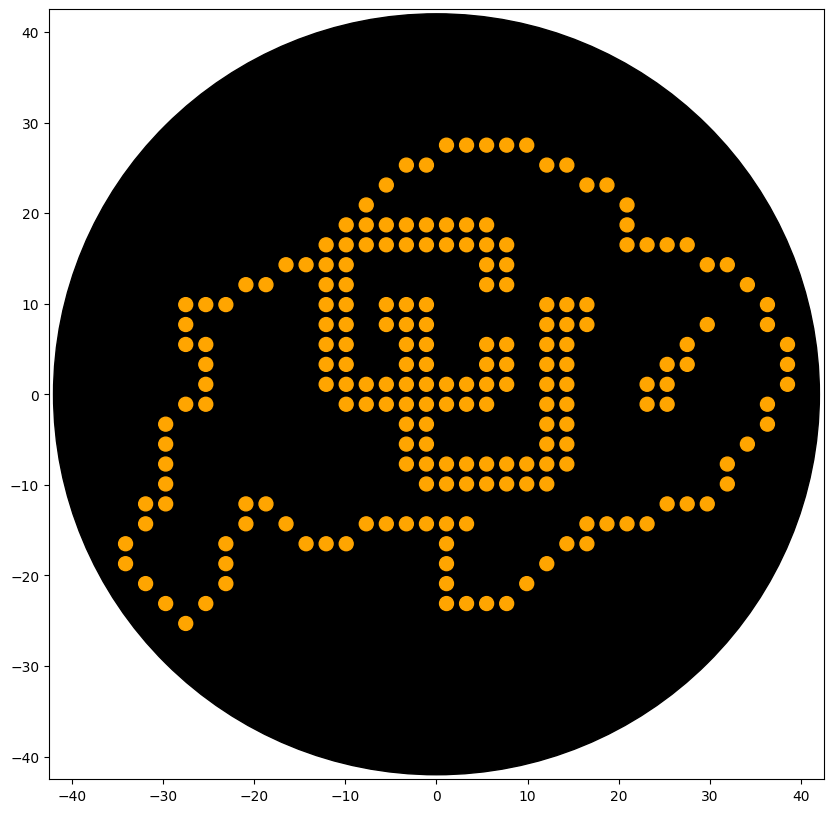
I used the opentrons-art.rcdonovan.com tool to draw out the “Ralphie” mascot logo of my undergraduate university (CU Boulder).
This was the code and the produced image (the original logo is on the left). After creating the art in the opentrons tool, I just copied the array of mko2_points in and iterated over them in the color “Orange” since gold wasn’t an option.

2. Post Lab Questions
- Find and describe a published paper that utilizes the Opentrons or an automation tool to achieve novel biological applications.
- I found a paper by Soh et. al on using “Opentrons for automated and high-throughput viscometry”. My own thesis research revolved around droplet microfluidics and multiphase flow. It’s often the case in biological or medical applications where you have a system of more than one fluid in the same area: especially with biological fluids which can tend to be extremely varied in viscosity. The properties of the fluids (e.g. viscosity, reynolds number, capillary number) determining the fluids’ behavior: blood will have different properties than say mucus, than cellular fluids, etc.). For systems like multi-phase lab-on-chip microfluidic systems, food science, cosmetics production (e.g. shampoos), and pharmaceuticals testing viscosities through multiple formulations is usually a time-intensive and laborious process. For my own research, it was a huge pain to have to set up a pendant drop viscometer over and over and over again for slightly different fluids, set up the experiment, wait for it to proceed, observing and collecting data, and then having to rigorously clean out the equipment after. Past that was the fact that my fellow researchers and I would always have slight differences in how we operated the protocol; which does matter when you get down to the microfluidic scale of things. In this paper Soh et al. leveraged the Opentrons liquid handling automation to conduct rheological experiments to characterize these fluids, both newtonian and power-law fluids (e.g. non-newtonian shear thinning fluids like ketchup that become less viscous when you shake them). They were able to get the viscometry measurement down to 1.5 minutes per run (and in a youtube video I watched of a conference talk by one of the other authors, Dr. Aniket Chitre, the system was paired with a computer vision analysis to rapidly reduce analysis time). To me this is the exact application of an automation platform like Opentrons: standard replications of slightly different conditions and then being able to automatically collect measurements. I would have KILLED to have access to something like Opentrons when I was doing research!
- Write a description about what you intend to do with automation tools for your final project. You may include example pseudocode, Python scripts, 3D printed holders, a plan for how to use Ginkgo Nebula, and more. You may reference this week’s recitation slide deck for lab automation details.
- bxyz
3. Final Project Ideas
(To Be Refined!!!!)
Idea 1: Cell-free at-home endometriosis detection
Endometriosis is a condition where endometrial cells are found in other places in the body. Just like cells in the uterus, these cells outside the uterus swell and bleed. However, unlike the cells in the uterus, there’s no exit route for these discharge… this can lead to IMMENSE and DEBILITATING pain for up to 11% of women, including my mother and sister.
Despite this, it’s a common occurrence that women are deprioritized by both medical professionals (women in pain are often told they’re exaggerating, as my friends have told me) refusing to dig deeper into the issue, and that women have been largely sidestepped in terms of the medical research being done. Male pattern baldness (an aesthetic gender-affirming issue for men) is researched more than endometriosis (debilitating pain, psychological sorrow).
A recent study done by Vash-Margita et al. at Yale identified a handful of miRNA targets (microRNA: 21-25 nucleotides) that were elevated by a statistically significant amount in the serum (blood/saliva) of endometriosis patients. Lateral flow detection technologies already exist (e.g. COVID tests, zika tests, etc.) that can take a presence of a biomarker and display a visible signal.
There’s definitely more work to be done refining this idea (e.g. testing through different stages of endometriosis to find robust biomarkers that could be used for a threshold sort of test, collecting data through multiple stages of the menstrual cycle especially focusing on when the debilitating pain is present). But I think the dream of a first-pass at-home screening test is not unfeasible so that the women in my life don’t have to be told they’re exaggerating their pain by a medical professional.
Idea 2: Bioengineered Graffiti
To me the very essence of creativity (and science!) is drawing on ideas from different domains, and combining them in new and creative ways. As a graffiti artist, graffiti provides a very versatile platform to bounce off from.
Subidea 1: Pigment/fluorescence expressing bacterial graffiti crew “turf war”
- Just like cells in a local area compete for resources for growth, graffiti crews (a crew being a group of artists who paint together) compete for visible spots and have “turf wars”. A lot of graffiti artists practice their work in blackbooks (the canonical graffiti sketchbook) or on plastic dioramas of spots that they’d want to put their pieces on e.g. trains, billboards, skate parks, etc. My thought was: why not coat such a diorama in a substrate that would facilitate different cellular graffiti “crews”! I can program a cell to express a certain color, and use a 3D printed holder and something like the Opentrons platform to set off the initial artists, then watch a time lapse as they cover the diorama with biological graffiti patterns.
Subidea 2: Bioluminescent canvas for a light-activated graffiti “buddha board”
- A buddha board is a reusable canvas for brush painting. You dip your brush in water, and can paint on the surface and release the art as it dries away. To me it’s very similar to the fleeting nature of street art: you can’t take it home with you, you have to experience it in the moment. Yes, you can take a picture but it’s not the same as seeing it in the moment live. One independent project I did a while back was trying to model different graffiti spray caps using conic sections: to make the metaphor a little clearer I used the concept of a flashlight’s light cone. My thought here is what if I can bioengineer a biofluorescent (not bioluminescent!) canvas: a canvas that could stay in a dark room, and then I can use flashlights (potentially black light flashlights?) with different light cones to practice spray painting techniques like flares, straight lines, stroke consistency etc. in a way that doesn’t actually permanently change the surface? I could coat a huge canvas in this bioengineered material (maybe a fluorescent protein, maybe a collection of cells) and then use my flashlights to spray paint and watch it slowly fade away like a bioengineered graffiti buddha board.
Idea 3: Opentrons for DNA Music Sequencing (Audiovisual Performance)
Sequencing and automation have different meanings in biology and music. Sequencing in biology means uncovering the DNA sequence of nucleotides whereas in music sequencing is essentially creating/editing/setting a sequence of MIDI notes. The structure of well plates are quite similar to a sequencer, but I thought of incorporating organic cell growth in like in an agar plate. Automation in biology automates lab protocols, whereas in music automation programmatically changes parameters like volume or effects like reverb or compression.
But an idea that’s run through my mind since seeing both MIDI sequencers AND my bio classmates’ well-plates was “hmm, these grid systems look remarkably similar!” Why not combine the two? Opentrons’ precision dispensing can create grid sequences within plates, and then the cells can grow organically and change the sequencing entirely! I could set up a camera on them and analyze them in different ways: maybe a scanline checking for a grid of areas that can be fed into MIDI notes. An alternative would be to measure parameters like spread, or total coverage, etc. (like for example a lot of audiovisual artists do with their hands and bodies to make music in touchdesigner and soundthread) and use that parameter as a control for automation like a pitch slider or a volume slider or compression.
My initial idea is this: have opentrons programmed to create some plates: e.g. one plate for the bassline, one for drums, one for a synth, one for reverb (or other types of music, use a computer vision algorithm with a specified scanline (or measuring % coverage etc) to read the notes/automation, and see how the music evolves organically over time. I’ve also been playing around with teaching myself touchdesigner for algorithmic visual art, and pairing the organic music + computer vision analysis of the plates with an organic algorithmic art visualizer would be absolutely sick
Idea 4: STI detecting condom coating
Just tossing another idea out (since in the BioClub recitation it was said that it was ok to go over 3 projects): with all this technology at our disposal like being able to detect biosensors, engineer proteins surely it should be possible to design a stable coating that can go inside of a condom (the way lube and spermicide are a mixed coating inside a condom) that can change colors if certain STIs are detected?