Week 4 HW: Protein Design Part I
Table of Contents
- Part A: Conceptual Questions
- Part B: Protein Analysis and Visualization
- Part C: Using ML-Based Protein Design Tools
Part A: Conceptual Questions
Pick any 9 of the following (can skip two)
- Chicken breast is higher protein (32g protein/100g) but I prefer chicken thigh ;) (25g protein/100g)
$500 \text{g chicken thigh} \cdot \frac{25 \text{g protein}}{100 \text{g chicken thigh}} \cdot \frac{1 \text{kg}}{1000 \text{g}} \cdot \frac{1 \text{Da}}{1.660539 \times 10^{-27} kg} \cdot \frac{1 \text{amino acid (approx)}}{100 \text{Da}}$
$=7.5276762545 \times 10^{23}\text{ amino acids}$ - When you eat beef or fish, it doesn’t remain as beef or fish, it is broken down by our digestive system into its component amino acids and hence loses any characteristic of being a “fish” or a “cow”. It’s these amino acid building blocks that we then use to build up human proteins using HUMAN RNA building blocks.
- One explanation is that there’s only 20 natural amino acids because that was the minimum functional number to achieve the necessary chemical functionality (regarding solubility, hydrophobicity, charge, etc.). Biology doesn’t often expand unnecessarily in terms of evolution once the function that optimizes for an environment is achieved, a kind of stability is reached.
- Absolutely, just change the R-group on the amino acid!
- I’m not sure what a suitable R-group would be, but I think that something photosensitive would be really cool: an amino acid that can change conformation when excited by photons
- Entirely useless, but I imagined an R group like buckministerfullerene that could fully encapsulate the amino acid. Not functional at all, but could make for some sick visuals (maybe as an amino acid soccer ball for protein motors to play with)
- Way back when, planet Earth was a super hot primordial soup and constantly bombarded by extraplanetary objects. It’s possible that one of these objects (a meteorite or a comet) could have delivered the first amino acids. At the same time though, a 1953 study recreated the conditions of early earth and were able to produce 11 standard amino acids through pure chemical synthesis. Later as biology developed and metabolic pathways were formed, the more chemically complex amino acids could be synthesized (or delivered by extraterrestrial objects!)
- Natural alpha helices are made from L-amino acids and most have a right-handedness (due to the L-amino acids’ chirality). I’d suspect that making an alpha helix with D-amino acids would create a mirror image helix (left-handed) but I wonder about whether any steric hinderance would leave the helix unstable.
- SKIP
- Due to steric factors! Since the 20 amino acids all have L-chirality, the way they assemble to maximize stability and minimize steric hinderance, tend to aggregate most commonly as right-handed helices (though as you can see in a Ramachandran plot, let handed helices do exist, but are just less common)
- Also steric factors! β-sheets have exposed edges that can hydrogen-bond (a strong intermolecular force) that other exposed edges of other β-sheets can stick to. Hydrogen bonding is the driving force as is hydrophobic interactions with other parts of the protein and the surrounding serum.
- It’s about stability: if a protein is “misfolded” but the misfolded configuration is more thermodynamically stable, then it will stay that way (e.g. prion diseases). β-sheets are extremely stable, and if they misfold, especially in a way that the polar parts are inside and hydrogen bonding to each other happens, and leaves the hydrophobic part of the sheet pointing outwards further stabilizing it, it’s just a bad time. It’s extremely stable, and unable to be corrected.
- SKIP
Part B: Protein Analysis and Visualization
Briefly describe the protein you selected and why you selected it.
- The protein I selected was glutamine synthetase. I selected it because as part of my graffiti art, I recreate a traditional indian art form known as “kolam” using spray paint. Glutamine synthetase has a largely symmetrical pattern very reminiscent to me of kolam patterns. I created ![this image] inspired by it (I think the protein is super pretty!) . Glutamine synthetase is an enzyme that catalyzes the reaction that synthesizes glutamine from Glutamate (yummy umami taste, like MSG!!!) and ammonia.
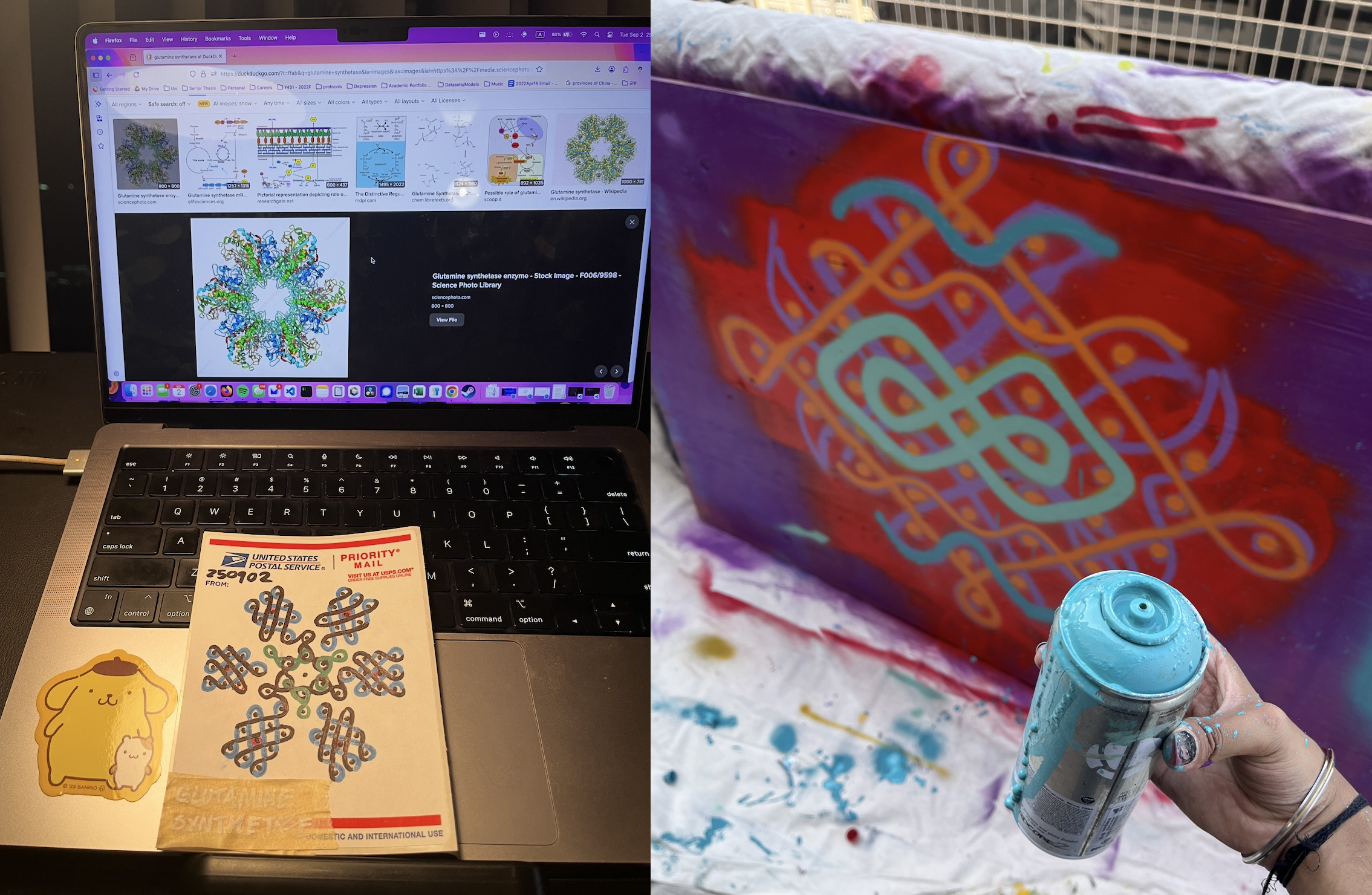
- The protein I selected was glutamine synthetase. I selected it because as part of my graffiti art, I recreate a traditional indian art form known as “kolam” using spray paint. Glutamine synthetase has a largely symmetrical pattern very reminiscent to me of kolam patterns. I created ![this image] inspired by it (I think the protein is super pretty!) . Glutamine synthetase is an enzyme that catalyzes the reaction that synthesizes glutamine from Glutamate (yummy umami taste, like MSG!!!) and ammonia.
Identify the amino acid sequence of your protein
- How long is it? What is the most frequent amino acid?
- How many protein sequence hoologs are there for your protein?
- Does your protein belong to any protein family?