I'm working at the intersection of engineering, data science, and creativity to the end of serving people.
Currently, I'm exploring the world of adversarial models, AI safety and alignment, and technical governance (focusing on tech, energy and renewables, and biotech policy). Previously, I was a process aligned engineering data scientist at the plasma pyrolysis company Monolith. Prior to that I got my B.S. in Chemical and Biological Engineering from CU Boulder and did my thesis on experimental and computational microfluidics (facilitated in part by computer vision) under the advisorship of Dr. Gesse Roure and Prof. Rob Davis.
Open-Source, Community-Deployed Microfluidic & Smartphone Imaging Platform (Decentralized Health Science) Table of Contents Biological engineering tool Governance and policy goals Governance actions Governance actions scoring matrix Prioritization recommendation Week 2 Lecture Prep 1. Biological engineering tool Motivation My senior year of high school, my sister got diagnosed with diabetes and I switched my prospective major from CS to Chemical and Biological Engineering. Around the same time, I watched a TED talk by Dr. Manu Prakash on his paper-fuge: an accessible, affordable, and hand-powered centrifuge. The device was made from paper and string, but could separate blood into components comparably with how multi-thousand dollar equipment do. Having grown up in a State Department family, moving around the global south (and in close proximity to USAID) I saw how solutions and processes taken for granted in the west are greatly inaccessible to a vast majority of the world; and additionally the strength of local and specific solutions to technical problems (the Indian concept of “jugaad”: frugal innovation).
Table of Contents Part 0: Basics of Gel Electrophoresis Part 1: Benchling and In-silico Gel Art Part 2: Gel Art - Restriction Digests and Gel Electrophoresis Part 3: DNA Design Challenge Part 4: Prepare a Twist DNA Synthesis Order Part 5: DNA Read/Write/Edit Part 0: Basics of Gel Electrophoresis Watched lecture, recitation AND the bootcamp 🫡
Table of Contents Python/Opentrons Artwork Post-Lab Questions Final Project Ideas 1. Python Script for Opentrons Artwork I used the opentrons-art.rcdonovan.com tool to draw out the “Ralphie” mascot logo of my undergraduate university (CU Boulder).
This was the code and the produced image (the original logo is on the left). After creating the art in the opentrons tool, I just copied the array of mko2_points in and iterated over them in the color “Orange” since gold wasn’t an option.
Table of Contents Part A: Conceptual Questions Part B: Protein Analysis and Visualization Part C: Using ML-Based Protein Design Tools Part A: Conceptual Questions Pick any 9 of the following (can skip two)
How many molecules of amino acids do you take with a piece of 500 grams of meat? (on average an amino acid is ~100 Daltons) 2. Why do humans eat beef but do not become a cow, eat fish but do not become fish? 3. Why are there only 20 natural amino acids? 4. Can you make other non-natural amino acids? Design some new amino acids. 5. Where did amino acids come from before enzymes that make them, and before life started? 6. If you make an α-helix using D-amino acids, what handedness (right or left) would you expect? 7. Can you discover additional helices in proteins? 8. Why are most molecular helices right-handed? 9. Why do β-sheets tend to aggregate? - What is the driving force for β-sheet aggregation? 10. Why do many amyloid diseases form β-sheets? - Can you use amyloid β-sheets as materials? 11. Design a β-sheet motif that forms a well-ordered structure. Chicken breast is higher protein (32g protein/100g) but I prefer chicken thigh ;) (25g protein/100g) $500 \text{g chicken thigh} \cdot \frac{25 \text{g protein}}{100 \text{g chicken thigh}} \cdot \frac{1 \text{kg}}{1000 \text{g}} \cdot \frac{1 \text{Da}}{1.660539 \times 10^{-27} kg} \cdot \frac{1 \text{amino acid (approx)}}{100 \text{Da}}$ $=7.5276762545 \times 10^{23}\text{ amino acids}$ When you eat beef or fish, it doesn’t remain as beef or fish, it is broken down by our digestive system into its component amino acids and hence loses any characteristic of being a “fish” or a “cow”. It’s these amino acid building blocks that we then use to build up human proteins using HUMAN RNA building blocks. One explanation is that there’s only 20 natural amino acids because that was the minimum functional number to achieve the necessary chemical functionality (regarding solubility, hydrophobicity, charge, etc.). Biology doesn’t often expand unnecessarily in terms of evolution once the function that optimizes for an environment is achieved, a kind of stability is reached. Absolutely, just change the R-group on the amino acid! I’m not sure what a suitable R-group would be, but I think that something photosensitive would be really cool: an amino acid that can change conformation when excited by photons Entirely useless, but I imagined an R group like buckministerfullerene that could fully encapsulate the amino acid. Not functional at all, but could make for some sick visuals (maybe as an amino acid soccer ball for protein motors to play with) Way back when, planet Earth was a super hot primordial soup and constantly bombarded by extraplanetary objects. It’s possible that one of these objects (a meteorite or a comet) could have delivered the first amino acids. At the same time though, a 1953 study recreated the conditions of early earth and were able to produce 11 standard amino acids through pure chemical synthesis. Later as biology developed and metabolic pathways were formed, the more chemically complex amino acids could be synthesized (or delivered by extraterrestrial objects!) Natural alpha helices are made from L-amino acids and most have a right-handedness (due to the L-amino acids’ chirality). I’d suspect that making an alpha helix with D-amino acids would create a mirror image helix (left-handed) but I wonder about whether any steric hinderance would leave the helix unstable. SKIP Due to steric factors! Since the 20 amino acids all have L-chirality, the way they assemble to maximize stability and minimize steric hinderance, tend to aggregate most commonly as right-handed helices (though as you can see in a Ramachandran plot, let handed helices do exist, but are just less common) Also steric factors! β-sheets have exposed edges that can hydrogen-bond (a strong intermolecular force) that other exposed edges of other β-sheets can stick to. Hydrogen bonding is the driving force as is hydrophobic interactions with other parts of the protein and the surrounding serum. It’s about stability: if a protein is “misfolded” but the misfolded configuration is more thermodynamically stable, then it will stay that way (e.g. prion diseases). β-sheets are extremely stable, and if they misfold, especially in a way that the polar parts are inside and hydrogen bonding to each other happens, and leaves the hydrophobic part of the sheet pointing outwards further stabilizing it, it’s just a bad time. It’s extremely stable, and unable to be corrected. SKIP Part B: Protein Analysis and Visualization Briefly describe the protein you selected and why you selected it.
Table of Contents Part A: SOD1 Binder Peptide Design Part B: BRD4 Drug Discovery Platform Tutorial Part C: Final Project: L-Protein Mutants Part A: SOD1 Binder Peptide Design Part 1: Generate Binders with PepMLM UniProt P00441 without the header: MATKAVCVLKGDGPVQGIINFEQKESNGPVKVWGSIKGLTEGLHGFHVHEFGDNTAGCTSAGPHFNPLSRKHGGPKDEERHVGDLGNVTADKDGVADVSIEDSVISLSGDHCIIGRTLVVHEKADDLGKGGNEESTKTGNAGSRLACGVIGIAQ The mutation “A4V” means the alanine at codon 4 (position) is changed to a valine. The M at the beginning is Methionine (coded by the codon AUG) but this is commonly ignored in canonical numbering since it’s the start codon. It’s there to signal the start of protein translation.
Subsections of Homework
Week 1 HW: Principles and Practices
Open-Source, Community-Deployed Microfluidic & Smartphone Imaging Platform (Decentralized Health Science)
My senior year of high school, my sister got diagnosed with diabetes and I switched my prospective major from CS to Chemical and Biological Engineering. Around the same time, I watched a TED talk by Dr. Manu Prakash on his paper-fuge: an accessible, affordable, and hand-powered centrifuge. The device was made from paper and string, but could separate blood into components comparably with how multi-thousand dollar equipment do. Having grown up in a State Department family, moving around the global south (and in close proximity to USAID) I saw how solutions and processes taken for granted in the west are greatly inaccessible to a vast majority of the world; and additionally the strength of local and specific solutions to technical problems (the Indian concept of “jugaad”: frugal innovation).
My technical background thus far has it’s hands in the buckets of microfluidics, imaging, bioengineering, data science, and high performance computation. My senior thesis in multiphase microfuidics studied microdroplet deformation as the droplets traveled down a straight channel. I wrote FORTRAN simulations, and to compare it with a practical experiment I built a dimensionally scaled acrylic flow cell to observe the deformation with imaging software I wrote to use my phone camera (leveraging information from a class I took on quantitative optical imaging). I’m quite terrible at wet-lab protocols but having devices like flow cells made the process much more accessible for me (a computationalist). Our research could be applied to single cell diagnoses, microreactors, and point of care assays. My senior design project for my degree in bioengineering involved designing a lentiviral vector production platform for CAR-T cell therapy. An extremely personalized medicine, but inaccessible due to high cost and highly centralized, regulated manufacturing.
The idea I’m tossing around generalizes concepts I’ve encountered in each of these different areas I’ve experienced so far.
The Platform: an Arduino for the Wet Lab
Layer
Description
Notes
Fabrication
Microfluidic Chips
3D resin-printed, open-source designs (potentially on a platform). Different geometries for diagnostics, micro-reactors, dye synthesis, fermentation, cell culture, etc. Researcher and Community provided templates
Imaging
Phone Camera + Magnification add-on
A universally available and reasonably precise optical sensor. With AI-powered imaging algorithms (e.g. segmentation, undistortion, etc.) “ballpark” imaging can give a lot of information over having 0 access to any analysis
Analysis
Node-based visual processing on any computer
Inspired by ComfyUI, TouchDesigner, Blender nodes, DaVinci Resolve Fusion. Not everyone knows how to code, so users build pipelines by connecting visual blocks (but you can code if you want finer control on the analysis). The platform with the cell designs also can hold AI models provided by researchers; workflows are shareable, auditable, and forkable.
Last year, USAID was shut down shuttering a huge chunk of global humanitarian funding. Last month (Jan 22, 2026) the US formally withdrew from the WHO. A lot of the world depends on aid funding and support for health endeavors, and these local political occurrences in the US have exposing ramifications worldwide. Science is going to advance regardless, but access doesn’t seem to be matching pace.
The goal here isn’t to decentralize fundamental research, but rather decentralizing the ability to apply the research: to deploy, test, adapt, iterate, and manufacture. Fundamentally, this platform should serve to educate and empower at the community level. Though the results may not be as precise as could be obtained with fancy equipment, a ballpark/order of magnitude estimate always beats 0 information.
2. Governance and policy goals
Goal A: Equity Access and Education
The individual and decentralized nature easily melds into the existing workflow of biohackers in the US, but it is essential that the platform reaches underserved communities who lack the infrastructure.
A1. Serve as a platform to allow DIY-ers around the globe (who may not have access to all that bio-hackers in the US enjoy) to develop their bioengineering chops. Minimize cost and technical barriers to fabrication, imaging, and analysis.
A2. Ensure knowledge transfer and education, tools without understanding just recreates dependency (e.g. building a well in South Africa and leaving vs. training the community on how to build and maintain wells).
Goal B: Safety Without Gatekeeping
Prevent harm without recreating the centralized approval bottleneck that blocks access and imposes non-universal standards universally. Culturally, norms in the US are different from those in India, different from those in Korea, etc. Aside from basic universal safety, safety involves nuance in the context of the application, and the community.
B1. Users understand the confidence level and limitations of their results using the platform.
B2. The tool itself clearly communicates unreliable outputs; safety is embedded in design not just tacked on at the end.
Goal C: Community Sovereignty
Who deserves to decide what’s “cautious enough”?
C1. Local communities decide what applications, and standards matter for their context. Embedded in the platform is a system for local/community governance to determine and regulate standards
C2. Governance doesn’t require permission from external institutions, remains transparent (infrastructurally), can factor in cultural and geographical nuance
Technical platform/community norms. Open-source (think homebrew or iGEM)
Policy change: national regulators
Technical strategy, platform developers + bioengineering researchers + open-source community
Purpose
• Microfluidic devices are super-common in bioengineering labs, but unlike the iGEM registry for biological components or GitHub for code, there’s no platform or standardized way to share microfluidic designs for community use. Since the processing workflow is node-based (like touchdesigner) it improves the clarity of processing by orders of magnitude over seeing huge blocks of code out-of-order.
• All diagnostics face the same approval pipeline, this would create a new “community screening” tool with lower barrier than formal diagnostics but with mandatory labeling for transparency. (e.g. home pregnancy test vs clinical blood panel) • Priority is to shift the framing from “is this analysis as accurate as possible” to “does the user understand what’s happening with their health?”
• Need results to have reliability indication for transparency: this builds confidence scoring and image quality into the nodes themselves to flag problems.
Design
Community-driven repository with wikipedia/open-source style collective maintenance. Paired training datasets could be built to improve AI models (e.g. images that are lab grade compared to phone camera images). This platform can hold chip designs, node-based imaging workflows, novel image processing blocks, AI models, and protocols shared with a way for the community to have discourse around it (to give feedback, ratings, safety info, etc.).
Would involve regulatory action. Perhaps a pilot program with mandatory labelling of screening vs diagnosis, confidence levels, recommended follow-ups. International adoption would likely come from a governing health body like the WHO (even though the US left) or could be implemented by regional or local health bodies.
Paired and living (actively updated) datasets built collaboratively by research labs and the community. Models shared on Hugging Face, can be imported as nodes. On-device or local inference (so that wifi is not a strict necessity for processing). Safety is built in as visible errors in the node-graph adding to the auditability of the safety of the processing pipeline
Assumptions
• Enough people will want to actively contribute to maintain quality • community review rigorously flags dangerous or poor-performing designs. • Node-based interface is accessible enough for non-technical users
• Assuming that regulators don’t see this as “lowering standards” but rather as creating a new specific category. • Assuming the political will exists to prioritize access and safety (not much evidence right now for this)
• Users will pay heed to confidence warnings • Collaborative datasets include a diversity of phone models, lighting, etc. • Confidence calibration is accurate enough to be genuinely useful
Risks of Failure & “Success”
Failure: • Community repo stagnates or quality falls off a cliff Success: • Community platform dominated by western biohackers, marginalizing the communities it’s meant to serve
Failure: • Rejected by regulators, tool is in legal limbo Success: • Could potentially codify a two-tier system (similar to World Bank interest rates on loans to european vs african countries) where wealthy countries get “real” diagnostics, the global south is stuck with “screenings”
Failure: • Poorly calibrated models essentially just making up analyses with false confidence Success: • over-reliance on the confidence metric, and conflating model confidence for the screening as a formal diagnosis
4. Governance Actions Scoring Matrix
Does the option:
Option 1
Option 2
Option 3
Enhance Biosecurity
• By preventing incidents
2
1
1
• By helping respond
1
2
2
Foster Lab Safety
• By preventing incident
2
1
1
• By helping respond
1
2
1
Protect the environment
• By preventing incidents
2
2
1
• By helping respond
1
2
2
Other considerations
• Minimizing costs and burdens to stakeholders
1
3
2
• Feasibility?
2
3
2
• Not impede research
1
2
1
• Promote constructive applications
1
2
2
Week 2 Lecture Prep
Homework Questions from Professor Jacobson:
Nature’s machinery for copying DNA is called polymerase. What is the error rate of polymerase? How does this compare to the length of the human genome. How does biology deal with that discrepancy?
Polymerase has about 1 error every 106 base incorporations. The human genome is about 3 billion (3 \times 109) base pairs, which would lead to an order of 10^3 errors during replication of the genome. This would be catastrophic for fine tuned machines like biological systems, so there are several biochemical error correction methods that biology provides. During DNA synthesis several enzymes (DNA polymerase included) have live proofreading functionality that can “backspace” errors by reversing direction while writing out sequences in nucleotides. After the DNA strand is synthesized, mismatch repair (nucleotide excision repair) can chop out regions with an incorrect nucleotide and polymerase can come back in to do its job.
How many different ways are there to code (DNA nucleotide code) for an average human protein? In practice what are some of the reasons that all of these different codes don’t work to code for the protein of interest?
Take a look at a codon chart and you’ll see that multiple base sequences can create the same amino acid, thus in a protein that can contains hundreds of amino acids, there’s an exponentially growing combinatorial tree of codes. However, in practice the minutia of the kinetics controlling these processes restrict the actual sequences that can create proteins. As amino acids are appended to the sequence, secondary structure (alpha helices, beta sheets) arise from steric effects. These secondary structures link directly to the functional geometric configuration of the protein, and certain sequences may form structures with steric effects on geometry that negatively impacts functionality.
Homework Questions from Dr. LeProust:
What’s the most commonly used method for oligo synthesis currently?
Phosphoramidite DNA Synthesis
Why is it difficult to make oligos longer than 200nt via direct synthesis?
If each additional nucleotide appended onto the chain has an error rate, each additional nucleotide multiplies the previous error rate with its own error rate. As the length of the chain incrases, the error rate increases exponentially, drastically reducing the amount of correct full-length product you’re left with.
Why can’t you make a 2000bp gene via direct oligo synthesis?
Let’s take an example error rate: a coupling efficiency of 99.5% (new bases are tacked on correctly 99.5% of the time), you do this for 2000 base pairs, and you get 0.995^2000=0.004%. The errors scale so fast you essentially wouldn’t get any properly made product. It’s more effective to make smaller chains up to 200nt in length, and splice them together.
Homework Questions from Prof. Church:
[Using Google & Prof. Church’s slide #4] What are the 10 essential amino acids in all animals and how does this affect your view of the “Lysine Contingency”?
The 10 essential amino acids in animals (that we are unable to synthesize, and thus must obtain through diet) are PVT TIM HALL:
Phenylalanine (Phe, F)
Valine (Val)
Threonine (Thr, T)
Tryptophan (Trp, W)
Isoleucine (Ile, I)
Methionine (Met, M)
Histidine (His, H)
Arginine (Arg, R)
Leucine (Leu, L)
Lysine (Lys, K)
The dinosaurs in Jurassic park were engineered to be unable to produce lysine as a safety, but the thing is they couldn’t produce it to begin with, and got it through diet! So long as somewhere in the food chain a lysine consuming organism (say some herbivore) exists in the environment this is not a containment strategy at all as the dinosaur could simply eat this organism to get lysine. However, as noted on the slide NSAAs (non-standard amino acids) exist that don’t exist in nature. If a non-standard amino acid was incorporated into the dinosaur’s essential proteins then that could be an effective method for containment. The idea of engineering metabolic dependency as a way to structurally impose biosafety is a great idea, but it needs to be thought out correctly!
Prompts Used:
“Take this obsidian markdown and help me reformat it to the markdown format of the hw assignment. Ask any questions to help me fill out missing gaps in my ideas” (attached _index.md from hw template)
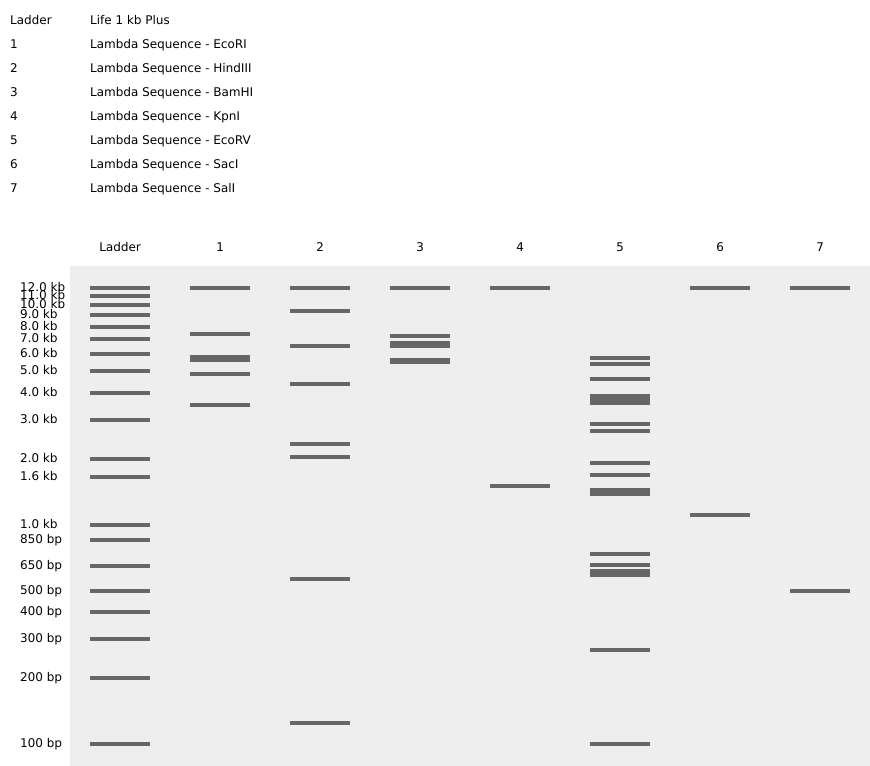
Click the scissors tool to digest, and search for each of the seven enzymes. After each individual enzyme is selected click “Run digest” to add a new lane to your virtual digest
Part 2: Gel Art - Restriction Digests and Gel Electrophoresis
Can’t perform - no wet lab access.
Part 3: DNA Design Challenge
3.1. Choose your protein
I’ve chosen mECFP, it’s a fluorescent protein that produces a lovely cyan/blue colour. It was my favourite fluorescent protein I saw in my quantitative optical imaging/microscopy class.
3.2. Reverse Translate: Protein (amino acid) sequence to DNA (nucleotide) sequence.
3.3. Codon optimization
3.4. You have a sequence! Now what?
3.5. [Optional] How does it work in nature/biological systems?
I used the opentrons-art.rcdonovan.com tool to draw out the “Ralphie” mascot logo of my undergraduate university (CU Boulder).
This was the code and the produced image (the original logo is on the left). After creating the art in the opentrons tool, I just copied the array of mko2_points in and iterated over them in the color “Orange” since gold wasn’t an option.
2. Post Lab Questions
Find and describe a published paper that utilizes the Opentrons or an automation tool to achieve novel biological applications.
I found a paper by Soh et. al on using “Opentrons for automated and high-throughput viscometry”. My own thesis research revolved around droplet microfluidics and multiphase flow. It’s often the case in biological or medical applications where you have a system of more than one fluid in the same area: especially with biological fluids which can tend to be extremely varied in viscosity. The properties of the fluids (e.g. viscosity, reynolds number, capillary number) determining the fluids’ behavior: blood will have different properties than say mucus, than cellular fluids, etc.). For systems like multi-phase lab-on-chip microfluidic systems, food science, cosmetics production (e.g. shampoos), and pharmaceuticals testing viscosities through multiple formulations is usually a time-intensive and laborious process. For my own research, it was a huge pain to have to set up a pendant drop viscometer over and over and over again for slightly different fluids, set up the experiment, wait for it to proceed, observing and collecting data, and then having to rigorously clean out the equipment after. Past that was the fact that my fellow researchers and I would always have slight differences in how we operated the protocol; which does matter when you get down to the microfluidic scale of things. In this paper Soh et al. leveraged the Opentrons liquid handling automation to conduct rheological experiments to characterize these fluids, both newtonian and power-law fluids (e.g. non-newtonian shear thinning fluids like ketchup that become less viscous when you shake them). They were able to get the viscometry measurement down to 1.5 minutes per run (and in a youtube video I watched of a conference talk by one of the other authors, Dr. Aniket Chitre, the system was paired with a computer vision analysis to rapidly reduce analysis time). To me this is the exact application of an automation platform like Opentrons: standard replications of slightly different conditions and then being able to automatically collect measurements. I would have KILLED to have access to something like Opentrons when I was doing research!
Write a description about what you intend to do with automation tools for your final project. You may include example pseudocode, Python scripts, 3D printed holders, a plan for how to use Ginkgo Nebula, and more. You may reference this week’s recitation slide deck for lab automation details.
bxyz
3. Final Project Ideas
(To Be Refined!!!!)
Idea 1: Cell-free at-home endometriosis detection
Endometriosis is a condition where endometrial cells are found in other places in the body. Just like cells in the uterus, these cells outside the uterus swell and bleed. However, unlike the cells in the uterus, there’s no exit route for these discharge… this can lead to IMMENSE and DEBILITATING pain for up to 11% of women, including my mother and sister.
Despite this, it’s a common occurrence that women are deprioritized by both medical professionals (women in pain are often told they’re exaggerating, as my friends have told me) refusing to dig deeper into the issue, and that women have been largely sidestepped in terms of the medical research being done. Male pattern baldness (an aesthetic gender-affirming issue for men) is researched more than endometriosis (debilitating pain, psychological sorrow).
A recent study done by Vash-Margita et al. at Yale identified a handful of miRNA targets (microRNA: 21-25 nucleotides) that were elevated by a statistically significant amount in the serum (blood/saliva) of endometriosis patients. Lateral flow detection technologies already exist (e.g. COVID tests, zika tests, etc.) that can take a presence of a biomarker and display a visible signal.
There’s definitely more work to be done refining this idea (e.g. testing through different stages of endometriosis to find robust biomarkers that could be used for a threshold sort of test, collecting data through multiple stages of the menstrual cycle especially focusing on when the debilitating pain is present). But I think the dream of a first-pass at-home screening test is not unfeasible so that the women in my life don’t have to be told they’re exaggerating their pain by a medical professional.
Idea 2: Bioengineered Graffiti
To me the very essence of creativity (and science!) is drawing on ideas from different domains, and combining them in new and creative ways. As a graffiti artist, graffiti provides a very versatile platform to bounce off from.
Just like cells in a local area compete for resources for growth, graffiti crews (a crew being a group of artists who paint together) compete for visible spots and have “turf wars”. A lot of graffiti artists practice their work in blackbooks (the canonical graffiti sketchbook) or on plastic dioramas of spots that they’d want to put their pieces on e.g. trains, billboards, skate parks, etc. My thought was: why not coat such a diorama in a substrate that would facilitate different cellular graffiti “crews”! I can program a cell to express a certain color, and use a 3D printed holder and something like the Opentrons platform to set off the initial artists, then watch a time lapse as they cover the diorama with biological graffiti patterns.
Subidea 2: Bioluminescent canvas for a light-activated graffiti “buddha board”
A buddha board is a reusable canvas for brush painting. You dip your brush in water, and can paint on the surface and release the art as it dries away. To me it’s very similar to the fleeting nature of street art: you can’t take it home with you, you have to experience it in the moment. Yes, you can take a picture but it’s not the same as seeing it in the moment live. One independent project I did a while back was trying to model different graffiti spray caps using conic sections: to make the metaphor a little clearer I used the concept of a flashlight’s light cone. My thought here is what if I can bioengineer a biofluorescent (not bioluminescent!) canvas: a canvas that could stay in a dark room, and then I can use flashlights (potentially black light flashlights?) with different light cones to practice spray painting techniques like flares, straight lines, stroke consistency etc. in a way that doesn’t actually permanently change the surface? I could coat a huge canvas in this bioengineered material (maybe a fluorescent protein, maybe a collection of cells) and then use my flashlights to spray paint and watch it slowly fade away like a bioengineered graffiti buddha board.
Idea 3: Opentrons for DNA Music Sequencing (Audiovisual Performance)
Sequencing and automation have different meanings in biology and music. Sequencing in biology means uncovering the DNA sequence of nucleotides whereas in music sequencing is essentially creating/editing/setting a sequence of MIDI notes. The structure of well plates are quite similar to a sequencer, but I thought of incorporating organic cell growth in like in an agar plate. Automation in biology automates lab protocols, whereas in music automation programmatically changes parameters like volume or effects like reverb or compression.
But an idea that’s run through my mind since seeing both MIDI sequencers AND my bio classmates’ well-plates was “hmm, these grid systems look remarkably similar!” Why not combine the two? Opentrons’ precision dispensing can create grid sequences within plates, and then the cells can grow organically and change the sequencing entirely! I could set up a camera on them and analyze them in different ways: maybe a scanline checking for a grid of areas that can be fed into MIDI notes. An alternative would be to measure parameters like spread, or total coverage, etc. (like for example a lot of audiovisual artists do with their hands and bodies to make music in touchdesigner and soundthread) and use that parameter as a control for automation like a pitch slider or a volume slider or compression.
My initial idea is this: have opentrons programmed to create some plates: e.g. one plate for the bassline, one for drums, one for a synth, one for reverb (or other types of music, use a computer vision algorithm with a specified scanline (or measuring % coverage etc) to read the notes/automation, and see how the music evolves organically over time. I’ve also been playing around with teaching myself touchdesigner for algorithmic visual art, and pairing the organic music + computer vision analysis of the plates with an organic algorithmic art visualizer would be absolutely sick
Idea 4: STI detecting condom coating
Just tossing another idea out (since in the BioClub recitation it was said that it was ok to go over 3 projects): with all this technology at our disposal like being able to detect biosensors, engineer proteins surely it should be possible to design a stable coating that can go inside of a condom (the way lube and spermicide are a mixed coating inside a condom) that can change colors if certain STIs are detected?
1. How many molecules of amino acids do you take with a piece of 500 grams of meat? (on average an amino acid is ~100 Daltons)
2. Why do humans eat beef but do not become a cow, eat fish but do not become fish?
3. Why are there only 20 natural amino acids?
4. Can you make other non-natural amino acids? Design some new amino acids.
5. Where did amino acids come from before enzymes that make them, and before life started?
6. If you make an α-helix using D-amino acids, what handedness (right or left) would you expect?
7. Can you discover additional helices in proteins?
8. Why are most molecular helices right-handed?
9. Why do β-sheets tend to aggregate?
    - What is the driving force for β-sheet aggregation?
10. Why do many amyloid diseases form β-sheets?
    - Can you use amyloid β-sheets as materials?
11. Design a β-sheet motif that forms a well-ordered structure.
Chicken breast is higher protein (32g protein/100g) but I prefer chicken thigh ;) (25g protein/100g)
$500 \text{g chicken thigh} \cdot \frac{25 \text{g protein}}{100 \text{g chicken thigh}} \cdot \frac{1 \text{kg}}{1000 \text{g}} \cdot \frac{1 \text{Da}}{1.660539 \times 10^{-27} kg} \cdot \frac{1 \text{amino acid (approx)}}{100 \text{Da}}$ $=7.5276762545 \times 10^{23}\text{ amino acids}$
When you eat beef or fish, it doesn’t remain as beef or fish, it is broken down by our digestive system into its component amino acids and hence loses any characteristic of being a “fish” or a “cow”. It’s these amino acid building blocks that we then use to build up human proteins using HUMAN RNA building blocks.
One explanation is that there’s only 20 natural amino acids because that was the minimum functional number to achieve the necessary chemical functionality (regarding solubility, hydrophobicity, charge, etc.). Biology doesn’t often expand unnecessarily in terms of evolution once the function that optimizes for an environment is achieved, a kind of stability is reached.
Absolutely, just change the R-group on the amino acid!
I’m not sure what a suitable R-group would be, but I think that something photosensitive would be really cool: an amino acid that can change conformation when excited by photons
Entirely useless, but I imagined an R group like buckministerfullerene that could fully encapsulate the amino acid. Not functional at all, but could make for some sick visuals (maybe as an amino acid soccer ball for protein motors to play with)
Way back when, planet Earth was a super hot primordial soup and constantly bombarded by extraplanetary objects. It’s possible that one of these objects (a meteorite or a comet) could have delivered the first amino acids. At the same time though, a 1953 study recreated the conditions of early earth and were able to produce 11 standard amino acids through pure chemical synthesis. Later as biology developed and metabolic pathways were formed, the more chemically complex amino acids could be synthesized (or delivered by extraterrestrial objects!)
Natural alpha helices are made from L-amino acids and most have a right-handedness (due to the L-amino acids’ chirality). I’d suspect that making an alpha helix with D-amino acids would create a mirror image helix (left-handed) but I wonder about whether any steric hinderance would leave the helix unstable.
SKIP
Due to steric factors! Since the 20 amino acids all have L-chirality, the way they assemble to maximize stability and minimize steric hinderance, tend to aggregate most commonly as right-handed helices (though as you can see in a Ramachandran plot, let handed helices do exist, but are just less common)
Also steric factors! β-sheets have exposed edges that can hydrogen-bond (a strong intermolecular force) that other exposed edges of other β-sheets can stick to. Hydrogen bonding is the driving force as is hydrophobic interactions with other parts of the protein and the surrounding serum.
It’s about stability: if a protein is “misfolded” but the misfolded configuration is more thermodynamically stable, then it will stay that way (e.g. prion diseases). β-sheets are extremely stable, and if they misfold, especially in a way that the polar parts are inside and hydrogen bonding to each other happens, and leaves the hydrophobic part of the sheet pointing outwards further stabilizing it, it’s just a bad time. It’s extremely stable, and unable to be corrected.
SKIP
Part B: Protein Analysis and Visualization
Briefly describe the protein you selected and why you selected it.
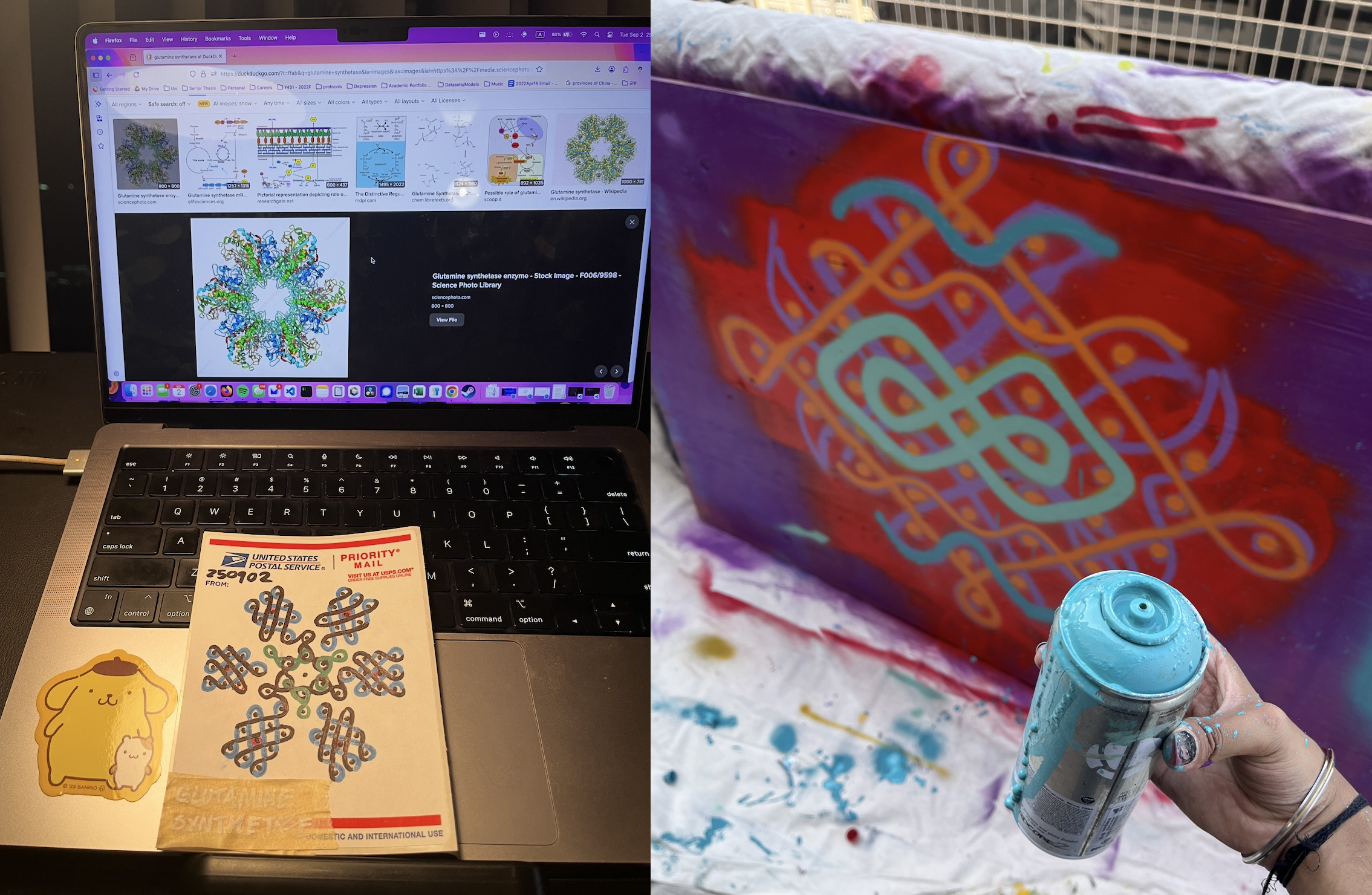
The protein I selected was glutamine synthetase. I selected it because as part of my graffiti art, I recreate a traditional indian art form known as “kolam” using spray paint. Glutamine synthetase has a largely symmetrical pattern very reminiscent to me of kolam patterns. I created ![this image] inspired by it (I think the protein is super pretty!) . Glutamine synthetase is an enzyme that catalyzes the reaction that synthesizes glutamine from Glutamate (yummy umami taste, like MSG!!!) and ammonia.
Identify the amino acid sequence of your protein
How long is it? What is the most frequent amino acid?
How many protein sequence hoologs are there for your protein?
The mutation “A4V” means the alanine at codon 4 (position) is changed to a valine. The M at the beginning is Methionine (coded by the codon AUG) but this is commonly ignored in canonical numbering since it’s the start codon. It’s there to signal the start of protein translation.