Week 7 HW: Genetic Circuits Part II: Neuromorphic Circuits
Assignment Part 1: Intracellular Artificial Neural Networks (IANNs)
In-cell Artificial Neural Networks (IANNs) offer a major advantage over traditional Boolean genetic circuits by enabling synthetic systems to operate at the same level of abstraction as natural cellular signaling. Unlike Boolean circuits, which are restricted to discrete on/off logic, IANNs use continuous, analog signal processing with nonlinear activation functions, allowing them to represent smooth and highly complex input–output relationships such as band-pass or non-monotonic responses. This enables IANNs to approximate arbitrary continuous functions more efficiently and compactly than combinations of rigid logic gates. In addition, their continuous nature makes them better suited for modeling real biological systems, which are inherently noisy and graded rather than binary. As a result, IANNs are more robust for complex cellular decision-making tasks and pattern recognition in biological environments.
A useful and artistic application for an in-cell Artificial Neural Network (IANN) is the Kinetic Bio-Interface , a system designed as a “living bridge” to translate human dance or gestures into a synchronized biological light show. In this setup, the input consists of multi-dimensional, continuous analog kinetic signals from a wearable MPU-6050 accelerometer, which are processed via machine learning into small electrical signals transmitted to electro-bacteria like Shewanella oneidensis or Geobacter. The IANN layer within these bacteria utilizes non-linear activation functions to integrate the intensity and rhythm of the electrical input, producing a graded bioluminescent output (such as color change or fluorescent emission) where light varies smoothly according to the “energy” of the movement, rather than simply switching on or off. However, achieving this goal faces several limitations, most notably a significant real-time latency where bacterial metabolism responds in minutes rather than seconds, a signal calibration bottleneck involving microampere-level bacterial currents that are difficult to align with high-frequency sensor data, and high engineering complexity related to maintaining cell viability within a microfluidic device and overcoming bio-prospecting constraints for orthogonal biological parts.
Intracellular Multilayer Perceptron (IANN)
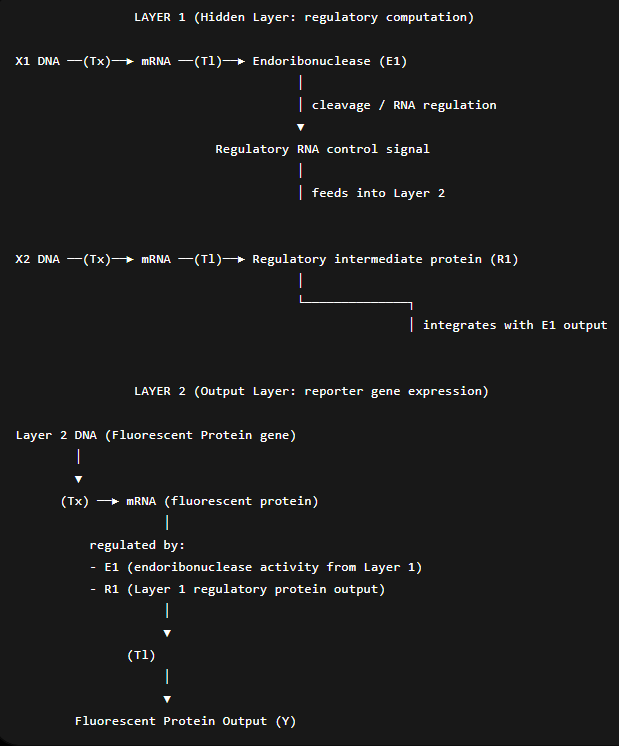
Functional interpretation (what the diagram means) Layer 1 acts as a computational layer X1 encodes an endoribonuclease (E1) that modifies RNA stability X2 encodes a regulatory protein (R1) Together they compute an intermediate regulatory state (like hidden neurons) Layer 2 is the output layer Fluorescent protein expression depends on post-transcriptional regulation E1 controls mRNA degradation or accessibility R1 modulates expression strength or translation efficiency Key idea
This system behaves like a biological multilayer perceptron:
Layer 1 = nonlinear regulatory computation (RNA processing + protein activity) Layer 2 = gene expression output (fluorescence) Output = continuous analog signal (not binary), shaped by combined regulatory inputs
Assignment Part 2: Fungal Materials
- Mycelium Packaging: Companies use fungal mycelium (the root structure) to grow biodegradable alternatives to Styrofoam and plastic packaging. Fungal Leather (Mycoleather): Fungi can be grown into dense mats that mimic the texture and durability of animal leather, used in fashion and upholstery. Construction Materials: “Myco-bricks” are made by allowing fungi to colonize agricultural waste, creating lightweight, fire-resistant, and insulating building materials.
Advantages and Disadvantages over Traditional Counterparts
- Advantages: Fungal materials are typically biodegradable, carbon-negative (they sequester carbon as they grow), and require significantly less land and water than leather or petroleum-based plastics.
- Disadvantages: They can be sensitive to moisture, may lack the tensile strength of traditional materials, and their growth can be less consistent than standardized industrial processes.
Advantages and Disadvantages over Traditional Counterparts
- Advantages: Fungal materials are typically biodegradable, carbon-negative (they sequester carbon as they grow), and require significantly less land and water than leather or petroleum-based plastics.
- Disadvantages: They can be sensitive to moisture, may lack the tensile strength of traditional materials, and their growth can be less consistent than standardized industrial processes.
- NASA’s mycotecture lab uses mycelium to builde remote habitats, including concepts such as the first self-growing space habitats (e.g., lunar or Martian structures grown rather than constructed).
NASA’s Mycotecture work explores using fungal mycelium as a “grown” construction material for space habitats, including concepts like self-growing lunar or Martian shelters and inflatable structures that are later “filled in” and strengthened by mycelium-based composites. One widely cited example is the idea of a “mycelium-based lunar habitat” (often discussed in NASA NIAC and related research contexts), where fungi are used to bind in-situ resources (e.g., regolith or agricultural waste) into lightweight, insulating building materials. In some experimental demonstrations, researchers have even shown early-stage fungal-grown structural components and prototype habitat shells, suggesting a pathway toward the first generation of biologically grown extraterrestrial construction materials.
This type of system is appealing because mycelium can be grown rather than manufactured, meaning it could potentially use minimal imported mass from Earth and instead rely on local resources. In a space environment, this could reduce launch costs while enabling structures that are self-repairing and adaptable.
However, there are important limitations: fungal growth requires carefully controlled temperature, humidity, and nutrient conditions, all of which are difficult in space or planetary environments. Additionally, ensuring long-term structural stability (against radiation, desiccation, and mechanical stress) remains a major engineering challenge. Even so, NASA’s mycotecture research highlights fungi as a promising platform for sustainable, in-situ construction in extreme environments, including future lunar and Martian bases.
Assignment Part 3: First DNA Twist Order
- Reviewed Individual Final Project documentation guidelines.
- Please use this directing link to see my submitted form.
- Order Details of the order from Twist Bioscience: https://drive.google.com/drive/folders/1RdyDg39u1akXjmPxIKRLrWrsKfAhuHpx