Week 3 HW: / Lab Automation
Python Script for Opentrons Artwork
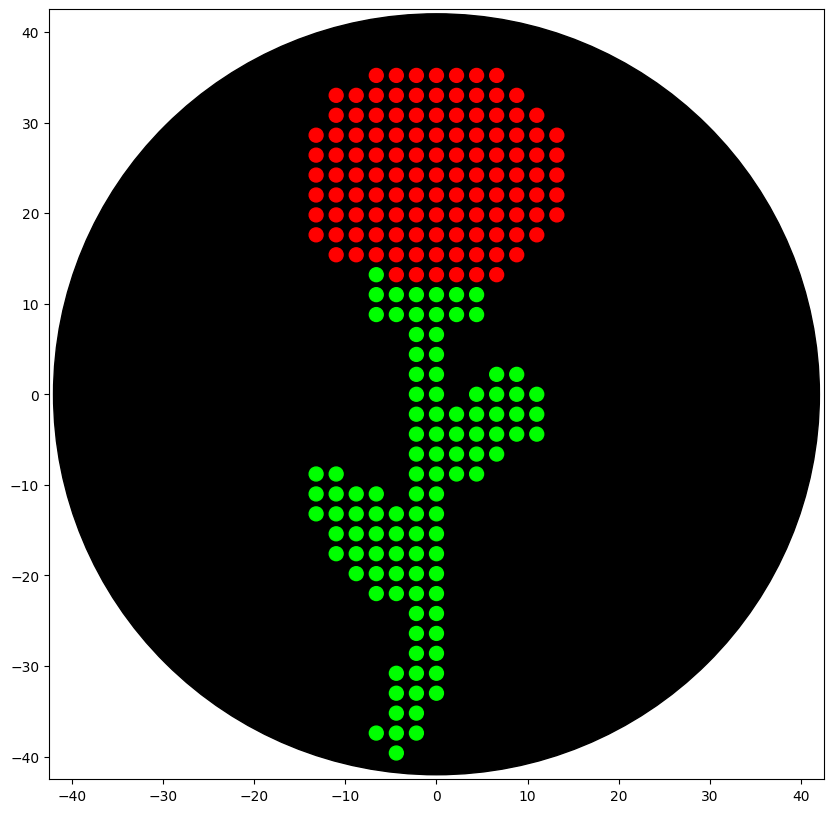
Generate an artistic design using the GUI at opentrons-art.rcdonovan.com.

Using the coordinates from the GUI, follow the instructions in the HTGAA26 Opentrons Colab to write your own Python script which draws your design using the Opentrons.
Post-Lab Questions
- Find and describe a published paper that utilizes the Opentrons or an automation tool to achieve novel biological applications.
Published Paper Using Opentrons for Novel Biological Applications
Citation
Nazeri, M., Watchorn, J., Mei, S., Zhang, A., Allen, C., & Gu, F. (2025).
Leveraging flexible pipette-based tool changes to transform liquid handling systems into dual-function sample preparation and imaging platforms.
HardwareX. https://doi.org/10.1016/j.ohx.2025.e00653
Summary
In this paper, the authors modified the Opentrons OT-2 liquid handling robot to function as both a pipetting system and a real-time imaging platform. They designed a 3D-printed adapter that holds both a pipette tip and a USB camera. When the robot picks up the pipette tool, the camera is lifted with it, allowing simultaneous liquid handling and in-situ imaging. The system was used to monitor ionically crosslinked hydrogels during formation, enabling real-time observation without manual sample transfer. This approach improves reproducibility, supports high-throughput experiments, and reduces human error. Although demonstrated with hydrogels, the platform could be applied to other biological and materials science processes such as polymerization, crystallization, and drug delivery development. This work highlights how open-source automation tools like Opentrons can be expanded into multifunctional research platforms.
- Write a description about what you intend to do with automation tools for your final project. You may include example pseudocode, Python scripts, 3D printed holders, a plan for how to use Ginkgo Nebula, and more. You may reference this week’s recitation slide deck for lab automation details.
Final Project: Using Automation to Develop a Bromelain-Based Wound Dressing
For my final project, I plan to use laboratory automation tools such as the Opentrons OT-2 liquid handling robot to develop and optimize a bromelain-based wound dressing.
Bromelain is a proteolytic enzyme derived from pineapple that has anti-inflammatory and debridement properties. However, its effectiveness depends on concentration, stability, and controlled release within a hydrogel or dressing matrix. Automation can significantly improve how these formulations are tested and optimized.
How Automation Will Help
Using the Opentrons robot, I will:
- Prepare multiple hydrogel formulations with varying bromelain concentrations.
- Automate mixing ratios of polymer base, crosslinker, and enzyme.
- Perform high-throughput testing of different conditions.
- Improve reproducibility and reduce pipetting error.
- Monitor gel formation consistency across replicates.
This approach allows systematic exploration of structure–property relationships, similar to combinatorial materials research discussed in class.
Example Workflow
- Load hydrogel base into plate.
- Dispense varying concentrations of bromelain.
- Add crosslinking agent.
- Incubate under controlled conditions.
- Record observations (gel strength, clarity, degradation rate).