iFP- Additional info
Additional Information and resources
Proposal and presentation slides
Proposal
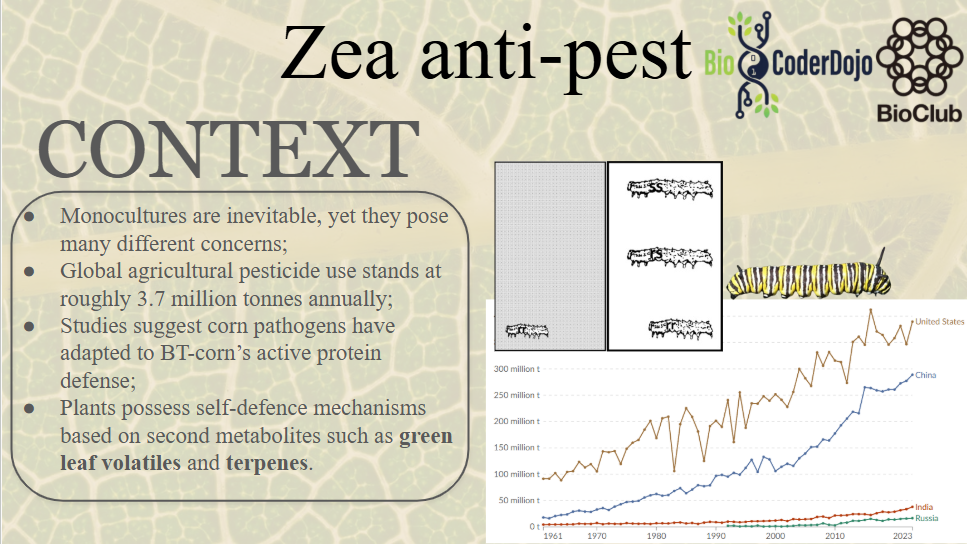
Modern crop growing techniques mainly revolve around monoculturing and industrial-scale usage of different chemical compounds, ranging from synthetic fertilisers to pesticides. Because regulating exact pest attacks on crops like corn is rather inefficient, farmers tend to have tons of pesticides sprayed atop of their cultures, more than often resulting in undesired pollution and other ecosystematic side effects which the present genetic engineering plan aims to diminish. Genetically modified plants such as MON810 (BT-corn) defend themselves by using specific compounds; specifically a protein expressed in Bacillus thuringiensis; similar alternatives are considerably better than reckless spraying of harmful insecticides, fungicides etc, however they still have to confront the problem of adapting pests.
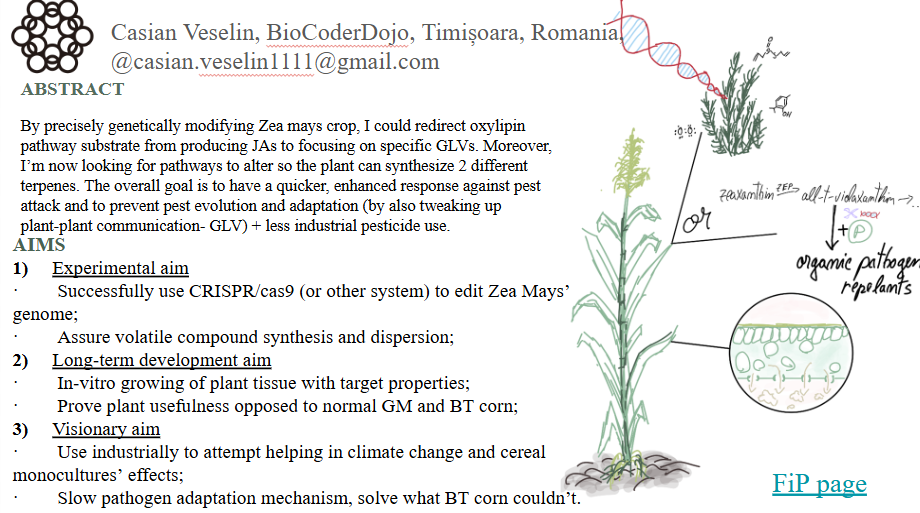
The approach I have designed primes two different classes of plant second metabolites: green leaf volatiles (GLVs) and terpenes, for the means of feasibility and time-imposed limitations, only (Z)-3-hexenal and (E)-β-caryophyllene respectively biosynthesis’ will be followed by an enhancing plan. Planned novelty comes from the diversity of chemical activity and structure present in the substances, but also from the genetic approach.
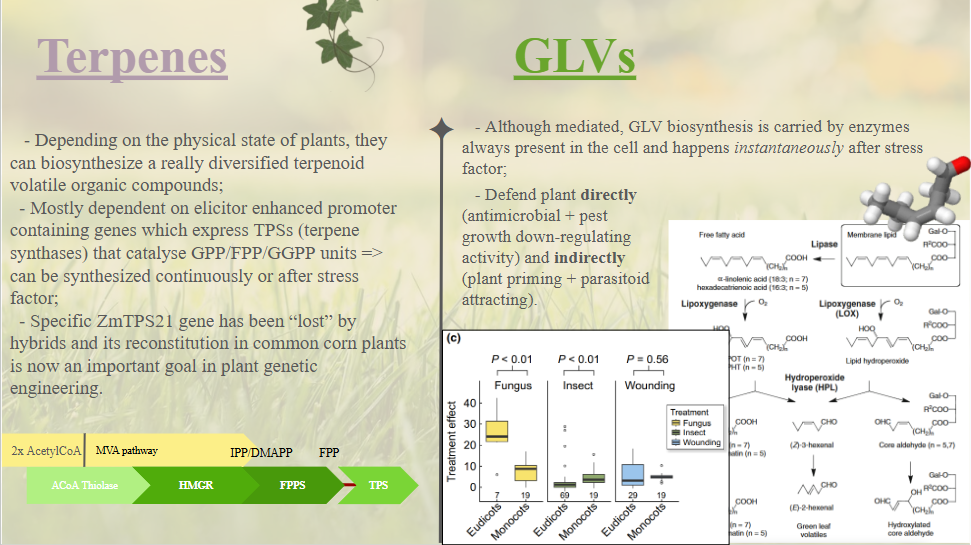
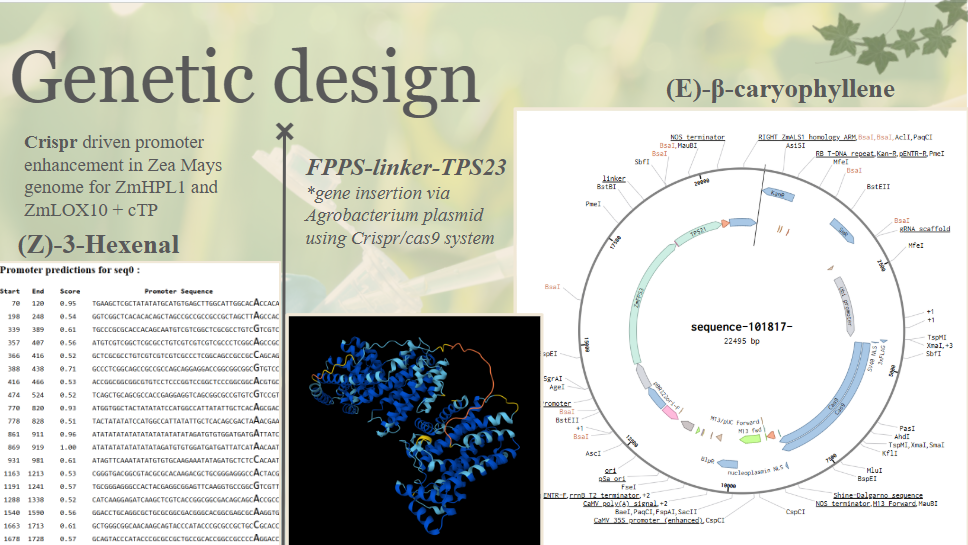
GLVs’ action has been defined as antimicrobial, gene upregulating, allelopathic and plant priming thus proving distinct techniques to deal with biotic and abiotic stress factors. Moreover, they are synthesized instantly after damage from released PUFA (polyunsaturated fatty acids) substrate from membrane phospholipid bilayer via the catalytic activity of lipoxygenase enzymes already present in the cytosol or chloroplast envelope-bound; one of the most notable examples is the type II 13-ZmLOX10 - main actor in (Z)-3-hexenal synthesis and ZmLOX12, capable of attaching to free membrane lipids using specific N-terminus PLAT domain. Ulteriorly, the lipid hydroperoxides are directly catalysed by representatives of the HPL family enzymes, such as hydroperoxide lipase1. They must be present in the cell at all times to assure immediate response to environmental factors via the synthesis of (mainly) (Z)-3-hexenal, which can spontaneously isomerize into (E)-2-hexenal or hydroxylated by aldehyde reductases with the usage of NADPH; all three GLVs possess antifungal, plant interspecific signaling priming and other pest repellent properties described further in this proposal. The genetic design is determined by Agrobacterium transported plasmid with a Crispr/cas9 system integrated with the purpose of ZmLOX10, ZmHPL1 promoters cleaving (knock-out) and replacement with higher-expression rate promoters and the addition of a cTP (chloroplast transit peptide) to lipoxygenase as in WT it is peroxisome-bound, this way limiting substrate diffusion and possible impact of JAs synthesis.
There are over 20’000 known terpenes, all synthesized by plants to deter pest damage and encourage symbiotic tritrophic relationships. Their synthesis depends on either the MVA or MEP metabolic pathway products: isopentenyl diphosphate (IPP) or dimethylallyl diphosphate (DMAPP), terpene precursors. Genetic design proposal is as well, based on plasmid insertion in embryonic Zea mays plant cells and tissue culturing until fully grown and experimentally-proofed metabolically stable GMO. Crispr/cas9 should insert FPPS linked to terpene synthase 23 native to WT teosinte and codon optimised for expression in globally grown maize via a flexible peptide chain, metabolically channeling substrate, avoiding interference with other cell systems and primarily to keep HMGR from self-downregulating its activity. The reasoning is the preference of a clearer, more efficient and robust metabolic engineering manner, as many undesired side effects can emerge from reckless genetic editing.