Week 7 HW: Genetic Circuts Part II: Neuromorphic Circuts
Assignment Part 1: Intracellular Artificial Neural Networks (IANNs)
- What advantages do IANNs have over traditional genetic circuits, whose input/output behaviors are Boolean functions?
IANNs allow for the detection of more gradient cellular signals and multiple signals being taken into account at once, which results in more nuanced outputs (not based on a single on/off like in traditional circuits).
- Describe a useful application for an IANN; include a detailed description of input/output behavior, as well as any limitations an IANN might face to achieve your goal.
Insulin/glucose detection and response might be a useful applictaion for an IANN. In those with diabetes, fluctuations are not binary and must be managed in both directions. An IANN could work better than a traditional genetic circuit to detect high/low levels of glucose and insulin and produce a proportional response. This is similar to the natural function of the pancreas. Limitations include the black box nature of IANNs, the risks of circuit failure, and immune responses.
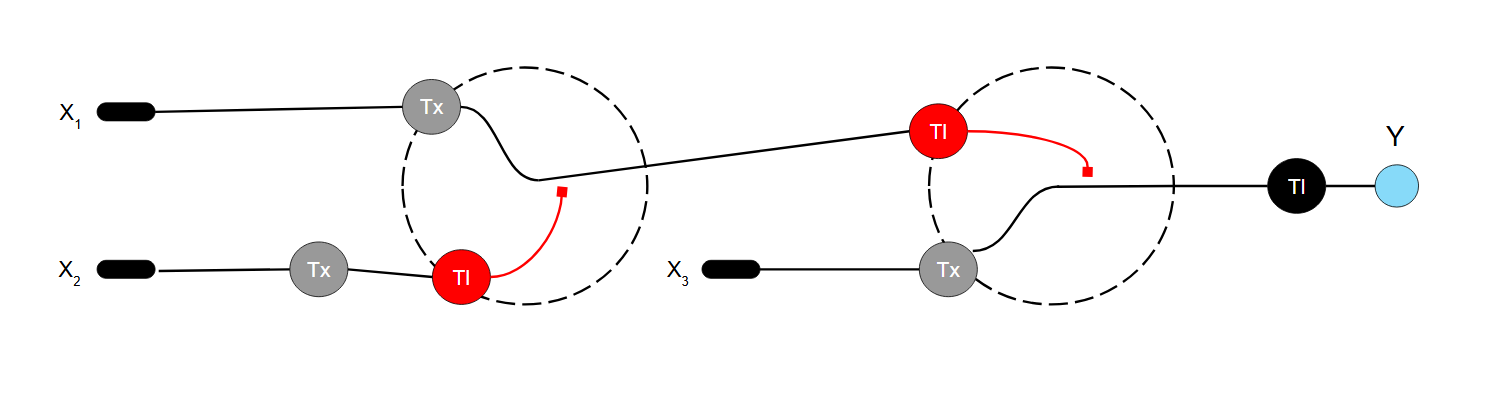
- Below is a diagram for an intracellular multilayer perceptron where layer 1 outputs an endoribonuclease that regulates a fluorescent protein output in layer 2. The X1 input is DNA encoding for the Csy4 endoribonuclease, the X2 input is DNA encoding for a protein that down regulates the Csy4 endoribonuclease mRNA, and the X3 input is DNA encoding for a fluorescent protein output whose mRNA is regulated by Csy4. Tx: transcription; Tl: translation.
Assignment Part 2: Fungal Materials
- What are some examples of existing fungal materials and what are they used for? What are their advantages and disadvantages over traditional counterparts?
Fungal materials include mycelium which is used for packaging, insulation, and construction material. They are more sustainable than their traditional counterparts, but require growing time and have lower durability (sensitivity to moisture, less mechanical strength).
- What might you want to genetically engineer fungi to do and why? What are the advantages of doing synthetic biology in fungi as opposed to bacteria?
Fungi would be a good possibility for a chassis for breaking down environmental toxins since they have enzymes that break down a lot of chemical structures and can be more resilent than bacteria in certain environments. As Eukaryotes, fungi can fold proteins with post-translational modifications, which gives them more synthetic biology possibilities.