Week 1 HW: Principles and Practices
Class Assignment — DUE BY START OF FEB 10 LECTURE
Question 01
First, describe a biological engineering application or tool you want to develop and why. This could be inspired by an idea for your HTGAA class project and/or something for which you are already doing in your research, or something you are just curious about.
According to the well-regarded popular science writer Matthew Cobb (2022), since the Asilomar conference in 1975, molecular biologists have been the vanguard in self-regulating when playing God. This means we refrain from conducting our research irresponsibly by deploying unnecessarily hazardous experimental methods. Alas, this also means that some of the most exciting genetic engineering is no longer done. Consider Dr. Oswald Avery’s transforming principle experiment. Blindly take a population of virulent pneumonia bacteria and feed them harmless kin until they lose their aggressive function and magically adapt into weak and indifferent pneumonia. Since Asilomar, this is indeed one kind of experiment that trustworthy principal investigators must abstain from. I get it, and still I contemplate. Wasn’t Avery the best of us, though? Between Schrodinger and Watson, Crick, and Franklin – Dr. Avery intuited DNA into existence with his transforming principle and used it effectively. Surely I didn’t name my oldest son after this man for nothing?
Unlike Dr. Avery, I am fortunate to be proposing my HTGAA 2026 project after the discovery of DNA and the Asilomar conference and the Once-in-a-Century Pandemic when mRNA Vaccines and CRISPR gene editing approaches were available. However, like Avery, with molecular biology, we can still take a population perspective to current wicked health problems. My first professional mentor, Dr. Paul Farmer, would often credit his milieu caring for the poorest of the poor as the center of his mission. Though I once aspired to that also, I now reflect that I am fortunate to just be an aspiring Molecular Biologist. In addition, when I marvel over everything that has been achieved since Avery, especially since the Human Genome Project and the advances of systems biology to synthetic biology, I see there are now viable alternatives in biological practice to help others and the living world.
This brings me to the project. I agree with Dr. Aubrey De Grey that biological aging is a vexing, immutable inequality in public health that must be solved. In fact, I am engaged in this research with my excellent Biology PHD mentors at North Carolina Agricultural and Technical State University (NCATSU), and one of them was on the team that first postponed senescence in Drosophila back when Star Wars movies were worthy of the hype.
Like Dr. De Grey, I believe exit velocity will be achieved in our lifetimes by engineering negligible senescence. The difference is that his model species are cohorts of robust, rejuvenated rodents centralized in a single laboratory, and I propose we develop many sites and open science approaches using goats instead. I also think that we will need to develop applied computational systems biology simulators (synthetic biology simulators too if they exist) and at the center of the approach needs to be the host-microbiome.
Why goats? They’re not even a monogastric species. Please hear me out.
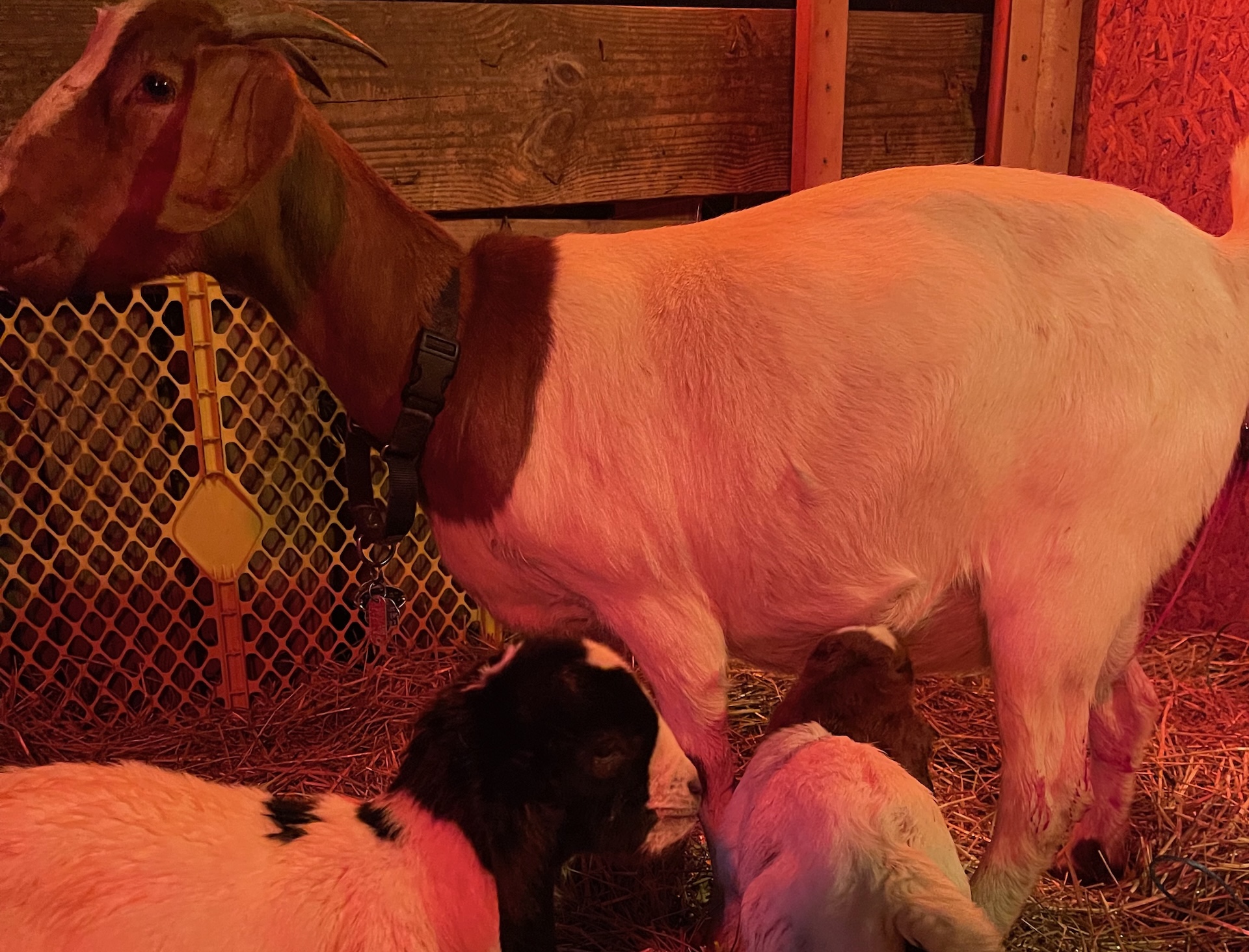
According to ChatGPT, the oldest recorded goat in the Guinness World Records is McGinty (22 years, 5 months). The buck was a Brition, he was male, and from a Pygmy breed. My understanding is that Pygmy goats were originally bred to feed large cats. This record was set in 2003 and I assume it hasn’t been challenged since. Although I never had the pleasure of meeting McGinty, the general indifference evident by his nefarious name and the dusting of a few social media posts and overall absence of life-history information makes plain that likely society gave up on even understanding goat longevity decades ago. This means that despite living among Homo sapiens for more than 10,000 years and sustaining us in every challenging environment on Earth, we still know more about goats’ genomic diversity than life history. That’s not a bad thing, though, because goats’ genomes and immune systems are as infinitely fascinating as our own.
In addition to not being popular, goats live a life preoccupied by parasites, predators, and food insecurity that is only moderately improved by domestication, let’s be honest. I often reflect on the goats I met in the Galapagos Islands – the first example of extreme biological environments. Goats are not indigenous to the Galapagos. They are migrants. They didn’t migrate there on their own volition, though – instead they brought in rafts and boats a Century ago, and still to this few re-wilded stragglers refuse to go extinct. In fact it’s hard to find an island in the Galapagos that doesn’t have a pile of goat skulls on it. I understand the issue is complicated but either way you land on the issue, it’s hard to deny that goats are specialists in acclimating in extreme environments. Ironically, it’s Charles Darwin’s theory of Natural Selection that I would like to structure the computational systems biology goat longevity simulator around, particularly using Neo-Darwinian genetics and postponement of senescence work by Rose, Muller, Luckinbill, and Graves.
I propose a Long Term Experimental Evolution (LTEE) study that leverages synthetic biology and local animal husbandry to study the role of gut microbiomes on cellular senescence in goats. I hypothesize that understanding diversity and abundance in genetic circuitry constituting biological signaling pathways between adaptive, senescence-resistant microbes and Metazoan somatic tissues will yield the putative attractor switches we need to cure cellular senescence and put apoptosis on a toggle switch. Theoretically, though I certainly don’t plan to achieve this in 10 weeks or morally at all. The point is that once you understand that one contingent evolutionary endosymbiotic event transformed an alpha-proteobacteria into the power center for every Metazoan cell that came after, and then the effects of the mitochondria on oxidative stress accumulation and stabilization. Inevitably, we can trust that the solution to aging in somatic cells will never again be an if question.
Endpoints I will be investigating are biologically and statistically significant variation in “aging” host and microbe genes identified through differential gene expression. The study will be a multigenerational LTEE for Synthetic Biology 101, targeting the bidirectional interactions between living goat genes and pathways and the microbiota in their gut. My stakeholders are the American Milk Goat Breeding Association and Nanopore, and every isolated mountain village or homesteader that is still alive because of their goat herd.
Question 2
Next, describe one or more governance/policy goals related to ensuring that this application or tool contributes to an “ethical” future, like ensuring non-malfeasance (preventing harm). Break big goals down into two or more specific sub-goals. Below is one example framework (developed in the context of synthetic genomics) you can choose to use or adapt, or you can develop your own. The example was developed to consider policy goals of ensuring safety and security, alongside other goals, like promoting constructive uses, but you could propose other goals for example, those relating to equity or autonomy.
GPG01: Explore synthetic biology for goat life history for a putative Mitocarta or SASP gene and phenotypic pathways that may be useful in future studies to bioengineer negligible senescence in goats.
GPG02: Integrate aim 1 gene with OMICs data using computational model to explore molecule mediated bidirectional interactions between somatic host cells and microbes in goat microbiomes.
GPG03: Consider systems-level synthetic biology interventions for extreme environments that support goat metabolism and gut microbiome health.
Question 3
Next, describe at least three different potential governance “actions” by considering the four aspects below (Purpose, Design,
Assumptions, Risks of Failure & “Success”). Try to outline a mix of actions (e.g. a new requirement/rule, incentive, or technical strategy) pursued by different “actors” (e.g. academic researchers, companies, federal regulators, law enforcement, etc). Draw upon your existing knowledge and a little additional digging, and feel free to use analogies to other domains (e.g. 3D printing, drones, financial systems, etc.). Purpose: What is done now and what changes are you proposing? Design: What is needed to make it “work”? (including the actor(s) involved - who must opt-in, fund, approve, or implement, etc) Assumptions: What could you have wrong (incorrect assumptions, uncertainties)? Risks of Failure & “Success”: How might this fail, including any unintended consequences of the “success” of your proposed actions?
CN Answer Purpose: Humans have been artifically selecting phenotypes in goats to consume for our benefit for more than 10,000 years. I understand goat meat, milk, and fiber are necessary for human differential reproductive success and maintenance. I actualy have a working goat farm. My purpose is not adjudicate my species, or rescue another, my intention is to use this incredible opportunity to make ammends to another population of Metazoans by helping my peers use synthetic biology to help goats live longer, higher quality lives. I do not pursue this idea to make a more profitable goat commodity either. In summation my reasoning at HW 1 is: because I know postponing senescence in Metazoans is possible and I care about the welfare of all goats, I want to help others and myself advance negligible senesence in goat somatic cells safely and humanly too. The changes I am proposing for my HTGAA 2026 project though are only to expand fair, accurate, timely, accessible open science data about goat life history and genetics, so through synthetic biology we can help goats live longer, healthier lives.
Design: Based on what I know about Synthetic Biology today, which is far less than I care to admit without embarassment on a public website. What is needed to make it “work” is Dr. Aubrey De Grey brillance, vision, ability and a sincere heart for animal welfare. Eventually a sustainable research enterprise plan will be useful to achieve endpoints, quality benchmarks, and safety standards. Let me make a clear point first though, all I am proposing at this juncture is cast out net for data, reel it in and evaluate what I find. This review will require oversite from experts – can anyone put me in contact with Dr. George Church or Dr. Aubrey De Grey?
Assumptions: I love this question because I am a scientist and I think no other discipline is more pragmatic than us when it comes to how we manage uncertainty. This is the crux about assumptions. Uncertainty is dangerous. Case and point, because I care about goat welfare and recognize I do not understand enough about Synthetic Biology interventions to expect what I don’t understand about goat life-history, physiology, and genetics I would never do anything to disrupt in vivo what I am learning to explain and make predictions about – that being the bioengineering of negligible senesence in goats.
Risks of Failure & “Success”: Here risk communication and management are key. I was an Epidemiologist for 20 years before going back to school. In Epidemiology although all Pandemics are orphans, a breech in prevention is always the root cause. I say this to explain why I am so proactive about preventing failure, especially when it comes to public health. Another example, is part of my PhD training was working in a Molecular Microbiology lab on a LTEE for NASA. Here a significant portion of the job is monitor and improve protocols and practice to minimize contamination, especially on a 100 day LTEE study.
Stakeholders: Registry of Standard Biological Parts (RSBP), SAB Biotherapeutics (SABBio), World Health Organization (WHO), Rocky Hill Farm in WV (RHFWV)
Rating Scale: ♛ Most Effective ♞ Moderately Effective ♟ Minimally Effective
| Does the option: | RSBP | SABBio | WHO |
|---|---|---|---|
| Explore synthetic biology for goat life history for a putative MitoCarta or SASP gene and phenotypic pathways that may be useful in future studies to bioengineer negligible senescence in goats. | |||
| • By reducing uncertainty about the life history of goats. | ♞ | ♞ | ♛ |
| • By reducing uncertainty about synthetic biology interventions for negligible senescence in goats. | ♞ | ||
| Integrate aim 1 gene with OMICs data using computational model to explore molecule mediated bidirectional interactions between somatic host cells and microbes in goat microbiomes. | |||
| • By mapping major biological signaling pathways where communication goes from goat somatic cell to -> GIT microbiome | ♞ | ||
| • By mapping major biological signaling pathways where communication goes from GIT microbe in GIT microbiome to goat somatic cell or system | ♞ | ||
| Consider systems-level synthetic biology interventions for extreme environments that support goat metabolism and gut microbiome health. | |||
| • By cataloging goat metabolites and microbiota and their interactions | ♟ | ♟ | ♟ |
| • By modeling seed to goat food webs for diverse local environments. | ♟ | ♟ | ♟ |
| • By writing an aspirational study protocol. | ♟ | ♟ | ♟ |
| Other considerations | |||
| • Minimizing costs and burdens to stakeholders | ♟ | ♟ | ♛ |
| • Feasibility? | ♟ | ♟ | ♟ |
| • Not impede research | ♛ | ♛ | ♛ |
| • Promote constructive applications | ♛ | ♛ | ♛ |
Assignment (Week 2 Lecture Prep) — DUE BY START OF FEB 10 LECTURE
In preparation for Week 2’s lecture on “DNA Read, Write, and Edit," please review these materials: Lecture 2 slides. The associated papers that are referenced in those slides. In addition, answer these questions in each faculty member’s section:
Homework Questions from Professor Jacobson:
Question 1
Nature’s machinery for copying DNA is called polymerase. What is the error rate of polymerase? How does this compare to the length of the human genome. How does biology deal with that discrepancy?
Based on the deck the error rate of polymerase is 1:10^6 or one error for every 1,000,000 base pairs. The size of the human genome according to the Molecular Biology of a Gene by Watson et al. (2007) the human genome is 3200 Mega base pairs in length which converts to 3,200,000,000 base pairs. Biology deals with the discrepancy through redundancy and replication forks moving from many different insertion sites at the same time. This way the redundancy offsets the discrepancy in the error rate. However errors still occur.
Question 2
How many different ways are there to code (DNA nucleotide code) for an average human protein? In practice what are some of the reasons that all of these different codes don’t work to code for the protein of interest?
There are two ways that I am aware of, Mass Spec and Edman Degredation. Both of these techniques identify amino residues that are synthesized as triple codons for a varity of lengths and structures. The total number of probable combinations is 3 codons multipled by 20 possible amino acids.
Homework Questions from Dr. LeProust: [Lecture 2 slides]
Question 1
What’s the most commonly used method for oligo synthesis currently?
Amplicon-Based Assays
Question 2
Why is it difficult to make oligos longer than 200nt via direct synthesis?
Turn-around time on results due to added complexity from higher Chimera rate, drop out rate, and uniformity constraints above 100nt
Question 3
Why can’t you make a 2000bp gene via direct oligo synthesis?
I couldn’t find an exact answer in the deck, but an article by Yin et al (2024) cited below, which is relatively up-to-date, reports that the current length record for direct oligo synthesis is between 800 mer - 1728 mer. This alone is an accomplishment since authors explain that the rate of errors increases significantly above 100nt. The article also discusses the original 1000nt ceiling due to the steric hindrance of the substrate macromolecule. Please forgive my answer being a little choppy; I am still learning how to converse in this language.
Yin, Y., Arneson, R., Yuan, Y., and Fang, S. (2025). Long oligos: Direct chemical synthesis of genes with up to 1728 nucleotides. Chemical Science, 16(4), 1966–1973. https://doi.org/10.1039/D4SC06958G
Homework Question from George Church: [Lecture 2 slides]
Choose ONE of the following three questions to answer; and please cite AI prompts or paper citations used, if any.
Question 1
[Using Google & Prof. Church’s slide #4] What are the 10 essential amino acids in all animals and how does this affect your view of the “Lysine Contingency”?
Question 2
[Given slides #2 & 4 (AA:NA and NA:NA codes)] What code would you suggest for AA:AA interactions?
Here I think you are asking me to provide an alternative code for the foundation of life? The irony is that is why I am here, I want you all to teach me how to rewrite code for AA:AA interactions. I know this because in preparing my answer I ran AA:AA interactions by AI for a second oppinion. My prompt was “what do you think Dr. George Church means by code for AA:AA interactions”. AI tells me that this code may need to demonstrate how sequences of amino acids influence physical interaction rules, which I interpret to be first order principles. Therefore what code would I suggest to influence AA:AA interactions that are able (if AI’s tip is correct) to perturb first order principles. My code as Dr. Nick Lane would say, should be efficient at turning the feedback loops of matter into biophysical waves of energy. In further prepartion I would turn to my greatest advisors in Natural Selection adaptation, bacteria and their metabolic motifs in Metazoans. I would need a coding system that respects phylogeny and doesn’t immagine I could ever devise a coding system more ingenious than the Krebs cycle or the molecularly machinery behind the deprotonation of hydrogen by Complex 5 in the Electron Transfer Chain. Still it’s a fascinating thought experiment if nothing else. To this end, I used your Acevodo-Rocha et al. (2016) paper and AI to find the Poliseno et al. (2024) paper and though I am not up-to-date on this team I do suspect there is an Epidemiologist among them, because their example of concordant and discordant pairing of coding and noncoding functions is what my coding system would be based on to optimize around the canonical rigidity of present AA:AA interaction.
Acevedo‐Rocha, C. G., & Budisa, N. (2016). Xenomicrobiology: A roadmap for genetic code engineering. Microbial Biotechnology, 9(5), 666–676. https://doi.org/10.1111/1751-7915.12398
Poliseno, L., Lanza, M., & Pandolfi, P. P. (2024). Coding, or non-coding, that is the question. Cell Research, 34(9), 609–629. https://doi.org/10.1038/s41422-024-00975-8
[(Advanced students)] Given the one paragraph abstracts for these real 2026 grant programs sketch a response to one of them or
devise one of your own:
https://arpa-h.gov/explore-funding/programs/boss https://www.darpa.mil/research/programs/smart-rbc https://www.darpa.mil/research/programs/go
Assignment (Your HTGAA Website) — DUE BY START OF FEB 10 LECTURE
Begin personalizing your HTGAA website in https://edit.htgaa.org/, starting with your homepage — fill in the template with
information about yourself, or remove what’s there and make it your own. Be creative! As with all assignments in HTGAA, be sure to
write up every part of this Homework on your HTGAA website in order to receive credit.
Important
For this week only, once your homework is complete and written up on your HTGAA website (and you’ve checked your published website at pages.htgaa.org and are happy with it), fill out the Homework 1 Completion form which David emailed out just after Lecture 1. This Google form expresses your interest in continuing with the course; without it you will not be accepted in HTGAA!