Assignment: DNA Assembly
Protocol and Study Questions
What are some components in the Phusion High-Fidelity PCR Master Mix and what is their purpose?
A proprietary gold standard heat-stable DNA polymerase alternative to Taq reagent synthesized and sold by Thermo Fisher Scientific. Unlike Taq which was isolated from thermophilic bacteria, Phusion emulates an archaea-based enzyme that evolved in the hydrothermal vents from extremeophile species. They function as DNA polymerases essentially in a form biomimickry with minimal replication error. The purpose of Phusion is to amplify target DNA sequences in the PCR protocol. Phusion PCR is more expensive but worth the investment to increase the accuracy of the run.
What are some factors that determine primer annealing temperature during PCR?
I don’t know if a question will formally cover this, but PCR methods include initialization, annealing, and extension. Heat is first applied in the initialization step of a hot start PCR protocol. There are two temperature modalities with a typical run: 205 °F or 208 °F. Phusion polymerase would be a proper reagent for a hot start PCR run. The next phase, denaturation, again includes a 201-208 °F step to separate double-stranded DNA templates by breaking hydrogen bonds. The next temperature cycle is the annealing step where temperature drops to 122–149 °F. A key factor with temperature annealing is to be exact with temperature and time to avoid an off-target reaction mixture.
There are two methods from this class that create linear fragments of DNA: PCR, and restriction enzyme digests. Compare and contrast these two methods, both in terms of protocol as well as when one may be preferable to use over the other. How can you ensure that the DNA sequences that you have digested and PCR-ed will be appropriate for Gibson cloning?
Fundamentally, the first difference between restriction enzymes and PCR is the inventor. Bacteria invented restriction enzymes to decrease the size of their individual single chromosome genome through Natural Selection to adapt to environmental niches faster. A professor once explained it to me like the traveller who embarks into the desert. Why would they carry junk DNA they do not need when they can prioritize every ounce of storage space for genes they will need to survive in the desert? PCR is an entirely different angle. Now we, the scientists, are using a laboratory machine to initialize, anneal, and extend sections of DNA we are interested in replicating experimentally. In fact, it is the exact opposite mechanism, like the continuum between divestment and investment of DNA. In terms of protocols, restriction enzymes are more of a puzzle based on the actual information available genetically, and PCR can be applied to any segment of DNA anywhere on the genome that can be extracted. Additionally, there is a quality differential between approaches in the input DNA.
How does the plasmid DNA enter the E. coli cells during transformation?
Bacteria naturally use three methods to transfer genetic material, including conjugation, transduction, and transformation. Conjugation requires direct contact. Transduction uses phages as intermediates. Transformation occurs in nature when bacteria incorporate genetic material from dead bacteria in the environment. Scientists have learned how to leverage bacterial transformation using heat shock and electroporation.
Describe another assembly method in detail (such as Golden Gate Assembly (GGA))
Golden Gate is one of my favorite parks in Cali and GGA is a new (circa 1996) assembly method detailed by New England Biolabs. Key components are Type IIS restriction enzymes, T4 DNA Ligase, the “backbone”, and Transcription Activator Like Effectors (TALEs). Conceptually, GGA is revolutionary because it unites restriction enzymes and PCR amplicon assembly in an expedited way. The workflow for GGA has a two-modality kit for either BsaI or BsmBI directed assemblies, both are restriction enzymes with recognition sites that generate 4-bp overhangs when cut. The they have different recognition sites, BsaI is for standard assembly and uses GGTCTC and BsmBI is a hierarchical system mod that uses CGTCTC.
Explain the other method in 5 - 7 sentences plus diagrams (either handmade or online).
An alternative to GGA is Gibson Assembly. In this approach:
- Step01: The homologous DNA assembly fragments must overlap by 20-40 bps.
- Step02: The reaction mix with 5’ exonuclease is applied which chews back 5’ ends of both fragments.
- Step03: The matching x overlapping ends then anneal or base pair spontaneously which aligns the joined fragments in the correct order.
- Step04: The addition of a high-fidelity DNA polymerase (i.e., Phusion) then extends the missing bases to produce the 3’ ends.
- Step05: The Taq DNA ligase is then applied to fill in the gaps, and with that all fragmentary assembles continuous double-stranded DNA plasmid or linear construct.
Model this assembly method with Benchling or a similar tool!
Gibson Protocol in Benchling GibAssemb
Adding Magenta Plasmid MagentaPlasmidDemo
Repeating a similar Benchling workflow to BioClub Japan teammate Nourelden Rihan's notebook. Not only is Dr. Rihan a natural leader of excellence in the work but his formatting makes me wish I were Egyptian.
In the workflow is to stich a GFP Protein to a plasmid. I tried the ENA route with a different vector and GFP ideal for mitochondrial superfluorescence imaging. I then took a different course.
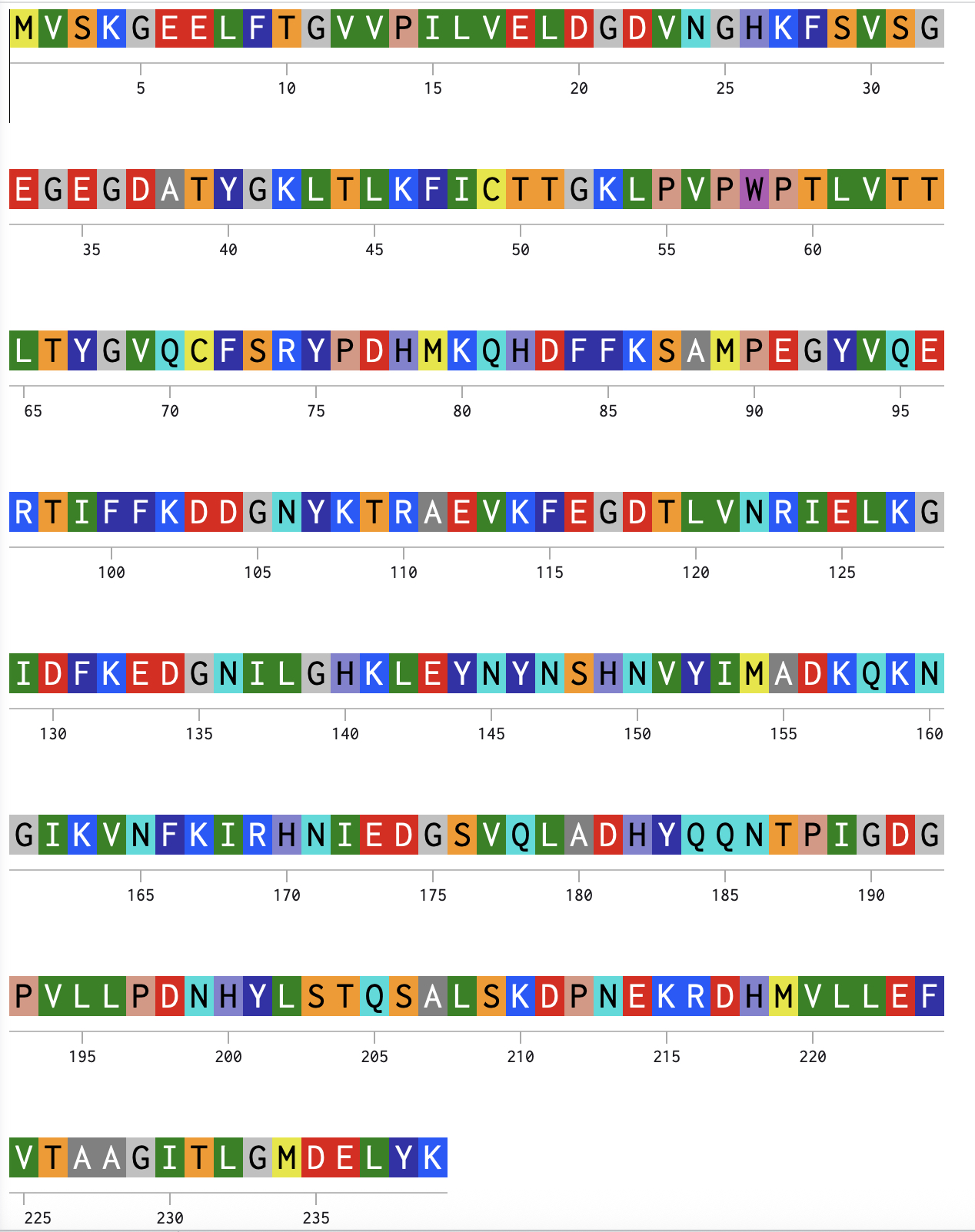
- First, I instead start with a eGFP protein without any additional fragments attached to it– shown here as U55761_EGFP_CDS translated into AA sequence for better artistic effect.
U55761_EGFP_CDS
Properties
Position 1-239
Summary MVSK…ELYK 239 AAs
Molecular weight 26941.36 Da
Isoelectric point (pI) 5.58
Extinction coefficient
Cys fully reduced 21890.00 M-1cm-1
Abs 0.1% (1 g/l) 0.813
Cys fully oxidized 22015.00 M-1cm-1
Abs 0.1% (1 g/l) 0.817
Instability index 29.06 (stable)
Amino Acid Frequencies
Amino acid Count
Ala A 8 3.3%
Arg R 6 2.5%
Asn N 13 5.4%
Asp D 18 7.5%
Cys C 2 0.8%
Gln Q 8 3.3%
Glu E 16 6.7%
Gly G 22 9.2%
His H 9 3.8%
Ile I 12 5.0%
Leu L 21 8.8%
Lys K 20 8.4%
Met M 6 2.5%
Phe F 12 5.0%
Pro P 10 4.2%
Ser S 10 4.2%
Thr T 16 6.7%
Trp W 1 0.4%
Tyr Y 11 4.6%
Val V 18 7.5%
Pyl O 0 0.0%
Sec U 0 0.0%
Net Charge
pH Charge
4 22.49
4.5 13.06
5 5.50
5.5 0.67
6 -3.06
6.5 -5.96
7 -7.70
7.5 -8.63
8 -9.31
8.5 -10.37
9 -12.81
9.5 -17.98
10 -26.38
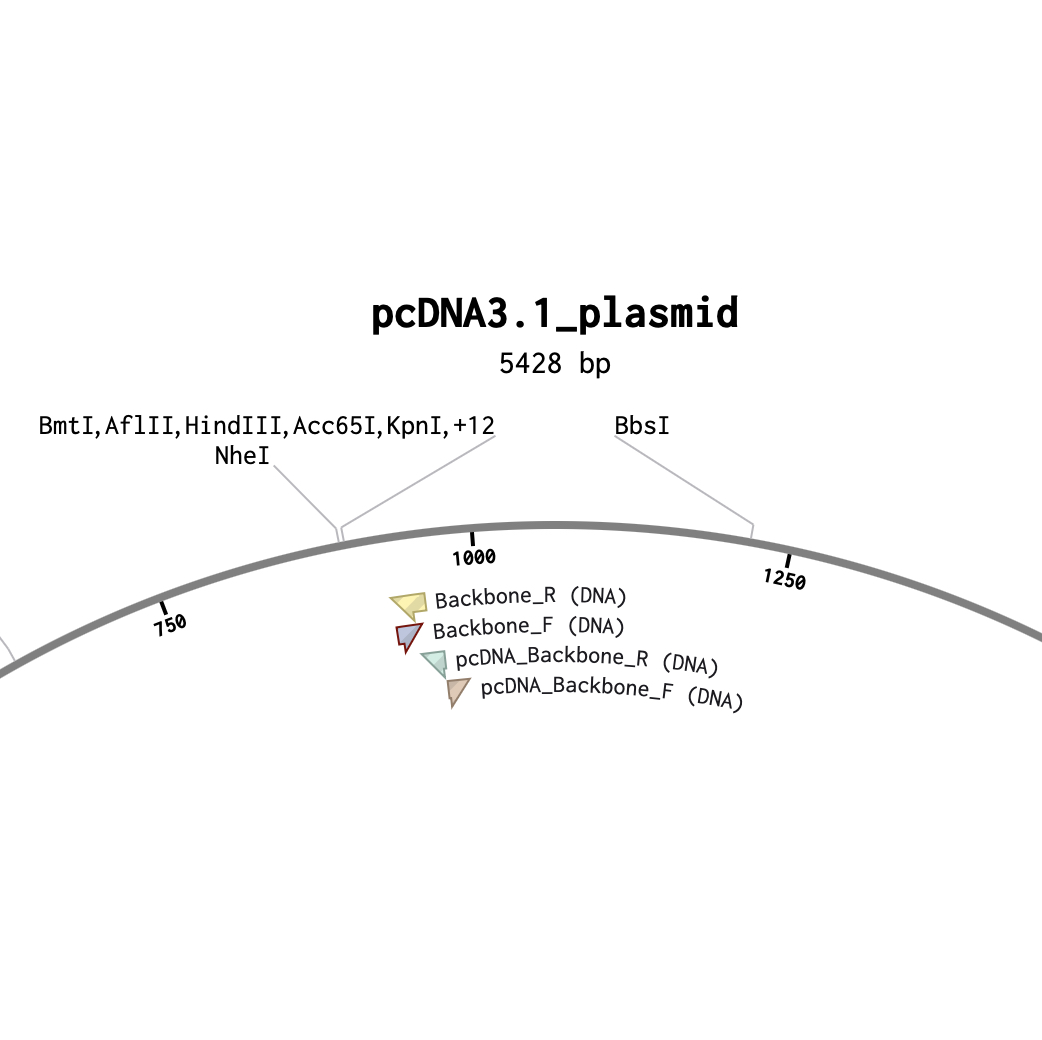
After wrestling with my pre-loaded mito_mGFP plasmid, I used ChatGPT to find the simplest, vanilla, mammalian expression vector with CMV promoter and selectable marker possible. Mission Accomplished – not quite, many more steps to follow after this. Also shown in this screenshot from the Benchling account is the primers that I had to create to guide the Gibson Assembly to follow.
pcDNA31_plasmidwREIIandPCRPrimers
Assignment: Asimov Kernel
Protocol and Study Questions
Create a Repository for your work
Create a blank Notebook entry to document the homework and save it to that Repository
Explore the devices in the Bacterial Demos Repo to understand how the parts work together by running the Simulator on various examples, following the instructions for the simulator found in the “Info” panel (click the “i” icon on the right to open the Info panel)
Create a blank Construct and save it to your Repository
Recreate the Repressilator in that empty Construct by using parts from the Characterized Bacterial Parts repository
Search the parts using the Search function in the right menu
Drag and drop the parts into the Construct
Confirm it works as expected by running the Simulator (“play” button) and compare your results with the Repressilator Construct found in the Bacterial Demos repository
Document all of this work in your Notebook entry - you can copy the glyph image and the simulator graphs, and paste them into your Notebook
Build three of your own Constructs using the parts in the Characterized Bacterials Parts Repo
Explain in the Notebook Entry how you think each of the Constructs should function
Run the simulator and share your results in the Notebook Entry
If the results don’t match your expectations, speculate on why and see if you can adjust the simulator settings to get the expected outcome
Resources
- Primer Design: HTGAA’s Supplement to Gibson Assembly Recitation
- NEB’s (New England Biolabs) video Introduction to Gibson Assembly
- NEB’s (New England Biolabs) explanation & protocols for Gibson Assembly®