Week 6 HW: Genetic Circuits Part 1
HTGAA Week 6 Genetic circuit part 1
DNA Assembly
1.What are some components in the Phusion High-Fidelity PCR Master Mix and what is their purpose?
The Phusion High-Fidelity PCR Master Mix is a concentrated DNA polymerase solution containing a high fidelity reaction buffer, MgCI (Magnesium chloride) and dNTPs ( deoxynucleoside triphosphates). It is used in PCR as polymerase solution can help fill the gaps in the sequence cloned during Gibson or HiFi assembly. The reaction buffer serves as a stabilizer and MgCI and dNTPs serve as building blocks for PCR. Reference list BioChain Institute Inc. (2024). Biochain Institute Inc. [online] Biochain Institute Inc. Available at: https://www.biochain.com/blog/using-dntp-in-polymerase-chain-reaction-pcr/. New England Biolabs (2026). [online] Neb.com. Available at: https://www.neb.com/en-gb/products/m0531-phusion-high-fidelity-pcr-master-mix-with-hf-buffer [Accessed 23 Mar. 2026].
2.What are some factors that determine primer annealing temperature during PCR? The primer annealing temperature during PCR will be determined by the melting temperature ( Tm) of primers and according to the primer design guidelines in the protocol the binding region 18-22 bp at a 52-58°C Tm allows for primers pairs to have 5°C between each other.
3.There are two methods from this class that create linear fragments of DNA: PCR, and restriction enzyme digests. Compare and contrast these two methods, both in terms of protocol as well as when one may be preferable to use over the other.
The aim of PCR is to amplify a specific DNA sequence in order to duplicate it a large amount of times and restriction enzyme digests uses enzymes to cut DNA of a chosen sequence sites into smaller sequence fragments. The PCR allows to copy the DNA while the restriction enzyme digest allows to cut DNA (insert and vector, so the plasmid) to create compatible fragment sides enabling better ligation, they are often used as a combination in cloning. PCR uses heat-stable DNA polymerase and primers in order to stimulate a DNA replication and the restriction enzyme digests uses endonuclease enzymes to break phosphodiester bonds.
Restriction enzyme digests tend to be the preferred method as it is an easier protocol, it is a single step incubation protocol and less machinery. PCR requires precise primers, binders, restriction digests and temperatures, there are a lot more steps to the protocol and a slight lack of precision in any part of the protocol or the media and the PCR might be incorrect. However, the PCR does produce very large amounts of DNA sequencing.
Reference list BBC (2019). Replication of DNA - Revision 3 - Higher Biology - BBC Bitesize. [online] BBC Bitesize. Available at: https://www.bbc.co.uk/bitesize/guides/zrwhrj6/revision/3. Biolabs, N.E. (n.d.). Restriction Enzyme Digestion | NEB. [online] www.neb.com. Available at: https://www.neb.com/en-gb/applications/cloning-and-synthetic-biology/dna-preparation/restriction-enzyme-digestion. Biology LibreTexts. (2024). 13.4: Lab Technique - Restriction Digest of DNA. [online] Available at: https://bio.libretexts.org/Courses/West_Los_Angeles_College/Biotechnology/13%3A_Biotechnology_Lab_Protocols/13.04%3A_Lab_Technique_-_Restriction_Digest_of_DNA. Nimrat Khehra, Padda, I.S. and Swift, C.J. (2023). Polymerase Chain Reaction (PCR). [online] Nih.gov. Available at: http://ncbi.nlm.nih.gov/books/NBK589663/. Pray, L.A. (2008). The Biotechnology Revolution: PCR and Cloning Expressed Genes | Learn Science at Scitable. [online] www.nature.com. Available at: https://www.nature.com/scitable/topicpage/the-biotechnology-revolution-pcr-and-the-use-553/. www.thermofisher.com. (n.d.). Restriction Enzyme Key Considerations - US. [online] Available at: https://www.thermofisher.com/uk/en/home/life-science/cloning/cloning-learning-center/invitrogen-school-of-molecular-biology/molecular-cloning/restriction-enzymes/restriction-enzyme-key-considerations.html.
4.How can you ensure that the DNA sequences that you have digested and PCR-ed will be appropriate for Gibson cloning? To make sure a DNA sequence is suitable for the Gibson cloning one can verify that the DNA sequence has homologous primers and high-fidelity amplification in order to check that there are overlapping homologous sequences which will allow for a seamless fragment assembly. Primer overlaps should have 20-40 homologous bp, preferably with a higher ratio of GC amino acids which favor stable annealing, between fragments an overlap of 15-30 bp is sufficient but the more there are fragments the longer the overlap sections should be.
Reference list addgene (n.d.). Addgene: Gibson Assembly Protocol. [online] www.addgene.org. Available at: https://www.addgene.org/protocols/gibson-assembly/. in (2025). Gibson Assembly 101: Expert Cloning Tips You Need to Know. [online] Life in the Lab. Available at: https://www.thermofisher.com/blog/life-in-the-lab/gibson-assembly-101-expert-cloning-tips-you-need-to-know/. New England Biolabs (2026). [online] Neb.com. Available at: https://www.neb.com/en-gb/tools-and-resources/feature-articles/gibson-assembly-building-a-synthetic-biology-toolset?srsltid=AfmBOorYZvusvriYBQ42MB0hdmuZMUJwiQMydK3EMtPPUCWN64IfcCDm [Accessed 23 Mar. 2026].
5.How does the plasmid DNA enter the E. coli cells during transformation? There are two main ways for E. coli to enter the cells during transformation: On one hand, a heat shock, a chemical transformation where heating the cell and DNA mixture abruptly forms a thermal current allowing to shape temporary pores in the bacterial cell letting the plasmid pass through. On the other hand, electroporation, creating those same pores in the bacterial cell for the plasmid to pass through but this time using high electrical voltage.
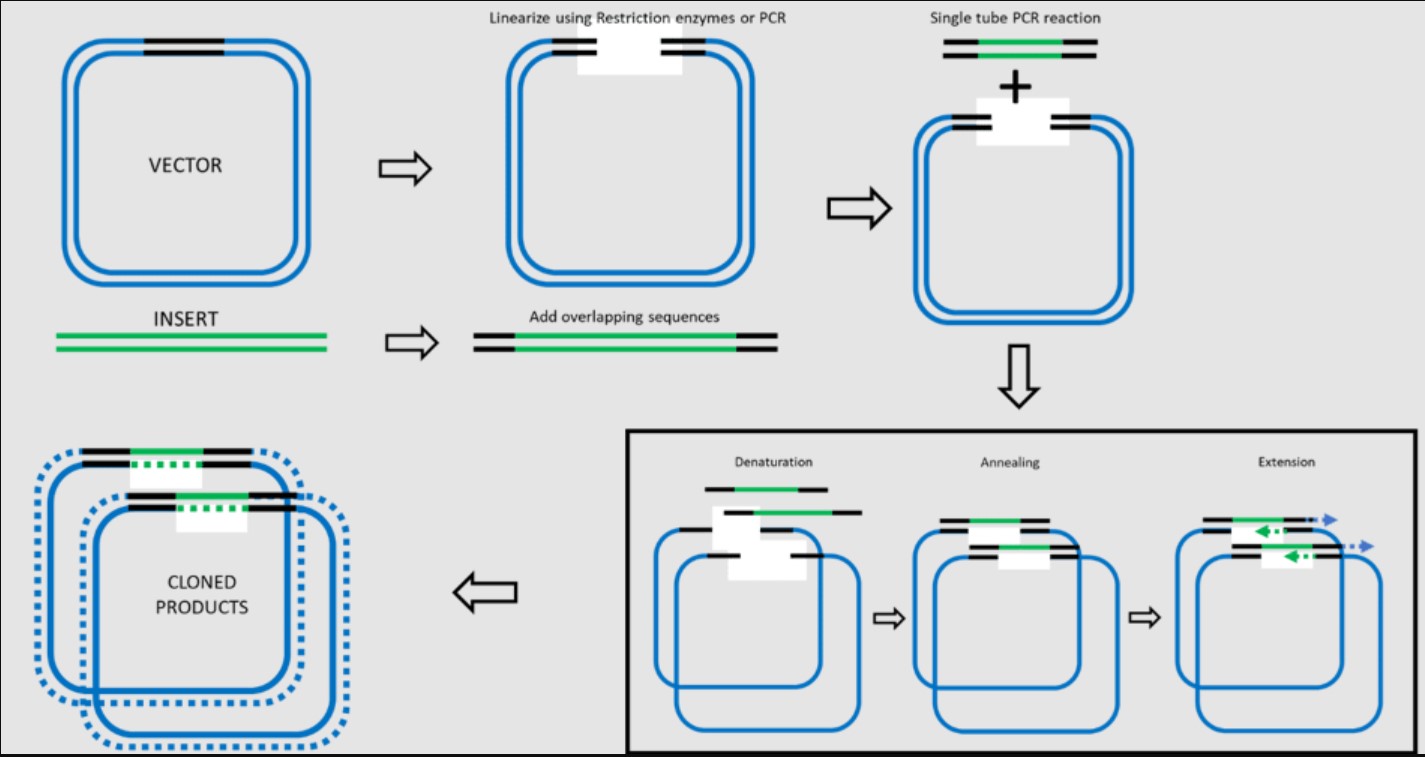
6.Describe another assembly method in detail (such as Golden Gate Assembly) Explain the other method in 5 - 7 sentences plus diagrams (either handmade or online).
Another DNA assembly method is the CPEC, Circular Polymerase Extension Cloning, an in vivo and in vitro technology that uses PCR to amplify and extend and overlap sequence fragments. Due to its overlapping quality it allows for inserts or assembly without using restriction enzymes. This technology relies on homologs, the fragments are first amplified in PCR with homologous ends between them, the homologous region give the possibility to anneal and extend each section by the DNA polymerase through a second PCR round, then the DNA can be recombined creating larger DNA sequences which can then be introduced to the plasmid.
Reference list Bitesize Bio. (2019). CPEC– a Quick and Inexpensive Cloning Strategy. [online] Available at: https://bitesizebio.com/44113/cpec-a-quick-and-inexpensive-cloning-strategy/. Chao, R., Yuan, Y. and Zhao, H. (2014). Recent advances in DNA assembly technologies. FEMS Yeast Research, p.n/a-n/a. doi:https://doi.org/10.1111/1567-1364.12171.
Asimov Kernel N/A as we were not given access