Week 3 HW: Lab Automation
Week 3: Lab Automation
Student: Constantin Convalexius
Course: HTGAA Spring 2026
Location: Vienna, Austria
Part 1: Python Script for Opentrons Artwork
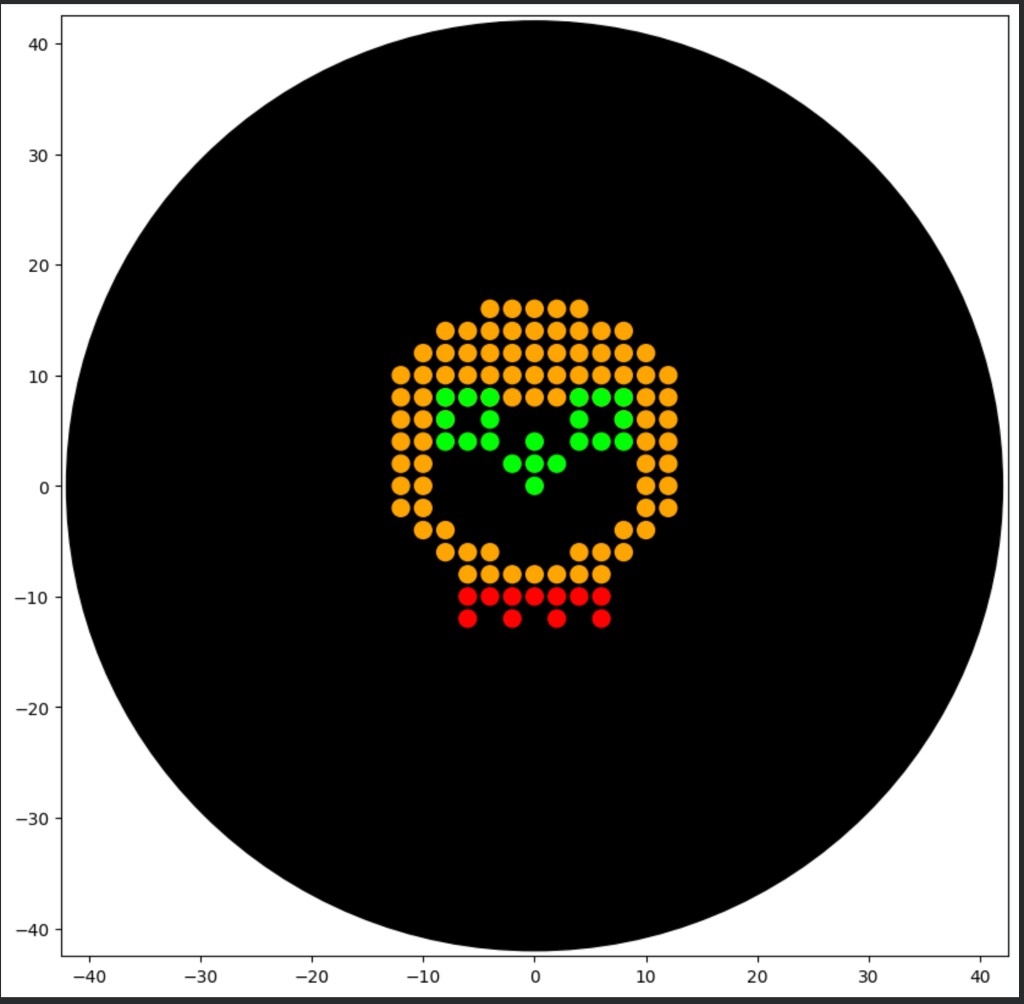
I created and tested an Opentrons Python script that generates a dotted skull design for gel art.
1.1 What I completed
- Designed a skull artwork concept and implemented it in Python for Opentrons (
apiLevel 2.20). - Used multi-color patterning with helper functions for safer droplet detachment (
dispense_and_detach). - Simulated the protocol in Colab and fixed simulator compatibility issues (e.g., replacing direct
protocol.commentcalls with mock-safe logging logic). - Generated a higher-resolution version of the skull by increasing point density.
Submission status
- Artwork script: completed.
- Opentrons skull design image: completed.
- I will submit the Python script for robot execution as required by the course submission form.
1.2 Proof of Opentrons skull artwork
Part 2: Post-Lab Questions
2.1 Published paper using Opentrons/automation for novel biology
Paper selected:
Herzog AE, Zheng S, Warner KA, Vanini JV, Somayaji R, Johnson MR, et al.
“Bmi-1 inhibition sensitizes head and neck cancer stem cells to cytotoxic chemotherapy.”
Translational Oncology. 2026;63:102603. doi:10.1016/j.tranon.2025.102603.
Why this paper is a strong example of lab automation
This study uses automation directly in a cancer-biology workflow, including an Opentrons OT-2 liquid handling robot to standardize and scale an automated orosphere assay in 96-well plates. The authors investigate whether inhibiting Bmi-1 (genetically and pharmacologically with PTC596/unesbulin) can reduce chemotherapy-driven cancer stemness in head and neck squamous cell carcinoma (HNSCC).
Main findings (concise)
- Platinum chemotherapies (cisplatin/carboplatin) increase stem-like tumor cell populations.
- Bmi-1 inhibition blocks this chemotherapy-induced stemness increase.
- Bmi-1 inhibition reduces self-renewal readouts (orosphere formation).
- Bmi-1 inhibition suppresses protective DNA-damage response signaling and IL-6R/STAT3 pathway activation.
- In vivo xenograft data supports combining Bmi-1 inhibition with conventional chemotherapy.
Why this is biologically novel and relevant
The key innovation is not only biological (targeting cancer stemness to overcome resistance) but also methodological: integrating an affordable, programmable OT-2 into a translational cancer workflow enables reproducible treatment delivery and phenotyping at scale. This demonstrates how benchtop automation can move from “pipetting convenience” to hypothesis-driven oncology research.
2.2 What I intend to do with automation tools for my final project
My project direction is to use automation for a small combinatorial therapeutic screen focused on therapy resistance biology.
Proposed project concept
Automate a matrix experiment testing combinations of:
- Cytotoxic drug condition (e.g., cisplatin dose levels),
- Pathway-modulating small molecule condition (e.g., Bmi-1/STAT3-related perturbation),
- Optional timing condition (simultaneous vs. staggered treatment).
The readout would be a plate-based viability/survival proxy and, if feasible, a stemness-related assay endpoint.
Why automation is essential
- Precise liquid handling across many conditions and replicates.
- Lower human pipetting variability.
- Easier reproducibility for repeated screens.
- Structured experimental logs that support downstream analysis.
Planned automation workflow (high-level pseudocode)
Potential hardware/software components
- Opentrons OT-2 for treatment dispensing.
- Python protocol files for condition mapping and transfer plans.
- Optional custom 3D-printed holder to stabilize specialized plate formats if needed.
- Optional cloud-lab extension for higher-throughput follow-up experiments.
AI Disclosure
I used AI tools to assist with coding, debugging, and documentation:
- Cursor assistant for protocol debugging, formatting, and writeup polishing.
- AI coding assistance in Colab/Cursor to refine Opentrons script structure and simulation compatibility.
All final scientific framing, selection of paper, and project direction were reviewed and approved by me.