Week 7 HW: Genetic Circuits II
What advantages do IANNs have over traditional genetic circuits, whose input/output behaviors are Boolean functions?
- Traditional genetic circuits are boolean, like the question says. Therefore, they can be either ‘on’ or ‘off’ and only can compute boolean functions. Limiting the cell’s computational ability. IANNs are different in the way that they produce continuos signals, they can take in multiple inputs. I think the benefits of IANNs over conventional genetic circuits are synonymous to the benefits of a neural network over a hard-coded solution. IANNs can react to novel inputs whereas the conv. genetic circuits can only respond to the input they were designed for.
Describe a useful application for an IANN; include a detailed description of input/output behavior, as well as any limitations an IANN might face to achieve your goal.
- A cell engineered with an IANN to continuously monitor the biomarkers of active demyelination, which is a common symptom in grave condtions like MS or Alzheimers. The input could be the MBP (myelin basic protein) fragment concentration (direct readout of myelin dmg) , neurofilament light chain (direct readout of axon dmg) and local ROS (indicator of inflammatory stress) and the output could be a fluoroscent compound or a peptide showing the stage of demyelination.
Below is a diagram depicting an intracellular single-layer perceptron where the X1 input is DNA encoding for the Csy4 endoribonuclease and the X2 input is DNA encoding for a fluorescent protein output whose mRNA is regulated by Csy4. Tx: transcription; Tl: translation. Draw a diagram for an intracellular multilayer perceptron where layer 1 outputs an endoribonuclease that regulates a fluorescent protein output in layer 2.
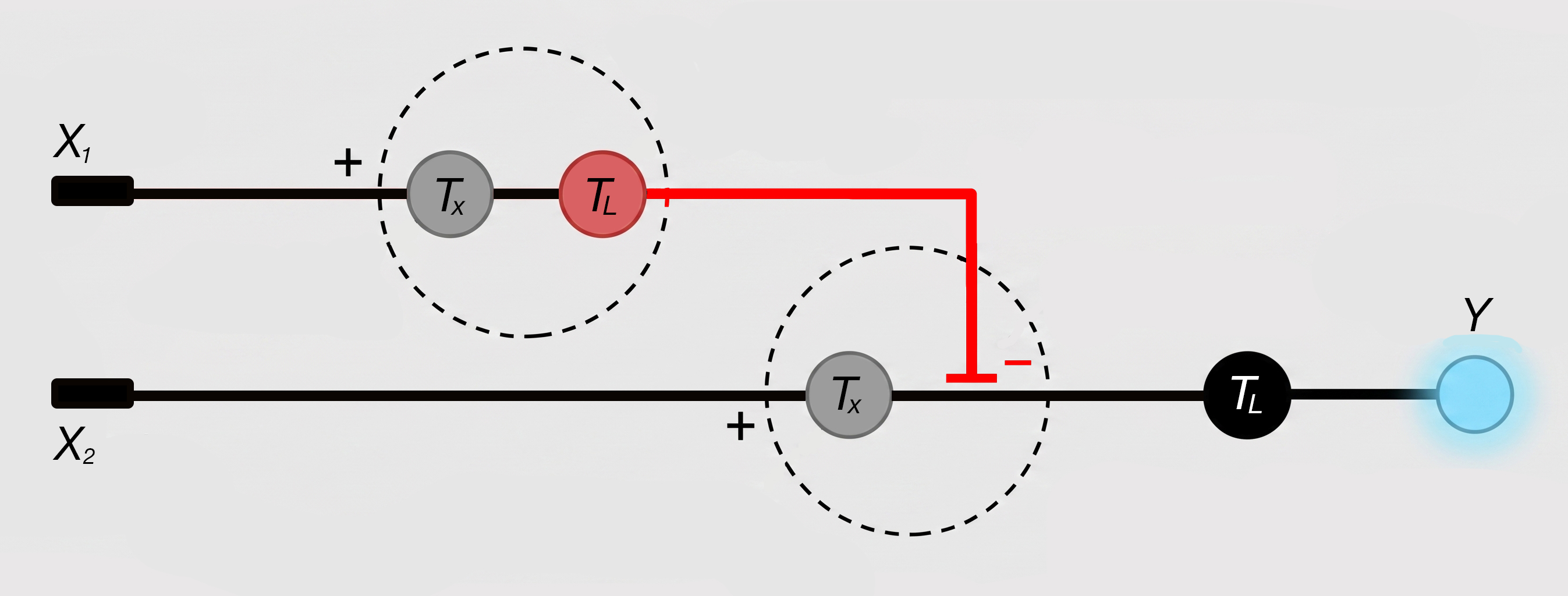
Diagram made in Photoshop.
Assignment 2
What are some examples of existing fungal materials and what are they used for? What are their advantages and disadvantages over traditional counterparts?
- Some existing fungal materials are mycelium composites that use dense hyphal network of fungi like Ganoderma grown on agricultural waste to form rigid, foam like structures. They are used for packaging and thermal insulation. The advantages they have are that they are fully biodegradable, the production method is carbon sequestering and they can be grown into arbitrary molds with minimal energie. The disadvantages are that they have lower compressive strength & impact resistance than plastics. They are also very sensitive to moisture and the growth conditions need to sterile which can be tough to maintain in large scale operations. There are also mycoprotein foods that are used as meat substitutes. They are nutritionally well built and do far fewer pollution and can be produced continuously in bioreactors. Fungi have also been used to produce dyes and pigments. They have lower color permanence than their synthetic counterparts.
What might you want to genetically engineer fungi to do and why? What are the advantages of doing synthetic biology in fungi as opposed to bacteria?
- The reasonable and next best thing to do would be to engineer fungus to produce materials with more tensile strength and water resistance than the current ones. Fungi can be used as biosensors to express certain colored reporters in responses to environmental pollution. The advantages of fungi over bacteria are that they are eukaryotes therefore closer to human cells. They possess the post-translational modification machinery that is need to produce complex mammalian proteins. Fungi naturally forms large 3D structures making it suitable for large scale production.