Week 11 HW: Building Genomes
Part A: The 1,536 Pixel Artwork Canvas | Collective Artwork
I was unable to contribute a pixel due to access constraints with the submission window. The activity was fun overall, it was interesting to see how everyone was trying to make something definitive, only to be overrun by somebody else. Seeing a timelapse of it all in the Review meeting was intriguing. If I had gotten a chance to contribute, I definitely would have just tried to support an existing effort at making something, some people tried to disrupt the existing artworks but it was futile for the most part. Next year maybe if each node had a part of the canvas, then there would be fun things created as the nodes can then plan on what is to be made.
Part B: Cell-Free Protein Synthesis | Cell-Free Reagents
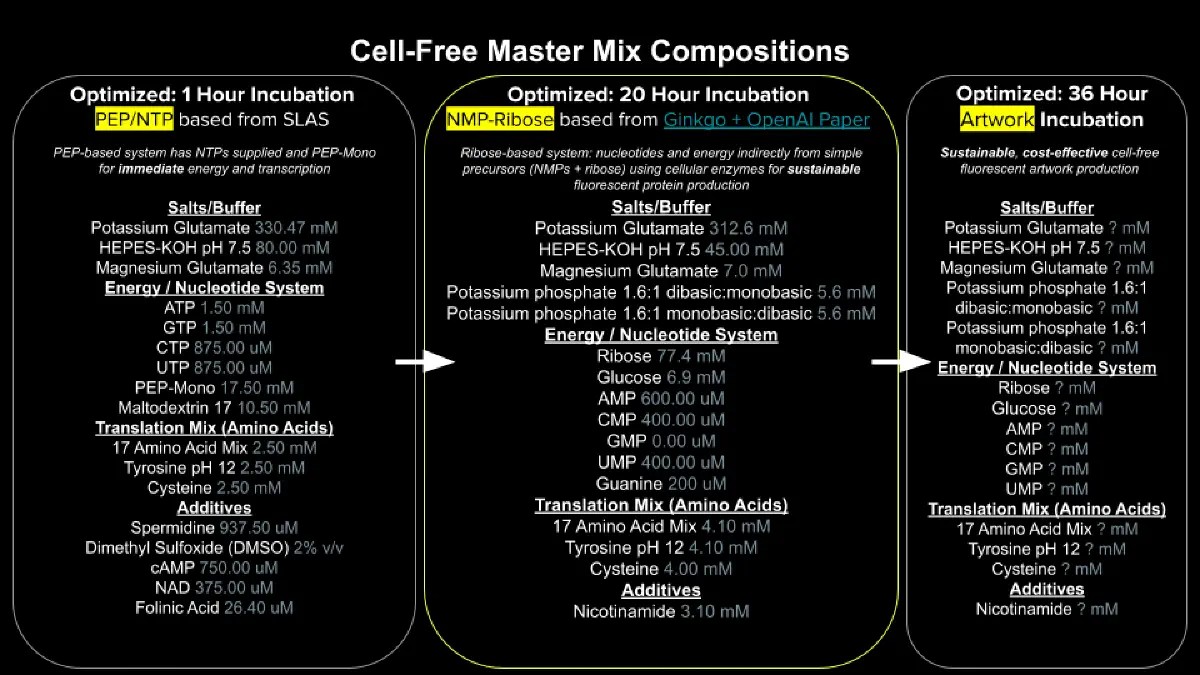
- Referencing the cell-free protein synthesis reaction composition (the middle box outlined in yellow on the image above, also listed below), provide a 1-2 sentence description of what each component’s role is in the cell-free reaction.
E. coli Lysate
- BL21 (DE3) Star Lysate (includes T7 RNA Polymerase): This lysate provides the entire cellular machinery required for gene expression, ribosomes, tRNAs, translation factors, chaperones, and metabolic enzymes. The included T7 RNA Polymerase specifically transcribes DNA templates under a T7 promoter into mRNA, initiating the transcription & translation.
Salts/Buffer
- Potassium Glutamate: Provides K⁺ ions essential for ribosome stability and translation stability; The glutamate acts like compatible solute that mimics the intracellular ionic environment which in turn supports enzyme activity without inhibiting translation.
- HEPES-KOH pH 7.5: A buffer that maintains the reaction pH near physiological levels (~7.5), which is optimal for the enzymatic activities of both transcription and translation machinery.
- Magnesium Glutamate: Supplies Mg²⁺ ions, which are critical cofactors for ribosome assembly, RNA polymerase catalysis, and stabilization of nucleotide triphosphates (NTPs) during phosphoryl-transfer reactions.
- Potassium phosphate monobasic / dibasic: The two together form secondary phosphate buffer that stabilizes pH and also donates inorganic phosphate, which participates in energy regeneration pathways within the lysate
Energy / Nucleotide System
- Ribose: A pentose sugar that feeds into the pentose phosphate pathway to generate PRPP (phosphoribosyl pyrophosphate), key for synthesis of nucleotides needed for transcription.
- Glucose: Serves as a primary carbon and energy source; it is metabolized via glycolysis to regenerate ATP and maintain energy in the system.
- AMP, CMP, GMP, UMP: These nucleoside monophosphates are phosphorylated by kinases present in the lysate to generate NTPs (ATP, CTP, GTP, UTP) which are the direct substrates for RNA synthesis during transcription.
- Guanine: A free purine base that is salvaged by the purine salvage pathway enzymes in the lysate, converting it to GMP and then to GTP, supplementing the GTP pool to sustain transcription.
Translation Mix (Amino Acids)
- 17 Amino Acid Mix: 17 of the 20 amino acids, these are direct building blocks for protein synthesis during translation.
- Tyrosine (pH 12): An amino acid that is provided separately because it has very low solubility at neutral pH and must be dissolved at alkaline pH (pH 12) before being added. It is essential for synthesizing proteins containing tyrosine residues.
- Cysteine: Supplied separately due to its high chemical reactivity (prone to oxidation); it is critical for proteins requiring disulfide bonds or specific structural folding.
Additives
- Nicotinamide: A precursor to NAD⁺ (via the NAD⁺ salvage pathway), which is essential for redox reactions and energy metabolism in the lysate, helping sustain metabolic activity throughout long cell-free incubations.
Backfill
- Nuclease-Free Water: Used to bring the reaction to the correct final volume without introducing RNases or DNases that would degrade the mRNA template or DNA, which would prematurely terminate protein production.
- Describe the main differences between the 1-hour optimized PEP-NTP master mix and the 20-hour NMP-Ribose-Glucose master mix shown in the Google Slide above. (2-3 sentences)
The 1-hour PEP-NTP system supplies pre-formed NTPs (ATP, GTP, CTP, UTP) alongside phosphoenolpyruvate (PEP) as an immediate energy source, which provides rapid transcription and translation but is quickly consumed, limiting productive reaction time to roughly one hour. In contrast, the 20-hour NMP-Ribose-Glucose system uses nucleoside monophosphates (NMPs) plus ribose and glucose as upstream energy precursors, allowing metabolic enzymes in the lysate to continuously regenerate NTPs from simpler substrates, dramatically extending reaction duration and protein yield. As a result, the 20-hour system is more cost-effective (NMPs and simple sugars are far cheaper than pre-made NTPs) and better sustains the energy balance needed for prolonged fluorescent protein production.
- How can transcription occur if GMP is not included but Guanine is?
Guanine (the free nucleobase) is a substrate for the purine salvage pathway enzymes naturally present in the E. coli lysate. Specifically, the enzyme hypoxanthine-guanine phosphoribosyltransferase (HGPRT) catalyzes the reaction: Guanine + PRPP → GMP + PPi. The resulting GMP is then sequentially phosphorylated by guanylate kinase and nucleoside diphosphate kinase to yield GDP and GTP, which T7 RNA Polymerase can use directly as a substrate for transcription. This salvage route thus replenishes the GTP pool without requiring pre-formed GMP to be added to the mix.
Part C: Planning the Global Experiment | Cell-Free Master Mix Design
Given the 6 fluorescent proteins we used for our collaborative painting, identify and explain at least one biophysical or functional property of each protein that affects expression or readout in cell-free systems. (Hint: options include maturation time, acid sensitivity, folding, oxygen dependence, etc) (1-2 sentences each)
- sfGFP (Superfolder GFP): sfGFP carries several stabilizing mutations that dramatically improve thermodynamic folding, allowing it to fold correctly even in the resource-limited environment of a cell-free system where chaperones are dilute. It is oxygen-dependent for chromophore maturation but has a relatively fast maturation half-time (~30 min), making it well-suited for shorter cell-free readouts.
- mRFP1: mRFP1 has a slow oxidative chromophore maturation, meaning a significant amount of translated protein may remain non-fluorescent during a short incubation window. In oxygen-limited cell-free conditions, this slow maturation is especially limiting and can cause the fluorescent signal to underrepresent actual protein yield.
- mKO2: mKO2 is a monomeric orange FP with one of the faster maturation times among orange/red-class FPs (~2.5 hours half-time), making it more practical for time-course cell-free experiments. It is still oxygen-dependent, but its relatively high photostability and decent brightness make it a reliable reporter once matured.
- mTurquoise2: mTurquoise2 is a cyan FP with an exceptionally high quantum yield (~0.93) (among the highest of any FP) and fast maturation, giving strong fluorescence signal per translated molecule in cell-free systems. However, it is moderately acid-sensitive, and if the pH of the cell-free reaction drifts downward during long incubations due to metabolic byproduct accumulation, the fluorescent signal could be quenched.
- mScarlet-I: mScarlet-I is a bright monomeric red FP engineered for fast maturation (~60 min half-time) and high quantum yield (~0.54), which makes it one of the best-performing red reporters in cell-free contexts where time is limited. It is oxygen-dependent for chromophore maturation, so oxygen availability during the incubation directly affects how much functional protein accumulates.
- Electra2: Electra2 is a recently engineered fluorescent protein optimized for expression in cell-free and synthetic biology contexts; it is notable for its reduced oxygen dependence during chromophore maturation compared to other FPs, which is a significant advantage in cell-free reactions where dissolved oxygen can become limiting over long incubations.
Create a hypothesis for how adjusting one or more reagents in the cell-free mastermix could improve a specific biophysical or functional property you identified above, in order to maximize fluorescence over a 36-hour incubation. Clearly state the protein, the reagent(s), and the expected effect.
Protein: mScarlet-I Problem: Oxygen-dependent chromophore maturation can become rate-limiting over a 36-hour incubation as dissolved O₂ is consumed and the reaction environment becomes more reducing.
Hypothesis: Supplementing the master mix with a higher concentration of Nicotinamide will enhance NAD⁺ regeneration within the lysate, sustaining the redox environment in a more oxidized state and thereby supporting the mScarlet-I maturation. Additionally, supplementing with a small amount of G6P could feed the pentose phosphate pathway to maintain NADPH balance, preventing quenching of the chromophore-forming reaction in reductive condition.
The expected outcome is higher fluorescence from mScarlet-I wells over the 36-hour window compared to in the standard master mix, reflecting improved maturation efficiency under low-oxygen conditions.