week 7 HW: genetic circuits part II
Part 1: Intracellular Artificial Neural Networks (IANNs)
- What advantages do IANNs have over traditional genetic circuits, whose input/output behaviors are Boolean functions?
Traditional genetic circuits can only read a signal as ON/OFF, even though molecules inside a cell exist at all kinds of intermediate concentrations. To build something complex out of ON/OFF switches, you have to layer many of them together, and each added layer introduces new opportunities for components to accidentally influence each other or fall out of sync. IANNs instead pass graded responses between nodes. Each node receives an actual concentration value, weighs it, and passes a continuous output forward. This means a single node carries far more information than an ON/OFF switch, so you need fewer of them to represent something complex, and there are fewer points at which things can go wrong.
- Describe a useful application for an IANN; include a detailed description of input/output behavior, as well as any limitations an IANN might face to achieve your goal.
A good use case is engineering bacteria to produce a drug. The bacteria need to balance how much raw material is available against how much final product has built up, since overproduction can stall or kill the cells. A Boolean circuit can only respond to whether the product level is above or below a fixed cutoff, shutting production on or off entirely. An IANN can instead read both signals as continuous values and smoothly adjust enzyme production in response, the same way a thermostat gradually responds to temperature rather than just cutting the heat off when a room gets warm.
- Draw a diagram for an intracellular multilayer perceptron where layer 1 outputs an endoribonuclease that regulates a fluorescent protein output in layer 2.
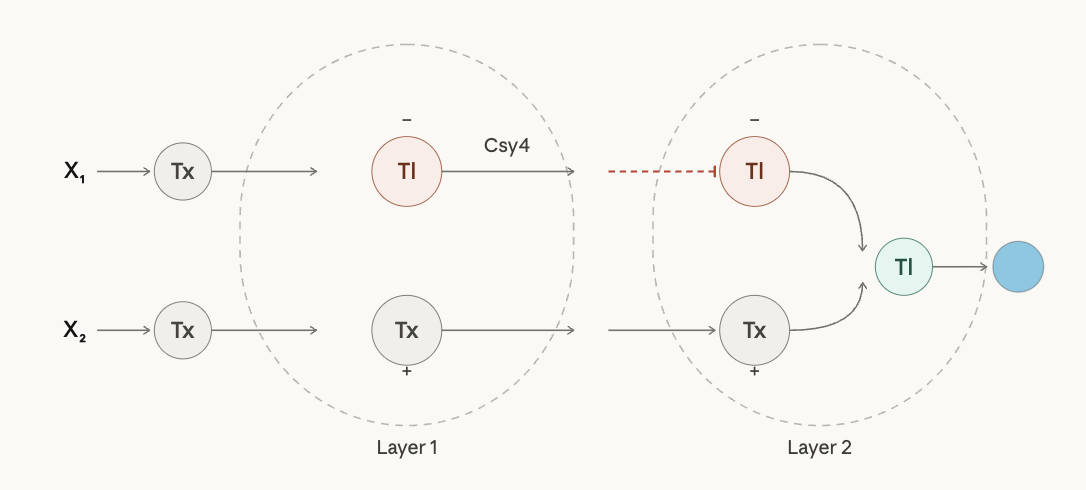
Layer 1 takes X₁ and X₂ as DNA inputs, each transcribed outside the cell. Inside, X₁ is translated into Csy4 (the inhibitory node, red) and X₂ is transcribed into FP mRNA. Both exit Layer 1 and enter Layer 2, where Csy4 represses translation of the FP mRNA while the mRNA itself drives it. The surviving signal is then translated by the output Tl node into the fluorescent protein.
Part 2: Fungal Materials
- What are some examples of existing fungal materials and what are they used for? What are their advantages and disadvantages over traditional counterparts?
Packaging: Mycelium grown on agricultural waste like straw can be molded into compostable styrofoam alternatives, but costs more to produce and is harder to manufacture consistently at scale.
Insulation: Mycelium panels outperform synthetic foam on fire resistance and sound absorption and are fully biodegradable, but absorb moisture easily and aren’t strong enough for load-bearing applications.
- What might you want to genetically engineer fungi to do and why? What are the advantages of doing synthetic biology in fungi as opposed to bacteria?
If I were engineering fungi for materials, the highest-leverage targets would be:
Hyphal architecture and growth uniformity. Wild-type mycelium grows in directions determined by nutrient gradients and available space, producing a material with inconsistent density. Engineering transcription factors that control hyphal branching frequency — likely homologs of the stuA gene in Aspergillus or FlbA pathway regulators — could force more consistent, isotropic growth. The goal is a material where mechanical properties are predictable from batch to batch without requiring tight environmental control during growth.
Water resistance at the cell wall level. Fungal cell walls are primarily chitin (a polysaccharide polymer) and glucans. Neither is particularly hydrophobic. Engineering fungi to overexpress hydrophobins — small, amphipathic proteins that fungi naturally use to coat aerial structures like spore surfaces — could give mycelium composites intrinsic water repellency without wax or polymer coatings applied post-production. Hydrophobins self-assemble into stable membranes at water-air interfaces, so overexpression would coat hyphal surfaces throughout the material rather than just at the exterior.
Melanin or secondary metabolite production for UV resistance. Fungi like Cladosporium naturally produce melanin, which provides UV protection. Engineering production of melanin or similar photoprotective compounds into a fast-growing, high-biomass strain would address a durability gap in current mycelium materials without applying synthetic coatings.
Growth rate via central carbon metabolism. Many industrial fungi have been domesticated for fermentation yield but not for biomass speed. Overexpressing rate-limiting enzymes in glycolysis or the TCA cycle, or knocking out competing secondary metabolite pathways that divert carbon away from growth, could meaningfully shorten the 5–7 day colonization time that currently limits throughput.
Why fungi over bacteria for this application?
The standard workhorse of synthetic biology is E. coli or B. subtilis, and for many applications they’re superior — faster doubling times, well-characterized genetics, enormous existing toolkits. But for structural materials, fungi have advantages that are difficult to engineer around in bacteria.
Most fundamentally, mycelium is the material. Bacteria produce molecular outputs (enzymes, polymers, small molecules) that must be extracted and processed into something useful downstream. Mycelium grows into the shape you want, binds substrate as it colonizes, and is harvested directly as a solid object — no downstream chemistry required.
Fungi also have chitin in their cell walls, the same structural polymer found in insect exoskeletons, which gives hyphal networks genuine mechanical integrity. Bacterial cell walls are peptidoglycan — structurally weak and easily degraded. Recreating a chitin-based matrix in bacteria would require extensive metabolic rewiring; in fungi it’s already the default.
Finally, as eukaryotes, fungi have the protein folding and glycosylation machinery (ER, Golgi) needed to correctly express complex structural proteins like hydrophobins. Bacteria simply lack this, making them poorly suited for producing the kinds of proteins that would give engineered mycelium useful surface properties.