week 6 lab: gibson assembly
Background
In this lab, we modifies the color-generatinf chromophore of the purple Acropora millepora chromoprotein in order to create a variety of different colored mutants.
Day 1: Preparation of DNA Fragments
We performed two PCR reactions, one for the backbone, and one for the color inserts.
We prepared four color-specific reactions: Blue, Light Pink, Magenta, and Orange.
Backbone PCR Reaction
Primers: Backbone Fwd and Backbone Rev
| Reagent | Stock Conc. | Desired Conc. | Volume (µL) |
|---|---|---|---|
| Template mUAV Plasmid | 38.5 ng/µL | 20 ng | 0.8 |
| Backbone Forward Primer | 5 µM | 0.5 µM | 2.5 |
| Backbone Reverse Primer | 5 µM | 0.5 µM | 2.5 |
| Phusion HF PCR Mix | 2X | 1X | 12.5 |
| Nuclease-free water | — | — | 6.8 |
| Total Volume | — | — | 25.0 |
Color DNA Reactions
Primers: Color Fwd and Color Rev
| Reagent | Stock Conc. | Desired Conc. | Volume (µL) |
|---|---|---|---|
| Template mUAV Plasmid | 38.5 ng/µL | 20 ng | 0.8 |
| Color Forward Primer | 5 µM | 0.5 µM | 2.5 |
| Color Reverse Primer | 5 µM | 0.5 µM | 2.5 |
| Phusion HF PCR Mix | 2X | 1X | 12.5 |
| Nuclease-free water | — | — | 6.8 |
| Total Volume | — | — | 25.0 |
After mixing, the tubes were placed in the thermocyclers. The backbone was run on one specialized program while the color mutations were run on another.
Purification & Analysis
(Note: DpnI digest was skipped as our reactions did not contain methylated DNA.)
We purified the PCR products using the Zymo DNA Clean & Concentrator kit. We ran the product through the column, washed twice, and then eluted.
Gel Analysis
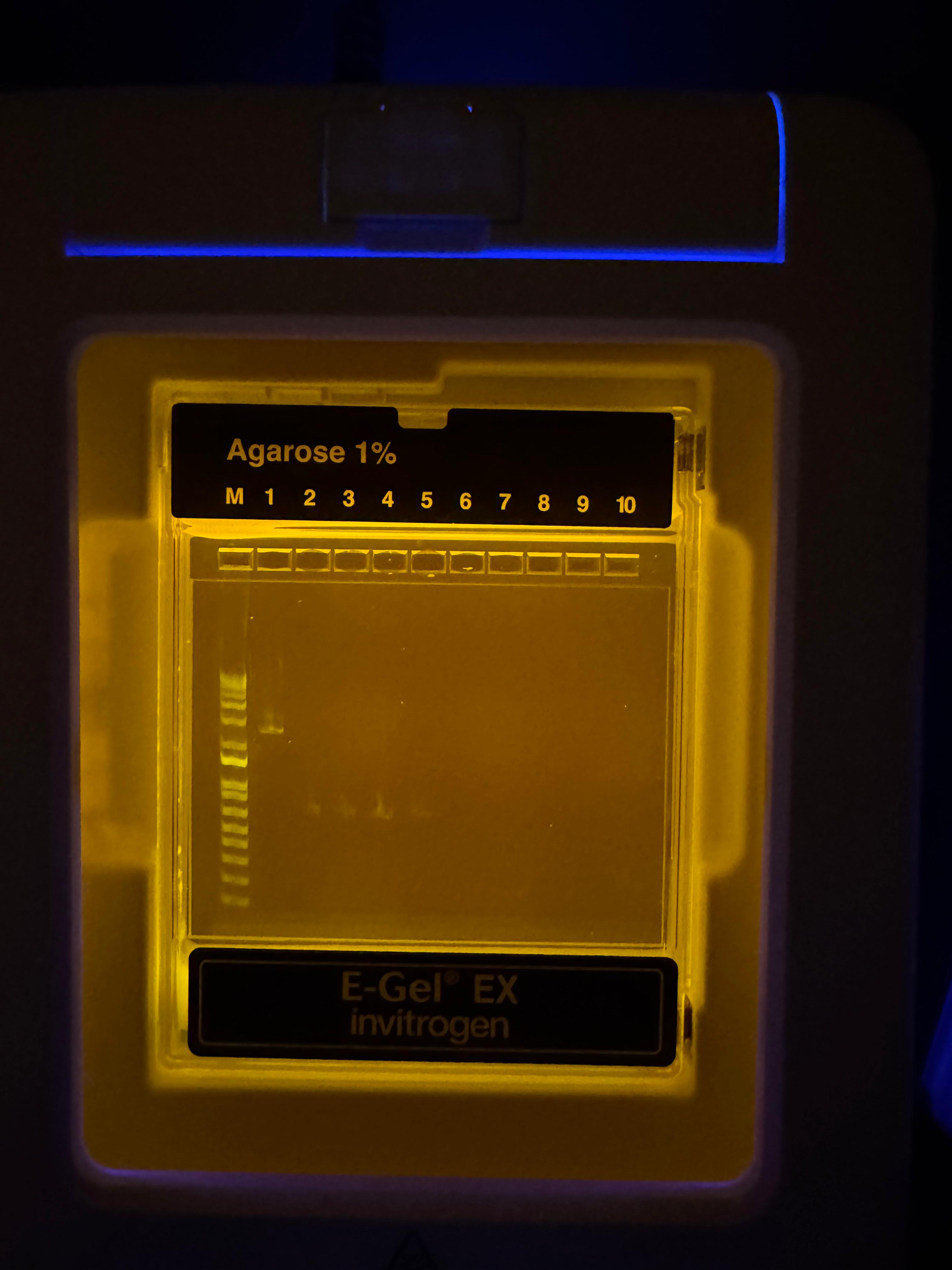
Gel electrophoresis was performed to verify the amplification. Lane 1 contains the native plasmid. Lanes 2–5 show the expected amplified fragments for the Gibson Assembly. Samples were then placed into the fridge until Day 2.
Day 2: Assembly & Transformation
Gibson Assembly
We used the unpurified PCR products for the assembly, rather than the purified products. This decision was made because other lab groups reported low DNA recovery after purification.
| Reagent | Stock Conc. (ng/µL) | Desired Conc (ng/µL) | Volume (µL) |
|---|---|---|---|
| Backbone Fragment | 50 | 25 | 0.5 |
| Color Fragment (Single) | 50 | 50 | 1.0 |
| Gibson Assembly Mix | 2X | 1X | 5.0 |
| Nuclease-free water | — | — | 3.5 |
| Total Volume | — | — | 10.0 |
The reaction was incubated at 50°C in the thermocycler for 30 minutes.
Transformation
We compared two competent E. coli strains: DH5α and 10-beta.
Incubation: competent cells were mixed with Gibson products and incubated on ice for 30 mins Heat Shock: the reaction was placed in thermocycler for 45 seconds in SOC medium, then immediately returned to ice. Outgrowth: the reaction was incubated for 60 minutes on a makeshift shaker made out of a pipette tip box.
100µL of each transformation was plated onto LB-Agar plates with Chloramphenicol.
Results
After 72 hours of incubation, we achieved the targeted chromophore mutations across both cell lines.
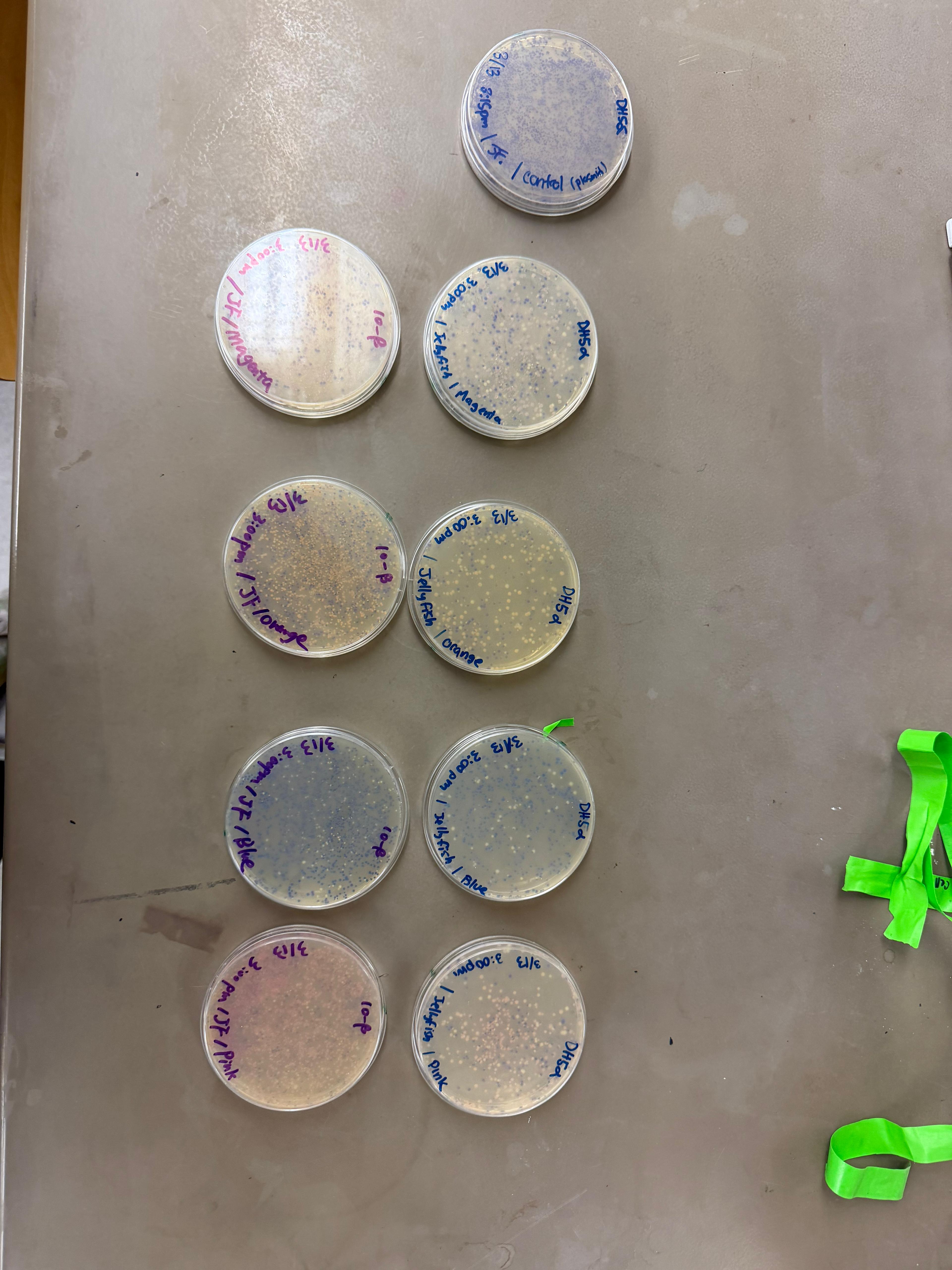
Analysis The positive control confirmed that the assembly was effective. While some purple colonies (native plasmid) were present on all plates, each plate showed distinct colored colonies (Orange, Light Pink, Blue, Magenta), indicating successful Gibson Assembly and transformation.