Week 7: Genetic Circuits Part II: Neuromorphic Circuits
Assignment Part 1: Intracellular Artificial Neural Networks
- What advantages do IANNs have over traditional genetic circuits, whose input/output behaviors are Boolean functions?
Instead of relying on ON/OFF logic, they process information in a continuous and distributed way, closer to how real cells behave. This allows them to integrate multiple signals with different intensities and avoid the exponential complexity that arises when scaling Boolean circuits. In addition, IANNs are inherently more flexible, since their behavior can be tuned by adjusting interaction strengths rather than completely redesigning the system, enabling more complex and nonlinear decision-making. Overall, they provide a more efficient, scalable, and biologically realistic framework for intracellular computation.
- Describe a useful application for an IANN; include a detailed description of input/output behavior, as well as any limitations an IANN might face to achieve your goal.
A useful application of an IANN would be an intracellular cancer classifier that integrates multiple biomarkers, such as oncogene expression, tumor suppressor loss, and metabolic changes, as continuous inputs. Instead of a simple Boolean response, it would compute a weighted, nonlinear decision and trigger outputs like pro-apoptotic gene expression only when the overall profile strongly indicates malignancy, improving specificity. However, limitations include difficulty in tuning interaction strengths, cellular noise, crosstalk with native pathways, and the challenge of reliably calibrating the system in vivo.
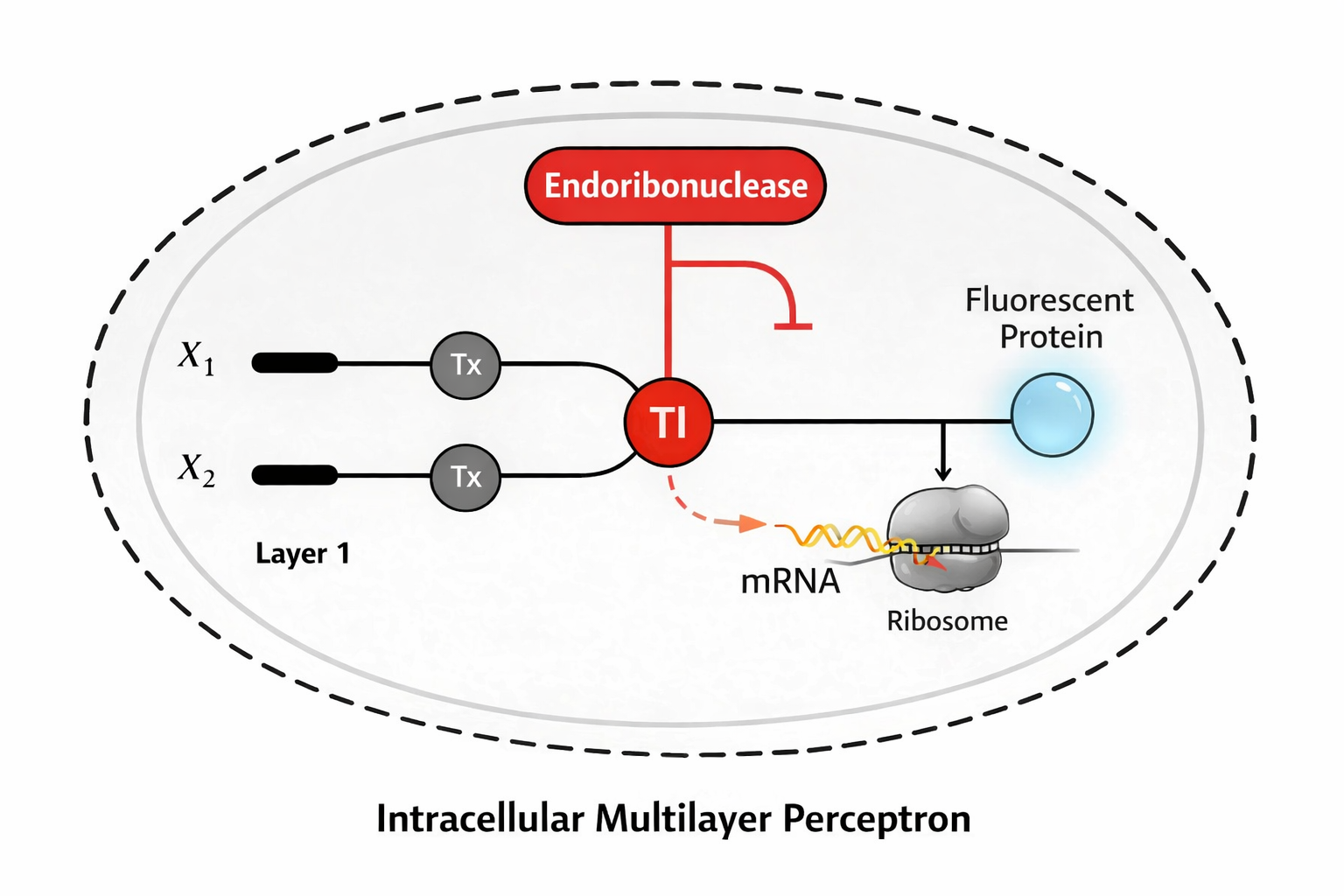
- Draw a diagram for an intracellular multilayer perceptron where layer 1 outputs an endoribonuclease that regulates a fluorescent protein output in layer 2.
Assignment Part 2: Fungal Materials
- What are some examples of existing fungal materials and what are they used for? What are their advantages and disadvantages over traditional counterparts? Derived from mycelium:
Based packaging: Used as a substitute for polystyrene foam in protective packaging.
Leather: Used in fashion as vegan leather alternatives.
Construction materials: Bricks, insulation panels, and composites used in architecture for lightweight, biodegradable building components
They are advantageous because are biodegradable, renewable, and can be grown with low energy input using agricultural waste, making them much more sustainable than petroleum-based plastics or animal-derived materials.
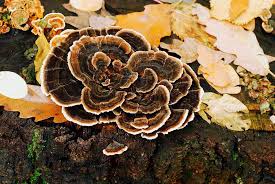
- What might you want to genetically engineer fungi to do and why? What are the advantages of doing synthetic biology in fungi as opposed to bacteria? For the biodegradation of environmental pollutants, especially industrial textile waste, since many fungi already have strong natural decomposing abilities. For example, Trametes versicolor can help reduce textile contamination because it produces enzymes like laccases and peroxidases that break down synthetic dyes. This capability could be enhanced by overexpressing ligninolytic enzymes (laccases, manganese peroxidases, lignin peroxidases), coupling their expression to inducible systems that activate in the presence of pollutants, and improving tolerance to harsh industrial conditions such as extreme pH, temperature, and heavy metals. Additionally, optimizing secretion pathways would increase extracellular enzyme release and overall degradation efficiency, making the process more effective for wastewater treatment.
For the biodegradation of environmental pollutants, especially industrial textile waste, since many fungi already have strong natural decomposing abilities. For example, Trametes versicolor can help reduce textile contamination because it produces enzymes like laccases and peroxidases that break down synthetic dyes. This capability could be enhanced by overexpressing ligninolytic enzymes (laccases, manganese peroxidases, lignin peroxidases), coupling their expression to inducible systems that activate in the presence of pollutants, and improving tolerance to harsh industrial conditions such as extreme pH, temperature, and heavy metals. Additionally, optimizing secretion pathways would increase extracellular enzyme release and overall degradation efficiency, making the process more effective for wastewater treatment.
Advantages over bacteria for synthetic biology:
They are eukaryotic organisms that can perform complex post-translational modifications and proper protein folding required for many eukaryotic proteins.
They have a strong natural capacity for protein secretion, which simplifies production and purification of recombinant proteins.
More complex genetic regulation and larger gene constructs, making them suitable for expressing multi-step pathways.
Their cellular organization and scalability in industrial fermentation further make them attractive platforms for producing pharmaceuticals, enzymes, and biomaterials, although they are typically slower growing and less genetically tractable than bacteria.
Part 3: First DNA Twist Order
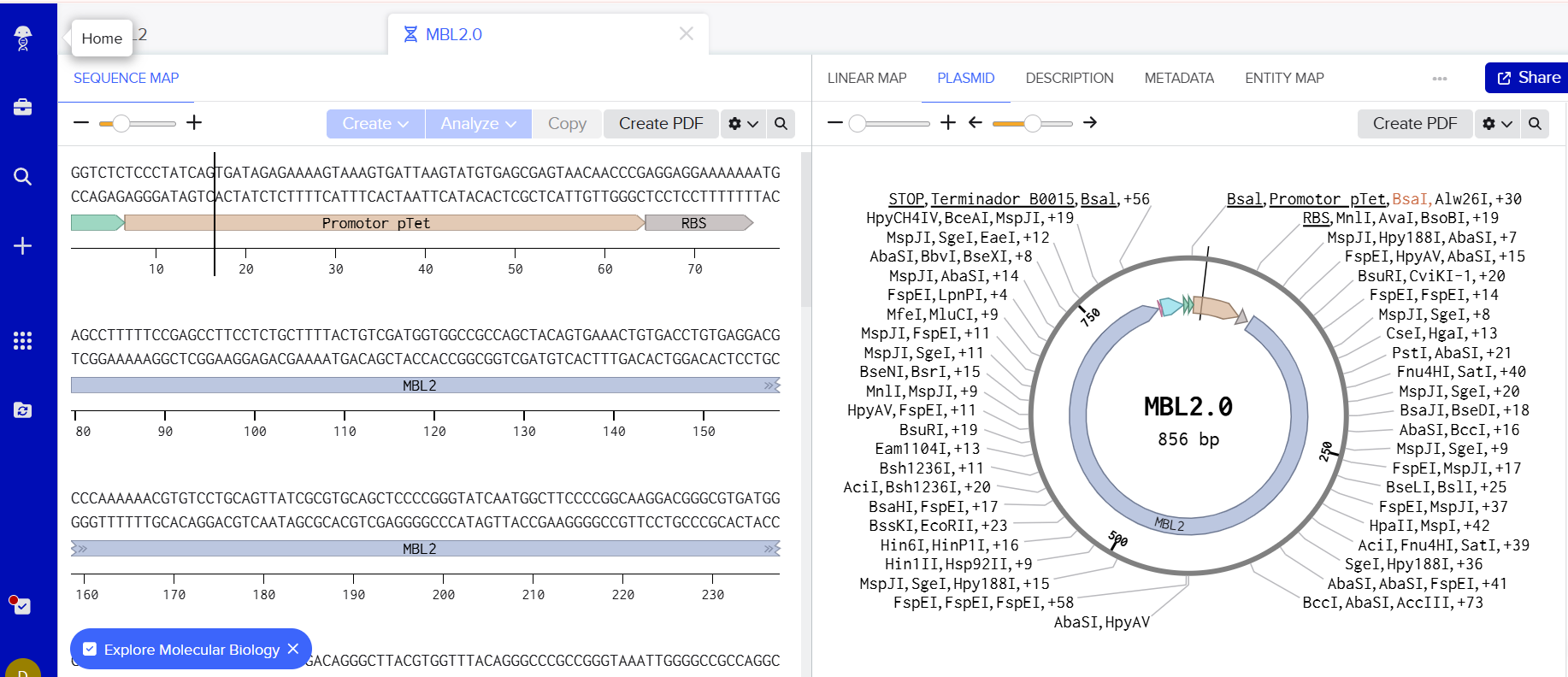
This insert is designed to be cloned into the pUC19 plasmid for expression in E. coli. The construct includes a pTet inducible promoter, allowing controlled expression of the gene of interest.