Week 7 HW: Genetic Circuits Part2
Assignment Part 1: Intracellular Artificial Neural Networks (IANNs)
1. What advantages do IANNs have over traditional genetic circuits, whose input/output behaviors are Boolean functions?
Traditional genetic circuits based on digital logic are primarily limited by low complexity of operations and needing an expressive amount of metabolic effort from cells. IANNs have the advantage of using analog logic. By leveraging non-linear functions and using continuous input ranges, instead of Boolean circuits that require discrete thresholds, neuromorphic systems allow for more nuanced decision-making, while reducing the metabolic burden since fewer components are needed. Intracellular Neural Networks take advantage of the type of chaotic organization that already happens inside a cell, instead of trying to impose a translation of logic into more readable inputs and outputs like digital logic does, providing access to more complexity, scalability and adaptability to different environments. The main drawback of neuromorphic systems is noise, like any biologic system, but this can be mitigated through the aggregation of information across a population of cells which diminishes the intrinsic noise of cellular environments.
2. Describe a useful application for an IANN; include a detailed description of input/output behavior, as well as any limitations an IANN might face to achieve your goal.
The most interesting application for IANNs that I see is as preventive therapy that can have an intravenous delivery and regulate the immune system in response to really early and small changes in cells, only activating the immunotherapy in the right tissue when inputs meet certain specific criteria. In this type of approach different circuits with different targets can be introduced into the body and each of them have a small numbers of inputs, lowering the complexity needed for each different circuit but creating a system that can analyze and potentially respond to a wide variety of targets. So, with each circuit having two or three biomarker inputs that only trigger a immunotherapy response if specific non-linear patterns are met, a full “body scan” can be performed with really high precision.
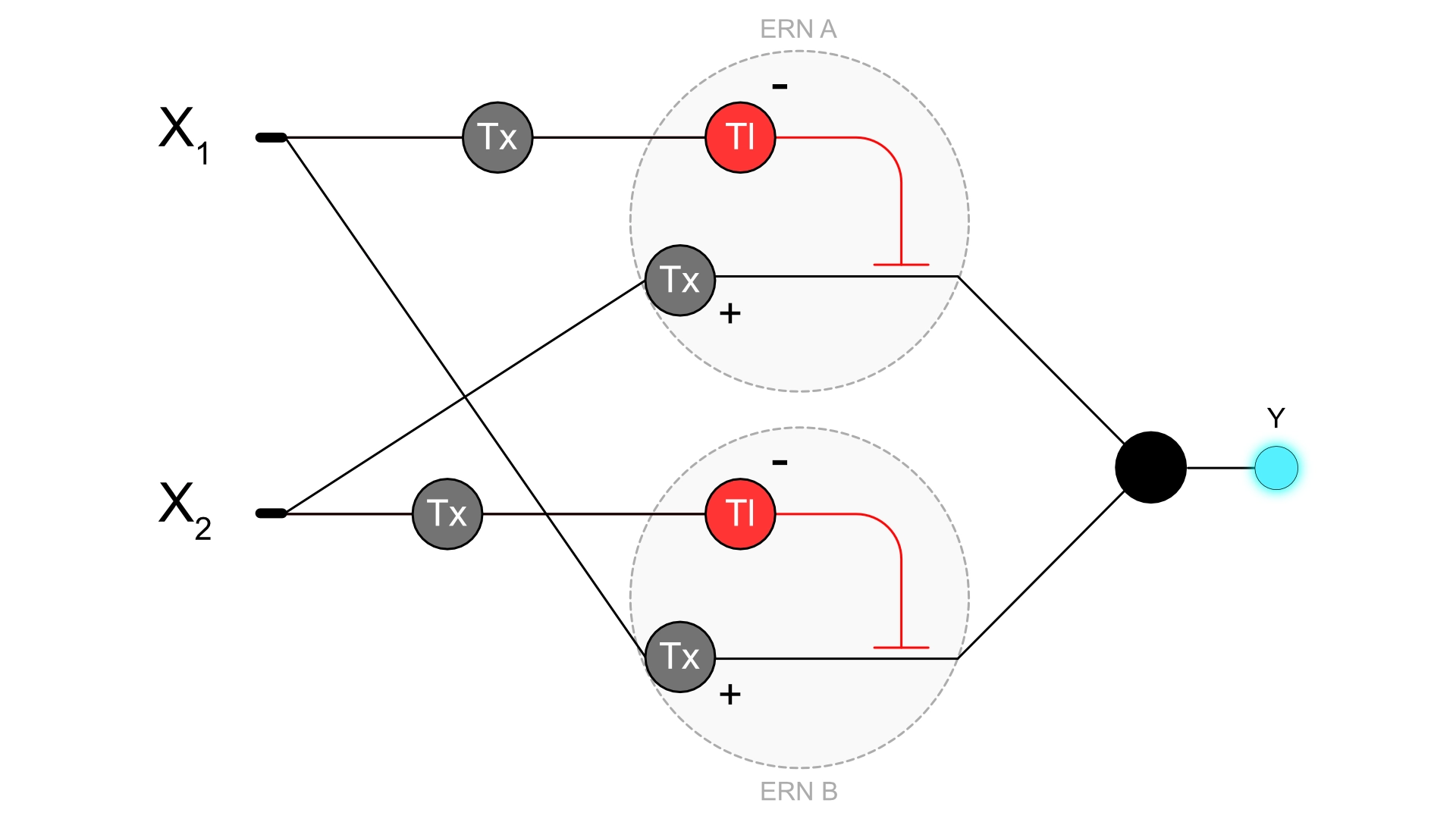
3. Draw a diagram for an intracellular multilayer perceptron where layer 1 outputs an endoribonuclease that regulates a fluorescent protein output in layer 2.
The diagram I drew represents an XOR function where the output is high when the inputs have “opposite” values. The output is only high when X1 is high and x2 is low or when x2 is high and x1 is low. If x1 and x2 are both high or low the output is low
Assignment Part 2: Fungal Materials
1. What are some examples of existing fungal materials and what are they used for? What are their advantages and disadvantages over traditional counterparts?
Fungal materials range from textiles like leather — which fungi are really good at mimicking since the formation of mycelium creates really strong and flexible networks— to more structural elements like building block for walls— mycelium has the ability to grow in many types of substrates like grain or straw, and while growing it aggregates these fibers or grains into solid chunks that can be later dried. This creates a strong material which can support some considerable charge and isn’t brittle, also having really good insolation qualities both for sound and heat.
2. What might you want to genetically engineer fungi to do and why? What are the advantages of doing synthetic biology in fungi as opposed to bacteria?
Besides the possibilities for materials derived from fungi, another really interesting scope through which I’m interested in fungi is the possibility of therapeutic solutions by engeneering human microbiomes with adaptogenic fungi that could regulate our imune systems through the amazing methabolic pathways they posess, which bacteria don’t.