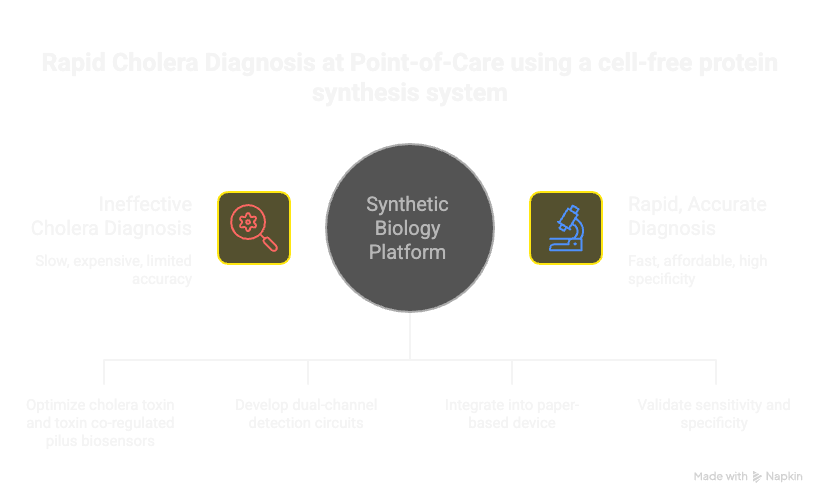
Project Description I want to develop a synthetic biology-based point-of-care diagnostic platform that can rapidly detect cholera toxin and toxin co-regulated pilus antigens in stool and environmental samples within 15-30 minutes using engineered cell-free biosensors integrated into a paper-based microfluidic device.
The system employs single-domain antibodies recognition elements fused to split T7 RNA polymerase domains that reconstitute active enzyme only upon antigen binding, driving colorimetric reporter expression for visual result interpretation requiring no laboratory infrastructure or specialized training.
I want to develop a synthetic biology-based point-of-care diagnostic platform that can rapidly detect cholera toxin and toxin co-regulated pilus antigens in stool and environmental samples within 15-30 minutes using engineered cell-free biosensors integrated into a paper-based microfluidic device.
The system employs single-domain antibodies recognition elements fused to split T7 RNA polymerase domains that reconstitute active enzyme only upon antigen binding, driving colorimetric reporter expression for visual result interpretation requiring no laboratory infrastructure or specialized training.
Aim 1: Design and validate a dual-channel cell-free biosensor that detects cholera toxin and toxin co-regulated pilus, demonstrating reliable, rapid results without living cells or laboratory infrastructure.
Aim 2: Embed the biosensor into a paper-based diagnostic strip and test it on real clinical and environmental samples, confirming accuracy, stability in tropical climates, and readiness for field deployment.
Aim 3: Create an adaptable platform for rapid infectious disease detection anywhere in the world from cholera to pandemic pathogens enabling real-time outbreak surveillance and early containment in resource-limited settings.
Unmet Global Need
    2.9M
    Annual Cases Worldwide
Despite being treatable, Cholera remains a major threat in resource-limited areas. Current gold-standard culture tests take 3 days and require intensive lab infrastructure.
Our Mission: To bridge the diagnostic gap with a $3 test that delivers results in under 30 minutes.
Mechanism: Split T7 Polymerase
The system utilizes Split T7 RNA Polymerase as a proximity-dependent biosensor.
Separated: T7N and T7C domains remain inactive when floating separately.
Detection: Specific nanobodies bind to the target protein (Cholera Toxin or TCP).
Signal: The active enzyme drives the production of a colorimetric output.
The dual-target detection strategy simultaneously targeting cholera toxin and TCP antigens provides unprecedented specificity for toxigenic Vibrio cholerae strains while distinguishing from non-toxigenic variants and other diarrheal pathogens. The integration of nanobody-based recognition elements with split T7 RNA polymerase systems creates a modular biosensor architecture that can be rapidly adapted to detect different pathogen targets by simply replacing the binding domains, representing a platform technology rather than a single-use diagnostic.
Engineered Fusion Proteins
Construct
Fusion Protein
Domain
Target Marker
Construct 1
CT-Nanobody A
T7N (1-179)
Cholera Toxin (Signal: BLUE)
Construct 2
CT-Nanobody B
T7C (180-883)
Cholera Toxin (Signal: BLUE)
Construct 3
TCP-Nanobody A
T7N (1-179)
TCP Protein (Signal: YELLOW)
Construct 4
TCP-Nanobody B
T7C (180-883)
TCP Protein (Signal: YELLOW)
Performance Targets
Parameter
Target Value
Public Health Significance
Sensitivity
≥ 95%
High true case detection rate
Specificity
≥ 98%
Elimination of false positives
Time-to-result
15-30 Minutes
Immediate clinical action
Cost Per Test
$3.00 USD
Affordable for global outbreaks
Storage Temp
2-30°C
No cold chain required
Reference
Core Synthetic Biology & Cell-Free Systems
Pardee, K., Green, A. A., Takahashi, M. K., Braff, D., Lambert, G., Lee, J. W., … & Collins, J. J. (2016). Rapid, low-cost detection of Zika virus using programmable biomolecular components. Cell, 165(5), 1255-1266.
o Key for: Paper-based cell-free biosensors, freeze-dried systems, toehold switches
Split Protein Systems & Protein Engineering
Galarneau, A., Primeau, M., Trudeau, L. E., & Michnick, S. W. (2002). β-Lactamase protein fragment complementation assays as in vivo and in vitro sensors of protein–protein interactions. Nature Biotechnology, 20(6), 619-622.
o Key for: Protein complementation assays, biosensor design
Shekhawat, S. S., & Ghosh, I. (2011). Split-protein systems: beyond binary protein–protein interactions. Current Opinion in Chemical Biology, 15(6), 789-797.
o Key for: Advanced split-protein applications, biosensor engineering
Nanobodies & Antibody Engineering
Muyldermans, S. (2013). Nanobodies: natural single-domain antibodies. Annual Review of Biochemistry, 82, 775-797.
o Key for: Nanobody fundamentals, single-domain antibodies
De Meyer, T., Muyldermans, S., & Depicker, A. (2014). Nanobody-based products as research and diagnostic tools. Trends in Biotechnology, 32(5), 263-270.
o Key for: Diagnostic applications of nanobodies
Jovčevska, I., & Muyldermans, S. (2020). The therapeutic potential of nanobodies. BioDrugs, 34(1), 11-26.
o Key for: Therapeutic and diagnostic nanobody applications