Wearable Electrochemical Immunosensor for Dual Allergy Detection Abstract Allergic diseases affect over 500 million people worldwide and represent a critical public health challenge. Current allergy diagnostics rely on laboratory-based immunoassays or skin-prick tests that require physical visits to the clinic and specialized equipment, without existence of real-time data during acute exposure events. This project addresses the need by creating a minimally invasive wearable device that simultanesly monitros both histamine, the trigger, and immunoglobin (IgE), antibody for allergic sensation, in real time. The plan is to create two independent, computaitonally designed DNA toehold switch circuits where one switch is triggered by histamine-bound aptamer output and one by IgE-bound aptamer output. The central hypothesis is that two switched can undergoe confromaitonal changes upon target engagement and produce a deetctable signal in a cell-free system.
Subsections of Projects
Group Final Project
Individual Final Project
Wearable Electrochemical Immunosensor for Dual Allergy Detection
Abstract
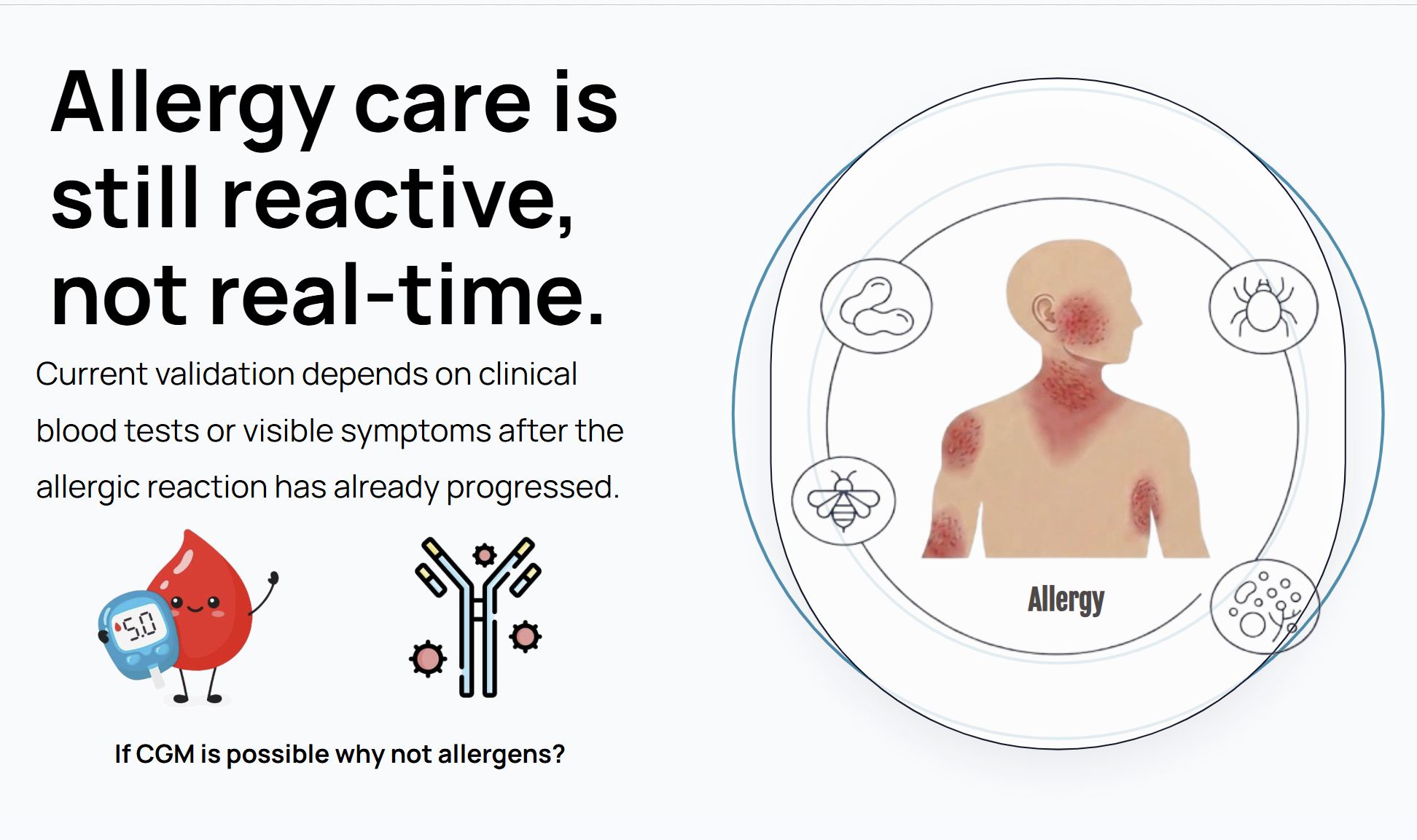
Allergic diseases affect over 500 million people worldwide and represent a critical public health challenge. Current allergy diagnostics rely on laboratory-based immunoassays or skin-prick tests that require physical visits to the clinic and specialized equipment, without existence of real-time data during acute exposure events.
This project addresses the need by creating a minimally invasive wearable device that simultanesly monitros both histamine, the trigger, and immunoglobin (IgE), antibody for allergic sensation, in real time.
The plan is to create two independent, computaitonally designed DNA toehold switch circuits where one switch is triggered by histamine-bound aptamer output and one by IgE-bound aptamer output. The central hypothesis is that two switched can undergoe confromaitonal changes upon target engagement and produce a deetctable signal in a cell-free system.
To test this hypothesis, this project will pursue the next three aims:
Computational aptamer construct design and scoring
Cell-free electrochemical validation
Integration of the validated sensing elements into a flexible wearable platform with multiplexed readout capability
Project Aims
Aim 1: Computational Design
The first aim of my project is to computationally design and score DNA aptamer toehold switch circuits - one for histamine detection and one for IgE detection. Each circuit concsisit of: validated seqeunce, toehold switch hairpin and a trigger strand.
Aim 2: cell-free electrochemical validation of aptamer-target binding
Aim 2 would be ordering Tiwst designs and validating each circuit independently using native PAGE gel shift assays and, if possible, a cell-free transcription/translation (TX-TL) reporter system. Each aptamer-toehold circuit will be incubated with its target (histamine or recombinant IgE), and band shifts will confirm conformational switching. The two circuits will then be tested together to confirm orthogonality — that each responds only to its own target.
Aim 3: integration of the validated sensing elements into a flexible wearable platform with multiplexed readout capability
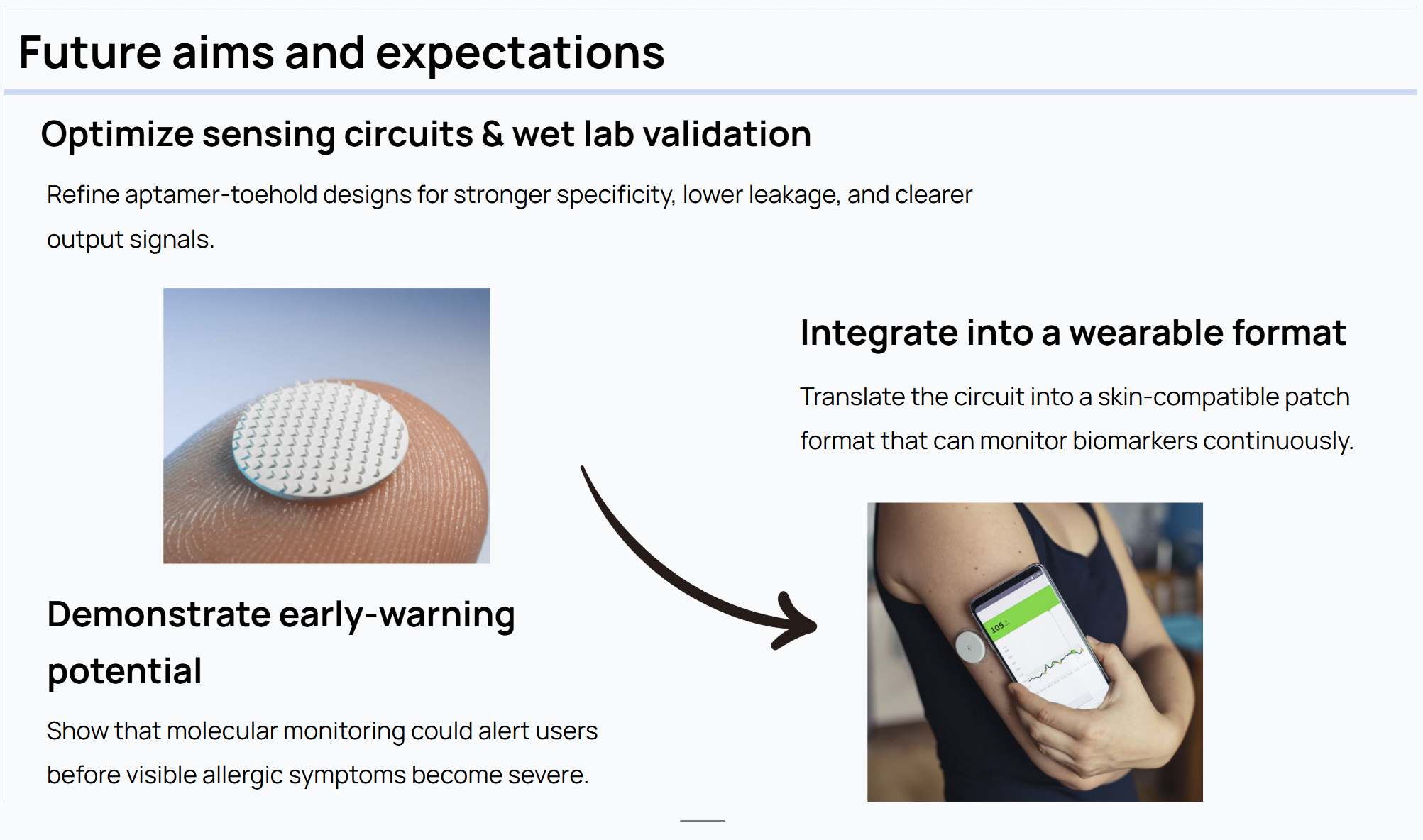
The long-term vision of this aim is to develop a multiplexed wearable patch that embeds both aptamer-toehold circuits within an electrochemical transduction layer and samples interstitial fluid through microneedles. Each circuit would produce a measurable impedance or current change upon target binding, enabling continuous, simultaneous monitoring of both allergy markers. In the broader context, this modular framework could be adapted to other biomarker pairs with known aptamers, including cytokines, infectious disease markers, or performance-related biomarkers.
Current microneedle-based sensing platforms show that minimally invasive access to interstitial fluid is feasible, but most systems remain limited to single-analyte detection or fixed recognition chemistries. By contrast, this project would expand the concept to establish a modular multiplexed wearable strategy for real-time monitoring of multiple allergy-related biomarkers, offering a more dynamic view of immune activation than traditional clinic-based tests.
A major barrier is biological noise, including biofouling, nonspecific adsorption, and interference from complex interstitial fluid components. These factors can reduce specificity, mask low-abundance targets, and undermine long-term sensing performance in real-world conditions.
To address this challenge, I would integrate the validated aptamer-toehold sensing elements into a flexible microneedle-electrode patch and test whether each module can generate a distinct electrochemical signal without cross-talk. If successful, this approach could shift allergy testing from infrequent clinical measurements toward continuous, personalized, at-home monitoring during natural exposure events.
Background
I was refering to multiple supproting studies and would like two highlight next two peer-reviewed researches that are relevant to my project:
Aptamer biosensor for label-free detection of human IgE
This paper shows that a DNA aptamer can be used as a label-free recognition element for human IgE, allowing allergy-related detection without antibody labeling. The study demonstrates real-time IgE sensing with good sensitivity and selectivity, which makes it a strong precedent for your planned IgE module in a wearable allergy-monitoring system.
Microneedle Aptamer-Based Sensors for Continuous, Real-Time Therapeutic Monitoring
This paper demonstrates that aptamer-based electrochemical sensors can be integrated into microneedle arrays to monitor molecules continuously in interstitial fluid. It is especially relevant to your project because it supports the idea that aptamer recognition can be translated into a minimally invasive, wearable platform with real-time and multiplexed readout potential.
This project is novel in three persepctives.
First, it applies toehold switch logic to DNA aptamer-based detection of protein and small-molecule targets, expanding synthetic biology tools into a new biosensing context. Second, it combines two orthogonal aptamer-toehold circuits for simultaneous histamine and IgE detection, enabling a dual-marker allergy sensor that has not yet been demonstrated. Third, it introduces an electrochemical signal readout for aptamer-toehold switching, creating a more practical and wearable-compatible output than the fluorescence or reporter-based systems commonly used in cell-free sensing.
The project addresses a major real-world problem: allergic diseases affect hundreds of millions of people worldwide, and severe reactions such as anaphylaxis can develop within seconds and become life-threatening. Current diagnostic tools are typically clinic-based and do not provide real-time information during active exposure, which limits their usefulness for prevention and rapid response. By simultaneously tracking histamine, the immediate chemical trigger, and IgE, the immune marker associated with allergic sensitivity, this platform could provide a more complete picture of allergic state than single-analyte approaches. The cell-free design also improves stability, manufacturability, and accessibility, making the system more practical for low-resource or decentralized settings. If successful, this framework could shift allergy monitoring from intermittent testing toward continuous, personalized sensing, and its modular logic could later be extended to other biomarkers beyond allergy.
This project raises several ethical considerations related to beneficence, non-maleficence, and justice. From a beneficence perspective, earlier and more precise detection of allergic responses could improve patient safety and support better clinical decision-making. At the same time, non-maleficence is important because false-positive or inaccurate signals could cause unnecessary anxiety, inappropriate medication use, or delayed trust in the device. Justice is also relevant because one goal of the platform is to create a low-cost and scalable sensing technology that could be accessible beyond well-resourced clinical environments. In addition, continuous wearable monitoring raises concerns about privacy, data ownership, and possible misuse of sensitive immunological information.
To ensure the project is ethical, the research should be conducted with careful validation, transparent reporting, and open sharing of design logic where appropriate. Any future human-subject or clinical use would require informed consent, institutional review board approval, and clear policies for data security and access. One potential unintended consequence is that users may overinterpret imperfect sensor readings, so the system should be framed as a supportive monitoring tool rather than a standalone diagnostic replacement. There are also scientific uncertainties, including whether computationally predicted binding behavior will hold under real biological conditions and whether the two circuits will remain orthogonal in complex samples. If cross-reactivity or instability occurs, alternative strategies could include redesigning the toehold regions, introducing stronger antifouling interfaces, or using a different sensing architecture such as antibody-based or protein-based recognition elements.
SECTION 4: Experimental Design, Techniques, Tools and Technology
Step 1Literature review & Seqeunce Collection identify validated histamine-binding and IgE-binding aptamer sequences from NCBI/literature. Collect information on sequence length, reported affinity (Kd), secondary structure, and experimental conditions used for validation.
Timeline ~ Day 1-3
Step 2
Import the selected histamine aptamer into Benchling and design the first toehold switch hairpin. Add a 5’ toehold region of approximately 7–10 nucleotides that remains single-stranded and is complementary to the trigger strand. Annotate all functional domains, including the aptamer stem, toehold, and trigger-binding region.
Timeline ~ Day 4-5
Step 3
Run the full Circuit 1 sequence through NUPACK or Mfold at 37°C and physiological ionic conditions. Confirm that the aptamer domain forms the expected stem-loop structure and that the toehold region remains accessible and unpaired.
Timeline ~ 6
Step 4
Design the Circuit 1 trigger strand to be complementary to the toehold and adjacent stem region, with a target length of approximately 20–25 nucleotides. Model strand displacement in NUPACK or Mfold by simulating the switch and trigger as interacting strands. Confirm that the hairpin opens upon trigger binding.
Timeline ~ 7
Step 5
Repeat the design workflow for the IgE-binding aptamer to construct Circuit 2. Use a different toehold sequence from Circuit 1 to reduce cross-reactivity and improve orthogonality. Annotate all sequence domains in Benchling.
Timeline ~ 8-9
Step 6
Analyze the full Circuit 2 sequence in NUPACK or Mfold under the same conditions used for Circuit 1. Verify correct folding of the aptamer stem-loop and accessibility of the toehold region.
Timeline ~ 10
Step 7
Design the Circuit 2 trigger strand and simulate strand displacement. Then test orthogonality computationally by pairing Circuit 1 with the Circuit 2 trigger and vice versa. Confirm that each switch responds preferentially to its own trigger and shows minimal cross-binding.
Timeline ~ 11
Step 8
Generate a script that reads NUPACK output files from both circuits and generates a ranked CSV table. The output should include sequence name, minimum free energy ΔG, GC content, toehold accessibility score, and orthogonality flag. This analysis will provide a standardized way to compare candidates across design variants.
Timeline ~ 12-13
Step 9
Generate three variants of each circuit by varying toehold length, such as 7, 9, and 11 nucleotides. Run the ranking script on each version and select the best-performing variant based on high toehold accessibility and the most favorable ΔG.
Timeline ~ 14-15
Step 10
Submit the final designs for synthesis through a commercial DNA synthesis provider such as Twist or a comparable vendor. Order the Circuit 1 switch, Circuit 1 trigger, Circuit 2 switch, Circuit 2 trigger, and scrambled control oligos for each circuit.
Timeline ~ 16
Step 11
Prepare a native PAGE workflow to test each switch strand alone and in combination with its trigger and target aptamer. Incubate the samples in binding buffer, then run them on a 12% native gel. A shift in band mobility is expected when the switch adopts an opened conformation after target or trigger engagement.
Timeline ~ 17
Step 12
Test each circuit with matched and mismatched triggers, scrambled oligos, and no-target controls. Compare band patterns to determine whether each switch is selective for its intended input.
Timeline ~ 18-19
Step 13
If the gel shifts are successful, move to a cell-free transcription/translation assay using a fluorescence or colorimetric reporter downstream of the switch output. Measure reporter activation in the presence of histamine or IgE and compare signal intensity across controls.
Timeline ~ 20-21
Step 14
Integrate the validated sensing elements into a simple electrochemical setup and measure impedance or current changes after target binding. Compare signal before and after activation to determine whether the switch can support wearable-compatible transduction.
Timeline ~ 22-23
Step 15
Compile all computational and experimental results into a final comparison of performance across circuit variants. Evaluate stability, accessibility, specificity, and signal output to determine whether the central hypothesis is supported.
Timeline ~ 24-29
Techniques relevant to my project
• Bioethical Considerations ✓
• DNA Construct Design ✓
• Designing a Twist Order ✓
• Gel Electrophoresis ✓
• Databases ✓
• Designing a Twist Order ✓
• Models and Notebooks ✓
• Cell-Free Reactions ✓
1. DNA Construct Design (Benchling): Each aptamer-toehold circuit will be designed as a single linear DNA strand in Benchling, with distinct annotated features: aptamer binding domain, stem region, loop, and toehold overhang. Benchling’s sequence editor enables visualization of domain boundaries, automatic Tm calculation for the toehold region, and export in formats compatible with NUPACK and Twist. Two separate constructs (Circuit 1: histamine; Circuit 2: IgE) will be designed in parallel, with the toehold sequences chosen to have <30% complementarity to each other to minimize cross-reactivity. The trigger strands will be designed as separate oligos in the same Benchling project and linked as a ‘part’ for version control.
2. Computaitonal Modeling: Mfold will be used to predict the thermodynamic ensemble of secondary structures for each switch strand at 37°C in physiological salt conditions (150 mM NaCl, 0 mM Mg2+), using both MFE analysis and partition function calculation. The partition function output provides per-base pairing probabilities, which will be parsed by the BioPython script to quantify toehold accessibility as the fraction of toehold nucleotides with pairing probability <0.1 (i.e., reliably single-stranded). Strand displacement will be modeled by inputting switch + trigger as a two-strand complex and verifying that the lowest free energy state corresponds to the open (trigger-bound) conformation. This automated pipeline will screen multiple toehold length variants and output a ranked CSV for construct selection.
SECTION 5: Results & Quantative Expectations
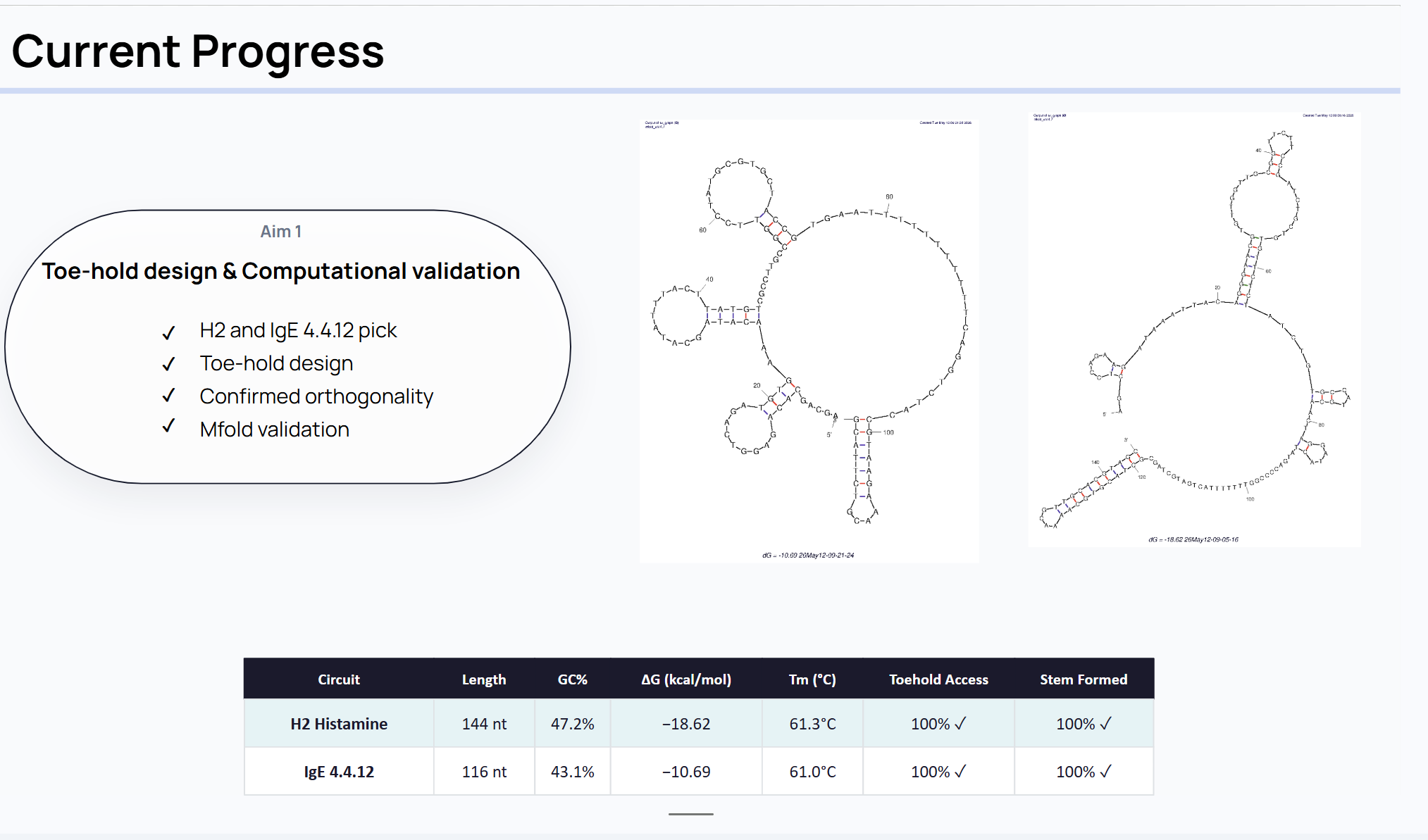
I chose to validate the DNA design logic for Aim 1, specifically the computational design of the histamine- and IgE-responsive aptamer-toehold switch circuits. This validation focused on whether the designed sequences formed the expected secondary structures and whether the toehold regions remained accessible for strand displacement. Because this project is still in the design stage, validating the computational construct design was the most feasible first step.
Detailed protocol
I collected validated histamine-binding and IgE-binding aptamer sequences from the literature and selected candidate sequences with reported target specificity.
I designed two independent DNA circuits in Benchling, each containing an aptamer-responsive switch region and a unique trigger-binding toehold sequence.
I exported the full sequences and analyzed them using NUPACK and/or Mfold under physiologically relevant conditions.
For each construct, I checked whether the predicted secondary structure formed the intended hairpin and whether the toehold region remained unpaired.
I then compared multiple design variants by adjusting toehold length and sequence composition to identify the most stable and accessible version.
Finally, I ranked the constructs based on predicted minimum free energy, toehold accessibility, and orthogonality between the two circuits.
The main synthetic biology techniques used in this validation were DNA circuit design, aptamer-based biosensor engineering, and computational secondary structure modeling. I also used sequence annotation in Benchling to organize functional domains such as the aptamer stem, toehold region, and trigger-binding sequence. In addition, I applied strand-displacement design principles, which are central to synthetic gene regulation and nucleic acid circuit behavior. This validation also involved rational design optimization, since I compared multiple sequence variants before selecting the best candidate. Together, these techniques allowed me to test whether the proposed sensing architecture was structurally plausible before experimental implementation.
I generated a comparison table of candidate designs using sequence features such as minimum free energy, GC content, and toehold accessibility. The data showed which constructs were predicted to be the most stable while still keeping the trigger-binding region open and available for strand displacement. I also compared the two circuits to assess whether they were orthogonal and unlikely to cross-react. This analysis helped identify the best design candidates for future synthesis and experimental validation.
One challenge was that computational predictions do not always reflect behavior in real biological conditions. For example, a design that appears stable in NUPACK may still misfold or behave differently in the presence of salts, competing nucleic acids, or target molecules. Another limitation is that orthogonality in silico does not guarantee orthogonality in solution, especially when sequences are short or partially similar. To address this, I would test multiple design variants with different toehold lengths and sequence compositions, and then prioritize the constructs with the strongest predicted accessibility and weakest cross-reactivity. If the designs still showed instability, an alternative strategy would be to simplify the circuit architecture or switch to a different recognition-output coupling strategy.
DNA oligonucleotides: histamine switch, IgE switch, trigger strands, scrambled control strands. Estimated budget: $150–$400 depending on length and purification.
High-purity oligo synthesis: HPLC-purified final switch strands for better experimental quality. Estimated budget: $100–$250.
Computational tools: Benchling, NUPACK, Mfold, Python. Budget: $0 if using student/free access.
Gel imaging access: shared lab imaging system or institutional equipment. Estimated budget: $0–$50.
Cell-free TX-TL reagents: if you test reporter output, use a commercial cell-free kit, reporter plasmid, and buffer components. Estimated budget: $200–$500.