Homework

Weekly homework submissions:

  • Week 1 HW: Principles and Practices

    First, describe a biological engineering application or tool you want to develop and why.

  • Week 2 HW: DNA Read/Write and Edit

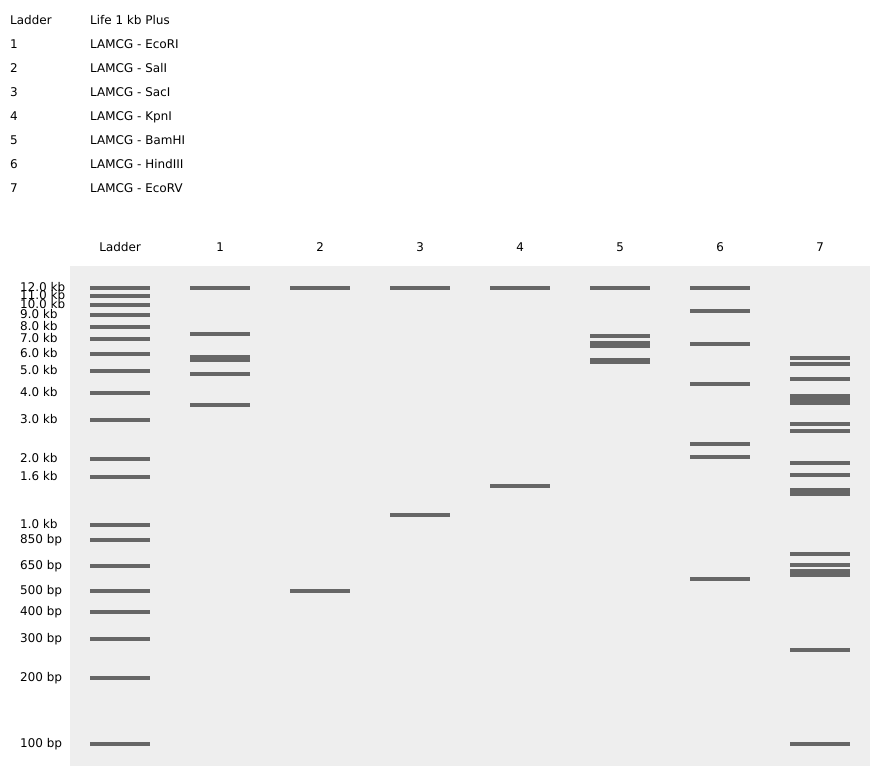
    Part 1: Benchling & In-silico Gel Art Make free account at benchling.com Import the Lambda DNA Simulate Restriction Enzyme Digestion with the following Enzymes: EncoRI HindIII BamHI KpnI EcoRV SacI SalI Create a pattern/image in the style of Paul Vanouse’s Latent Figure Protocol artworks. Part 3: DNA Design Challenge 3.1 Choose your protein In recitation, we discussed that you will pick a protein for your homework that you find interesting. Which protein have you chosen and why? Using one of the tools described in recitation (NCBI, UniProt, google), obtain the protein sequence for the protein you chose 3.2 Reverse Translate: Protein (amino acid) sequence to DNA (nucleotide) sequence.

Subsections of Homework

Week 1 HW: Principles and Practices

cover image cover image
  1. First, describe a biological engineering application or tool you want to develop and why.

    Currently one area of interest is the development of a biotechnological tool capable of inhibiting and remediating toxic mould species commonly found in damp and poorly ventilated residential environments. In England alone, it is estimated that between 962,000 and 6.5 million households experience damp and mould, with up to 58% of tenants in the private rented sector affected (BRE, 2021). The prevalence is particularly acute in London, where housing commodification has intensified overcrowding and substandard living conditions. The populations most impacted include low-income households, residents of social housing, migrants, and racialized communities. Exposure to indoor mould is strongly associated with respiratory conditions, asthma exacerbation, allergic reactions, and increased vulnerability among infants, children, the elderly, and individuals with pre-existing respiratory diseases. The National Health Service (NHS) in England is estimated to spend approximately £1.4 billion annually on treating illnesses linked to cold and damp housing conditions (BRE, 2021).

    Current market remediation strategies are limited in effectiveness and safety. Chemical agents such as sodium hypochlorite (bleach), ammonium compounds, and hydrogen peroxide are widely used but pose risks to human health, indoor air quality, and building materials. Conversely, domestic remedies such as vinegar or sodium bicarbonate often lack sufficient antifungal efficacy, particularly against toxigenic species such as Stachybotrys chartarum and Aspergillus spp.

    This project proposes the development of a bioengineered antifungal building material or coating capable of both remediating existing mould infestations and preventing future colonization, while simultaneously restoring structural integrity through biologically driven repair mechanisms. It could look at combining various enzymes and organisms such as chitinases derived from fungal antagonists and urease producing bacteria used in self-healing concrete or fibre forming bacterial cellulose for self-repair after mould damage.

  2. Next, describe one or more governance/policy goals related to ensuring that this application or tool contributes to an “ethical” future, like ensuring non-malfeasance (preventing harm). Break big goals down into two or more specific sub-goals.

    Goal 1: Ensuring non-malfeasance

    • Use products that have a low risk of virulence and infection
    • toxicological safety assurance - require comprehensive testing

    Goal 2: Ensure the technology reduces environmental harm

    • Create clear policies for managing waste byproducts safely
    • Consideration of biodegradability of materials and assess life-cycles

    Goal 3: Prevent dual-use misuse and malicious applications

    • Restrict access to strains and enzymes, limit distribution of engineered organisms
    • Require transparent documentation of biological materials stored by trusted party
  3. Describe at least three different potential governance ‘actions’ by consider the four aspects below. (Purpose, Design, Assumptions, Risks of Failure & “Success”) Try to outline a mix of actions (e.g. a new requirement/rule, incentive, or technical strategy) pursued by different “actors” (e.g. academic researchers, companies, federal regulators, law enforcement, etc). Draw upon your existing knowledge and a little additional digging, and feel free to use analogies to other domains (e.g. 3D printing, drones, financial systems, etc.).

    Actor 1: Academic researchers

    • Perform long-term environmental persistence studies with anti-mould/repair building materials
    • Require instructions to be paired with reserach publications
    • Design with use-case in mind for equitable accessibility

    Actor 2: Companies

    • Restrict usage such as for indoor use only
    • Track product distribution
    • Provide recall mechanisms

    Actor 3: Governments/ Federal regulators

    • Prohibit off-label indoor use
    • Require post-market surveillance
    • Enforce stop-use orders if unexpected effects emerge
  4. Next, score (from 1-3 with, 1 as the best, or n/a) each of your governance actions against your rubric of policy goals. The following is one framework but feel free to make your own: x x
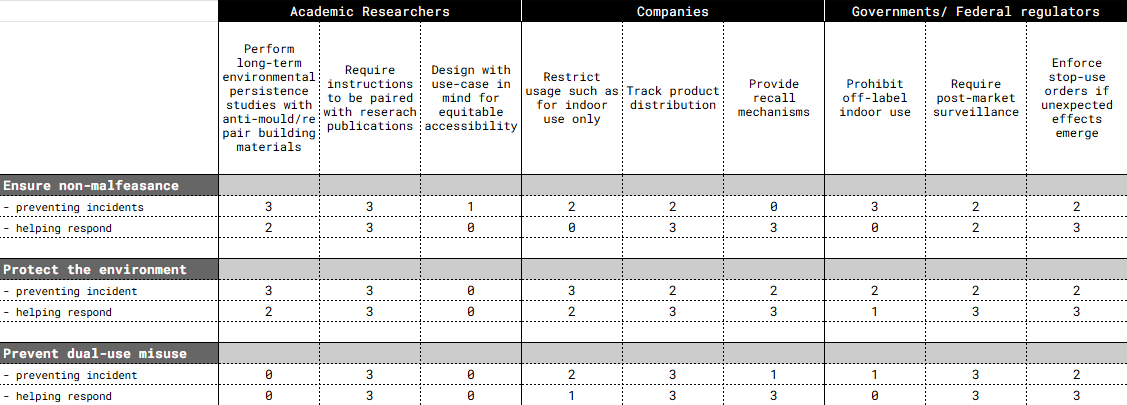
  5. Last, drawing upon this scoring, describe which governance option, or combination of options, you would prioritize, and why. Outline any trade-offs you considered as well as assumptions and uncertainties.

    I would prioritize requiring that clear, standardized usage instructions be paired with all research publications, with academic researchers as the primary responsible actors. This exercise highlighted the critical importance of accurate information dissemination in preventing misuse and enabling effective responses to potential harms, thereby supporting my governing goals related to safety, non-maleficence, and responsible deployment. However, this approach assumes that other researchers, companies, and end users will actively engage with and adhere to the guidance provided, which represents a key governance risk if compliance is low.

In addition, I would prioritize tracking product distribution by companies, as this enables restrictions on who may manufacture, sell, and apply the technology, while also establishing accountability mechanisms. Distribution tracking would allow incidents to be traced efficiently, improving response times and regulatory enforcement. Together, these measures strengthen oversight, encourage responsible use, and create a feedback loop between research, deployment, and governance.

Week 2 Lecture Prep

Questions from Professor Jacobson:

  1. Nature’s machinery for copying DNA is called polymerase. What is the error rate of polymerase? How does this compare to the length of the human genome.How does biology deal with that discrepancy?

    Error rate for Error Correcting Polymerase: 1:10^6

    Throughput Error Rate Product Differential ~10^8

    Biology deals with the discrepancy by proofreading by DNA polymerases, mismatch repair systesm, and DNA damage repair pathways.

  2. How many different ways are there to code (DNA nucleotide code) for an average human protein? In practice what are some of the reasons that all of these different codes don’t work to code for the protein of interest?

    Up to 1M Oligos/Chip, 50Mbp for ~$1K (instead of ~$1M).

Questions from Dr. LeProust:

  1. What’s the most commonly used method for oligo synthesis currently? DNA on Siliocn Platform

  2. Why is it difficult to make oligos longer than 200nt via direct synthesis?

  3. Why can’t you make a 2000bp gene via direct oligo synthesis?

Question from George Church:

  1. Using Google & Prof. Church’s slide #4 What are the 10 essential amino acids in all animals and how does this affect your view of the “Lysine Contingency”? Serine, Aspartate, Histidine, Cysteine, Methionine, Asparagine, Lysine, Arginine, Tyrosine,Threonine. I had no view of the ‘Lysine Contingency’ before this question, it’s odd they had this concept as no animals can produce their own lysine anyways so not sure why it was thought as a contingency.

Week 2 HW: DNA Read/Write and Edit

cover image cover image

Part 1: Benchling & In-silico Gel Art

  • Make free account at benchling.com
  • Import the Lambda DNA
  • Simulate Restriction Enzyme Digestion with the following Enzymes:
    • EncoRI
    • HindIII
    • BamHI
    • KpnI
    • EcoRV
    • SacI
    • SalI
    • enzyme image enzyme image
  • Create a pattern/image in the style of Paul Vanouse’s Latent Figure Protocol artworks.

Part 3: DNA Design Challenge

  • 3.1 Choose your protein

    • In recitation, we discussed that you will pick a protein for your homework that you find interesting. Which protein have you chosen and why? Using one of the tools described in recitation (NCBI, UniProt, google), obtain the protein sequence for the protein you chose
  • 3.2 Reverse Translate: Protein (amino acid) sequence to DNA (nucleotide) sequence.

    • The Central Dogma discussed in class and recitation describes the process in which DNA sequence becomes transcribed and translated into protein. The Central Dogma gives us the framework to work backwards from a given protein sequence and infer the DNA sequence that the protein is derived from. Using one of the tools discussed in class, NCBI or online tools (google “reverse translation tools”), determine the nucleotide sequence that corresponds to the protein sequence you chose above.
  • 3.3 Codon Optimization

    • Once a nucleotide sequence of your protein is determined, you need to codon optimize your sequence. You may, once again, utilize google for a “codon optimization tool”. In your own words, describe why you need to optimize codon usage. Which organism have you chosen to optimize the codon sequence for and why?
  • 3.4 You have a sequence! Now what?

    • What technologies could be used to produce this protein from your DNA? Describe in your words the DNA sequence can be transcribed and translated into your protein. You may describe either cell-dependent or cell-free methods, or both.
  • 3.5 How does it work in nature/biological systems?

    • Describe how a single gene codes for multiple proteins at the transcriptional level.
    • Try aligning the DNA sequence, the transcribed RNA, and also the resulting translated Protein!!! See example below.

Part 4: Prepare a Twist DNA Synthesis Order

  • 4.1 Create Twist account/ Benchling account
  • 4.2 Build your DNA insert Sequence
  • 4.3 On Twist, Select The “Genes” Option
  • 4.4. Select “Clonal Genes” option
  • 4.5. Import your sequence
  • 4.6. Choose Your Vector

Part 5: DNA Read/Write/Edit

  • 5.1 DNA Read

    • (i) What DNA would you want to sequence (e.g., read) and why?
    • (ii) In lecture, a variety of sequencing technologies were mentioned. What technology or technologies would you use to perform sequencing on your DNA and why?
        1. Is your method first-, second- or third-generation or other? How so?
        2. What is your input? How do you prepare your input (e.g. fragmentation, adapter ligation, PCR)? List the essential steps.
        3. What are the essential steps of your chosen sequencing technology, how does it decode the bases of your DNA sample (base calling)?
        4. What is the output of your chosen sequencing technology?
  • 5.2 DNA Write

    • (i) What DNA would you want to synthesize (e.g., write) and why?
    • (ii) What technology or technologies would you use to perform this DNA synthesis and why?
        1. What are the essential steps of your chosen sequencing methods?
        2. What are the limitations of your sequencing method (if any) in terms of speed, accuracy, scalability?
  • 5.3 DNA Edit

    • (i) What DNA would you want to edit and why?
    • (ii) What technology or technologies would you use to perform these DNA edits and why?
        1. How does your technology of choice edit DNA? What are the essential steps?
        1. What preparation do you need to do (e.g. design steps) and what is the input (e.g. DNA template, enzymes, plasmids, primers, guides, cells) for the editing?
        2. What are the limitations of your editing methods (if any) in terms of efficiency or precision?