Week 7 HW: Genetic Circuits II - Neuromorphic Circuits
Intracellular Artificial Neural Networks (IANNs)
1. What advantages do IANNs have over traditional genetic circuits, whose input/output behaviors are Boolean functions?
IANNs are interesting and different than traditional genetic circuits becuase their inputs are continous molecular concentrations. So a basic artificial neuron can take 2 inputs and have an output that is a constantly changing and evolving based on the changing concentration amounts of the inputs. They are able to therefore handle more complexity than traditional genetic circuits. You might need multiple genetic circuits to create calculations IANNs can do.
2. Describe a useful application for an IANN; include a detailed description of input/output behavior, as well as any limitations an IANN might face to achieve your goal.
Bulding off of what was discussed in the lecture I think IANN would be really useful in helping autoimmune conditions. In autoimmune conditions, the immune system is overreactive and starts attacking its own healthy cells. IANN could be designed to diffentiate between a normal immune response (which we would want to keep) and an unhealthy immune self-attack (which we would want to stop). At the moment the issue is that to alleviate certain autoimmune conditions we use immunosuppressants which just reduces the function of the immune system completely, and makes people immune compromised and more susceptible to illnesses. This would be a great way to be more specific, to identify problem areas, and not shut down the immune system of a person as a whole.
Using AI and IANN we could discover a combination or range or different signals/proteins in the body that would differentiate between an attack on a real pathogen versus an attack on harmless human tissue. These signals are already known and lie in differences between interferon signature, TNF/IFN ratio, and IL-10 resolution. Machine learning on automimmmune data would be helpful here to be able to set the exact “weights” that would be used in the IANN.
I think the limitation is that these IANN would have to be personalized to the own person’s biology - and that would make the creation of this therapy expensive. Though hopefully as medical innovation progresses, so would the price of treatment.
3. Below is a diagram depicting an intracellular single-layer perceptron where the X1 input is DNA encoding for the Csy4 endoribonuclease and the X2 input is DNA encoding for a fluorescent protein output whose mRNA is regulated by Csy4. Tx: transcription; Tl: translation.
Draw a diagram for an intracellular multilayer perceptron where layer 1 outputs an endoribonuclease that regulates a fluorescent protein output in layer 2.
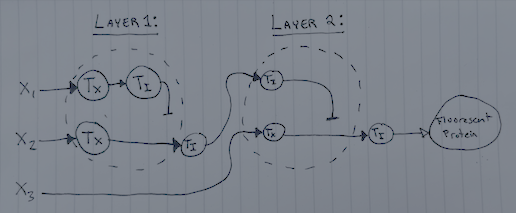
In this diagram X1 is Csy4 DNA which cleaves X2 which is an additional endoribonuclease DNA.
This becomes the output that regulates X2 (the fluorescent protein) which is output in layer 2.
References:
Cantaert T, Baeten D, Tak PP, van Baarsen LG. Type I IFN and TNFα cross-regulation in immune-mediated inflammatory disease: basic concepts and clinical relevance. Arthritis Res Ther. 2010;12(5):219. doi: 10.1186/ar3150. Epub 2010 Oct 28. PMID: 21062511; PMCID: PMC2991015. https://pmc.ncbi.nlm.nih.gov/articles/PMC2991015/
Kyogoku C, Smiljanovic B, Grün JR, Biesen R, Schulte-Wrede U, Häupl T, Hiepe F, Alexander T, Radbruch A, Grützkau A. Cell-specific type I IFN signatures in autoimmunity and viral infection: what makes the difference? PLoS One. 2013 Dec 31;8(12):e83776. doi: 10.1371/journal.pone.0083776. PMID: 24391825; PMCID: PMC3877094. https://pmc.ncbi.nlm.nih.gov/articles/PMC3877094/
Fungal Materials
1. What are some examples of existing fungal materials and what are they used for? What are their advantages and disadvantages over traditional counterparts?
Fungal materials can be used for many things! At the moment they are being used as eco-friendly packaging (mostly for luxury products), there is also a company that uses them for acoustic panels since their styrofoam-like properties give them the ability to absorb sound waves. Research is also being done to use them as water filtration systems since they have a porous-mesh like texture when dried. They are also being used in construction. The advantages they have is they create a strong lightweight materials which can easily be grown and formed into any shape. The disadvantage is that they take a long time to grow – you have to wait for the mycelium to inoculize and fill out the container you’ve placed it in. Another disadvantage is without any post-processing the fungal materials can easily disintegrate, especially when in contact with water.
2. What might you want to genetically engineer fungi to do and why? What are the advantages of doing synthetic biology in fungi as opposed to bacteria?
I think I would want to either genetivally engineer fungi to help them breakdown PET plastics a bit more efficiently. Oyster mushroom mycelium already has the ability to do this and it would be great to boost this ability. There is also research on fungal batteries, where different fungal strains can be used as anodes and cathodes and transfer electrons via their hyphae. One of the advantages of doing synthetiv biology in fungi is that fungi is a bit more stable than bacteria, which need more specific environmental conditions to thrive. They also have a tendency to be seen as “safer” organisms as opposed to bacteria. This might help with regulation and biosecurity issues.
First DNA Twist Order
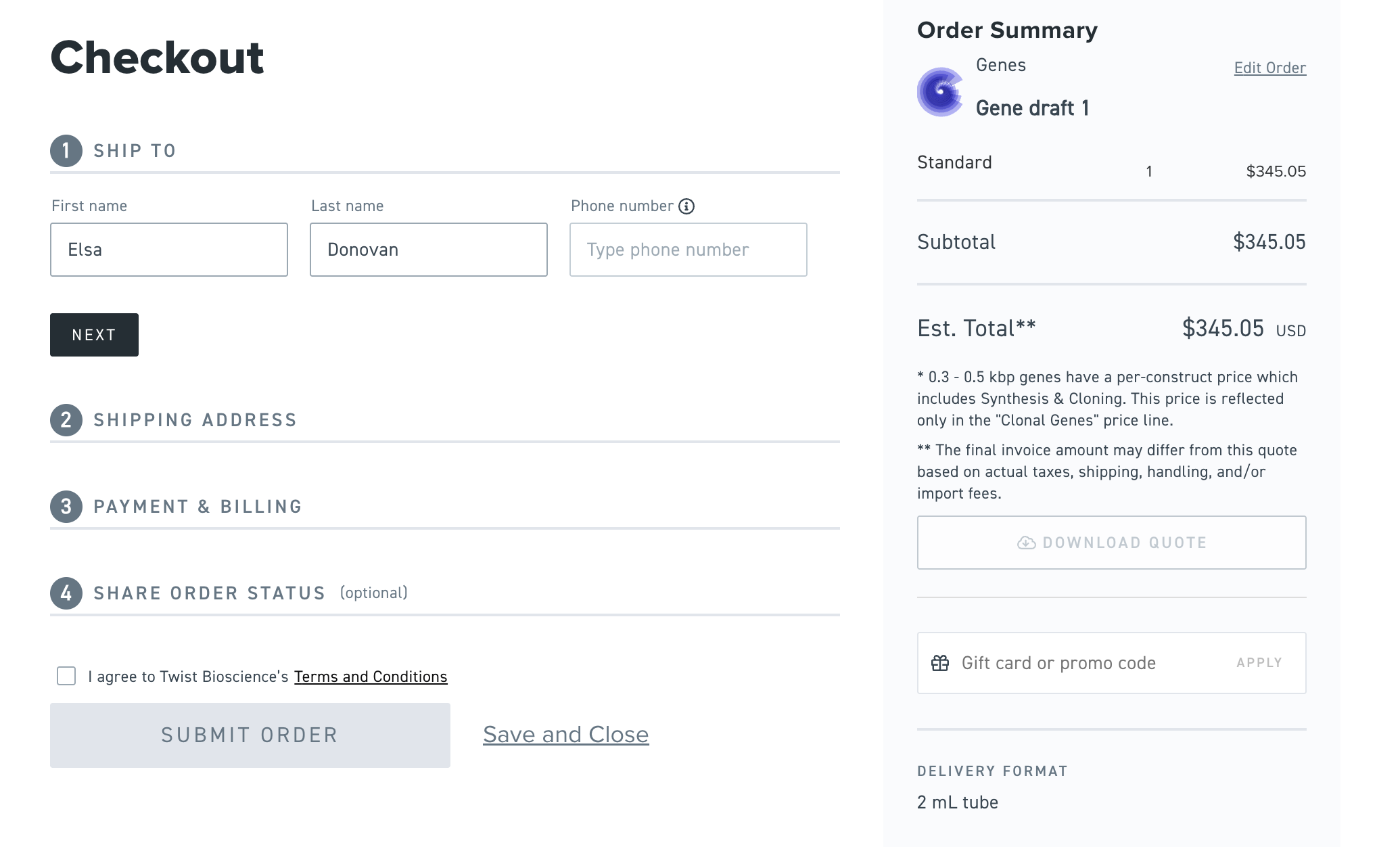
Created a Twist Order that was added to the LifeFabs spreadsheet but ultimately not ordered.
It was a way to boost the electron transfer capabilities in Oneidensis Shewanella by using a pLacI promoter to overexpress mtrC - a key protein in this process.
It was based on this research paper: https://link.springer.com/article/10.1186/s40643-018-0221-9
The Benchling that I linked to was:
https://benchling.com/s/seq-JXmpxdKZEg7PCGlFdLam?m=slm-p8iaRal4Htu0nMB0tkQR
However, since Shewanella is understudied I was unable to cross-check the genetic sequence that was used in the paper. Which made me not want to pursue this direction further.
This ended up being the mock Twist Order:
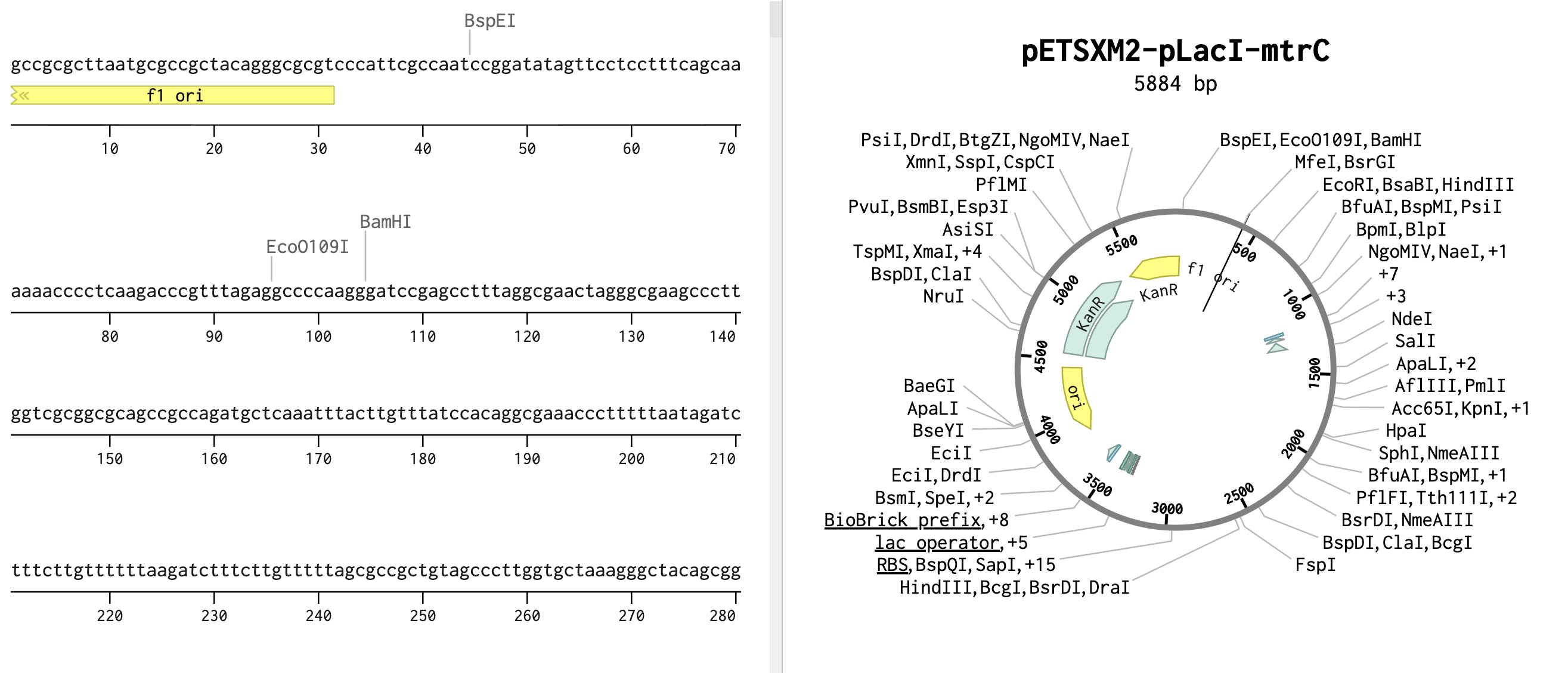
The insert is the the mtrC gene sequence and the vector backbone is pET-28a, which was modified with pLacI for constitutive expression.