Week 1 HW: Principles and Practices
Week 1: Project Concept — The “Copper-Sentinel” Initiative
My Vision: Why This Matters
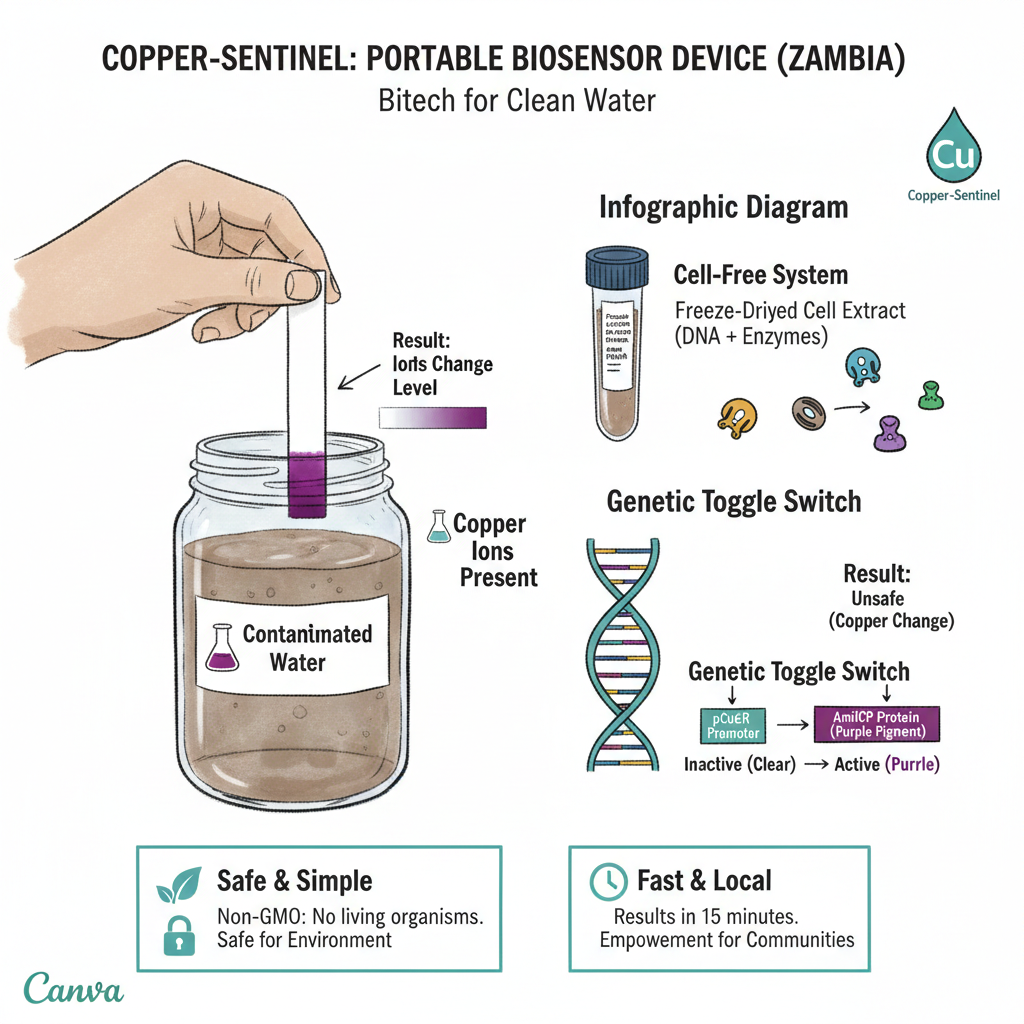
Living in the Copperbelt, we see the good and bad aspects of mining every day—it drives our economy, but it also leaves a heavy footprint on our groundwater. I want to build Copper-Sentinel, a low-cost, decentralized tool for real-time water monitoring.
Instead of traditional sensors that require expensive labs, I’m looking at using Cell-Free Synthetic Biology. Basically, we take the “machinery” out of a cell (the parts that can read DNA and make proteins) and freeze-dry them onto simple paper strips. When a person dips this strip into their well water, a specific DNA circuit I’ve designed reacts to copper ions. If the copper is above the safe limit, the strip turns a vivid purple. Because there are no living bacteria involved, there’s no risk of accidentally releasing a “GMO” into our local environment.
Ensuring an Ethical Future (Governance & Policy)
It isn’t enough to just hand out sensors; we have to think about the “what ifs.” My goal is to ensure this technology contributes to an ethical future where people are protected, not just informed.
Goal 1: Environmental Safety (Non-malfeasance)
- Specific Sub-goal A: We must stick strictly to a Cell-Free platform. By ensuring the tool is non-living, we avoid the ethical nightmare of synthetic organisms self-replicating in our rivers.
- Specific Sub-goal B: We need a clear “End-of-Life” protocol for these strips so they don’t become a new source of litter or chemical waste.
Goal 2: Data Equity & Autonomy
- Specific Sub-goal A: I want the results to be owned by the community. If a village finds high copper, they should have the first right to that data before it goes to a corporation or a government agency.
- Specific Sub-goal B: The science needs to be “legible”—meaning a person without a science degree should be able to look at the strip and understand exactly what it means for their health.
How We Make This Work (The Governance Matrix)
| Aspect | Action 1: The Technical “Kill-Switch” | Action 2: The Community “Water Union” | Action 3: National Bio-Policy |
|---|---|---|---|
| Purpose | Using “Cell-Free” extracts instead of live bacteria to prevent any biological spread. | Training local youth and leaders to act as “Sentinel Guardians” of their own data. | Proposing that the Zambian government recognizes citizen-led bio-data as legal evidence. |
| Design (Actors) | Synthetic biologists and molecular designers (like us in HTGAA). | Local community leaders, NGOs, and residents. | ZEMA (Zambia Environmental Management Agency) and the Ministry of Mines. |
| Assumptions | We’re assuming these delicate biological reagents can survive the Zambian heat without a fridge. | We’re assuming that mining firms won’t try to suppress the findings of local citizens. | We assume the government is willing to prioritize public health over short-term mining profits. |
| Risks of Failure & Success | Failure: The strip gives a “false safe” reading because it got too hot, and people drink toxic water. | Failure: The community finds high copper but has no money or help to dig a new, cleaner well. | Success Risk: We find so much pollution that land values drop, causing an economic crisis for the locals. |
Scoring the Governance Actions
I’ve rated these from 1 (Most Effective/Easiest) to 3 (Hardest/Riskiest).
| Does the option: | Option 1 (Technical) | Option 2 (Community) | Option 3 (Legal) |
|---|---|---|---|
| Enhance Biosecurity | 1 | 2 | 2 |
| Foster Lab & Field Safety | 1 | 1 | 2 |
| Protect the Environment | 1 | 2 | 1 |
| Minimize Costs & Burdens | 2 | 1 | 3 |
| Feasibility? | 2 | 1 | 3 |
| Promote Constructive Use | 1 | 1 | 2 |
My Recommendation & Trade-offs
If I have to choose, I’m prioritizing a combination of the Technical (Cell-Free) and Community-led models (Options 1 and 2).
The “Cell-Free” design is a non-negotiable for me because it’s the most responsible way to use biotech in the wild. But a tool is useless if the people don’t trust it. By building a “Water Union,” we empower people. The biggest trade-off here is the cost of cell-free reagents, which are currently more expensive than living bacteria. However, I believe the environmental safety is worth the extra few cents per test.
I’d present this plan to the Zambian Ministry of Green Economy and Environment. We need them to create a “Safe Sandbox” for us to test these sensors without being buried in the red tape that usually slows down biotech.
Personal Reflection
This week made me realize that biotech isn’t just about what happens in a test tube. I was struck by the idea of Dual-Use risks. A sensor that finds copper could, in the wrong hands, be used to sabotage water supplies or manipulate land prices.
Also, a new ethical concern for me was technological Paternalism the idea of an expert coming in with a fancy tool and leaving. To fix this, our governance needs to focus on remediation. It’s not enough to tell someone their water is poisoned; we must also provide the biological tools (like copper-absorbing biopolymers) to help them clean it.
Week 2 Lecture Prep: Reading and Writing Life
Part 1: Professor Jacobson’s Questions
- Nature’s machinery for copying DNA is called polymerase. What is the error rate of polymerase? How does this compare to the length of the human genome? How does biology deal with that discrepancy?
The Discrepancy: The error rate of standard DNA polymerases is roughly 1 in 10,000 to 1 in 100,000 nucleotides. Since the human genome has approximately 3 billion base pairs, relying solely on basic polymerase would mean tens of thousands of mutations every time a cell divides. The Solution: Biology uses a multi-layered “spell-check” system. First, the polymerase has proofreading abilities (exonuclease activity) that catch most mistakes as they happen. Second, Mismatch Repair (MMR) proteins scan the strands to fix remaining errors. This brings the final error rate down to about 1 in a billion.
- How many different ways are there to code (DNA nucleotide code) for an average human protein? In practice, what are some of the reasons that all of these different codes don’t work?
The Numbers: There are an astronomical number of ways to write the same protein due to code degeneracy. For an average human protein (~400 amino acids), there are roughly $10^{150}$ possible DNA sequences. Practical Constraints: Not all codes work because some codons are “rare,” causing the cell to run out of tRNA and stall production. Additionally, certain sequences can create hairpins (DNA folding on itself) or unintended stop signals that terminate the process prematurely.
Part 2: Dr. LeProust’s Questions
What’s the most commonly used method for oligo synthesis currently?
The gold standard is Phosphoramidite synthesis. This chemical process builds DNA one nucleotide at a time on a solid surface.
Why is it difficult to make oligos longer than 200nt via direct synthesis?
It is due to Efficiency. Even with a 99% coupling efficiency, errors compound over 200 steps. By the end, only a tiny fraction of the strands are correct; the rest are “trash” sequences, missing letters.
Why can’t you make a 2000bp gene via direct oligo synthesis?
The math implies the yield for a 2000bp strand would be effectively zero—not a single perfect molecule would exist in the tube. Instead, scientists synthesize many short 100-200nt pieces and “glue” them together using enzymes (assembly).
Part 3: George Church’s Question:
What are the 10 essential amino acids in all animals and how does this affect your view of the “Lysine Contingency”?
The 10 Essentials: Phenylalanine, Valine, Threonine, Tryptophan, Isoleucine, Methionine, Histidine, Arginine, Leucine, and Lysine. My View: In Jurassic Park, the “Lysine Contingency” was a fictional “kill switch.” However, in reality, all animals (including humans) are unable to make lysine. It isn’t a special safety feature—it is a fundamental natural limitation that shows how all life depends on its environment and diet for survival.
References
Week 1: The “Copper-Sentinel” Initiative & Governance
Carter, S. R., & Friedman, R. M. (2016). Policy and governance of cell-free synthetic biology. J. Craig Venter Institute. https://www.jcvi.org/sites/default/files/2016-09/policy-and-governance-of-cell-free-synthetic-biology-report.pdf
Pardee, K., Green, A. A., Ferrante, T., Cameron, D. E., Daleykeyser, A., Yin, P., & Collins, J. J. (2014). Paper-based synthetic gene networks. Cell, 159(4), 940–954. https://doi.org/10.1016/j.cell.2014.10.004
Wan, X., Volpetti, F., Petrova, M., French, C., Maerkl, S. J., & Wang, B. (2019). Cascaded cell-free transcriptional switches for high-performance analyte detection. ACS Synthetic Biology, 8(6), 1255–1264. https://doi.org/10.1021/acssynbio.8b00522
Week 2: Lecture Prep (Jacobson, LeProust, & Church)
Caruthers, M. H. (1985). Gene synthesis machines: DNA chemistry and its uses. Science, 230(4723), 281–285. https://doi.org/10.1126/science.3863253
Crichton, M. (1990). Jurassic Park. Alfred A. Knopf.
Kosuri, S., & Church, G. M. (2014). Large-scale de novo DNA synthesis: Technologies and applications. Nature Methods, 11(5), 499–507. https://doi.org/10.1038/nmeth.2918
Kunkel, T. A. (2004). DNA replication fidelity. Journal of Biological Chemistry, 279(17), 16895–16898. https://doi.org/10.1074/jbc.R400006200
Mandell, D. J., Lajoie, M. J., Mee, M. T., Takeuchi, R., Kuznetsov, G., Norville, J. E., … & Church, G. M. (2015). Biocontainment of genetically modified organisms by synthetic auxotrophy. Nature, 518(7537), 55–60. https://doi.org/10.1038/nature14121
Plotkin, J. B., & Kudla, G. (2011). Synonymous but not identical: The evolutionary and biological significance of codon bias. Nature Reviews Genetics, 12(1), 32–42. https://doi.org/10.1038/nrg2899